

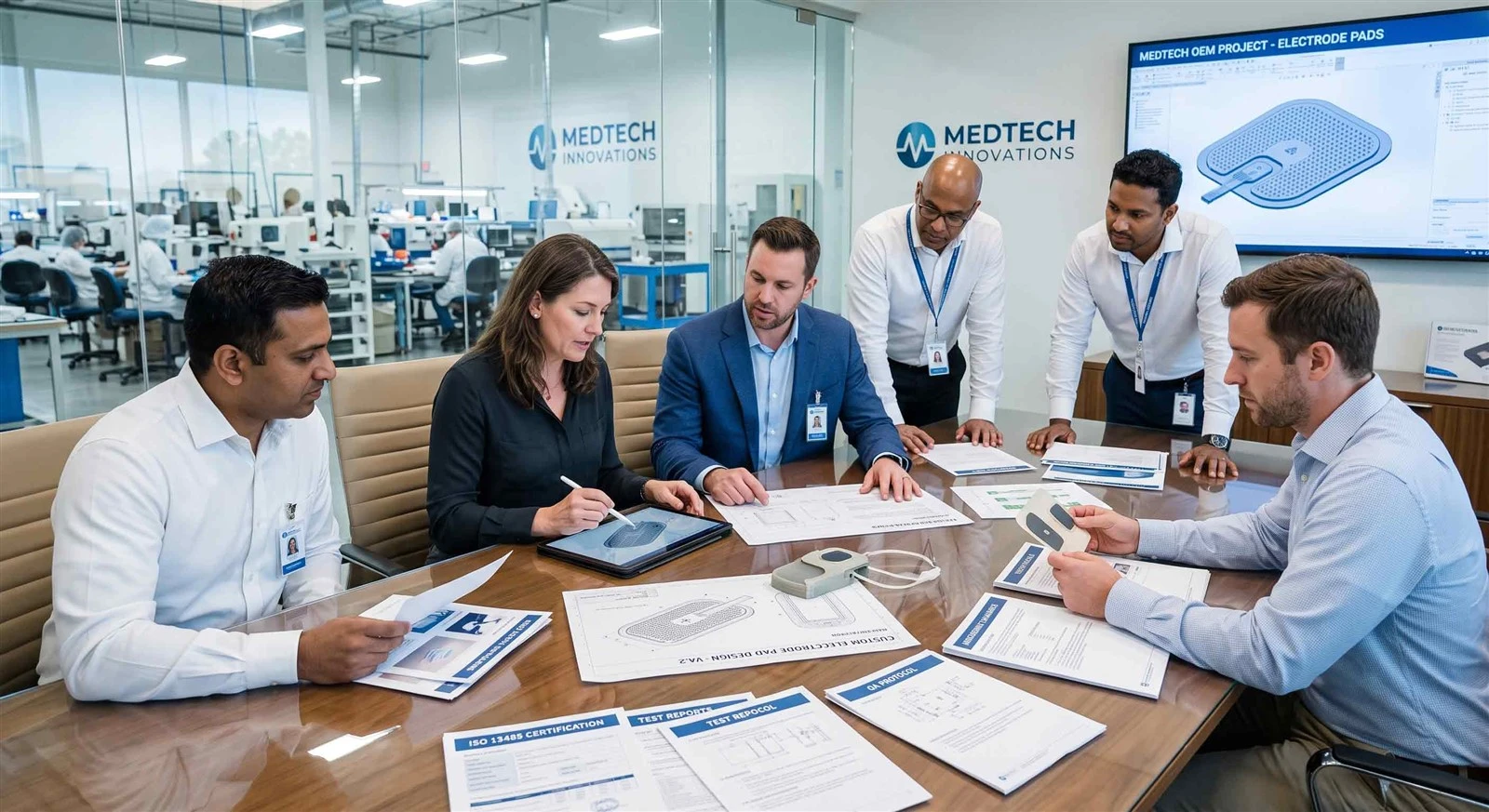
Launching a custom electrode pad project involves much more than selecting a product from a catalog.
For medical device brands, distributors, rehabilitation equipment manufacturers, and private-label companies, a successful OEM project requires careful planning, clear technical requirements, and close collaboration with an experienced manufacturing partner.
The better prepared you are before development begins, the smoother the entire process-from sampling to mass production.
This guide outlines the key steps OEM buyers should follow when preparing a custom electrode pad project.
Quick Answer
Before starting an OEM electrode pad project, buyers should prepare:
- Product application requirements
- Electrode pad specifications
- Connector type
- Hydrogel performance expectations
- Packaging requirements
- Regulatory objectives
- Forecasted order volume
- Branding and customization needs
Proper preparation helps reduce development time, improve communication, and minimize production risks.

Step 1: Define the Intended Application
The first question any manufacturer should ask is:
How will the electrode pad be used?
Different applications require different product designs.
For example:
|
Application |
Typical Requirements |
|---|---|
|
TENS Therapy |
Comfortable adhesion, reusable hydrogel |
|
EMS Training |
Stable conductivity during muscle contractions |
|
NMES Rehabilitation |
Consistent electrical performance for extended sessions |
|
FES Systems |
Precise electrode placement and reliable signal transmission |
|
Beauty & Aesthetic Devices |
Skin-friendly materials and cosmetic-grade appearance |
Clearly defining the application helps determine the appropriate product configuration.
Why It Matters
A pad designed for home pain relief may not perform optimally in a clinical rehabilitation system.
Selecting the right design begins with understanding the intended use.
The intended application is the foundation for selecting the appropriate electrode pad design.
Step 2: Determine Product Specifications
Once the application is clear, define the technical specifications.
Typical customization options include:
Pad Shape
- Round
- Square
- Rectangle
- Butterfly
- Custom die-cut designs
Pad Size
Choose dimensions based on treatment area and device output.
Connector Type
- Examples include:
- Snap connector
- Pin connector
- Customized connectors
Backing Material
Depending on product positioning, buyers may choose:
- Non-woven fabric
- Foam
- PET film
- Other medical-grade substrates
The more detailed the specifications, the fewer revisions are required during development.

Step 3: Define Performance Expectations
Not every project has the same priorities.
Some customers focus on:
- Strong adhesion
- Reusability
- Stable conductivity
- Comfort
- Low skin irritation
Others prioritize:
- Shelf life
- Easy removal
- High production efficiency
- Cost optimization
Discussing priorities early helps manufacturers recommend the most suitable material combination.
Key Performance Indicators (KPIs)
Examples include:
- Adhesion strength
- Conductivity consistency
- Reusability cycles
- Skin compatibility
- Moisture retention
- Packaging durability
Clearly defining performance expectations helps ensure that product development aligns with application requirements.
Step 4: Prepare Branding & Packaging Requirements
OEM projects often include custom branding.
Typical customization options include:
- Private label printing
- Logo integration
- Custom pouch design
- Retail packaging
- User instructions
- Multilingual labeling
- Barcode and QR code printing
Packaging should also comply with the target market's regulatory and logistics requirements.

Step 5: Discuss Regulatory Requirements Early
Different markets have different compliance requirements.
For example:
|
Market |
Typical Considerations |
|---|---|
|
United States |
FDA registration, labeling requirements |
|
European Union |
CE compliance under applicable regulations |
|
Canada |
Medical Device Licence (MDL), bilingual labeling requirements where applicable |
|
Australia |
TGA registration (depending on product classification) |
If regulatory documentation is required, discussing it before development begins can prevent delays later in the project.
Why Early Communication Matters
Early alignment helps manufacturers:
- Prepare technical documentation
- Confirm testing requirements
- Plan product labeling
- Support market registration
Step 6: Evaluate Samples Thoroughly
Prototype evaluation should never focus solely on appearance.
Buyers should assess:
- Adhesion
- Conductivity
- Comfort
- Reusability
- Connector fit
- Packaging quality
Collecting structured feedback allows design improvements before mass production.
Step 7: Plan for Scalable Production
Before placing a bulk order, discuss:
- Production capacity
- Lead time
- MOQ
- Quality control procedures
- Batch traceability
- Inspection standards
Reliable manufacturers should be able to maintain consistent product quality across every production batch.
Common Mistakes OEM Buyers Should Avoid
Many first-time buyers encounter avoidable issues.
Common mistakes include:
❌ Providing incomplete specifications
❌ Choosing products based only on price
❌ Ignoring connector compatibility
❌ Overlooking packaging requirements
❌ Delaying regulatory discussions
❌ Approving samples without structured testing
Avoiding these mistakes can save both time and development costs.
Frequently Asked Questions
How long does a custom OEM electrode pad project typically take?
What information should buyers prepare before contacting a manufacturer?
Can electrode pads be fully customized?
When should regulatory requirements be discussed?