

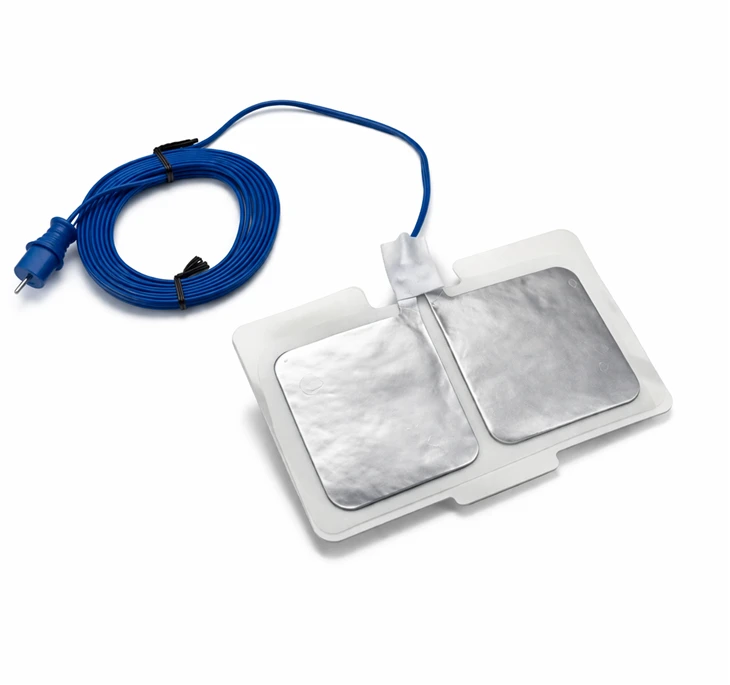
Wholesale Surgical Grounding Pads | ESU Patient Plates | TOP-RANK
B2B wholesale surgical grounding pads (ESU plates). Engineered with split-ring geometric sensors for contact quality monitoring (CQM) and micro-thick aluminum arrays to eliminate high-frequency RF edge burns.
Product Overview
Surgical grounding pads, professionally known as electrosurgical unit (ESU) dispersive electrodes or patient return plates, are critical Class IIb/Class III equivalent single-use safety consumables deployed in sterile operating theaters. During monopolar electrosurgery, the surgeon uses an active pencil electrode to concentrate high-frequency radiofrequency (RF) current (typically 300kHz to 1MHz) to cut or coagulate tissue. The surgical grounding pad provides a massive, ultra-low-impedance return path to safely capture this wandering energy and route it back to the ESU generator. We manufacture these precision dispersive matrices for hospital group purchasing organizations (GPOs), operating room kit assemblers, and global medical hardware OEMs.
Technical/Engineering Description
The anatomy of an ESU dispersive plate requires robust material lamination to handle extreme radiofrequency current densities. The foundation is a medical-grade polyethylene (PE) foam backing coated with a non-conductive, aggressive acrylic border. Centered within this perimeter is a highly conductive aluminum foil electrode matrix. The foil is patterned into either a single solid sheet or a split-conductor dual-zone ring. The skin-facing layer is a specialized low-impedance, high-water-content polyacrylamide hydrogel. This specific hydrogel lacks the high sticky-tack of TENS pads, prioritizing instead a fluidic rheology to achieve an absolute 100% molecular wet-out against the patient's skin. This eliminates any microscopic air-void bottlenecks that could trigger a 100W radiofrequency arc. Standard B2B wholesale runs dictate an MOQ of 20,000 units packed in sealed, anti-static aluminum multi-pouches.
Key Features
-
Split-Ring Geometry for Contact Quality Monitoring (CQM)
The greatest hazard in electrosurgery is a partial pad detachment. If half of the pad peels off during a 90-minute procedure, the remaining surface area must carry the entire current load. This exponential spike in current density triggers an immediate radiofrequency heat burn. Our split-ring pads incorporate two independent, isolated conductive zones. When plugged into an ESU generator equipped with Return Electrode Monitoring (REM/CQM), the host machine continuously sends an ultra-low interrogation signal from one ring to the other. If the inter-plate impedance deviates by even a fraction due to minor pad lifting, the generator instantly locks out the cutting current and fires an audible alarm before an RF burn can physically manifest on the patient's skin.
-
Edge-Effect Mitigation Layout
High-frequency alternating current exhibits a physical phenomenon known as the "edge effect." Instead of distributing evenly across a flat plate, the electrons violently migrate toward the outer perimeter and corners of the metal foil. Standard rectangular foils generate severe electrical stress at their four corners, making them primary sites for operating room burns. We re-engineer the aluminum core with micro-rounded radiuses and a specialized capacitive distribution field. By tapering the conductive density toward the borders, the RF current is forced to flatten into an isotropic, homogenous field, guaranteeing zero voltage crowding across the entire active footprint.
-
Pre-Op Disinfectant Hydrophobic Barrier Ring
During surgical prep, clinicians flood the operative site with conductive pooling fluids like betadine or alcohol-based preps. If these liquids seep beneath the grounding pad, they will short-circuit the hydrogel matrix, altering the local dielectric constants and tunneling the electrosurgical current into a single high-conductive liquid path. We surround the active hydrogel matrix with a heavy-gauge, closed-cell PE foam ring lined with a high-shear hydrophobic acrylic adhesive. This physical dam completely chokes off fluid ingress from surgical irrigation, maintaining dry, isolated electrical parameters for the entire duration of long-window thoracic or abdominal surgeries.
Applications
General Laparoscopic Surgery
Dispersive safety plates managing sustained high-energy monopolar cutting loops without localized thermal rise.
High-Power Orthopedic Arthroplasty
Heavily reinforced split pads designed to withstand the extreme current densities required to cut through thick bony matrices.
Neonatal Electrosurgery
Ultra-scaled micro-foots prints with ultra-soft low-avulsion hydrogels tailored to protect the hyper-permeable skin of pediatric patients in the NICU.
OEM & Private Label
-
Automated Hermetic Bagging : Surgical grounding pads are highly sensitive to oxygen exposure, which causes aluminum oxidation. We pack the pads on automated high-speed horizontal lines into zero-permeability AL/PE laminated pouches. The envelopes can be customized with sterile-field graphics, custom brand typography, and barcode serialization to match Western clinical tracing networks.
-
Vietnam Tariff Shunting Hub : Multi-layer polymer extrusion, raw aluminum chemical etching, and grid casting execute in our China chemical facilities. Precision multi-cavity die-cutting, terminal cable integration, and final sterile box palletization route through our Vietnam hub, protecting international medical distributors from volatile Section 301 tariffs on electrosurgical consumables.
Certifications
-
Rigid Biocompatibility Clearances : Hydrogel and adhesive matrices are extensively audited under independent laboratory settings against ISO 10993-5 (Cytotoxicity), ISO 10993-10 (Irritation), and ISO 10993-11 (Systemic Toxicity) boundaries to confirm zero clinical reactivity.
-
MDSAP & ISO 13485 Manufacturing : Our electrosurgical fabrication lines operate strictly within facilities audited under the Medical Device Single Audit Program (MDSAP) and ISO 13485:2016 frameworks, ensuring full batch-traceability from raw chemicals to the operating room.
FAQ
Q: Can we use a solid grounding pad on an electrosurgical generator that requires a split/dual-zone pad?
A: No. If you insert a solid (non-split) pad into a modern ESU generator equipped with contact quality monitoring (CQM/REM), the host machine will immediately detect a system error. The generator sends an interrogation signal expecting to find two isolated zones separated by an electrical resistance. A solid pad creates an instant short-circuit across the pins, causing the machine to permanently lock out the surgical current as a safety failure.
Q: Why does the metal connector cable occasionally become hot during long, multi-hour surgical procedures?
A: Cable heating indicates an impedance mismatch or a mechanical breakdown within the wire core (work-hardening fatigue). When high-frequency current passes through fractured copper strands, the narrowed pathway forces a dramatic localized resistance spike, converting the RF energy into thermal heat. We reinforce our integrated cable variants with Kevlar tensile cores and heavy-gauge brass terminal crimps to eliminate this fatigue failure.
B2B surgical hospital supply chains and electrosurgical hardware OEMs can request technical blueprints, high-frequency impedance mapping charts, and MDSAP evaluation samples.
👉 [Request Surgical Grounding Pad Samples]
Hot Tags: surgical grounding pads, China surgical grounding pads manufacturers, suppliers, factory, disposable cautery pad, Disposable Grounding Pads, electrocautery pads, Electrosurgical Grounding Pads, Grounding Pad, surgical grounding pad
Specifications
| Parameter | Clinical Configuration | Engineering Detail |
| RF Frequency Band | 300 kHz - 1.0 MHz Compatible | Zero waveform distortion |
| Circuit Design | Split-Ring (Dual-Zone) / Solid | Integrated with REM/CQM host monitoring |
| Conductive Core | Micro-Thick Aluminum Foil | Direct charge-transfer vector |
| Hydrogel Modulus | Low-Impedance Fluidic Polyacrylamide | Penetrates skin micro-crevices |
| Adhesive Border | Non-Conductive PE Foam Ring | Seals out pre-operative fluids |


