

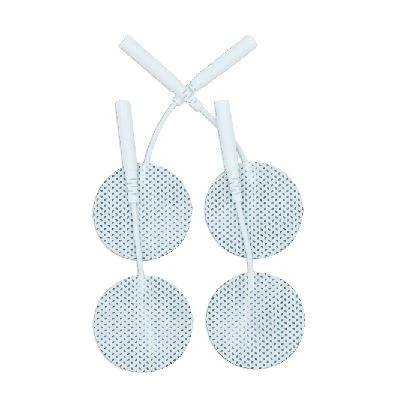
OEM Microcurrent Electrodes | Low-Impedance Pads | TOP-RANK
B2B microcurrent electrodes for wound healing and pain management. Engineered with silver-carbon hybrid traces to maintain signal fidelity at <500µA outputs, preventing amplitude dampening.
Product Overview
Microcurrent electrodes are high-fidelity transdermal interfaces calibrated specifically for sub-sensory, micro-ampere ($\mu A$) electrical therapy protocols. Unlike TENS pads designed for motor unit recruitment (mA range), microcurrent interfaces require an extremely low electrical threshold to prevent signal dampening. If an electrode exhibits high intrinsic resistance, it acts as an insulator, dissipating the ultra-low-voltage waveform before it can penetrate the stratum corneum. We supply these low-impedance matrices for clinical electrotherapy OEMs, advanced wound care brands, and research-grade physical therapy hardware.
Technical/Engineering Description
The microcurrent substrate is built upon an ultra-thin silver-infused carbon conductive film. Silver possesses vastly superior electrical conductivity compared to standard carbon black, ensuring that the ultra-weak waveforms (often square or triangular) generated by the host device are transmitted without wave-shape distortion. The skin-contact layer utilizes a specialized, highly conductive electrolyte hydrogel with a controlled chloride ion concentration, which minimizes the polarization potential at the metal-to-electrolyte interface. The multi-layer laminate is heat-pressed to eliminate microscopic air gaps that cause signal jitter. Standard wholesale runs require an MOQ of 20,000 packs.
Key Features
-
Silver-Carbon Hybrid Signal Path
Microcurrent devices output very low amplitude (measured in $\mu A$). Standard carbon pads have a baseline resistance that can "choke" these weak pulses. We integrate a micro-patterned silver-flake grid into the carbon conductive ink. This creates a low-resistance "highway" for the microcurrent, allowing the electrical signal to reach the epidermal tissue with zero amplitude loss. This ensures that the therapy protocol delivered by the hardware is identical to the signal received by the nerve endings.
-
Zero-Threshold Ionic Interface
At microcurrent levels, the electrochemical interface at the skin-gel boundary must be perfectly stable. If the interface is unstable, it acts as a capacitor, storing charge rather than passing it through. Our hydrogel matrix is specifically titrated with high-mobility chloride salts that lower the electrochemical polarization potential. This "zero-threshold" design ensures that as soon as the microcurrent device triggers a pulse, the ions within the gel respond instantaneously.
-
Precision Die-Cut Edge Integrity
For research and clinical use, the electrode's footprint must be exact to ensure accurate current density calculations. We utilize micro-radius steel-rule dies to cleave the hydrogel and backing layers simultaneously. This precise cutting process eliminates "ragged edges" or "gel fraying." Ragged edges create non-uniform current pathways, which can cause micro-stinging. Our clean-cut edges ensure the electric field generated by the pad is uniform and geometrically predictable.
Applications
Post-Operative Wound Healing
MENS (Microcurrent Electrical Neuromuscular Stimulation) pads used for targeted tissue regeneration protocols.
Advanced Pain Management
Sub-sensory neuromodulation for chronic neuropathy where high-mA stimulation is contraindicated.
Clinical Research Hardware
Standardized consumable interface for academic and diagnostic studies requiring quantifiable, low-threshold current transmission.
OEM & Private Label
-
Low-Impedance Validation : We provide batch-specific electrical impedance certificates, allowing your hardware engineers to calibrate their device output software based on our electrode resistance profiles.
-
Logistics Routing : Polymer base synthesis and silver-carbon printing occur in our China facility. Final die-cutting, individual barrier pouching, and global palletization route via our Vietnam hub to minimize supply chain shocks and manage international medical device trade tariffs.
Certifications
-
Quality Frameworks : Manufacturing protocols strictly operate under audited ISO 13485:2016 and MDSAP quality management systems, ensuring traceability for medical-grade consumables.
-
Biocompatibility : Conductive matrices are verified against ISO 10993-5 (Cytotoxicity) and ISO 10993-10 (Sensitization) limits for continuous, long-duration wear.
FAQ
Q: Can these microcurrent pads be used with standard 100mA TENS stimulators?
A: Functionally, they will conduct the current, but they are engineered for low-threshold signals. Pushing 100mA through a specialized microcurrent electrode might create excessive current density at the terminal junction because the trace is optimized for $\mu A$ signal integrity rather than high-mA load buffering. We recommend using these exclusively for microcurrent hardware.
Q: Does the silver content make the pad more prone to electrical arcing?
A: No. Silver drastically lowers the contact resistance, which actually prevents arcing. Arcing occurs when resistance is high and the voltage has to "jump" across a gap. By lowering the electrical resistance, we establish a stable, continuous ionic path, which minimizes the probability of sparking.
B2B clinical hardware developers can request silver-carbon hybrid impedance profiles and low-threshold signal test samples.
👉 [Request Microcurrent Pad Samples]
Hot Tags: microcurrent electrodes, China microcurrent electrodes manufacturers, suppliers, factory, New Pads for TENS Machine, Self Adhesive Electrode Pads, TENS electrode, TENS therapy pads, TENS Unit Electrodes, TENS Unit Pads for Sensitive Skin
Specifications
| Parameter | Signal Configuration | Engineering Detail |
| Current Fidelity | Supports 10µA - 500µA range | No amplitude dampening |
| Impedance | < 20 Ohms (at 10Hz) | Silver-Carbon Hybrid trace |
| Dielectric Strength | Optimized for low-voltage | Zero-threshold transmission |
| Cohesion | High storage modulus (G') | Maintains edge-to-edge contact |
| Interface | 2.0mm Pin / 3.5mm Snap | Mechanically reinforced junction |


