

Choosing an electrode pad for an OEM project involves much more than comparing product prices.
The right electrode pad needs to match the electrical characteristics of the device, the intended application, the target users, and the requirements of the final product.
For OEM buyers, a supplier's manufacturing capability is equally important. A sample may perform well during evaluation, but the real challenge is maintaining the same quality throughout long-term mass production.
So, what should buyers look at when sourcing medical electrode pads?
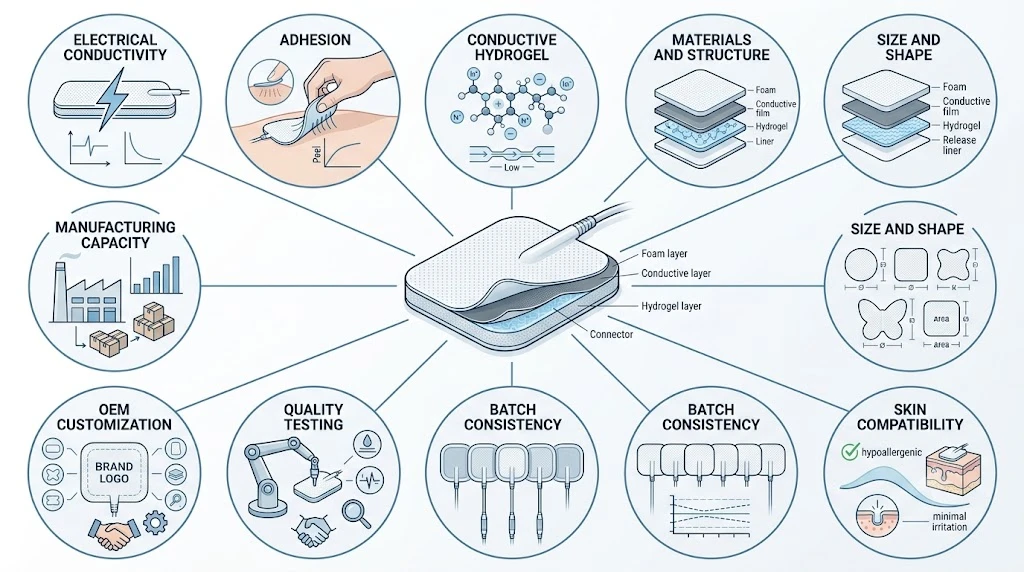
Here are 10 key factors to evaluate before choosing a supplier.
Quick Answer
The most important factors include:
- Electrical conductivity
- Adhesion performance
- Hydrogel quality
- Electrode pad structure and materials
- Size and shape
- Skin compatibility
- Product consistency
- Quality testing
- OEM/ODM customization
- Manufacturing and supply capability
The ideal balance depends on the device, application, target market, and product requirements.
1. Electrical Conductivity
Conductivity is one of the fundamental performance characteristics of an electrode pad.
The electrode must provide an effective electrical interface between the device and the skin.
However, higher conductivity does not automatically mean better overall performance.
OEM buyers should consider:
- Conductive material
- Hydrogel formulation
- Contact stability
- Electrical resistance
- Consistency during the intended product lifespan
The goal is stable and predictable electrical performance rather than simply maximizing one specification.
Related reading
Why Stable Conductivity Matters More Than Strong Adhesion
2. Adhesion Performance
An electrode pad needs to remain in stable contact with the skin during its intended use.
Insufficient adhesion can lead to:
- Edge lifting
- Pad movement
- Reduced contact area
- Inconsistent electrical transmission
However, excessive adhesion may make removal uncomfortable.
Therefore, OEM buyers should look for a balanced adhesion profile rather than simply asking for the strongest adhesive.
3. Conductive Hydrogel Quality
Hydrogel is one of the most important functional components of many electrode pads.
It influences several characteristics simultaneously, including:
- Conductivity
- Adhesion
- Skin contact
- Moisture retention
- Comfort
- Product lifespan
When evaluating a supplier, buyers should ask about hydrogel formulation, production controls, material specifications, and consistency between batches.
Related reading
Why Hydrogel Is the Most Critical Material in an Electrode Pad
4. Electrode Pad Structure and Materials
An electrode pad is not simply a piece of conductive gel.
Depending on the design, it may contain:
- Conductive hydrogel
- Conductive layer
- Backing material
- Adhesive system
- Connector
- Release liner
Each layer has a specific function.
The backing material, for example, can influence flexibility, durability, and conformity to curved surfaces.
This is why OEM buyers should evaluate the complete construction of the electrode pad, rather than focusing on one material.
5. Size and Shape
Electrode pad geometry can influence both product performance and usability.
Important design considerations include:
- Pad dimensions
- Contact area
- Shape
- Corner radius
- Flexibility
- Compatibility with the target application
There is no universally "best" electrode pad shape.
The appropriate geometry depends on the intended application and device design.
Related reading
How Electrode Pad Shape Affects Current Distribution

6. Skin Compatibility
An electrode pad is designed to interact directly with the user's skin.
Therefore, skin compatibility is an important consideration during product development.
OEM buyers should consider:
- Skin contact materials
- Hydrogel properties
- Adhesive characteristics
- Biocompatibility requirements
- Intended duration of use
Different users may also have different skin conditions, which can influence adhesion and electrical contact.
For products intended for regulated medical applications, appropriate testing and documentation should be considered according to the applicable market and product classification.
7. Batch-to-Batch Consistency
This is one of the factors that is often underestimated during supplier evaluation.
A supplier may provide an excellent sample, but OEM buyers need to know:
Will production batch #50 perform like production batch #1?
Consistency can involve:
- Hydrogel thickness
- Pad dimensions
- Conductivity
- Adhesion
- Connector positioning
- Appearance
- Packaging
A mature manufacturing system should have processes in place to monitor and control these variables.
Related reading
Why Batch-to-Batch Consistency Matters in Electrode Pad Manufacturing

8. Quality Testing and Inspection
A professional supplier should be able to explain how products are evaluated before shipment.
Depending on the product, quality programs may include:
- Visual inspection
- Dimensional inspection
- Adhesion testing
- Electrical performance testing
- Material verification
- Packaging inspection
- Batch traceability
OEM buyers should ask for information about the supplier's testing procedures rather than relying only on a statement such as "100% quality checked."
9. OEM and ODM Customization Capability
For private-label and OEM projects, customization can be critical.
Potential customization options may include:
- Pad dimensions
- Shape
- Hydrogel characteristics
- Connector type
- Backing material
- Packaging
- Labeling
- Branding
More importantly, buyers should determine how the supplier handles customization.
A capable OEM partner should be able to communicate clearly about feasibility, tooling, sampling, validation, and mass production.

10. Manufacturing and Supply Capability
Finally, evaluate whether the supplier can support the project beyond the first order.
Important considerations include:
- Production capacity
- Manufacturing locations
- Quality management systems
- Lead times
- Raw material supply
- Production scalability
- Documentation
- After-sales support
A supplier that can produce a small batch is not necessarily a supplier that can reliably support long-term OEM growth.
For many buyers, manufacturing stability is ultimately more valuable than the lowest initial quotation.
How Should OEM Buyers Compare Suppliers?
A useful way to evaluate suppliers is to separate the decision into four categories:
|
Category |
What to Evaluate |
|---|---|
|
Product |
Conductivity, adhesion, materials, dimensions |
|
Quality |
Testing, consistency, traceability |
|
Customization |
OEM, ODM, packaging, connectors |
|
Supplier |
Manufacturing capacity, certifications, communication |
This prevents buyers from making a decision based solely on unit price.

Why the Cheapest Electrode Pad May Not Be the Lowest-Cost Option
A lower unit price can be attractive, but the total cost of an OEM project may involve much more than the initial quotation.
Unexpected costs can come from:
- Inconsistent batches
- Product complaints
- Repeated sampling
- Production delays
- Packaging errors
- Regulatory documentation gaps
- Difficult communication
For this reason, OEM buyers should evaluate total supplier value, rather than comparing price alone.
Common Mistakes When Sourcing Electrode Pads
Choosing based only on price
The cheapest quotation may not provide the best long-term value.
Evaluating only one sample
A sample demonstrates potential product performance, but it does not necessarily demonstrate mass-production consistency.
Ignoring the hydrogel
Hydrogel properties can significantly influence conductivity, adhesion, comfort, and lifespan.
Focusing only on the electrode pad
The complete product system-including the device, connector, application, and intended user-should be considered.
Asking for customization without defining requirements
Suppliers can provide better recommendations when buyers clearly communicate their intended application and technical requirements.
Frequently Asked Questions
What is the most important factor when sourcing electrode pads?
Should OEM buyers test samples before placing a bulk order?
Is stronger adhesion better?
Why is batch consistency important?