

FDA 510(k)-Cleared Ultrasound Gel Pad | TOP-RANK
Ultrasound imaging depends on more than the performance of the ultrasound system itself. The interface between the transducer and the patient's body also plays an important role in acoustic transmission.
Ultrasound coupling products are designed to support this interface. While conventional ultrasound gel is widely used, gel pads offer an alternative product format for applications that require a defined coupling medium and a convenient, application-specific design.
For medical device manufacturers and healthcare distributors, selecting an ultrasound gel pad involves more than comparing product dimensions or prices. Buyers need to consider intended use, acoustic characteristics, material properties, product consistency, regulatory status, and manufacturing capabilities.
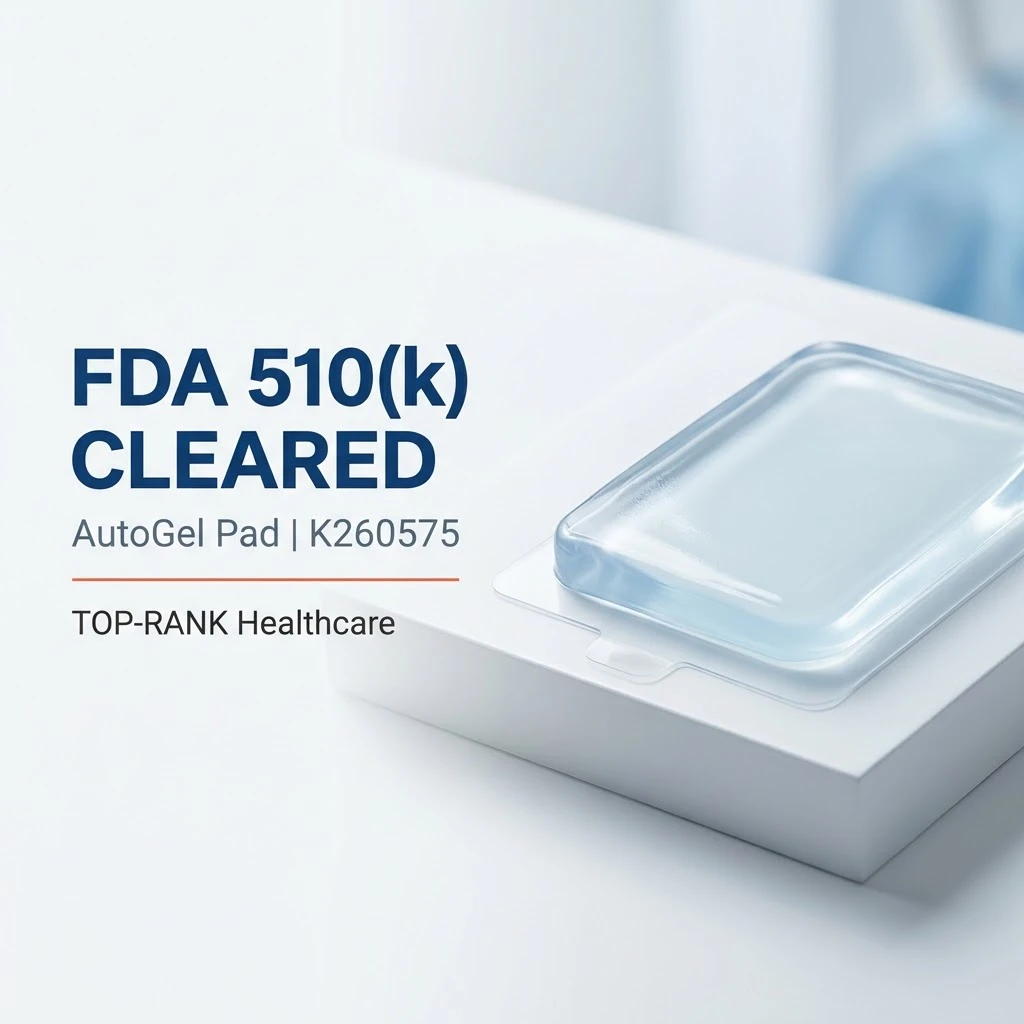
TOP-RANK Healthcare is pleased to announce that its AutoGel Pad has received FDA 510(k) clearance under K260575. The cleared device includes models 400-046 and 400-005.
This milestone represents an important step in TOP-RANK's expansion of its medical consumables portfolio and its commitment to developing products for regulated medical device markets.
Quick Answer: What Is an Ultrasound Gel Pad?
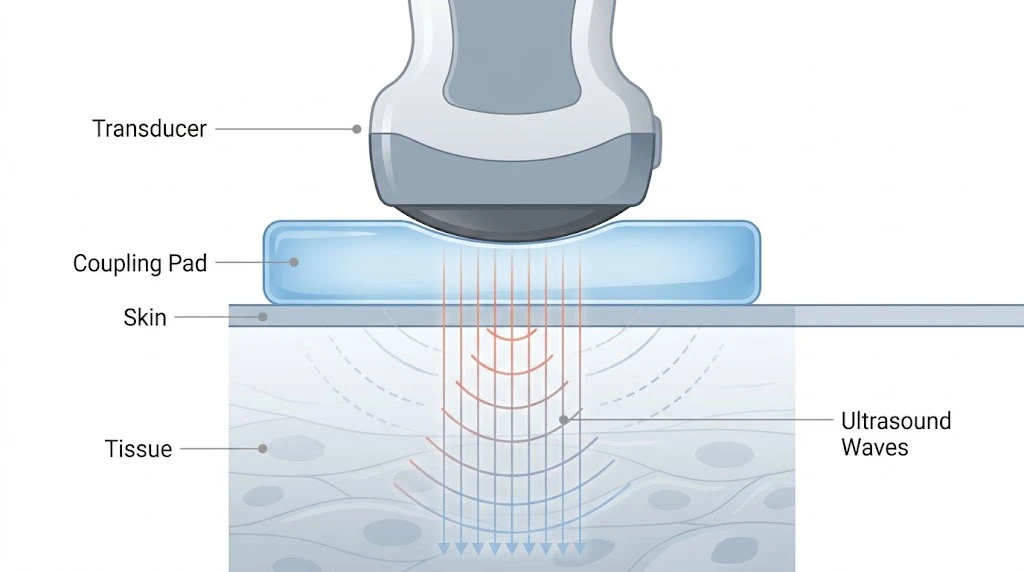
An ultrasound gel pad is a medical ultrasound coupling medium designed to facilitate the transmission of ultrasound waves between a transducer and the body surface.
It provides a defined coupling interface that helps reduce the acoustic mismatch associated with an air gap between the transducer and the skin.
Compared with conventional liquid or gel coupling media, a gel pad is supplied in a preformed pad format. Its design can be developed around particular device configurations and application requirements.
For B2B buyers, the most important evaluation factors include:
- Intended use and compatibility with the ultrasound system
- Acoustic transmission characteristics
- Material composition and physical stability
- Contact interface and product dimensions
- Packaging and storage requirements
- Regulatory documentation and manufacturing consistency
1. How Does an Ultrasound Gel Pad Work?
Ultrasound imaging uses high-frequency sound waves to generate images of internal body structures.
During an examination, the ultrasound transducer sends sound waves into the body and receives returning echoes. For effective transmission, the interface between the transducer and the skin must minimize air gaps.
Air creates a substantial acoustic impedance mismatch at the transducer-skin interface. This can result in significant reflection of ultrasound energy.
An ultrasound coupling medium helps establish a more suitable acoustic interface.
An ultrasound gel pad performs this function through its coupling material and designed contact surface.
The Basic Acoustic Coupling Process
- Transducer contact: The ultrasound transducer is positioned against the coupling interface.
- Acoustic transmission: Ultrasound energy passes through the coupling medium toward the body.
- Echo reception: Returning ultrasound signals travel back through the interface to the transducer.
- Image formation: The ultrasound system processes the received signals to generate an image.
The coupling medium is therefore part of the overall ultrasound system interface, rather than simply an accessory for convenience.
Why Is the Coupling Interface Important?
The performance of an ultrasound coupling product can be influenced by several physical characteristics:
| Characteristic | Why It Matters |
|---|---|
| Acoustic impedance | Influences acoustic energy transmission and reflection at interfaces |
| Sound velocity | Affects the propagation of ultrasound waves through the material |
| Attenuation | Describes the reduction of ultrasound signal intensity as it travels through the material |
| Thickness | Influences the physical distance and acoustic path through the coupling medium |
| Contact consistency | Helps establish a repeatable interface between the transducer and the body |
These characteristics should be evaluated in relation to the intended ultrasound system and the device's cleared indications.
2. Ultrasound Gel Pad vs. Conventional Ultrasound Gel
Both ultrasound gel pads and conventional ultrasound gel are used as coupling media. However, they differ in product format and practical handling characteristics.
| Comparison | Ultrasound Gel Pad | Conventional Ultrasound Gel |
|---|---|---|
| Product format | Preformed pad | Liquid or semi-liquid gel |
| Application | Positioned as a defined coupling interface | Applied directly to the relevant contact area |
| Handling | Supplied in a prepared product format | Requires dispensing and application |
| Product dimensions | Can be manufactured to defined dimensions | Typically supplied in bottles, tubes, or sachets |
| Packaging | Can be individually or application-specifically packaged | Commonly supplied in bulk or unit containers |
| Design flexibility | Can be developed around particular device requirements | Formulation and packaging can be customized |
Neither format is universally suitable for every ultrasound application.
The appropriate choice depends on the device design, intended use, clinical workflow, and relevant regulatory requirements.
For OEM buyers, the key question is not simply which format is more convenient. It is whether the coupling product is suitable for the intended ultrasound system and application.
3. What Should Buyers Evaluate When Sourcing Ultrasound Gel Pads?
When evaluating an ultrasound gel pad manufacturer, procurement teams should consider several technical and commercial factors.
3.1 Acoustic Performance
Acoustic performance is one of the fundamental considerations for ultrasound coupling products.
Buyers should request relevant technical information, including:
- Acoustic impedance
- Sound velocity
- Ultrasound attenuation
- Relevant test methods and conditions
- Performance consistency between production batches
These parameters should be assessed against the intended application and applicable device requirements.
A supplier should be able to explain how its product specifications are established and how performance is verified.
3.2 Material Composition and Physical Properties
The material system influences the physical characteristics and functional performance of an ultrasound gel pad.
Depending on the product design, buyers may need to evaluate:
- Material composition
- Flexibility and dimensional stability
- Surface characteristics
- Moisture retention or material stability, where applicable
- Compatibility with the intended contact environment
- Packaging compatibility
Material selection should be based on the product's intended use and supporting verification data, rather than assumptions based solely on material names.
3.3 Dimensions and Device Compatibility
Ultrasound gel pads may need to fit specific transducer designs or application requirements.
Important specifications can include:
- Length and width
- Thickness
- Shape and edge design
- Contact area
- Positioning requirements
- Compatibility with the intended transducer configuration
For OEM projects, dimensional requirements should be confirmed early in product development.
3.4 Packaging and Storage
Packaging is another important part of product development.
Buyers should clarify:
- Individual or bulk packaging requirements
- Packaging material specifications
- Protection against contamination or physical damage
- Storage conditions
- Shelf-life documentation
- Labeling and traceability requirements
Packaging configurations should be validated for the actual product and distribution conditions.
3.5 Regulatory Documentation
Regulatory status is particularly important when sourcing medical devices for the U.S. market.
Buyers should verify the exact device name, manufacturer, model, 510(k) number, intended use, and applicable labeling.
A supplier's general statement that a product is FDA registered or FDA compliant is not a substitute for checking the relevant regulatory record.
TOP-RANK's AutoGel Pad is listed in the FDA 510(k) database under K260575.
4. TOP-RANK AutoGel Pad: FDA 510(k) Clearance K260575
TOP-RANK Healthcare has achieved an important regulatory milestone with the FDA 510(k) clearance of its AutoGel Pad.
FDA Regulatory Information
| Item | Information |
|---|---|
| Manufacturer | TOP-RANK HEALTH CARE CO., LTD. |
| Device Name | AutoGel Pad |
| 510(k) Number | K260575 |
| Model Numbers | 400-046, 400-005 |
| Classification Name | Media, Coupling, Ultrasound |
| FDA Product Code | MUI |
| Regulation Number | 21 CFR 892.1570 |
| FDA Decision | Substantially Equivalent |
The FDA database identifies AutoGel Pad under the ultrasound coupling media classification.
What does 510(k) clearance mean?
The FDA 510(k) pathway is a premarket notification process used to determine whether a medical device is substantially equivalent to a legally marketed predicate device.
A 510(k) clearance is not the same as FDA approval through the Premarket Approval (PMA) pathway.
For buyers, the clearance provides an important regulatory reference when evaluating the device for the U.S. market. However, the product must still be used and marketed in accordance with its cleared indications, applicable labeling, and regulatory requirements.
Official FDA record: K260575
https://www.accessdata.fda.gov/scripts/cdrh/cfdocs/cfTPLC/tplc.cfm?ID=591
5. Why Work with an Experienced Medical Consumables Manufacturer?
For medical device OEMs and distributors, a reliable manufacturing partner should provide more than a finished product.
The supplier should understand the relationship between product design, material selection, manufacturing processes, quality management, and regulatory documentation.
At TOP-RANK Healthcare, our medical consumables manufacturing experience supports product development and manufacturing projects across different medical applications.
Our capabilities and development approach focus on:
- Material expertise: Understanding the role of material properties in product performance.
- Product development: Translating application requirements into practical product specifications.
- Manufacturing consistency: Establishing controlled processes and repeatable production.
- Quality management: Supporting manufacturing activities within a medical device quality management framework.
- OEM/ODM collaboration: Working with customers on product specifications, packaging, and project requirements.
With the FDA 510(k) clearance of AutoGel Pad K260575, TOP-RANK continues to expand its medical product portfolio and strengthen its capabilities in medical coupling products.

6. OEM/ODM Ultrasound Gel Pad Development: What Information Should Buyers Provide?
If you are evaluating an ultrasound gel pad for a new medical device or an existing product line, providing clear technical requirements can make the development process more efficient.
We recommend preparing the following information before contacting a manufacturer:
| Requirement | Information to Provide |
|---|---|
| Application | Intended ultrasound procedure or device application |
| Device compatibility | Ultrasound system and transducer information |
| Product dimensions | Required length, width, and thickness |
| Product design | Reference images, drawings, or existing samples |
| Material requirements | Required material properties or restrictions |
| Packaging | Individual, bulk, or customized packaging |
| Regulatory market | United States, Europe, Canada, or other target markets |
| Estimated volume | Sample quantity and expected annual demand |
If you have an existing product, drawings, or technical specifications, these can help the manufacturer assess feasibility and identify development requirements.
For customized projects, intended use and regulatory considerations should be discussed before finalizing the product design.
Frequently Asked Questions
1. What is an ultrasound gel pad used for?
2. What is the difference between an ultrasound gel pad and ultrasound gel?
3. Does TOP-RANK have FDA 510(k) clearance for its ultrasound gel pad?
4. Is FDA 510(k) clearance the same as FDA approval?
5. What technical specifications should buyers request for ultrasound gel pads?
Buyers should request relevant information about acoustic impedance, sound velocity, attenuation, dimensions, material properties, packaging, storage, and applicable product verification data. The required specifications depend on the intended application.
6. Can ultrasound gel pads be customized for OEM projects?