

TENS & EMS Electrode Compatibility: A Buyer's Guide
A TENS or EMS device and its electrode pads work as a connected system. Even when an electrode appears to fit a device, physical compatibility alone does not establish that the combination will perform as intended.
For medical device manufacturers, private-label brands, and rehabilitation equipment suppliers, electrode compatibility is an important consideration when developing new products, sourcing replacement pads, or evaluating alternative electrode suppliers.
Compatibility depends on several factors, including connector configuration, electrical characteristics, electrode dimensions, material construction, and the operating requirements of the intended device.
Understanding these factors helps buyers define clearer specifications and establish an appropriate evaluation process before approving an electrode for production or commercial use.
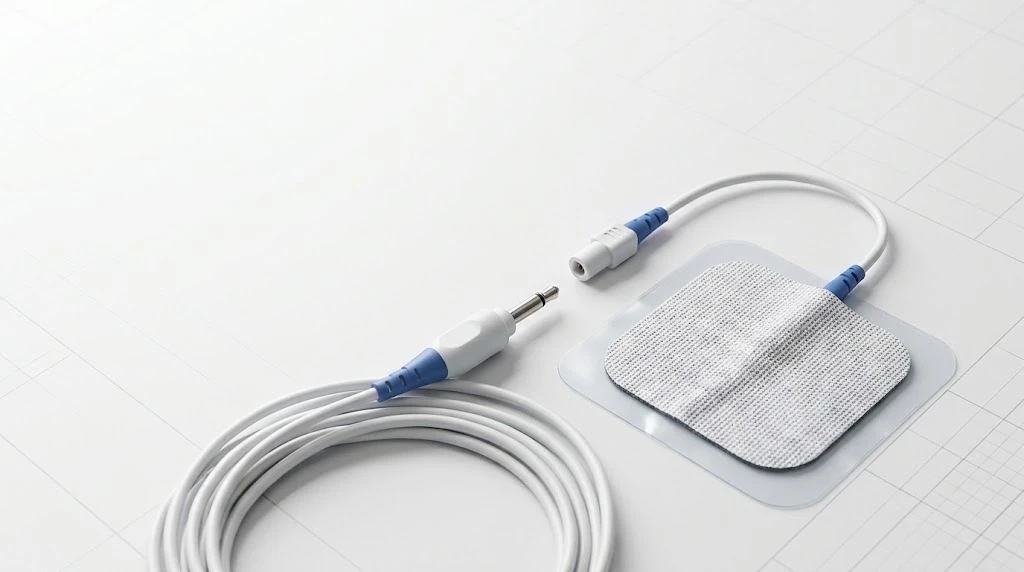
Quick Answer: What Determines TENS and EMS Electrode Compatibility?
TENS and EMS electrode compatibility depends on five primary considerations:
- Connector compatibility: The electrode must connect correctly to the intended device or lead wire.
- Electrical compatibility: Its electrical characteristics must be suitable for the device's specified operating conditions.
- Physical compatibility: Its size, shape, and configuration must suit the intended application.
- Material and contact characteristics: The electrode's construction must be appropriate for its intended skin-contact and stimulation functions.
- Functional evaluation: The electrode-device combination must be evaluated against defined requirements.
A matching connector is only the starting point. Buyers should assess the complete electrode-device combination rather than assuming that a physically interchangeable pad is automatically suitable.
1. Start With the Device Interface
The first step is to confirm how the electrode connects to the TENS or EMS device.
Electrode pads may use different connection arrangements, and these configurations are not necessarily interchangeable.
Common interface considerations include:
- Snap connectors
- Pin-style connections
- Lead-wire interfaces
- Connector dimensions and tolerances
- Connection retention and mechanical stability
The appropriate configuration depends on the device design and its intended electrode system.
Why connector appearance is not enough
Two connectors may look similar but differ in dimensions, retention characteristics, or electrical contact requirements.
A connection that is loose, difficult to engage, or mechanically unstable may create problems during normal use.
For OEM/ODM projects, buyers should provide the manufacturer's connector specifications, technical drawings, or an approved reference sample wherever possible.
What should buyers confirm?
Before requesting samples, clarify:
- The connector type and dimensions
- Whether the connector is attached directly to the electrode or through a lead wire
- The intended mating component
- Any specified connection or retention requirements
- Whether the electrode must fit an existing device platform
These details help prevent unnecessary sampling and design revisions.
2. Evaluate Electrical Characteristics
An electrode's connector may fit the device correctly, but the electrode's electrical characteristics must also be appropriate for the intended system.
Electrical compatibility should be evaluated against the device's specifications and the requirements of the electrode's intended use.
Impedance and electrical contact
The electrode-skin interface contributes to the electrical behavior of the stimulation system.
Factors that may influence this interface include:
- Electrode contact area
- Skin condition and contact quality
- Conductive material properties
- Hydrogel characteristics
- Electrode placement
- The electrical signal and operating conditions of the device
These factors interact. Consequently, electrode impedance should not be treated as a fixed value independent of the measurement conditions.
For example, measurements taken under different conditions may not be directly comparable. Buyers and manufacturers should define the relevant measurement method and conditions when establishing electrical acceptance criteria.
Why the device specifications matter
TENS and EMS devices can differ in their output characteristics and operating requirements.
An electrode intended for one device should not automatically be assumed suitable for another simply because the connector matches.
The buyer and manufacturer should determine which electrical characteristics need to be evaluated and establish appropriate acceptance criteria for the intended combination.
Questions to ask an electrode manufacturer
- Which electrical characteristics are specified for the electrode?
- Under what conditions are these characteristics measured?
- Are the measurement methods consistent with the product specification?
- Is additional evaluation required for the intended device?
The goal is to establish a technically meaningful basis for compatibility, not simply to compare isolated numbers.
3. Check Electrode Size, Shape, and Contact Area
Physical configuration is another important part of compatibility.
The electrode's dimensions and shape must be suitable for the intended application, while the contact area and construction must align with the device's requirements.
Size and geometry
TENS and EMS electrode pads may be rectangular, square, circular, oval, or custom-shaped.
A replacement electrode with different dimensions may still connect to the device, but its suitability for the intended application must be assessed separately.
Changes in geometry can influence contact area, placement, flexibility, and the overall behavior of the electrode-device system.
Contact area and device output
Electrode contact area can influence current density and the electrical interface during stimulation.
However, a larger electrode is not automatically better, and a smaller electrode is not automatically unsuitable. The appropriate design depends on the intended application, device output characteristics, electrode construction, and applicable requirements.
Buyers should avoid treating electrode dimensions as an isolated purchasing specification.
Practical compatibility checks
Before approving an electrode configuration, confirm:
- Overall dimensions and shape
- Available contact area
- Intended placement and application area
- Compatibility with the device's specified operating conditions
- Any restrictions imposed by the device design
For custom electrode projects, these requirements should be documented in the product specification.
4. Consider Hydrogel and Skin-Contact Performance
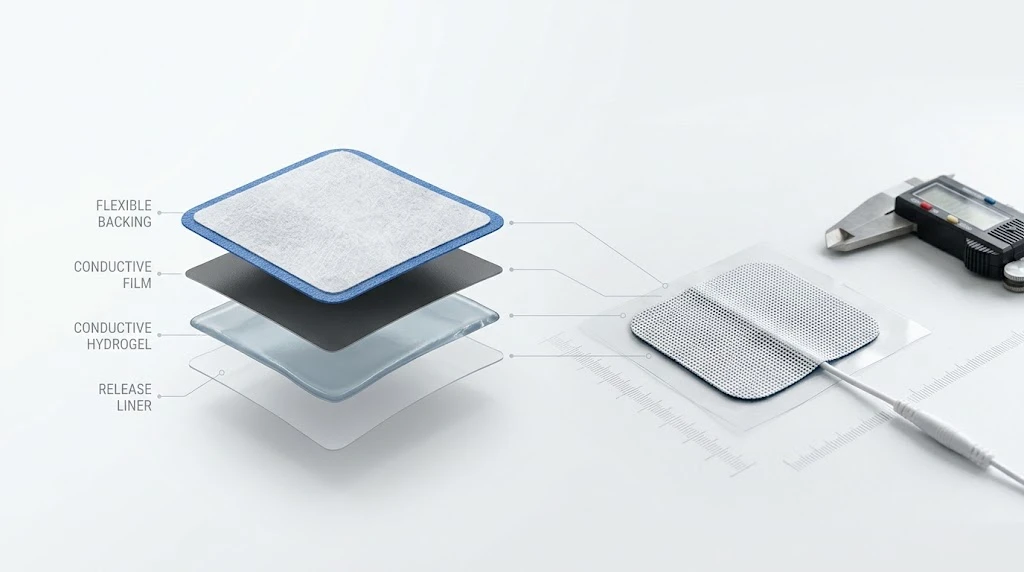
The conductive hydrogel is an important component of many TENS and EMS electrode pads.
It contributes to the electrical interface between the electrode and the skin and influences the product's adhesion and contact characteristics.
However, hydrogel selection should not be based on a single property.
Electrical and physical characteristics
Relevant considerations may include:
- Conductive performance under defined conditions
- Adhesion during intended use
- Moisture retention
- Conformability to the application area
- Skin-contact suitability
- Compatibility with the electrode's backing and other components
These characteristics need to be considered together.
For example, optimizing adhesion alone does not establish that an electrode has suitable electrical performance or that it is appropriate for a particular application.
Why replacement electrodes require evaluation
A replacement pad may use a different hydrogel formulation or construction from the original electrode.
Even if its dimensions and connector appear identical, differences in the materials can affect the behavior of the complete electrode-device system.
For this reason, buyers evaluating alternative electrodes should consider both the product specification and the evidence available for the intended application.
5. Distinguish TENS and EMS Device Requirements
TENS and EMS devices both use electrical stimulation, but their intended functions and device specifications can differ.
TENS is generally associated with transcutaneous electrical nerve stimulation for pain management, while EMS uses electrical stimulation to activate muscles.
This difference does not mean that all TENS electrodes are incompatible with EMS devices, or vice versa. Compatibility must be evaluated for the specific electrode and device combination.
What should be assessed?
Depending on the product, relevant considerations may include:
- Device output specifications
- Electrode contact area
- Connector configuration
- Electrode construction and material characteristics
- Intended placement and use conditions
- Manufacturer-defined compatibility requirements
A product's marketing category alone is not enough to establish suitability.
For example, an electrode advertised for EMS should still be assessed against the specific device requirements if it is being considered for another stimulation system.
A practical rule for OEM buyers
Evaluate the actual device-electrode combination, not just the TENS or EMS label.
This approach is particularly important when a brand plans to use one electrode configuration across several devices or product models.
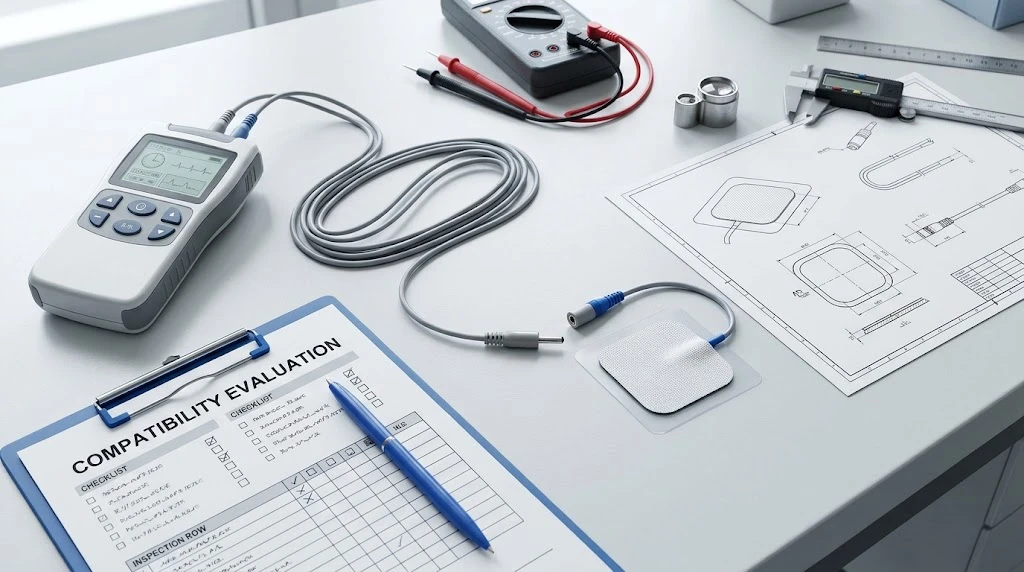
6. Establish a Compatibility Evaluation Process
For B2B buyers, compatibility should be treated as a documented evaluation process rather than a visual inspection.
The depth of evaluation will depend on the electrode type, device specifications, intended use, and applicable regulatory requirements.
A practical process may include the following steps.
Step 1: Define the intended combination
Identify the device model, electrode configuration, connector type, and intended application.
Step 2: Review the specifications
Compare the electrode's documented characteristics with the device requirements.
Identify any missing information or unresolved compatibility questions.
Step 3: Inspect the physical interface
Check connector dimensions, engagement, retention, and any relevant mechanical requirements.
Step 4: Evaluate relevant electrical characteristics
Use defined methods and conditions to assess the electrical characteristics that matter for the product and intended device.
Step 5: Conduct appropriate functional evaluation
Where required, evaluate the electrode-device combination under defined conditions and against established acceptance criteria.
Step 6: Document the results
Record the evaluated configuration, test conditions, results, deviations, and approval decision as appropriate to the project.
Step 7: Control changes
If the electrode material, connector, geometry, or device configuration changes, assess whether the existing compatibility evidence remains applicable.
This process helps establish a clear technical basis for product approval.
7. Common Mistakes When Selecting Replacement TENS and EMS Electrodes
Several assumptions can complicate electrode sourcing and product development.
Mistake 1: Assuming the same connector means full compatibility
Connector fit establishes only one aspect of compatibility. Other electrical, physical, and functional requirements may still need evaluation.
Mistake 2: Comparing electrodes by dimensions alone
Two electrodes with identical dimensions may differ in material construction, electrical characteristics, and other product requirements.
Mistake 3: Treating impedance as a standalone number
Electrical measurements depend on the measurement method and conditions. Values should be interpreted in the context of the relevant specification.
Mistake 4: Assuming TENS and EMS electrodes are always interchangeable
The suitability of an electrode depends on the specific device, intended use, and applicable requirements-not simply the category name.
Mistake 5: Skipping evaluation when changing suppliers
An alternative supplier may offer a product with a similar appearance and connector, but equivalence should be established against defined requirements.
A structured evaluation can help buyers identify meaningful differences before approving an alternative electrode.
8. What OEM/ODM Buyers Should Provide to an Electrode Manufacturer
When requesting a compatible TENS or EMS electrode, buyers can accelerate the initial technical review by preparing a concise information package.
|
Information |
Purpose |
|---|---|
|
Device model or interface specification |
Establishes the intended connection and operating requirements |
|
Connector drawing or reference sample |
Clarifies the physical interface |
|
Electrode dimensions and shape |
Defines the target geometry |
|
Relevant electrical specifications |
Establishes the characteristics requiring evaluation |
|
Intended application |
Helps clarify the product's functional requirements |
|
Material requirements or restrictions |
Guides construction and material discussions |
|
Existing electrode sample |
Provides a reference for comparison |
|
Required documentation |
Identifies project-specific technical and regulatory needs |
Not every project requires all of these items at the first inquiry.
If certain specifications are unavailable, buyers should identify them as unknown rather than assume compatibility based on appearance.
An experienced manufacturer can then help clarify which additional information is necessary for the next development step.
9. How TOP-RANK Healthcare Supports TENS and EMS Electrode Projects
TOP-RANK Healthcare manufactures medical electrode products and related materials, including TENS/EMS electrodes and conductive gels.
For OEM/ODM projects, the initial technical discussion can focus on the intended device interface, electrode dimensions, material requirements, and the product characteristics that need to be evaluated.
These details help establish whether a proposed electrode configuration aligns with the project's manufacturing and technical requirements.
For buyers developing a new stimulation device, sourcing replacement electrodes, or evaluating an alternative electrode supplier, the first step is to define the intended device-electrode combination and its acceptance criteria.
Explore the company's product range and manufacturing information through the official website:
Frequently Asked Questions
1. Are TENS and EMS electrode pads interchangeable?
2. Does a matching connector guarantee electrode compatibility?
3. What should I check when buying replacement TENS electrodes?
4. Can one electrode design be used with multiple TENS or EMS devices?
5. Why do electrode materials matter for compatibility?
6. How is electrode electrical compatibility evaluated?