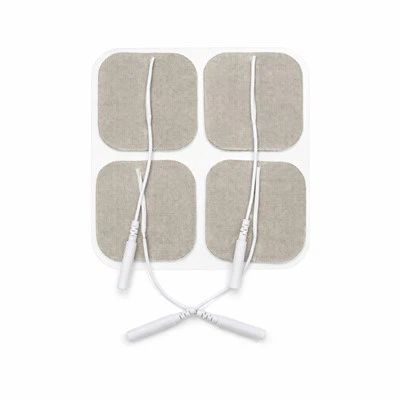

OEM Snap Type TENS Electrodes | Stud Electrotherapy Pads | TOP-RANK
B2B contract manufacturing of snap-type TENS/EMS electrode pads for wireless stimulation pods and snap-lead systems. Features 3.5 mm / 4.0 mm nickel-plated brass or carbon studs, radial current-dispersal underlays, >45N snap pull-out retention, and volume resistivity <18 Ohm-cm.
Product Overview
Stud-mounted TENS and EMS electrode pads provide direct mechanical coupling and electrical energy transfer for modular wearable pulse generators, sports recovery modules, and clip-on clinical lead systems. Designed to dock active electronic housings directly onto cutaneous therapy sites, these assemblies eliminate external cable snags. The interface conducts biphasic rectangular pulses across a 1 Hz to 120 Hz bandwidth at current amplitudes up to 80 mA, establishing low-impedance conduction channels over paraspinal segments, joint margins, and kinetic muscle groups.
Directly seating an active electrotherapy module onto cutaneous pads reveals three specific mechanical and electrochemical vulnerabilities that standard wired electrodes do not encounter:
- Host Casing Strain and Edge Delamination from Pin Spacing Variance: Dual-output wireless generators dock across two parallel fastener studs at fixed structural intervals. When carrier punch positions drift during roll-fed converting, the resulting spacing deviation forces the host's internal metallic spring clips outward. This constant lateral tension strains the plastic generator housing, initiating hairline cracks around the socket walls while pulling the pad's outer boundary away from the skin.
- Galvanic Degradation Across Dissimilar Metallic Boundaries: During repetitive home or athletic therapy, saline perspiration penetrates the mechanical junction between the electrode's metallic stud and the generator's internal socket clips. When dissimilar alloys meet inside this electrolyte bath, bimetallic galvanic corrosion accelerates. Non-conductive oxidation products coat the micro-contact points, driving circuit impedance from below 0.1 Ohms to over 30 Ohms and triggering persistent connection error halts.
- Peripheral Gel Extrusion and Fiber Contamination from Fastener Seating: Engaging a wireless module or snap lead onto an electrode requires direct downward thumb pressure (typically 10N to 15N) over the fastener post. In conventional pads where hydrogel extends across the full die-cut area, this compressive force squirts fluid gel past the backing boundary. The exposed adhesive fringe rapidly gathers dust and fabric lint from clothing, causing progressive edge curling over repeated sessions.
This electrode platform resolves these operational challenges through precision production controls: optical servo punch systems hold dual-stud centerline spacing within ±0.12 mm to eliminate casing stress; an optional injection-molded conductive carbon-polymer fastener eliminates metallic galvanic corrosion and skin sensitization; and an integrated 2.0 mm peripheral dry-border rebate prevents thumb-induced gel displacement. We supply single-stud and multi-stud geometries for wireless medical brands, physical conditioning providers, and clinical distribution channels worldwide.
Technical & Engineering Description
The high-volume manufacturing of direct-docking stud TENS electrodes operates in Class 8 cleanroom environments across automated converting lines equipped with optical tension compensation, slot-die hydrogel positioning, and multi-track fastener assembly decks. The manufacturing cycle follows five sequential stations:
- Station 1: Servo-Calibrated Aperture Tooling: Medical spunlace non-woven rolls (65 g/m2) or closed-cell polyethylene foam webs advance under closed-loop servo feed control. High-speed optical sensors detect web displacement, dynamically adjusting unwind braking to eliminate tension stretch. Rotary punch modules stamp mounting apertures, holding the center-to-center pitch of dual-stud footprints (calibrated to 40.0 mm or 50.0 mm standards) strictly within a $\pm$0.12 mm window to prevent dimensional binding during host docking.
- Station 2: Automated Fastener Feeding & Flange Clamping: Fastener sets-comprising either passivated H62 copper-zinc alloy studs or injection-molded conductive carbon-polypropylene components-feed from multi-channel vibratory bowls into the punched web. Lower tubular eyelets seat through the carrier and are mechanically expanded against internal rigid polymer rings under hydraulic pressing (680N dwell force), forming a seamless mechanical collar without cutting adjacent carrier fibers.
- Station 3: Positioned Dry-Border Hydrogel Lamination: An ultraviolet-polymerized crosslinked polyacrylate solid hydrogel (thickness 0.90 mm to 1.00 mm, volume resistivity <18 Ohm-cm) is pattern-laminated via vacuum transfer drums. The hydrogel web is cut 2.0 mm narrower than the carrier profile on all four margins, establishing an ungelled perimeter gasket that acts as a dry barrier against ambient dust and thumb-pressure squeeze-out.
- Station 4: Continuous Continuity Mapping & Boundary Tooling: Multi-cavity rotary tooling punches finished pad profiles (50x50 mm square or 50x100 mm dual-stud rectangles) with 3.5 mm radiused corners. An inline probe station scans electrical resistance between the top stud terminal and the lower gel face, automatically flagging any component measuring above 0.5 Ohms.
- Station 5: Release Film Mounting & Gas-Purged Hermetic Sealing: Cut pads mount in pairs or quads onto 75 um fluorosilicone-treated PET release liners. The collated strips feed into horizontal flow-wrappers, sealed inside multi-layer PET/AL/PE barrier pouches with reclosable zip-lock profiles under positive nitrogen flush. The standard contract manufacturing MOQ is 10,000 pouches.
Key Features
-
Dual-Axis Pitch Control within ±0.12 mm (Stopping Casing Micro-Cracking and Terminal Pre-Stress in Cordless Pods)
Wearable stimulation devices using dual-channel circuits (such as athletic recovery pods and knee conditioning stimulators) mount onto two parallel snap studs separated by a fixed dimensional span (typically 40.0 mm or 50.0 mm). When pad apertures are punched on uncalibrated web lines, material tension variations cause the center-to-center pitch to wander by 0.3 mm to 0.7 mm. When users force a rigid electronic enclosure onto these misaligned studs, the host socket clips are bent outward, generating constant lateral lever strain against the enclosure openings. Over a few weeks of use, fatigue micro-cracks propagate through the plastic casing around the sockets, while the tilted studs exert continuous shear against the hydrogel layer beneath, causing the far edges of the pad to lift off the skin. Our production platform eliminates this mechanical binding through optical servo-controlled rotary punch decks that hold dual-stud center-to-center pitch strictly within a ±0.12 mm tolerance window. The dual-stud geometry forms an unyielding anti-rotation plane that secures the active generator in neutral alignment, neutralizing casing fatigue, stopping pad rotation, and keeping the assembly flat against the skin during movement.
-
Metal-Free Conductive Polymer Fasteners (Neutralizing Galvanic Bimetallic Corrosion and Transdermal Nickel Leaching)
Standard electrotherapy studs rely on nickel-plated brass. While functional in dry clinics, repetitive personal use exposes the connection to perspiration containing aggressive electrolytes (sodium chloride, lactic acid, urea). When this saline moisture infiltrates the junction between the brass stud and the host device's stainless steel or beryllium-copper socket clips, a galvanic bimetallic cell forms. Electrolytic oxidation attacks the contact points, depositing non-conductive metallic oxides that spike circuit impedance from below 0.1 Ohms to over 30 Ohms. Furthermore, microscopic plating micro-cracks allow nickel ions to leach into the skin, triggering contact dermatitis in sensitive individuals. To resolve this electrochemical failure, our platform offers an injection-molded conductive carbon-polypropylene fastener as an entirely metal-free terminal. The conductive polymer matrix maintains bulk volume resistivity below 12 Ohm-cm while remaining completely inert to galvanic cell oxidation and sweat salt erosion. The fastener preserves electrical contact across hundreds of sweaty exercise sessions, eliminates metal allergy risks, and provides complete radiolucent transparency under clinical X-ray and CT imaging beams.
-
2.0 mm Perimeter Dry-Border Rebate (Halting Thumb-Pressure Gel Extrusion and Textile Lint Accumulation)
Perimeter hydrogel contamination is a frequent point of mechanical failure in direct-docking electrodes. Snapping a wireless pulse unit or clip connector onto a pad requires localized downward thumb force (10N to 15N) directly over the stud. In conventional electrodes where hydrogel is coated across the full carrier footprint, this installation pressure squeezes soft polyacrylate gel past the outer backing edge. The extruded gel bead along the top and outer edges acts as a magnet for dust, lint, and loose textile fibers from shirts, pants, and bedding. Within 3 to 5 treatment applications, the perimeter becomes coated in a non-adhesive fuzzy layer that loses all skin contact and curls upward. We eliminate this operational failure by implementing an exact 2.0 mm dry-border rebate: the hydrogel is pattern-laminated with a 2.0 mm perimeter setback from the fabric die-cut boundary. This ungelled fabric perimeter functions as an overflow dampening channel. When thumb force compresses the hydrogel layer, any transient lateral gel creep is contained entirely within the dry margin without breaking past the fabric outline. The perimeter stays clean and dry throughout multi-day therapy, preventing fiber fouling and preserving edge tack over 30+ reuse cycles.
Applications
Dual-Channel Cordless EMS & Athletic Conditioning Pods
Deployed as dedicated contact interfaces for rigid, two-pin wireless muscle stimulators; standard 50x100 mm dual-stud pads maintain exact 40 mm or 50 mm center distances, locking the receiver module securely over the quadriceps, calves, and latissimus dorsi. The rigid two-point anchor eliminates rotational yaw and housing micro-cracks during dynamic physical movement.
Hypoallergenic Wearable Therapy for Sensitive Dermal Demographics
Sourced by digital health innovators and pain management clinics targeting pediatric, geriatric, and metal-sensitive patients; utilizing metal-free conductive carbon-polypropylene studs, the electrode eliminates transdermal nickel leaching, resisting sweat-induced galvanic corrosion across long-dwell ambulatory sessions without dermal erythema.
Active Daily Wear & Post-Operative Ambulatory Pain Protocols
Utilized with button-docking wearable micro-current generators for patients recovering from lumbar spine, cervical spine, or knee interventions; the 2.0 mm dry-border design keeps the pad outer margins clean and lint-free during contact with shirts, waistbands, and bedsheets, preventing premature edge lifting during daytime office work or nighttime sleep.
OEM & Private Label
-
Fastener Metallurgy, Pad Footprints & Packaging Configurations : We provide modular turnkey engineering solutions for wearable health device brands and DME distributors:
· Fastener Configurations: Standard 3.5 mm or 4.0 mm male studs; available in cold-formed passivated nickel-plated brass, passivated stainless steel, or metal-free conductive carbon-polypropylene for radiolucent and hypoallergenic applications.
· Die-Cut Geometries: Single-stud formats in 50x50 mm square or 50 mm round; dual-stud formats in 50x100 mm and 50x120 mm rectangles with custom pitch calibration (35 mm, 40 mm, 50 mm, or 60 mm); specialized ergonomic butterfly profiles for lumbar and abdominal placement.
· Carrier Substrates: Standard 65 g/m2 white spunlace non-woven fabric (breathable); flesh-tone tan tricot cloth (two-way elasticity for articulating joints); or 1.0 mm closed-cell white PE foam (wipe-clean barrier).
· Perimeter dry margins: Factory-set at 2.0 mm; customizable from 1.5 mm to 3.5 mm based on the physical docking pressure of the client's host pod.
· Custom Packaging: Multi-layer PET/AL/PE barrier foil pouches with zip-lock closures; full-color custom gravure printing, localized regulatory IFU instructions, and serialized UDI barcodes.
-
Two-Center Supply Chain Mechanics : Raw conductive hydrogel synthesis, conductive carbon film twin-screw extrusion, stud cold-forming and polymer injection, and medical adhesive coating operate within our primary China facility. Automated optical servo rotary die-cutting, high-speed fastener orbital staking, 100% line-scan vision inspection, nitrogen pouch packaging, cleanroom cartoning, and container logistics route through our Vietnam hub, shielding overseas B2B purchasers from regional medical device tariffs and Section 301 duties.
Certifications
-
ISO 10993 Comprehensive Dermal Biocompatibility : Master production lots undergo testing in accredited independent testing laboratories confirming strict compliance with ISO 10993-5 (In Vitro Cytotoxicity Grade 0), ISO 10993-10 (Skin Sensitization: 0% allergic response in guinea pig maximization tests), and ISO 10993-23 (Primary Dermal Irritation Index = 0.0). The pads are certified 100% natural rubber latex-free, phthalate-free, non-toxic, and non-irritating over multi-hour daily stimulation sessions.
-
Electrical Safety & Mechanical Joint Verification : Product lines satisfy FDA 21 CFR 882.1320 requirements for cutaneous electrotherapy electrodes and IEC 60601-1 Type BF electrical safety standards. Lot release testing confirms that snap engagement force remains within 10N to 15N and separation force remains within 12N to 18N after 100 continuous mechanical cycles, while axial stud pull resistance consistently exceeds 45N without backing tear or electrical discontinuity.
-
MDSAP & ISO 13485 Manufacturing System Controls : Continuous hydrogel coating decks, orbital riveting bays, and pouch packaging operations run strictly under certified ISO 13485:2016 and MDSAP regulatory frameworks (covering US FDA 21 CFR 820, Health Canada, TGA Australia). Unbroken electronic Device History Records (DHR) capture brass stud plating thickness, riveting clamping force, hydrogel coat weights, and snap pull-out force data across every manufactured production lot.
Technical FAQ
Q: How does dual-snap center-to-center pitch tolerance (+/- 0.15 mm) prevent device casing cracking and interface peeling in wireless dual-output stimulators?
A: Dual-snap electrodes are required by multi-channel wearable stimulators (such as sports recovery pods and bilateral nerve conditioners) that feature two fixed female spring receptacles embedded inside a single rigid injection-molded casing: •The Physics of Dimensional Mismatch: The female receptacles on a wireless pulse pod are cast inside an unyielding polycarbonate or ABS enclosure with a fixed center distance (e.g., 40.0 mm). When cheap dual-snap pads are stamped on standard machines without web tension compensation, stretching of the non-woven backing introduces pitch deviations between 0.3 mm and 0.8 mm. When a clinician or user forces the pod onto these misaligned studs, the outer stud shanks hit the inner chamfer of the socket openings: 1.The rigid plastic enclosure is subjected to high outward or inward flexural bending stresses, resulting in fatigue micro-cracking around the socket housings after a few weeks of use. 2.The misaligned studs are forced outward at a continuous lateral angle. This sustained mechanical shear pulls against the fabric carrier and hydrogel layer beneath, creating localized delamination air pockets and causing the far edge of the pad to roll off the skin. •Our In-Process Tolerance Control: We prevent structural binding and edge roll through optical servo registration on our rotary punch decks: 1.Tension-Compensated Punching: High-resolution optical sensors read registered pitch markers on the advancing carrier web. Servomotors automatically adjust feed tension at 25 meters per minute, holding center-to-center aperture spacing strictly within 40.0 mm (+/- 0.15 mm) or 50.0 mm (+/- 0.15 mm). 2.Zero Mechanical Pre-Stress: When the wireless pod is snapped home, both stud shanks engage their mating spring clips simultaneously and perpendicularly. Zero lateral bending load is transferred into the pod housing, and zero static shear force acts on the hydrogel plane. The assembly sits seated flat on the skin, maintaining balanced current transmission and preventing premature casing failure.
Q: In what specific export and clinical scenarios should buyers select metal-free conductive carbon studs over standard nickel-plated brass snaps?
A: While nickel-plated brass is the industry standard for conventional TENS therapy, contract manufacturing buyers should specify conductive carbon-polymer studs across three specific technical and regulatory environments: 1.Long-Term Multi-Session Wear in Humid or High-Perspiration Climates: Export orders intended for tropical sports therapy, gym conditioning, or patients suffering from hyperhidrosis present high risks of galvanic degradation. Traditional nickel plating micro-cracks over repeated friction cycles, allowing saline sweat to bridge the brass substrate with the stimulator's internal copper-alloy or stainless clips. The resulting galvanic cell corrodes the terminal, generating non-conductive oxide layers and causing machine cutoffs. Conductive carbon-polypropylene fasteners contain zero metallic elements, completely eliminating electrochemical galvanic oxidation and holding contact resistance below 12 Ohm-cm across hundreds of sweat-soaked sessions. 2.Clinical Environments Requiring Radio-Transparency (CT, X-Ray, Fluoroscopy): In hospital intensive care units, post-surgical pain suites, or interventional orthopedic therapy, patients frequently undergo diagnostic imaging while receiving sensory electro-analgesia. Solid brass studs cast dense, radio-opaque metal artifacts on X-ray and CT scans, obscuring anatomical views of bone margins and joint spaces. Conductive carbon fasteners match the radiolucency of soft human tissue, delivering zero shadow artifacts under diagnostic imaging beams without requiring electrode detachment. 3.Strict Compliance with Nickel-Release Limits for Hypoallergenic Branding: Under EU REACH regulations and clinical biocompatibility standards, transdermal nickel leaching from worn metal hardware must not exceed 0.5 ug/cm2/week. In consumer health lines branded as hypoallergenic or designed for sensitive pediatric or chronic pain users, brass plating failure can result in product recalls. Formulated with zero nickel or heavy metal additives, conductive carbon studs offer complete chemical safety, passing ISO 10993-10 maximization tests with zero dermal sensitization.
Wireless electrotherapy device manufacturers, wearable health brand engineers, and physical therapy supply chain managers can access official Certificates of Analysis (COA), 45N snap pull-out mechanical test logs, ISO 10993 dermal biocompatibility dossiers, and unbranded evaluation sample packs (including 3.5 mm / 4.0 mm single-snap and dual-snap formats).
👉 [Request Snap Type TENS Electrode Evaluation Packs]
Hot Tags: snap type tens electrodes, China snap type tens electrodes manufacturers, suppliers, factory
Specifications
| Analytical Parameter | Engineering Baseline | Testing Standard |
| Footprint Formats | 50x50 mm (Single snap), 50x100 mm (Dual snap), Round 50 mm | Standard dies |
| Snap Stud Caliber | 3.5 mm (+/- 0.03 mm) or 4.0 mm (+/- 0.03 mm) male stud | Optical micrometer |
| Snap Metallurgy | Solid H62 Brass with 3.0 um Passivated Bright Nickel Plating | Salt spray 48h |
| Optional Carbon Snap | High-Conductivity Carbon-Filled Polycarbonate (Metal-Free) | Radiolucent |
| Snap Retention Force | Initial engagement: 10N to 15N; Disengagement: 12N to 18N | Custom test fixture |
| Stud Pull-Out Strength | Axial Pull Force > 45N (Typical: 55N to 70N) | Tensile test machine |
| Radial Dispersal Layer | Conductive Carbon-Silver Printed Disc (Dia 20 mm to 30 mm) | Surface mapping |
| Conductor Substrate | 45 um Isotropic Carbon-Loaded Polyethylene Film (30 to 45 Ohm/sq) | Four-point probe |
| Conductive Hydrogel | High-Shear-Modulus Crosslinked Solid Hydrogel (Caliper: 0.95 mm) | Extruded matrix |
| Volume Resistivity | < 18.0 Ohm-cm at 1 kHz (Typical: 10 to 14 Ohm-cm) | Four-electrode cell |
| 90-Degree Peel Tack | 4.0N to 5.2N / 25 mm on Polished Stainless Steel | ASTM D3330 |
| Docking Cycle Life | > 100 Engagement and Separation Cycles without Play | Mechanical endurance |
| Operating Shelf-Life | 36 Months sealed in PET/AL/PE pouches at 15C to 30C | Accelerated aging |