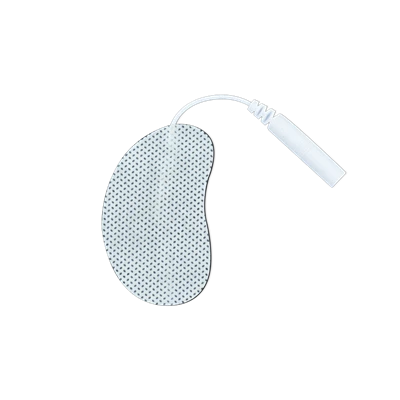

OEM Pigtail TENS Electrodes | 2.0mm Pin Electrodes | TOP-RANK
B2B wholesale pigtail TENS electrodes featuring molded 2.0mm female receptacles, tensile-reinforced copper tinsel wires, isotropic carbon film, and 25+ cycle reusable hydrogel.
Clinical Rationale & Biomechanical Profile
Connecting clinical electrotherapy consoles to human anatomy via flexible pigtail leadwires remains the global gold standard across hospital physical therapy wards, chiropractic clinics, and rehabilitation centers. Unlike rigid snap electrodes whose raised metal studs (4mm- 6mm tall) press painfully into muscle bellies when patients lie supine on treatment tables, a pigtail electrode routes the electrical junction horizontally away from the active treatment zone via a flexible insulated wire. This low-profile geometry eliminates focal pressure points and prevents mechanical lever-arm dislodgement when lead cables snag on clothing.
Standard commercial pigtail pads fail prematurely at the wire-pad junction: repeated patient movement causes standard solid-strand copper wires to suffer work-hardening fatigue, snapping internally beneath the molded boot and leaving the practitioner troubleshooting intermittent open circuits. Furthermore, poorly crimped wire eyelets concentrate incoming current into a tiny contact point, generating severe localized current density spikes (>1.2mA/cm²) that burn patient skin directly beneath the wire root.
This pigtail electrode integrates high-flexibility copper tinsel conductors, an overmolded strain-relief collar, and an isotropic carbon-vinyl charge dispersion layer. Paired with a high-cohesion, skin-friendly polyacrylamide hydrogel, the assembly withstands over 10,000 dynamic bending cycles while maintaining a low volume impedance (<15Ω) across 25 to 30 continuous patient application cycles. We supply these standard consumables in bulk to physical therapy supply distributors, DME/HME prescription networks, and electrotherapy device OEMs globally.
Manufacturing Kinetics & Leadwire Staking Workflow
Industrial manufacturing of pigtail TENS electrodes combines multi-strand wire processing, high-tonnage terminal staking, tension-controlled lamination, and precision rotary die-cutting inside cleanroom facilities. The process begins with conductor fabrication: ultra-thin oxygen-free copper foils are helically wrapped around high-tensile synthetic polymer filaments (such as nylon or aramid) to form flexible tinsel strands. The bundle is extruded with medical-grade PVC or thermoplastic elastomer (TPE) insulation. The wire is cut to length (typically 50mm to 100mm), and the patient-side terminal is terminated with a precision phosphor-bronze 2.0mm female socket overmolded with an anti-slip grip collar.
At the converting line, the opposite bare end of the tinsel conductor is fanned out and mechanically staked onto a carbon-loaded vinyl film using automated, high-tonnage micro-crimp presses. To isolate this electrical junction from external mechanical forces, an elastomeric strain-relief boot is molded directly over the entry point, distributing axial tension across the broad pad backing rather than the conductive interface.
The carbon film web is laminated to a carrier backing-such as a breathable 60g/m² spunlace non-woven or a cross-linked PE foam. A high-viscoelasticity polyacrylamide hydrogel loaded with pharmaceutical polyols and physiological electrolyte buffers is slot-die extruded across the carbon conductor at a calibrated caliper (0.8mm to 1.2mm). Following in-line UV photopolymerization, servo-driven rotary dies stamp out finished geometries (50× 50mm, 50× 90mm, or custom shapes) with smooth, rounded corners. The electrodes are mounted on fluorosilicone PET release cards and sealed into airtight multi-layer barrier foil pouches under ISO 13485 cleanroom controls. The minimum contract manufacturing threshold is 20,000 units.
Core Engineering Assets
-
Helical Tinsel Conductor Architecture (>10,000 Dynamic Bend Cycles Without Core Fatigue)
Standard commercial electrodes use conventional bunched copper strands inside their pigtail leads. Under the repeated cyclic flexing caused by patient motion and clinic handling, these straight copper wires rapidly work-harden and snap internally right at the boot junction, causing intermittent connection drops and sudden power surges. We engineer our pigtails with multi-strand helical tinsel wires: thin oxygen-free copper ribbons are wound spirally around high-denier synthetic textile filaments. This structure converts axial bending strain into rotational shear along the textile core, eliminating metal embrittlement. Standardized mechanical testing confirms over 10,000 dynamic 90° continuous bend cycles without broken filaments or resistance drift (<0.1Ω variance).
-
Low-Profile Transition Collar (Decoupling of Mechanical Cable Tension & Bed Sore Prevention)
When patients roll over or sit back against therapy cushions, standard bulky rubber grommets press hard against the skin, causing severe localized bruising in elderly or cachectic patients. Simultaneously, pulling on the wire can tear the crimped terminal right out of the gel layer. Our pad incorporates a specialized low-profile, overmolded strain boot made of medical-grade thermoplastic elastomer. The collar tapers gradually from the 2.0mm wire down to the wafer-thin backing plane, maintaining an ultra-low vertical clearance (<2.5mm). It distributes external mechanical tugs (>25N axial pull rating) across the outer foam/cloth border, isolating the internal electrical connection from tensile stress while presenting a flat, smooth profile that prevents pressure ulcers during prolonged bed rest.
-
Isotropic Carbon Film Interfacial Dispersion (Suppression of Lead-Root Current Density Spikes)
The primary cause of painful electrical "biting" or "stinging" sensations in TENS therapy is localized current crowding at the lead entry point. If the conductive carbon film exhibits uneven carbon-filler density, incoming current travels along the path of least resistance, discharging immediately beneath the wire eyelet rather than spreading across the pad. We use a calendered conductive vinyl film formulated with high-dispersion furnace black nanoparticles, delivering uniform surface resistivity (<80Ω/sq). Incoming biphasic waveforms disperse instantly across the entire conductive footprint, keeping spatial current density variance below 0.08 mA/cm². This ensures smooth, comfortable sensory stimulation and deep motor-unit recruitment across the full pad surface.
Commercial & Clinical Deployments
Hospital Rehabilitation & Physical Therapy Suites
High-turnover universal electrodes paired with multi-channel clinical electrotherapy carts (compatible with Chattanooga, BTL, and Enraf-Nonius systems) for acute post-injury pain, joint rehabilitation, and neuromuscular re-education.
DME / HME Post-Operative Pain Prescription Kits
Pre-packaged replacement electrode sets bundled alongside portable, take-home digital TENS and NMES machines prescribed by orthopedic surgeons for non-narcotic post-surgical pain relief.
Global Pharmacy Chains & OTC Brand Replenishment Packs
Turnkey 4-pack, 8-pack, and 16-pack replacement electrode bundles packaged inside retail zip-lock pouches or hang-tab blister cards, supplied to consumer healthcare brands for pharmacy retail shelves and digital health platforms.
Packaging Configurations & Transnational Logistics
-
Hermetic Zip-Lock Barrier Pouching : Pigtail hydrogels require balanced hydration to preserve sub-15 Ohm conductivity and adhesive peel tack over time. Electrodes are mounted in pairs onto double-sided fluorosilicone PET release cards, stacked, and sealed inside heavy-gauge multi-layer PET/AL/PE foil barrier pouches fitted with airtight zip-locks. This barrier drives Moisture Vapor Transmission Rates (MVTR) near zero, guaranteeing a 36-month shelf life without hydrogel dry-out or adhesive softening.
-
Transnational Logistics Resilience : Base conductive film calendering, multi-strand tinsel wire spinning, and multi-cycle hydrogel formulation execute natively inside our primary China facility. Terminal socket crimping, strain-relief boot overmolding, cleanroom die-cutting, packaging, and master carton palletization route through our Vietnam hub, shielding international B2B buyers from regional medical consumable trade tariffs.
Quality, Regulatory & Biocompatibility Systems
-
ISO 10993 Dermal Biocompatibility Clearance : Production lots undergo regular validation in certified independent laboratories against ISO 10993-5 (Cytotoxicity Grade 0), ISO 10993-10 (Sensitization: 0% allergic response), and ISO 10993-23 (Primary Dermal Irritation Index = 0.0). The entire assembly is 100% latex-free, non-cytotoxic, and free of phthalate plasticizers (DEHP-free).
-
MDSAP & ISO 13485 Manufacturing Controls : Continuous coating lines, automatic wire staking bays, and packaging cleanrooms operate strictly within facilities certified to ISO 13485:2016 and MDSAP regulatory frameworks, delivering unbroken lot-serialization and electronic batch traceability from raw copper spools and chemical monomers to outbound shipping pallets.
Technical FAQ
Q: Why do pigtail electrodes remain the preferred configuration in clinical physical therapy over snap-style pads?
A: Pigtail electrodes offer two key mechanical and clinical advantages over snap electrodes. First, a standard snap electrode has a rigid, raised metal post (4mm to 6mm tall) mounted directly in its center; when a patient lies supine or leans against a therapy chair during lower back or shoulder treatment, this metal post concentrates their body weight into a tiny pressure point that causes discomfort or tissue bruising. Pigtail electrodes route the connection horizontally away through a flexible wire, maintaining a flat, comfortable surface against the skin. Second, connecting a snap leadwire requires pressing downward directly onto the patient's body, which can be painful over tender or traumatized areas, whereas 2.0mm pigtail pins slide smoothly into the lead socket without pushing against the patient's skin.
Q: What prevents the copper wire strands from pulling out of the conductive carbon film when patients yank the leadwire?
A: In low-cost generic pads, wires are held in place solely by adhesive tape or a shallow press, which tears out under 5N to 8N of tension. We engineer our junction with a two-tier mechanical decoupling system. First, the stranded copper tinsel is fanned out and staked to the carbon film using a high-tonnage micro-crimp that mechanically bites into the conductive vinyl backing. Second, this crimp is encased inside an overmolded elastomeric thermoplastic strain boot that is chemically and mechanically locked to the outer cloth/foam carrier. When tension is applied to the cable, the mechanical strain is transferred to the broad fabric substrate rather than the delicate electrical joint. The assembly withstands sustained axial pull forces over 25N, preventing wire detachment and maintaining electrical continuity under rough clinical handling.
Rehabilitation distributors, physical therapy clinic chains, and electrotherapy device OEMs can request ANSI/AAMI EC12 electrical validation dossiers, cable bending fatigue test logs, and unbranded evaluation sample packs in multiple standard formats.
👉 [Request Pigtail TENS Electrode Evaluation Samples]
Hot Tags: pigtail tens electrodes, China pigtail tens electrodes manufacturers, suppliers, factory, best TENS unit pads, electrical pads, Electrode Pad, muscle stim pads, Muscle Stimulator Electrode Pads, TENS pads for sensitive skin
Technical Specifications
| Analytical Parameter | Engineering Baseline | Testing Standard |
| Terminal Receptacle | Standard 2.0mm Female Socket (DIN 42802 Compatible) | Phosphor bronze insert |
| Conductor Composition | High-Flex Multi-Strand Copper Tinsel Wire | Helically wound on textile core |
| Leadwire Pull-Out Force | > 25.0N Axial Pull-to-Failure | Mechanical tensile destruction test |
| Flexural Fatigue Life | > 10,000 Cycles at ± 90° | Cyclic cable bend tester (500g load) |
| AC Volume Impedance | < 15 Ohms at 100Hz | Four-point probe planar measurement |
| Planar Current Variance | Spatial Variance < 0.08 mA/cm² at 10mA | Multi-point array mapping |
| Peel Adhesion Tack | 4.5N - 6.0N / 25mm | ASTM D3330 dynamic steel plate |
| Re-Application Durability | ≥ 25 - 30 Applications on Clean Skin | Tack & impedance retention |
| Backing Substrates | White Spunlace Non-Woven / Hydrophobic PE Foam | Flexible cloth or fluid barrier |