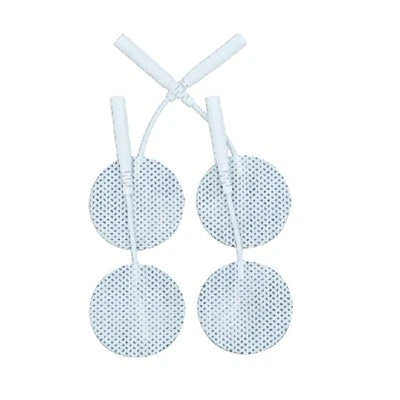

OEM Dysphagia Treatment Electrodes | Throat NMES Pads | TOP-RANK
B2B wholesale dysphagia treatment electrodes compatible with VitalStim and NMES units. Formulated with high-shear hydrogels, focused bipolar spacing, and dynamic neck-contour flexibility.
Clinical & Biomechanical Profile
These dysphagia treatment electrodes operate as specialized, low-profile neuromuscular electrical stimulation (NMES) interfaces engineered explicitly for post-stroke dysphagia, head and neck post-radiation fibrosis, traumatic brain injury (TBI), and pediatric swallowing disorders. Applying therapeutic motor-level electrostimulation (15mA to 25mA, 80Hz) across the anterior cervical triangle presents extreme biomechanical and anatomical difficulties: the throat is a high-mobility zone where active swallowing drives 15 - 25mm of vertical hyolaryngeal excursion (thyroid cartilage and hyoid bone displacement). Generic square or large rectangular TENS pads buckle across the thyroid notch, tenting over tracheal concavities and peeling away under dynamic muscle contractions. More critically, unfocused current fields risk lateral spread into the vascular carotid triangle, where electrical stimulation of the carotid sinus can trigger reflex bradycardia and profound hypotension. This specialized dysphagia electrode utilizes paired mini-oval or dual-arch contoured geometries with a high-viscoelastic, shear-resistant hydrogel (G' > 35,000 Pa) and a high-homogeneity silver-carbon dispersion grid. The matrix delivers tight, isolated electrical vectors to the suprahyoid (mylohyoid, geniohyoid, anterior digastric) and infrahyoid (thyrohyoid) muscle groups without carotid leakage. We mass-produce these converting-ready electrode blanks for speech therapy brand owners, neuro-rehabilitation clinics, and NMES hardware OEMs globally.
Manufacturing Kinetics & Anterior Neck Converting
The industrial fabrication of dysphagia treatment electrodes combines high-precision rotary screen printing, automated dual-zone dielectric passivating, high-cohesion hydrogel slot-die extrusion, and cleanroom rotary die-cutting. An ultra-flexible, medical-grade polyurethane (PU) or cross-elastic spunlace web (45g/m²) is fed through servo-driven printing decks. A dual-track conductive grid is printed using functionalized silver-carbon ink to form tightly bounded bipolar electrode pairs. An insulating dielectric barrier strip (>4mm width) is cross-linked between the paired conductive elements to prevent surface fluid bridging and micro-arcing. A high-viscoelastic polyacrylamide hydrogel plasticized with pharmaceutical-grade polyols and anti-sweat ionic buffers is extruded at calibrated layer thicknesses (1.0mm to 1.2\mm ) over the active sensing zones. The polymer matrix is cured via calibrated inline UV photopolymerization, building a robust, high-cohesion 3D network resistant to fluid plasticization from patient saliva drool or perspiration. High-speed rotary tooling stamps out paired mini-oval or anatomical dual-arch profiles with smooth perimeter radii. The finished electrodes are mounted on fluorosilicone PET release cards and sealed in zero-MVTR foil barrier pouches under ISO Class 7 cleanroom controls. The minimum contract manufacturing threshold is 10,000 pairs.
Core Engineering Assets
-
Dynamic Hyolaryngeal Excursion Compliance (High-Shear Adhesion for 25mm Elevation)
During normal and effortful swallowing rehabilitation maneuvers (such as the Mendelsohn maneuver or Masako swallow), the thyrohyoid and suprahyoid muscles contract violently to pull the larynx upward and forward by up to 25mm. Generic hydrogels lack mechanical shear strength (G' < 10,000 Pa); they shear off the skin, roll up at the edges, and break contact during mid-swallow, inducing painful electrical shocks. We formulate our dysphagia hydrogel with a high-cohesion polymer network delivering a dynamic shear storage modulus exceeding 35,000 Pa. The gel stretches elastically with moving cervical fascia, maintaining unbroken, low-impedance electrical contact throughout repetitive, high-displacement swallowing therapy sessions without edge peeling.
-
Focused Bipolar Vector Targeting (Elimination of Carotid Sinus Current Leakage)
The anterior neck contains critical vascular structures within millimeters of targeted swallowing muscles. Wide, unfocused electrode pads allow electrical current to spill laterally into the carotid sheath, stimulating the carotid sinus baroreceptors and triggering sudden bradycardia, dizziness, or vasovagal syncope in fragile post-stroke patients. Our paired dysphagia electrode architecture pre-configures a narrow, calibrated inter-electrode spacing (15mm to 20mm ) separated by a printed dielectric moat. This strict geometry confines current vectors entirely within the midline sagittal plane (suprahyoid/thyrohyoid muscle fibers), providing deep motor-unit recruitment for pharyngeal clearing while shielding the lateral carotid sinus from stray electrical fields.
-
Secretion-Resistant Anti-Hydrolysis Hydrogel (Defense Against Drool, Sweat & Tracheostomy Moisture)
Severe dysphagia patients routinely suffer from impaired oral motor control, leading to continuous saliva drooling down the anterior neck, while tracheostomy patients have localized tracheal secretions. Standard water-soluble hydrogels absorb excess external saliva, swelling uncontrollably and liquefying into a slippery, non-adhesive film within 10 minutes. Our formulation incorporates a hydrophobic-crosslinked polyol complex that resists rapid external moisture uptake. The gel maintains its tack (4.2N – 5.8N /25mm ) and volume resistivity even when exposed to ambient saliva drool or neck perspiration, ensuring stable clinical therapy without mid-session pad failures.
Clinical & Rehabilitation Deployments
Post-Stroke Speech-Language Pathology (SLP) Departments
Standardized paired NMES electrodes deployed by SLP clinicians to treat pharyngeal phase dysphagia, restore laryngeal elevation, and prevent silent aspiration pneumonia in stroke rehabilitation wards.
Head & Neck Oncology Post-Radiation Clinics
Gentle-adhesion, focused electrodes utilized to re-educate fibrotic pharyngeal constrictors and suprahyoid musculature following chemoradiotherapy for laryngeal or oral cancers.
Pediatric Dysphagia & Cerebral Palsy Centers
Compact mini-oval electrode sets engineered for pediatric anterior neck anatomy, providing sub-sensory to motor-level neuromuscular re-education for children with congenital swallowing dysfunctions.
Precision Packaging & Global Supply Routing
-
Pre-Kitted Paired Blister / Foil Packaging : Dysphagia electrodes are typically used in 2-pad or 4-pad configurations per session. Electrodes are shingled in matched pairs on siliconized release cards and sealed in heavy multi-layer PET/AL/PE foil pouches with 8mm solid perimeter seals, driving Moisture Vapor Transmission Rates (MVTR) near zero to guarantee a 24-month warehouse shelf life under varied hospital storage conditions.
-
Transnational Logistics Resilience : Conductive ink formulation, high-precision screen printing, and hydrogel compounding execute natively inside our primary China facility. Anatomical rotary die-cutting, terminal socket injection-molding, and automated sterile packaging route through our Vietnam hub, protecting global B2B procurement networks from regional medical consumable import tariffs.
Quality, Regulatory & Biocompatibility Systems
-
ISO 10993 Dermal Safety Clearance : Finished dysphagia pad assemblies undergo continuous testing in certified independent clinical laboratories against strict ISO 10993-5 (Cytotoxicity Grade 0), ISO 10993-10 (Sensitization: 0% allergic response), and ISO 10993-23 (Primary Dermal Irritation Index = 0.0) boundaries, confirming zero chemical erythema or follicular irritation on thin cervical skin.
-
MDSAP & ISO 13485 Manufacturing : Cleanroom printing, hydrogel curing, and packaging bays operate strictly under ISO 13485:2016 and MDSAP regulatory frameworks, delivering unbroken lot-serialization from raw conductive pastes to outbound shipping cartons.
Technical FAQ
Q: Why cannot standard square TENS electrodes (50x50mm) be safely substituted for specialized dysphagia treatment electrodes?
A: Standard 50x50mm pads are far too large for the anterior cervical triangle. They bridge across the midline tracheal groove, lifting off the skin during swallowing, and their wide current field spreads laterally into the carotid triangle. Stimulating the carotid sinus baroreceptors can cause dangerous reflex bradycardia and sudden drops in blood pressure. Our dysphagia electrodes feature compact, anatomically contoured boundaries (22× 30mm ) with strict inter-electrode spacing, focusing current exclusively on target suprahyoid/infrahyoid muscles without carotid engagement.
Q: How does the high-shear hydrogel formulation survive continuous 25mm laryngeal excursion without peeling off the neck?
A: Standard hydrogels have low cohesion (G' < 10,000 Pa ) and behave like viscous liquids under dynamic strain, shearing off the skin as the thyroid cartilage slides beneath. We formulate our hydrogel with an elastic, highly cross-linked 3D polyacrylamide network (G' > 35,000 Pa ) combined with a cross-stretchable PU backing. When the larynx elevates during a swallow, the electrode deforms elastically with the skin fascia and snaps back without delaminating, preserving continuous low impedance (<15Ω ).
Speech-language pathology procurement directors, neuro-rehabilitation hospital networks, and NMES electrotherapy OEMs can request dynamic shear rheology logs, clinical current field simulation reports, and unbranded evaluation sample kits.
👉 [Request Dysphagia Treatment Electrode Samples]
Hot Tags: dysphagia treatment electrodes, China dysphagia treatment electrodes manufacturers, suppliers, factory, Back Massager Electrodes, large TENS pads, Self Adhesive Electrode Pads, TENS pads for sensitive skin, TENS unit gel pads, TENS Unit Pads
Technical Specifications
| Analytical Parameter | Target Baseline | Testing Standard |
| Stimulation Compatibility | VitalStim, VocallStim, Phagenyx & Standard NMES | Symmetrical biphasic 80Hz |
| Footprint Geometry | Paired Dual-Oval (22 30mm) / Butterfly Arch | Precision placement over suprahyoid/infrahyoid |
| Inter-Electrode Center Spacing | Fixed 15mm - 20mm Gap Alignment | Dielectric bridge preventing superficial shorting |
| Dynamic Shear Modulus (G') | > 35,000 Pa at 1.0Hz | Rheological shear oscillation |
| Current Homogeneity Variance | < 0.08mA/cm² across Active Face | Spatial multi-point current scan |
| AC Volume Impedance | < 15 Ohms at 100Hz | Four-point probe planar measurement |
| Lead Connector Interface | Integrated 2.0mm Female Socket / 3.5mm Snap | Strain-relieved molded housing |
| Biological Safety Scoring | Primary Dermal Irritation Index = 0.0 | ISO 10993-10 / ISO 10993-23 compliance |