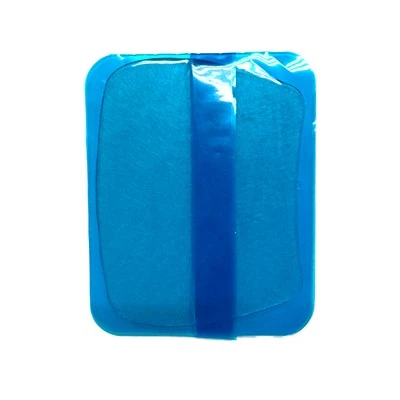

Wholesale Curved TENS Electrodes for Joints | Joint Contour Pads | TOP-RANK
B2B curved TENS electrodes for knee, elbow, and shoulder pain. Engineered with strain-relief slits and high-modulus hydrogels to prevent edge-peeling during 120° joint flexion.
Product Profile
These curved TENS electrodes function as specialized, highly conformable transdermal consumable interfaces engineered for osteoarthritis, patellofemoral pain syndrome, and post-operative joint rehabilitation. Applying transcutaneous electrical nerve stimulation over highly mobile, three-dimensional joint structures-such as the knee, elbow, or shoulder-presents severe physical challenges: sharp anatomical curvature and dynamic flexion up to 120 degrees generate extreme multi-axial shear strains. Standard rectangular or square pads buckle across the patella or joint crease, causing edge lifting, air-gap formation, and violent electrical stinging. Our joint-contoured pads integrate a multi-lobed slotted geometry with an ultra-flexible SPUNLACE/PU carrier to maintain 100% skin contact throughout full range-of-motion routines. We mass-produce these specialized blanks for orthopedic device stockists, sports medicine GPOs, and global e-commerce brand lines.
Slotted Die-Cutting & Multi-Axis Lamination
The industrial processing of joint-contoured electrodes paths a highly elastic spunlace non-woven or ultra-thin PU film carrier through multi-station rotary die-cutting and high-cohesion hydrogel coating lines. To ensure the electrode deforms seamlessly over spherical joint topologies without buckling, the die-cutting station stamps out strategic strain-relief slits or a four-lobed cloverleaf profile. This geometry allows the conductive wings to overlap and flex independently when the joint bends. The carrier film is laminated under precision tension control with a screen-printed conductive silver-carbon busbar. The skin-facing layer utilizes a thick, high-modulus polyacrylamide hydrogel formulated to fill the skin's micro-crevices around joint creases. Completed pads are mounted on fluorosilicone-coated PET release sheets and heat-sealed in airtight AL/PE foil pouches with a minimum order threshold of 20,000 units.
Core Engineering Assets
-
Strain-Relief Slit Geometry (Zero-Buckling Joint Flexure)
Applying a continuous, rigid square pad across a flexing knee or elbow forces the material to undergo high planar tension along the outer apex while compressing along the inner crease. This mechanical stress difference tears the hydrogel layer away from the skin, creating dry air pockets that cause violent current arcing. Our curved joint pads integrate engineered strain-relief slits and U-shaped cutouts. The physical slits absorb the kinetic tension during 120-degree joint flexion, allowing the conductive lobes to articulate independently while maintaining 100% planar contact over the joint capsules without buckling or lifting.
-
Isotropic Charge Scattering Over Bony Prominences (Hotspot Erasure)
Joint anatomy is defined by hard, protruding bony landmarks-such as the patella, lateral epicondyles, and olecranon-covered by extremely thin subcutaneous tissue. Standard carbon pads exhibit current crowding over these bony points, causing sharp voltage spikes and burn risks. We eliminate this electrical bottleneck by screen-printing a branched, gradient-compensated carbon-silver pattern. The busbar layout forces incoming electrons to scatter laterally across the soft muscular and ligamentous periphery before crossing the skin barrier, delivering a flat, mathematically uniform current density field (mA/cm²) across the entire joint complex.
-
High-Modulus Cohesive Anchor Against Dynamic Shear
Repeated bending of the knee during gait therapy or exercise protocols subjects the electrode-skin interface to rapid, multi-directional shear strain. Low-modulus hydrogels suffer internal cohesive breakdown under this strain, leaving sticky residue on the skin while losing adhesion at the margins. We formulate our skin-facing gel with a high covalent cross-linking density and an elevated storage modulus ($G' > 32,000\text{ Pa}$). The gel matrix absorbs dynamic mechanical deformation and recovers its shape synchronously with the SPUNLACE/PU carrier, preserving a solid 5.5N–7.5N peel anchor throughout a 60-minute active rehab protocol.
Downstream B2B Deployments
Sports Medicine & Orthopedic Rehab
Specialized curved pads deployed in physical therapy wards for targeted quadriceps re-education, patellar tendinopathy, and post-ACL reconstruction protocols.
Osteoarthritis Clinical Management
Heavy-duty, high-conformity electrodes supplied to rheumatology and pain clinics for long-duration electro-analgesia over arthritic knee and shoulder joints.
DTC Joint Care Private Label Extensions
Custom-shaped replacement electrode kits packaged in branded foil pouches targeting the high-growth DTC home-care joint pain relief market.
Packaging & Transnational Logistics Routing
-
Zero-MVTR Barrier Pouching : Slotted joint pads feature long cut-edge perimeters that accelerate moisture loss during storage. We package completed joint pads on automated horizontal flow-wrappers into heavy PET/AL/PE foil pouches with 8mm solid heat-seals. This technical barrier drives the Moisture Vapor Transmission Rate (MVTR) near zero, preventing hydrogel crystallization and guaranteeing a 24-month shelf life.
-
Supply Chain Resilience Routing : Polymer synthesis, carbon ink screen-printing, and continuous web lamination run inside our primary China facility. Precision slotted die-cutting, terminal pigtail/snap crimping, and automated pouching execute at our Vietnam hub, providing supply chain redundancy and protecting international distributors from regional import trade tariffs.
Regulatory & Quality Safeguards
-
ISO 10993 Dermal Safety Validation / 严苛的生物相容性核准: Finished multi-layer laminates (PU/spunlace backing, conductive carbon trace, and active hydrogel) undergo continuous batch testing against strict ISO 10993-5 (Cytotoxicity Grade 0) and ISO 10993-10 (Primary Dermal Irritation Index <0.1) boundaries to eliminate skin allergy and redness risks.
-
MDSAP & ISO 13485 Systems : Manufacturing and cleanroom converting bays function securely under ISO 13485:2016 and MDSAP regulatory frameworks, delivering unbroken lot-serialization from raw monomer synthesis to final shipping cartons.
Technical FAQ
Q: Why do regular square TENS pads fall off or cause stinging when used on the knee during bending exercises?
A: The knee skin stretches over 40% in length during 90-degree flexion. A rigid square pad cannot stretch at the same rate, creating high mechanical tension that pulls the hydrogel away from the skin. The resulting air gaps force the TENS current to concentrate on the remaining contact points, causing sharp electric stinging. Our curved joint pads utilize strain-relief slits and multi-lobed profiles that flex with the knee, eliminating mechanical tension and preserving 100% full-surface electrical contact.
Q: Can these curved joint pads be cleaned and reused for patients with oily skin around the joints?
A: Yes. The high-cohesion hydrogel matrix can be gently wiped with a drop of clean water to remove accumulated skin lipids and restore surface tack. However, for clinical health environments with high patient turnover, we recommend single-patient multi-use protocols (typically 20-30 sessions per pad) to avoid cross-contamination and ensure baseline impedance stability.
DME procurement networks, medical equipment brand owners, and GPO distributors can request joint contour impedance distribution mapping, dynamic flexion test logs, and unbranded joint evaluation samples.
👉 [Request Curved Joint Pad Samples]
Hot Tags: curved tens electrodes for joints, China curved tens electrodes for joints manufacturers, suppliers, factory, best TENS unit pads, electro pads for muscles, Large TENS Unit Pads, TENS Machine Electrode Pads, TENS Machine Sticky Pads, TENS unit sticky pads
Technical Specifications
| Structural Parameter | Metric Target | Engineering Test Standard |
| Anatomical Geometry | Multi-Lobed Clover / U-Slotted Profile | Relief slits for patellar & olecranon flex |
| Flexion Tolerance | 0° to 120° Dynamic Flexure | Unbroken conduction through full ROM |
| Substrate Elasticity | > 180% Dynamic Stretch (PU/Spunlace) | Multi-directional kinetic yield |
| Z-Axis Impedance | < 35 Ohms (100Hz AC bridge) | Isotropic charge dispersion over bone |
| Peel Anchor | 5.5N - 7.5N / 25mm | ASTM D3330 joint strain protocol |