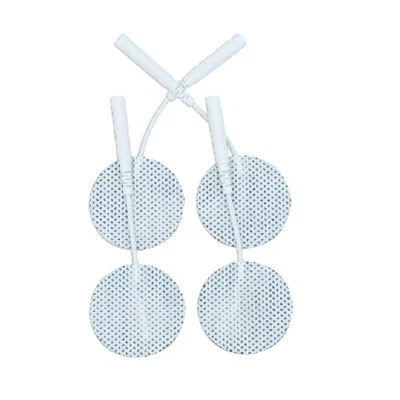

Stainless Steel Fabric TENS Electrodes | Conductive Knit | TOP-RANK
Neurostimulation electrodes utilizing a knitted stainless steel fabric substrate. Designed for extreme multidirectional stretch on dynamic joints. Features dual-layer hydrogel for lateral current dispersion.
Product Overview
These electrodes serve as high-flexibility hardware interfaces for transcutaneous electrical nerve stimulation (TENS) and neuromuscular electrical stimulation (NMES). Instead of a standard carbon film substrate, the pads utilize a knitted stainless steel conductive fabric. This architecture maintains electrical continuity over highly irregular anatomical contours and dynamic joints without physical structural failure. B2B physical therapy distributors supply these for high-movement rehabilitation protocols.
Key Features
-
Multidirectional Strain Tolerance
Carbon film substrates undergo micro-cracking when repeatedly bent over moving joints like the elbow or knee. These micro-cracks create open circuits or electrical arcing. The stainless steel fibers in this fabric are knitted rather than woven. Under mechanical load, the knitted loops elongate and shift alongside the underlying skin, accommodating extreme joint flexion while maintaining an unbroken conductive pathway.
-
Dual-Layer Edge-Bite Mitigation
Standard single-layer gels frequently cause "edge-biting," where current density spikes at the perimeter of the pad. The dual-layer hydrogel formulation builds a deliberate impedance mismatch. The high-impedance upper layer restricts immediate vertical current drop, driving the electrical energy horizontally across the metal fabric. The low-impedance lower layer then couples uniformly to the skin, eliminating localized focal hotspots.
-
Hydrogel Micro-Penetration Bonding
Delamination between the conductive layer and the gel is a primary failure mode in dynamic movement. During the manufacturing lamination phase, the liquid-state hydrogel is extruded directly into the interstitial spaces of the porous stainless steel knit before cross-linking. This creates a mechanical interlock, locking the polymer chains into the metal mesh and preventing separation under sheer stress.
Applications
Dynamic Joint NMES
Motor unit recruitment protocols over the patella, elbow, or shoulder complexes.
Paraspinal TENS
Conforms to the deep curvature of the lumbar erector spinae.
High-Intensity Muscle Rehab
Handles high mA outputs for severe muscle atrophy treatments without thermal breakdown.
OEM & Private Label
-
Die-Cutting Operations : Tooling is available for standard rectangular, oval, and butterfly profiles. The stainless steel knit requires specialized hardened rotary anvils to prevent burring along the cut edges.
-
Supply Chain: Metal fabric weaving and bulk hydrogel coating operate in China. Final assembly, wire crimping, and packaging are completed at our Vietnam hub for optimized global tariff management.
Certifications
Quality Systems : Production sites audited to ISO 13485:2016 and MDSAP regulatory frameworks.
Regulatory : Supported technical documentation for FDA, CE, and UKCA compliance.
FAQ
Q: Why is the impedance of the stainless steel fabric lower than carbon film?
A: Carbon film relies on graphite particles suspended in a binder ink; electrons jump between these particles. Stainless steel provides a continuous, unbroken metallic lattice for electron transfer. This drops the baseline interface resistance from ~50 Ohms (carbon) to < 30 Ohms (steel fabric).
Q: Does the metal knit interfere with MRI or X-Ray equipment?
A: Yes. Unlike carbon electrodes, stainless steel is radiopaque and will cast shadows on radiographic imaging. It is also ferrous and strictly contraindicated for use inside or near MRI magnetic fields.
CTA
B2B physical therapy suppliers can request stainless steel knit samples and dual-layer impedance comparative reports.
👉 [Request Stainless Steel Electrode Samples]
Hot Tags: stainless steel fabric tens electrodes, China stainless steel fabric tens electrodes manufacturers, suppliers, factory, Rehabilicare TENS Unit Pads, TENS Therapy Replacement Pads, electrode self adhesive, extra large TENS pads, TENS Replacement Pads, TENS machine pads
Specifications
| Parameter | Metric Value | Engineering Detail |
| Conductive | Knitted Stainless Steel Fabric | Multidirectional mechanical stretch |
| Hydrogel | Dual-Layer Polymer Matrix | Tiered impedance architecture |
| Impedance | < 30 Ohms | Low-resistance metallic baseline |
| Interface | 2.0mm Pin / Pigtail Wire | High-tensile copper core |
| Backing | Spunlace Non-Woven | Highly conformable profile |