

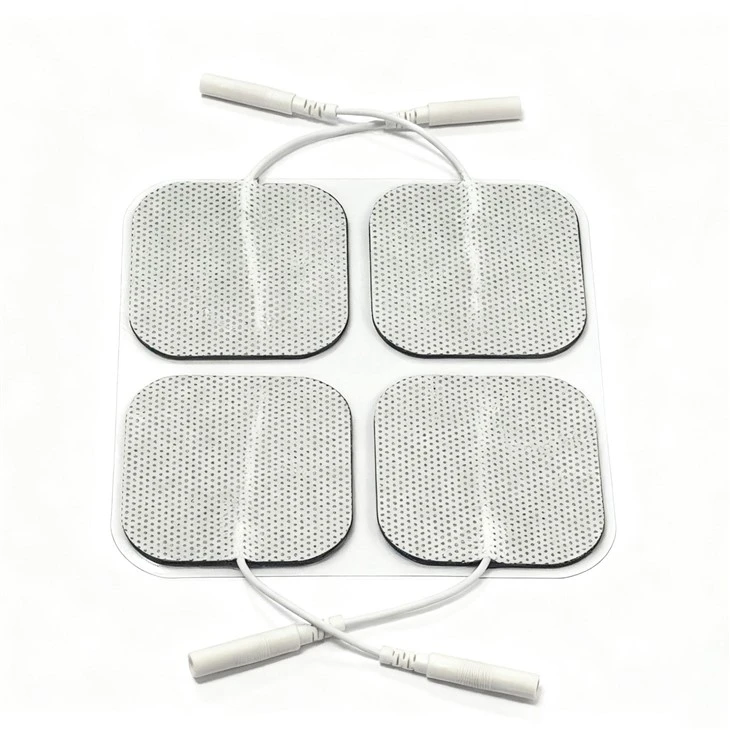
Wholesale 2x2 TENS Electrodes | 50x50mm Square Pads | TOP-RANK
B2B high-volume 2x2 TENS electrodes. Engineered with an isotropic 25cm² footprint and low-ooze roll-to-roll convert lines to maintain uncompromised current density for global DME distributors.
Product Overview
Pre-wired TENS electrodes, commonly referred to as "pigtail" pads, represent a massive segment of the clinical transdermal consumable market. Unlike snap-on variants that require the clinician to physically press a rigid metal stud down into the patient's inflamed skin, these pads feature a pre-integrated, flexible lead wire terminating in a molded female socket. This "off-site" connection geometry eliminates localized mechanical pressure during setup. Our engineering focus for this product line centers on the structural integrity of the wire-to-pad junction, ensuring the embedded copper mesh survives aggressive kinetic pulling in high-turnover physical therapy environments. We supply these assemblies in bulk to clinical distributors and durable medical equipment (DME) brands.
Technical/Engineering Description
The high-speed fabrication of a 2x2 inch electrode operates on a continuous web converting architecture. A substrate carrier web (spunlace non-woven or cross-linked PE foam) is subjected to tension-controlled unwinding, where it is laminated directly to a low-resistance carbon conductive film. The critical technical challenge when operating web lines at 200+ units per minute is the hydraulic displacement of the hydrogel at the sharp 90-degree corners. Blunt rule dies compress the polyacrylamide lattice hydrogel laterally, resulting in corner bleeds that instantly ruin packaging aesthetics. We mitigate this by employing a proprietary solid tungsten rotary anvil cut with a specialized micro-bevel rule. This tooling cleanly shears the gel matrix at exact right-angle vectors without lateral squishing. Standard wholesale outputs are packed as 4 pads per clear PET liner strip, with automated pouching systems configured for an MOQ baseline of 20,000 individual pads to maximize raw material yield.
Key Features
Isotropic 25cm² Current Density Balancing
A square 50x50 mm geometry creates an isotropic electrical footprint where current vectors travel equidistantly from the center terminal out to the four straight borders. If the printed carbon ink or extruded film contains microscopic variances in thickness, the electricity will bypass the corners and bottleneck along the shortest path. This creates a severe center current tunneling effect (mA spike), resulting in an intense stinging sensation for the patient. Our roll-to-roll extrusion process guarantees absolute thickness uniformity of the carbon substrate across the entire 25cm² area. The current is mathematically forced to disperse evenly over the entire perimeter, delivering soft, rolling neuromuscular stimulation even at maximum clinical power settings.
Right-Angle Rotary Cleaving Modulus (Anti-Ooze)
Square electrodes are highly susceptible to "cold flow" defects at their sharp corners during maritime transit inside unconditioned shipping containers. Under the constant pressure of bulk stacking, the hydrogel lattice behaves as a viscoelastic fluid, slowly oozing beyond the 90-degree backing cut. We counteract this by shifting the polymer's viscoelastic rheology. By altering the cross-linking agent density during UV vulcanization, we elevate the storage modulus (G') of the hydrogel. When struck by the micro-bevel steel rule, the polymer chain cleaves sharply with zero micro-fracturing. The four straight edges and corners maintain a zero-ooze boundary limit (< 0.2mm) throughout a 24-month warehouse lifecycle.
High-Velocity Web Alignment Tracking
When mass-producing a high-volume commodity item like the 2x2 pad, a lateral material misalignment of even 0.8mm ruins production efficiency. If the backing web drifts relative to the carbon film, the active electrode surface area shrinks, causing immediate batch resistance discrepancies. Our manufacturing lines incorporate high-speed CCD line-scan cameras coupled to pneumatic steering guides operating at a 200Hz correction frequency. This optical tracking loop continuously cross-references the web edges, keeping the layer-to-layer lamination misalignment strictly below $\pm 0.3\text{mm}$ across thousands of linear meters, ensuring absolute batch-to-batch structural uniformity.
Applications
DME Reimbursement Networks
The absolute standard commodity pad used for high-turnover medical insurance fulfillment codes, requiring maximum cost-efficiency and zero machine error lock-outs.
OTC Pharmacy Private Labeling
Packaged as high-volume replacement multi-packs for retail pharmacy chains, optimized for automatic peg-hook hanging cartons.
Physical Therapy Franchises
The go-to 50x50mm workhorse electrode utilized for daily clinical TENS and EMS pain-gating protocols across multi-location clinic networks.
OEM & Private Label
Automated White-Label Kit Assembly : We route high-volume 2x2 runs into automated horizontal form-fill-seal (HFFS) packaging modules. Pads are laid down on continuous liners, sealed inside customized, gloss-printed PET/AL/PE foil pouches with inline thermal transfer printing for lot numbers, and stacked directly into retail cartons without human hand contact.
Vietnam Customs Optimization Hub : Base roll chemistry synthesis and precision carbon web coating execute in our primary China plant. Multi-cavity rotary die-cutting, automated foil pouching, and container palletization execute through our audited Vietnam hub, isolating high-volume commodity bulk consumables from specific target international import tariffs for North American distributors.
Certifications
Isotropic Biocompatibility Clearance : The high-volume hydrogel formula is strictly cleared against ISO 10993-5 (Cytotoxicity) and ISO 10993-10 (Skin Irritation), validating that extended 24-hour current exposure triggers zero systemic skin irritation.
MDSAP Regulatory Tracking : Raw material batch retention, rotary knife wear chronicles, and lamination tension matrices operate fully under audited ISO 13485:2016 and MDSAP regulatory frameworks to support international medical device.
FAQ
Q: Why do many 2x2 generic pads leak gel from the sharp corners inside the bag, while your pads stay dry?
A: Corner gel leakage is a direct symptom of blunt rotary blades and improper polymer rheology. Cheap factories run their steel rule dies past their wear limits. Instead of cutting the hydrogel sharply, the blunt edge forcefully smashes it laterally, breaking the polymer chains at the 90-degree vertices and initiating "cold flow" ooze. We specify an elevated storage modulus (G') for our polyacrylamide gel and use inline laser tool-wear sensors to change our solid tungsten carbomer rotary anvils before any compression deformity can manifest.
Q: How does your facility maintain batch-to-batch electrical impedance consistency when manufacturing millions of 2x2 pads monthly?
A: High-volume impedance drifts occur due to fluctuations in carbon ink viscosity during long screen-printing runs. If the ink thins out due to mechanical heat, the sheet resistance spikes. We eliminate this variable by implementing automated planetary solvent titration vats that maintain ink viscosity at a strict ±2% constant cPs window. Furthermore, inline eddy-current sensors continuously monitor the Z-axis conductive density of the web post-cure, alerting the engineering staff instantly if a resistance shift is detected.
Global DME procurement managers and pharmacy private-label developers can request 1,000-unit unbranded evaluation blocks and rotary alignment engineering specification files.
👉[Request 2x2 TENS Electrodes ]
Hot Tags: 2x2 tens electrodes, China 2x2 tens electrodes manufacturers, suppliers, factory, adhesive electrode pads, Electro Pads for TENS Unit, electrode self adhesive, Electrotherapy Replacement Pads, TENS pads for sensitive skin, TENS Unit Pads
Specifications
Parameter | Mechanical Configuration | Engineering Detail |
Dimensions | 2.0 x 2.0 inches (50.8 x 50.8 mm) | Global standard commodity format |
Dimensional Tolerance | ± 0.5 mm | High-speed rotary die tolerance |
Active Footprint | ~25.8 cm² | Optimizes low-frequency impedance |
Edge Ooze Boundary | < 0.2 mm (Post-press validation) | Prevents liner bonding |
Conductive Layer | Homogenous Extruded Carbon Film | Eliminates impedance variance |


