

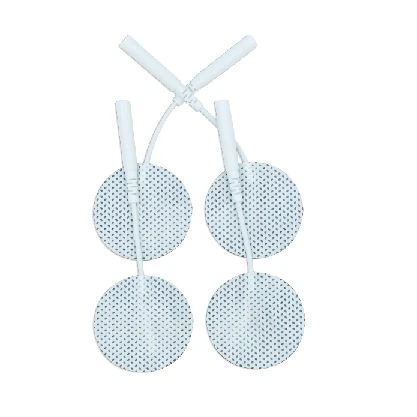
OEM Round TENS Electrodes | Ø 32mm & 50mm | TOP-RANK
B2B round TENS/EMS electrodes. Engineered with radial carbon coating to prevent focal hot spots in small footprint applications. Calibrated for zero-ooze rotary die-cutting.
Product Overview
Circular electrodes are the secondary baseline consumable after standard square matrices. They are designed specifically for targeted pain gating on high-curvature, low-surface-area anatomy such as the cervical spine, elbows, and ankles. While the circular geometry inherently eliminates sharp corners that catch on clothing, it introduces severe engineering challenges regarding current crowding at the center lead wire junction. We supply these anatomically specific substrates in high-volume batches to orthopedic clinics and OTC hardware OEMs requiring precision localization.
Technical/Engineering Description
The structural stack involves laminating a flexible backing (spunlace non-woven or PU film) to a conductive carbon film, topped with a highly cohesive hydrogel. Because the active footprint of a Ø 32mm pad is significantly smaller than a 50x50mm square, the electrical load per square centimeter is exponentially higher. We titrate the carbon ink extrusion to establish a thicker conductive baseline, actively preventing the hydrogel from breaking down under concentrated milliampere (mA) loads. Standard automated production runs dictate an MOQ of 20,000 packs per diameter configuration.
Key Features
Concentric Current Dispersion
In a small circular pad, the electrical current naturally funnels straight down from the center snap or pin. This creates a severe "hot spot" directly in the middle, burning the tissue while leaving the perimeter unstimulated. The carbon trace in these pads is screen-printed with a concentric resistance gradient. This forces the incoming electrons to scatter radially outward to the absolute edge of the circle before penetrating the z-axis of the hydrogel, maintaining a mathematically flat mA delivery curve.
Radial Die-Cutting Tolerance
Cutting a perfect circle without hydrogel displacement is mechanically difficult on high-speed web lines. Blunt rotary dies squeeze the polymer, causing the gel to bleed outward around the 360-degree perimeter. This "cold flow" ruins the pad during warehouse storage. We utilize micro-bevel steel rule dies combined with a stiffened polyacrylamide hydrogel formulation (elevated storage modulus G'). The matrix cleaves sharply without lateral squishing, locking the radial edge ooze strictly below 0.2mm.
High-Curvature Conformability
Anatomical zones like the elbows, wrists, and ankles have virtually no flat planes. Stiff substrates wrinkle and detach when the joint flexes, breaking the electrical circuit. The combination of a circular footprint (which eliminates corners that catch on clothing) and a multi-directional stretch spunlace backing prevents mechanical leverage. The pad expands and contracts with the shifting epidermal topography without separating from the skin.
Applications
Cervical Trigger Points
Targeted neuromodulation applied directly over tight splenius or trapezius muscle knots without overlapping onto the hairline.
Carpal Tunnel Therapy
Fits seamlessly over the flexor retinaculum of the wrist for localized pain gating.
Facial Palsy Recovery
Micro-circular pads (Ø 25mm) engineered for precise motor unit recruitment on facial muscles.
OEM & Private Label
Multi-Cavity Rotary Tooling : Circles naturally create more material waste (matrix web) than squares. We machine custom multi-cavity rotary anvils to tightly nest the circular cuts, maximizing raw material yield and significantly dropping the per-unit cost for high-volume OEM clients.
Logistics Routing : Roll-to-roll carbon printing and gel coating operate in China. Final dimensional die-cutting, terminal attachment, and foil pouching route through our Vietnam facility to neutralize specific B2B medical consumable tariffs for the North American market.
Certifications
Biocompatibility : Raw materials and cured hydrogel matrices are vetted against ISO 10993-5 (Cytotoxicity) limits.
Systems : Physical compounding and converting lines operate strictly within audited ISO 13485:2016 and MDSAP regulatory parameters.
FAQ
A: It is strictly prohibited. Pushing 80mA through a surface area of only ~800 mm² mathematically exceeds safe current density limits. It risks severe electrochemical burns regardless of the hydrogel quality. Small round pads are strictly intended for low-intensity, targeted neuromodulation (typically < 30mA).
A: Edge-curling on circular pads is a mechanical symptom of cheap, non-stretch backing materials (like thick PET) resisting the natural curvature of the body. Upgrading to a highly conformable PU film or spunlace backing immediately resolves this mechanical resistance.
B2B clinical distributors and hardware developers can request radial die-cut prototypes and concentric impedance mapping reports.
👉[Request Round Pad Prototypes]
Hot Tags: round tens electrodes, China round tens electrodes manufacturers, suppliers, factory
Specifications
Parameter | Metric Configuration | Engineering Detail |
Diameter | Ø 25mm, Ø 32mm, Ø 50mm | Targeted anatomical mapping |
Impedance | < 40 Ohms | Compensates for small surface area |
Peel Force | 3.0N - 4.5N | High-tack for dynamic joints |
Edge Tolerance | < 0.2mm radial ooze | Prevents liner bonding |
Interface | 2.0mm Pin or 3.5mm Snap | Centered hardware anchor |


