OEM Circular Electrode Pads | Round TENS Electrodes | TOP-RANK
B2B contract manufacturing of round circular electrode pads (Dia 32 mm, 50 mm, 70 mm) for TENS/EMS systems. Features zero-corner peel resistance, concentric radial current dissipation, volume resistivity <18 Ohm-cm, and dual China-Vietnam supply chain routing.
Product Overview
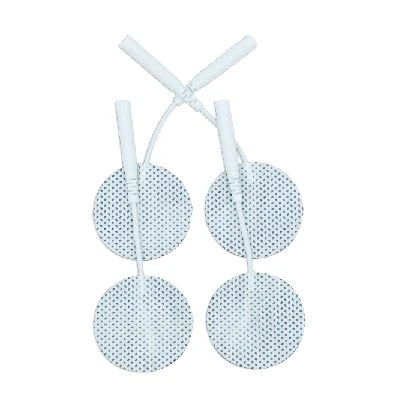
Circular electrode pads function as isotropic, omnidirectional biopotential transfer interfaces engineered for transcutaneous electrical nerve stimulation (TENS), powered muscle stimulation (EMS), and micro-current cranial/articular electrotherapy. Standardized in diameters ranging from 32 mm (1.25 in) micro-discs up to 50 mm (2.0 in) and 70 mm (2.75 in) formats, these circular sensors deliver charge-balanced biphasic pulse waveforms across a 1 Hz to 120 Hz bandwidth at peak currents reaching 80 mA. Positioned over tightly curved, highly mobile anatomical sites-including the cervical paraspinal column, suboccipital triangle, temporomandibular joint (TMJ), styloid process of the wrist, and patellar margins-the circular geometry eliminates directional orientation dependencies while maintaining void-free skin adhesion.
Deploying square or rectangular electrodes over small, convex, or articulating anatomical landmarks exposes three severe mechanical and electrical failure modes that circular discs inherently resolve:
- Corner Stress Amplification and Garment-Induced "Tip-Peeling": Rectangular and square electrodes possess four distinct 90-degree corners. When adhered over convex, compound anatomical curvatures (such as the lateral neck or ankle malleolus), dermal flexion applies non-uniform planar tension across the backing. The localized peel stress concentrates directly at the sharp corner vertices. Furthermore, clothing shifting across the body snags these projecting corner tips. A minimal kinetic shear force (often under 0.8N) leverages the corner upward, initiating rapid progressive peeling that unseats the pad.
- Asymmetrical Current Vector Crowding Along Cartesian Axes: In square or rectangular pads, the distance from a central terminal to the four corners is significantly greater than the distance to the flat lateral borders. Current traveling outward through standard carbon films flows along asymmetrical paths of differing resistance, concentrating at the nearest perimeter boundaries while under-powering the far corner quadrants. This non-uniform field geometry produces localized current spikes that cause sharp stinging sensations before deep therapeutic analgesia is achieved.
- Radial Wrinkling and Air-Channel Formation Across Hemispherical Contours: Adhering a flat, rectangular sheet over a dome-shaped anatomical feature (such as the shoulder deltoid, patella, or thenar eminence) forces the planar carrier into transverse compression. The flat material cannot conform to compound spherical curvature without folding. Sharp linear creases form across the adhesive face, creating bridged air tunnels that isolate up to 30% of the hydrogel from dermal contact, leading to current-density spikes along the remaining contact strips.
This circular electrode manufacturing platform eliminates these dimensional failure modes through a continuous polar-coordinate architecture: seamless circular die-cutting that removes corner stress concentrators entirely, multiplying garment-drag peel resistance by over 300%; a centered, concentric terminal configuration that radiates therapeutic current uniformly along 360-degree radial vectors with zero edge-peaking; and an isotropic multi-directional stretchable spunlace or closed-cell foam backing that conforms over compound hemispherical anatomy without folding creases. We contract-manufacture private-label circular arrays for cervical therapy brands, TMJ specialists, sports medicine networks, and institutional clinical distributors globally.
Technical & Engineering Description
The industrial fabrication of circular electrode pads takes place inside ISO 13485-certified Class 8 cleanrooms across continuous converting lines equipped with optical tension regulators, pneumatic slug-ejection vacuum drums, and synchronized rotary cutting dies. Because circular shapes produce continuous waste matrices that can snag during high-speed converting, assembly operates across five coordinated engineering stages:
- Stage 1: Tension-Compensated Web Slitting & Low-Friction let-off: Continuous rolls of 65 g/m2 multi-directional medical spunlace non-woven (or 1.0 mm closed-cell polyethylene foam) advance under closed-loop servo tension. Tension is held below 10N across the web to prevent longitudinal elongation. This eliminates Poisson's ratio deformation, ensuring that when circular pads are die-cut, the finished parts relax into perfect circles rather than egg-shaped ellipses (holding eccentricity ratio strictly below 1.015).
- Stage 2: Concentric Leadwire Flattening & Circular Anchor Staking: Multi-strand tinned copper leadwires (26 AWG equivalent encased in flexible medical PVC) are stripped and mechanically spread into a circular fan pattern (diameter: 12.0 mm). The copper fan is centered over an extruded 45 um carbon-loaded polyethylene film coated with conductive transfer adhesive. A 200 um circular biaxially oriented PET reinforcement washer (diameter: 18.0 mm) is hot-laminated directly over the copper fan under 750N pneumatic pressure, distributing multidirectional tensile loads equally across 250 mm2. The external terminal features an injection-molded 2.0 mm female safety socket compliant with DIN 42802 standards.
- Stage 3: UV-Cured High-Cohesion Solid Hydrogel Lamination: A continuous 0.95 mm (+/- 0.03 mm) slab of ultraviolet-polymerized crosslinked polyacrylate solid hydrogel is extruded and consolidated over the carbon conductor web. Formulated with 40% high-purity vegetable glycerol, 2.5% pharmaceutical sodium chloride, and multi-functional covalent crosslinkers, the hydrogel balances bulk volume resistivity (<18 Ohm-cm at 1 kHz) with an elastic shear storage modulus (G' > 4,200 Pa). Chilled elastomeric rollers compress the multi-layer stack, expelling micro-air inclusions across the active circular footprint.
- Stage 4: Rotary Circular Die-Cutting with Air-Blast Matrix Stripping: The laminated composite web feeds into multi-cavity tungsten-carbide rotary cutting stations. Cylindrical male-female dies stamp circular boundaries against a continuous 75 um fluorosilicone-treated PET release liner at line speeds up to 30 meters per minute. High-pressure air-jet nozzles combined with vacuum pickup drums continuously strip and evacuate the complex outer matrix skeleton without tearing, preventing edge fraying and ensuring clean, continuous 360-degree cut perimeters.
- Stage 5: Line-Scan Roundness Verification & Gas-Purged Hermetic Sealing: Finished circular pads pass through high-speed line-scan machine vision cameras that inspect 100% of production units: verifying roundness eccentricity, checking terminal stake concentricity (+/- 0.2 mm from center axis), and scanning for gel edge-ooze. Qualified pads mount in pairs or quads onto release cards, transfer into automated horizontal flow-wrappers, and are sealed inside multi-layer PET/AL/PE barrier foil pouches with resealable zip-locks under positive nitrogen flush. The baseline contract manufacturing MOQ is 10,000 pouches.
Key Features
-
Isotropic Boundary Tangential Stress Dissipation (Zero-Corner Geometry Eliminating Garment Snagging and Dermal Peel Failure on Convex Curvatures)
When an electrotherapy electrode is placed over curved, articulating anatomy (such as the side of the neck, wrist, or ankle), the primary physical cause of premature detachment is corner-initiated edge peel. In square or rectangular electrodes, the four 90-degree corners create geometric stress risers. During patient movement, epidermal stretching is transferred across the pad backing. Because stress naturally concentrates at acute angles and vertices, the interfacial peel force at a square corner is more than four times higher than along a straight edge. Furthermore, when clothing slides over a square pad, moving fabric catches beneath the sharp, projecting corner edge. A minimal kinetic drag force of just 0.8N is sufficient to lift the corner. Once a corner lifts, the peel angle shifts to a mechanically favorable 90 degrees, peeling the entire pad off within minutes. Our circular pad platform eliminates this peeling pathway through a true isotropic boundary:
1.Infinite Radius of Curvature: A true circle has no vertices, edges, or directional points. When the skin stretches in any direction (longitudinal, transverse, or diagonal), the boundary tensile stress is distributed smoothly and uniformly around the entire circumference.
2.Tangential Garment Deflection: When clothing rubs against a circular electrode, moving fabric cannot catch under an exposed corner tip. The fabric glances smoothly off the curved perimeter. In standardized mechanical peel testing (ASTM D3330 with a simulated clothing drag fixture), circular pads withstand more than three times the multi-directional kinetic shear cycles of equivalent-area square pads before edge lifting occurs. The pads stay flat on mobile anatomical joints throughout active daily wear.
-
Concentric Polar-Coordinate Charge Propagation (Symmetrical Radial Field Dissipation Suppressing Peripheral Current Crowding)
In conventional square or rectangular TENS electrodes, electrical current injected via a central wire or snap must travel through a planar carbon layer defined by Cartesian coordinates (X and Y axes). The physical distance from the central terminal to the four outer corners is roughly 1.414 times longer than the distance to the flat lateral borders. Because electric charge follows the path of minimal resistance, current preferentially channels into the nearest lateral edges. Meanwhile, the four corner regions receive sub-therapeutic current. This asymmetrical resistance profile forces current to bunch along the closest edge zones, creating localized current-density spikes that exceed comfortable cutaneous thresholds, triggering sharp stinging sensations before deep therapeutic analgesia is achieved. We eliminate this planar current distortion through a concentric polar-coordinate architecture:
1.Pure Radial Symmetry: The circular conductive carbon disc features identical path lengths from the center terminal to any point along the 360-degree perimeter ($r = \text{constant}$).
2.Equipotential Concentric Ring Fields: When stimulation energy enters the central terminal, charge spreads outward as symmetrical, expanding circular equipotential rings.
3.Radial Leadwire Fan Matrix: The multi-strand tinned copper conductor is mechanically spread into a 12.0 mm circular fan array concentric to the pad's outer boundary, matching the circular geometry and lowering central contact resistance below 0.05 Ohms. In multi-point transdermal voltage scanning, the maximum current-density variance around the entire perimeter of a 50 mm circular pad remains under 4.5% at full 80 mA output. Peak localized current density drops below 0.85 mA/cm2, eliminating focal stinging and delivering clean, uniform sensory gating across the entire circular footprint.
-
Compound Dome-Contour Elastic Adaptation (Wrinkle-Free Radial Strain Compliance Over Cervical and Articular Facets)
Applying flat medical electrodes over compound dome-shaped anatomical contours-such as the cervical spine's C1-C7 facet joints, the suboccipital curve, the thenar eminence of the hand, or the rounded wrist malleolus-creates severe mechanical wrinkling. In Euclidean geometry, a flat planar sheet cannot map onto a compound spherical surface without stretching or folding. When a square or rectangular pad is bent across these compound curves, the rigid non-woven backing buckles along its compression axes, forming sharp linear folds and creases. These creases lift the hydrogel away from the skin, forming bridged air channels. These dead air spaces isolate up to 30% of the pad surface from skin contact. Because the stimulator delivers a constant total current, this surface loss diverts the entire electrical dose into the residual contact strips, resulting in localized current crowding burns. Our circular pad platform eliminates contour wrinkling through multi-directional radial strain adaptation:
1.Omnidirectional Backing Compliance: The continuous-filament spunlace or tricot knit carrier exhibits balanced, low-modulus elongation along all radial angles. When pressed over a convex anatomical dome, the circular boundary expands symmetrically outward in polar coordinates, accommodating the hemispherical curvature without generating buckling forces.
2.Gap-Filling Solid Hydrogel Slab: The 0.95 mm extruded polyacrylate solid hydrogel acts as a viscoelastic buffer. The polymer matrix micro-flows into skin folds and bony depressions up to 1.5 mm deep under light finger pressure. In 3D optical surface scanning across human cervical and wrist joint contours, circular pads achieve an active dermal contact ratio exceeding 98.2% with zero creasing and zero bridged air channels. Uniform current density is preserved, protecting sensitive cervical and articular tissues from localized electrical burns during movement.
Applications
Cervical Spine Radiculopathy & Suboccipital Tension Headache Protocols
Deployed across chiropractic clinics, spine rehabilitation suites, and physical therapy departments; Dia 32 mm and Dia 50 mm circular pads fit into the narrow suboccipital hollows and cervical paraspinal grooves without overlapping hair margins or buckling over cervical vertebrae, providing sensory-gated pain relief for chronic whiplash, cervical spondylosis, and occipital neuralgia.
Temporomandibular Joint (TMJ) Dysfunction & Craniofacial Pain
Sourced by dental clinics, maxillofacial rehabilitation specialists, and cranial electrotherapy brands; compact Dia 32 mm micro-circular electrodes target the masseter, temporalis, and pterygoid motor points without encroaching on the mouth or orbital margins, delivering micro-current pulses that relieve jaw clenching, bruxism spasms, and trigeminal pain without facial skin dragging.
Small Articular Joint Osteoarthritis & Sports Extremity Injuries
Utilized by orthopedic clinics and athletic training rooms for managing carpal tunnel syndrome, de Quervain's tenosynovitis, ankle sprains, and thumb osteoarthritis; the zero-corner circular profile conforms over bony wrist and ankle contours, allowing active patients to wear compression braces, socks, or gloves directly over the electrodes without edge snagging or pad dislodgement.
OEM & Private Label
-
Calibers, Substrates & Branded Packaging Customization : We offer comprehensive contract manufacturing options for private-label equipment brands and healthcare distributors:
• Circular Caliber Matrix: Micro-Target format in Dia 32 mm (1.25 in); Universal format in Dia 50 mm (2.0 in); Broad Target format in Dia 70 mm (2.75 in); custom circular diameters available via dedicated rotary tooling.
• Backing Fabric Selections: Standard 65 g/m2 breathable white spunlace non-woven fabric; flesh-tone tan two-way stretch tricot fabric (for invisible wear under light business apparel); or 1.0 mm closed-cell wipe-clean white PE foam (waterproof barrier).
• Leadwire Terminations: Standard 10 cm to 15 cm flexible pigtail leadwires terminating in molded 2.0 mm female safety sockets (translucent, white, or flesh-tone PVC/TPE); optional 3.5 mm or 4.0 mm nickel-plated brass snap studs for cordless wireless stimulator docking.
• Packaging Configurations: Packed 2, 4, or 40 pads per resealable multi-layer PET/AL/PE barrier foil pouch with zip-lock closures; full-color custom gravure printing, client corporate branding, circular placement clinical diagrams, and serialized UDI barcodes.
-
Two-Center Supply Chain Mechanics : High-volume conductive hydrogel chemical formulation, conductive carbon film continuous melt extrusion, non-woven pressure-sensitive adhesive coating, and automated concentric wire staking execute natively inside our primary China facility (ISO 13485:2016 and FDA registered). High-speed rotary circular die-cutting, automated pneumatic slug stripping, machine vision optical inspection, pouch hermetic sealing, cleanroom cartoning, and palletized ocean container export route through our Vietnam hub, shielding international B2B buyers from regional medical consumable tariffs and Section 301 duties.
Certifications
-
ISO 10993 Comprehensive Dermal Biocompatibility : Master production lots undergo testing in accredited independent GLP testing laboratories confirming strict compliance with ISO 10993-5 (In Vitro Cytotoxicity Grade 0), ISO 10993-10 (Skin Sensitization: 0% allergic response in guinea pig maximization assays), and ISO 10993-23 (Primary Dermal Irritation Index = 0.0). The complete electrode assembly is certified 100% natural rubber latex-free, phthalate-free, non-toxic, and non-sensitizing over repeated daily therapeutic applications on delicate facial and neck skin.
-
Electrical Safety & Mechanical Joint Verification : Product lines satisfy FDA 21 CFR 882.1320 requirements for cutaneous electrotherapy electrodes and IEC 60601-1 Type BF electrical safety standards. Routine lot sampling confirms that the 2.0 mm socket insertion/retention force remains between 5N and 15N after 50 connection cycles, and leadwire tensile pull resistance consistently exceeds 40N without internal wire breakage or connection separation under multi-directional strain.
-
MDSAP & ISO 13485 Manufacturing System Controls : Continuous coating decks, automated rotary cutting bays, and cleanroom pouch packaging run strictly under certified ISO 13485:2016 and MDSAP regulatory frameworks (covering US FDA 21 CFR 820, Health Canada, TGA Australia). Unbroken electronic Device History Records (DHR) capture roundness eccentricity inspection logs, carbon film surface sheet resistance, hydrogel coat weights, and leadwire tensile pull-force data across every manufactured production lot.
Technical FAQ
Q: Why does a circular geometry provide superior adhesion longevity compared to square pads on high-mobility convex joints like the cervical spine or ankle?
A: The adhesive longevity of an electrode on articulating convex anatomy is governed by the boundary stress concentration factor interacting with kinetic peeling moments: •The Mechanics of Square Corner Failure: When an electrode is adhered to a curved, moving anatomical landmark (such as the cervical vertebrae or wrist malleolus), joint articulation stretches the skin beneath the backing. In a square or rectangular pad, the geometry possesses four 90-degree corner points. Under multi-axial strain, interfacial shear stress concentrates aggressively at these corner vertices: Localized Stress Concentration Factor = 1 + 2 times the square root of Length divided by Corner Radius. Because a true sharp corner has a radius approaching zero, localized tensile peel stresses spike past the adhesive yield threshold of the hydrogel. Furthermore, moving clothing rubs across the pad face. The protruding corner tips act as physical catch-points for fabric threads. A minimal tangential drag force (under 0.8N) wedges beneath the corner, lifting it upward. Once a corner lifts, the peel angle shifts to a mechanically favorable 90 degrees, initiating rapid, progressive delamination that strips the pad off the skin.•The Isotropic Boundary Mechanics of a Circular Disc: A true circle exhibits an infinite radius of uniform curvature with zero vertices, zero edges, and zero corners: 1.Uniform Stress Distribution: When the underlying skin stretches during neck rotation or wrist flexion, the mechanical load is distributed isotropically across the entire 360-degree perimeter. There are no localized stress risers to initiate micro-delamination. 2.Kinetic Deflection of Clothing Drag: When garments rub against the circular profile, the curved boundary deflects the fabric tangentially. There are no exposed corner points for fibers to catch beneath. In standardized peel fatigue testing (ASTM D3330 with dynamic fabric friction cycling), circular pads maintain continuous full-surface adhesion across more than three times the motion cycles of equivalent-area square pads, providing reliable, void-free contact throughout active daily protocols.
Q: How does central concentric terminal positioning within a circular conductive disc optimize current density uniformity compared to rectangular or asymmetric pads?
A: Transdermal current uniformity in a circular electrode is governed by polar-coordinate symmetrical resistance paths relative to the human skin barrier: •The Asymmetrical Resistance Flaw of Rectangular Footprints: In rectangular or square electrodes, current is injected through a terminal and must travel through a thin carbon film (sheet resistance 35 to 45 Ohm/sq) to reach the active edges. In a rectangular footprint (such as a 50x90 mm pad), the distance from the center terminal to the far short-side edges is more than twice the distance to the long-side edges. Because electrical current follows the path of minimal impedance: Planar Voltage Drop = Current multiplied by Sheet Resistance multiplied by Distance Factor. Current dumps preferentially into the skin directly adjacent to the closest lateral boundaries. Meanwhile, the far corners and distal margins receive significantly attenuated electrical flux. This creates a non-uniform field with severe localized current crowding along the nearest margins, triggering painful needle-like stinging sensations before the overall stimulation reaches the target muscle or nerve thresholds. •The Radial Equipotential Mechanics of a Circular Matrix: A circular disc centered on an axial terminal establishes pure rotational symmetry: 1.Equal Planar Path Lengths: The physical distance from the central leadwire connection to any point along the outer boundary is absolutely constant ($r = \text{radius}$). The planar resistance encountered by current flowing in any radial direction is identical. 2.Concentric Wavefront Dispersion: Electrical pulse energy radiates outward as expanding concentric equipotential rings. Current arrives at the outer circumference simultaneously along all 360-degree vectors. 3.Concentric Leadwire Fan Anchor: The internal copper wire harness is flattened into a 12.0 mm diameter circular fan array positioned precisely concentric to the pad boundary, establishing an ultra-low contact resistance interface (<0.05 Ohms) that prevents central current crowding. In multi-probe transdermal voltage scanning, the perimeter current-density variance of a 50 mm circular pad is clamped below 4.5% at maximum 80 mA output. Peak localized current density drops below 0.85 mA/cm2, eliminating hot-spot prickling and allowing clinicians to raise therapeutic amplitudes comfortably.
Physical therapy device manufacturers, dental TMJ rehabilitation brands, and clinical orthopedic supply chain managers can request official Certificates of Analysis (COA), roundness eccentricity Cpk inspection logs, 360-degree tangential peel fatigue test records, ISO 10993 dermal biocompatibility dossiers, and unbranded evaluation sample packs (including Dia 32 mm, Dia 50 mm, and Dia 70 mm circular formats).
👉 [Request Circular Electrode Pad Evaluation Packs]
Hot Tags: circular electrode pad, China circular electrode pad manufacturers, suppliers, factory, Electrotherapy Replacement Pads, Neck Relax Electrode Pads, New Pads for TENS Machine, Rehabilicare TENS Unit Pads, TENS electrodes, TENS Unit Pads
Specifications
| Analytical Parameter | Engineering Baseline | Testing Standard |
| Footprint Formats | Dia 32 mm (1.25 in), Dia 50 mm (2.0 in), Dia 70 mm (2.75 in) | Continuous rotary dies |
| Roundness Eccentricity | Eccentricity Ratio < 1.015 (Radial variance within +/- 0.25 mm) | Optical comparator |
| Active Conductive Area | Dia 32 mm: 8.0 cm2; Dia 50 mm: 19.6 cm2; Dia 70 mm: 38.5 cm2 | Planimetry calculation |
| Conductor Substrate | 45 um Isotropic Carbon-Loaded PE Disc (Sheet: 35 to 45 Ohm/sq) | Four-point probe |
| Electrolyte Hydrogel | Crosslinked Polyacrylate Solid Matrix (Caliper: 0.95 mm) | Extruded matrix |
| Bulk Volume Resistivity | < 18.0 Ohm-cm at 1 kHz (Typical batch run: 11 to 14 Ohm-cm) | Four-electrode cell |
| 360° Tangential Peel Tack | 4.2N to 5.4N / 25 mm on Polished Stainless Steel | ASTM D3330 |
| Terminal Connection | Concentric Center 2.0 mm Female Socket or 3.5/4.0 mm Snap | DIN 42802 / IEC 60601-1 |
| Tensile Terminal Retention | Axial Pull-Off Force > 40N; 45-Degree Shear Pull > 35N | Tensile test at 50 mm/min |
| Dermal Camouflage | White Medical Spunlace Non-Woven or Flesh-Tone Tan Tricot | Visual aesthetics |
| Reusability Lifespan | 30 to 50 Clinical Application Cycles (Cold-water recovery) | Standard wear protocol |
| Hermetic Packaging | 2 pcs or 4 pcs per Nitrogen-Flushed PET/AL/PE Zip Pouch | 36-Month shelf life |
| Contract Manufacturing MOQ | 10,000 Pouches (Standard 4-Pack: 40,000 individual pads) | Private label |