

Patient Return Electrodes: Selection Guide for OEM Buyers
Patient return electrodes are an essential component of monopolar electrosurgical systems. They provide the return pathway for electrical current after it passes through the patient and the surgical site.
Although these products may appear relatively simple, their design and selection involve important technical considerations.
For medical device manufacturers, distributors, and OEM/ODM buyers, selecting a suitable patient return electrode requires more than checking product dimensions or comparing prices.
Factors such as electrosurgical generator compatibility, electrode configuration, contact area, conductive materials, adhesive performance, and manufacturing consistency all need to be considered.
Understanding these factors helps buyers establish clearer purchasing specifications and evaluate whether a product is appropriate for its intended electrosurgical system.
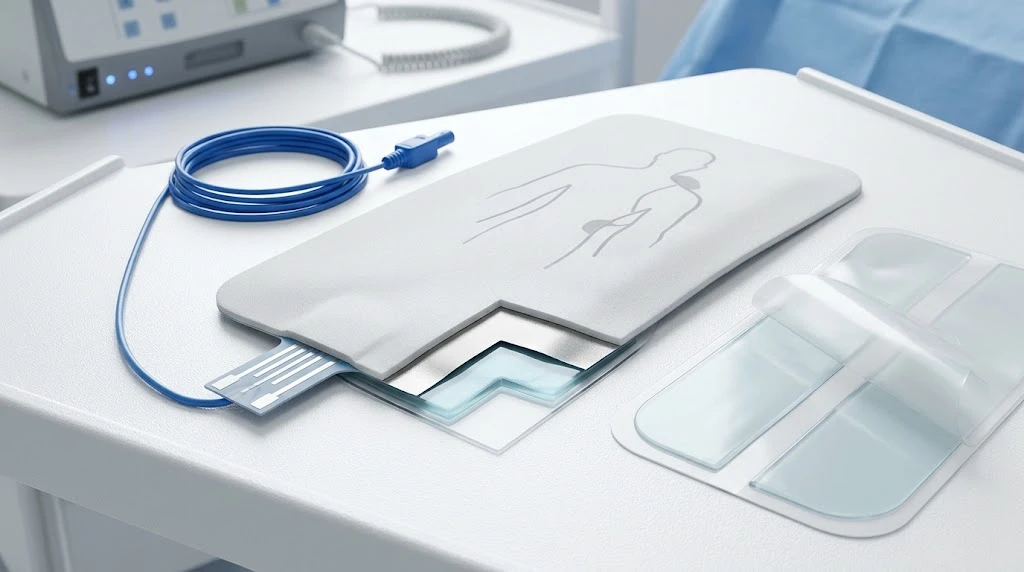
Quick Answer: What Should You Consider When Selecting a Patient Return Electrode?
When evaluating patient return electrodes, buyers should consider six key areas:
- Electrode type: Is the product designed for the intended monopolar electrosurgical application?
- Generator compatibility: Does the electrode meet the requirements of the intended electrosurgical system?
- Electrode configuration: Is it a conventional or split (dual-surface) return electrode?
- Contact and adhesive design: Is the product designed to maintain appropriate contact under its intended conditions of use?
- Material construction: Are the conductive, adhesive, and backing materials suitable for the intended application?
- Quality and regulatory requirements: Does the manufacturer have appropriate quality systems, product documentation, and evaluation evidence?
The appropriate choice depends on the device, intended application, patient population, and applicable product requirements.
1. Understand the Function of a Patient Return Electrode
A patient return electrode is used in monopolar electrosurgery as part of the electrical circuit.
In a typical monopolar electrosurgical system, electrical current travels from the generator through an active electrode, passes through the patient's tissue at the surgical site, and returns to the generator through the patient return electrode.
The return electrode is generally positioned at an appropriate site on the patient's body according to the device manufacturer's instructions and applicable clinical protocols.
Why is the return electrode important?
The return electrode provides a large-area contact interface for the return current.
Its design is intended to support appropriate current distribution across the contact area and help reduce the risk of excessive localized heating when used correctly with a compatible electrosurgical system.
However, product design alone does not guarantee safe performance. Proper selection, device compatibility, correct application, and adherence to the manufacturer's instructions are all important.
Patient return electrode vs. active electrode
These two components have different functions.
|
Feature |
Active Electrode |
Patient Return Electrode |
|---|---|---|
|
Main function |
Delivers electrosurgical energy to the surgical site |
Provides the return pathway for current |
|
Contact area |
Generally smaller |
Generally larger |
|
Application |
Used at the surgical site |
Applied to an appropriate patient contact area |
|
Design consideration |
Controlled energy delivery |
Appropriate return-current distribution |
|
Common terminology |
Surgical electrode |
Return electrode, grounding pad, dispersive electrode |
Although the term "grounding pad" is commonly used in the market, patient return electrode is a more technically descriptive term for the component in a monopolar electrosurgical circuit.
2. Understand the Different Types of Patient Return Electrodes
Patient return electrodes are available in different configurations depending on the electrosurgical system and intended application.
One important distinction is whether the electrode uses a conventional single-surface design or a split return electrode configuration.
Conventional return electrodes
Conventional return electrodes generally use a single conductive contact surface.
Their design and suitability must be evaluated against the requirements of the electrosurgical generator and the intended application.
The specific monitoring and compatibility requirements depend on the system being used.
Split patient return electrodes
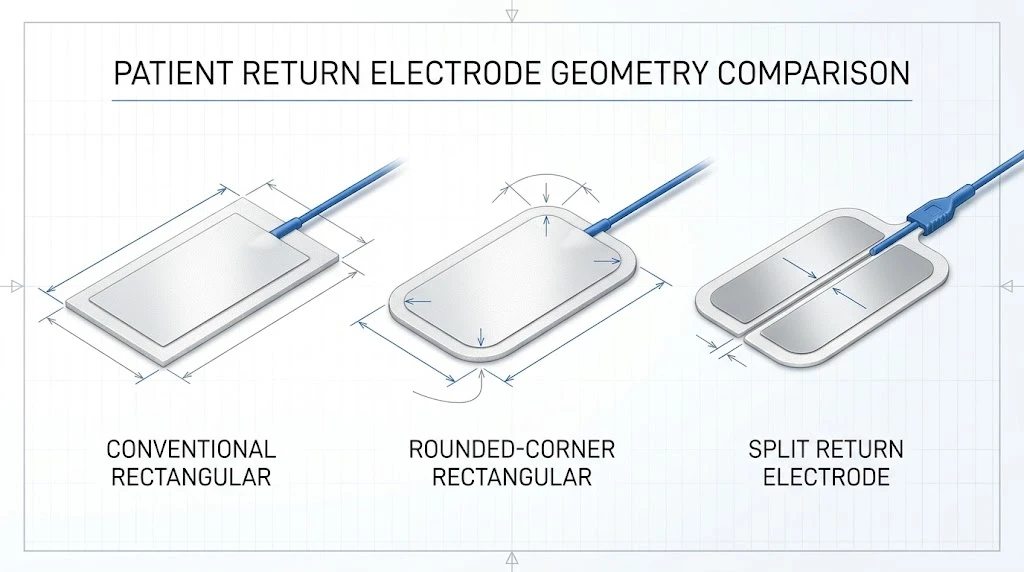
Split return electrodes, sometimes called dual-surface or divided return electrodes, contain two conductive sections separated by an insulating area.
These electrodes are commonly associated with electrosurgical systems that use a contact-quality monitoring function, often referred to as a return electrode monitoring system.
The generator can use the electrical relationship between the two conductive sections to monitor aspects of the electrode-patient contact interface.
The exact monitoring method and compatibility requirements vary by equipment manufacturer and system design.
Why the distinction matters
A conventional return electrode and a split return electrode should not be assumed to be interchangeable.
A split electrode intended for a particular monitoring system may not be suitable for a generator that does not support its configuration.
Similarly, a conventional electrode should not be assumed to provide the same monitoring functionality as a compatible split return electrode.
For OEM buyers and distributors, identifying the required electrode configuration is therefore an essential first step.
3. Check Compatibility With the Electrosurgical Generator
Generator compatibility is one of the most important considerations when selecting a patient return electrode.
A product may have the correct dimensions and connector appearance but still fail to meet the requirements of the intended electrosurgical system.
Connector compatibility
Buyers should confirm:
- Connector type
- Connector dimensions
- Connection arrangement
- Mechanical retention requirements
- Compatibility with the generator's return-electrode interface
A connector that looks similar to another model should not automatically be considered interchangeable.
Monitoring-system compatibility
For systems using contact-quality monitoring, the return electrode configuration must be appropriate for the generator's monitoring function.
Buyers should confirm whether the system requires:
- A conventional return electrode
- A split return electrode
- A specific connector configuration
- A manufacturer-defined compatible electrode model
Electrical requirements
The electrode's electrical characteristics should be evaluated against the applicable device specifications.
The relevant requirements may include characteristics related to the conductive interface and the generator's monitoring or operating conditions.
These requirements should be confirmed through technical documentation and appropriate evaluation rather than inferred from product appearance.
What should buyers provide?
When requesting a quotation or sample, buyers should ideally provide:
- Electrosurgical generator model or interface specifications.
- Required return electrode configuration.
- Connector drawings or reference photographs.
- Existing approved electrode samples, if available.
- Relevant technical or regulatory requirements.
These details help the manufacturer understand the actual compatibility requirements before recommending a product configuration.
4. Evaluate Contact Area and Electrode Design
The contact area is a fundamental characteristic of a patient return electrode.
The electrode is designed to provide an appropriate return-current interface over a relatively large area.
Its design must be considered in relation to the intended electrosurgical system and applicable requirements.
Why contact area matters
Current distribution across the return electrode interface is an important design consideration.
An unsuitable contact interface or inadequate contact may contribute to localized heating and increase the risk of patient injury.
However, contact area alone does not determine product suitability.
Other factors, including electrode construction, application conditions, contact quality, and system compatibility, also matter.
Shape and dimensions
Patient return electrodes may have different shapes and dimensions.
Common configurations include:
- Rectangular designs
- Rounded-corner rectangular designs
- Other application-specific geometries
The appropriate dimensions should be based on the product specification and intended application.
For OEM/ODM projects, buyers should clarify whether the product must match an existing design or whether a new configuration is being developed.
Design considerations
When reviewing the product geometry, consider:
- Overall dimensions
- Conductive contact area
- Connector position
- Backing flexibility
- Edge configuration
- Compatibility with the intended application
Changes to geometry should be reviewed against the relevant product requirements rather than treated as cosmetic modifications.
5. Consider Adhesive Performance and Skin Contact
Patient return electrodes are generally designed to maintain contact with the patient's skin during the intended procedure.
The adhesive system is therefore an important part of the overall product construction.
However, adhesion should not be evaluated as an isolated characteristic.
Adhesion and contact stability
The product should be designed to maintain the intended contact interface under its specified conditions of use.
Relevant considerations may include:
- Adhesive performance
- Conformability to the intended application area
- Backing flexibility
- Resistance to unintended lifting
- Compatibility between adhesive and backing materials
The specific requirements depend on the electrode design and applicable product specifications.
Skin-contact considerations
Materials used in patient return electrodes should be assessed for their intended skin-contact application.
Depending on the product and applicable requirements, evaluation may include relevant biological safety considerations.
Manufacturers and buyers should also consider whether the product is intended for a particular patient population or application condition, as this may influence the required specifications.
Avoid evaluating adhesion by peel strength alone
A single adhesion measurement cannot establish overall product suitability.
The test method, substrate, environmental conditions, application procedure, and acceptance criteria all influence how results should be interpreted.
For this reason, buyers should review the complete evaluation approach rather than comparing isolated adhesion values from different suppliers.
6. Understand the Materials Used in Patient Return Electrodes
Patient return electrodes typically involve multiple functional materials.
The exact construction depends on the product design and manufacturer.
Common material considerations include conductive components, adhesive materials, backing substrates, and protective liners.
Conductive components
The conductive component provides the electrical interface required by the product design.
Its properties and integration into the complete electrode structure should be evaluated against the relevant electrical specifications.
Adhesive and conductive hydrogel
Depending on the electrode design, the skin-contact layer may involve a conductive adhesive or hydrogel-based material.
Important considerations may include:
- Electrical characteristics
- Adhesion
- Material compatibility
- Moisture-related properties
- Skin-contact suitability
The material should be evaluated as part of the finished electrode rather than as an isolated raw material.
Backing materials
The backing provides mechanical support for the electrode.
Relevant considerations may include flexibility, conformability, dimensional stability, and compatibility with the other product layers.
Release liner
A release liner protects the adhesive or conductive contact surface before use.
Its release characteristics and compatibility with the adhesive system should be considered during product development.
Why integrated material development matters
Material selection and electrode construction are closely connected.
A change in one component may influence the behavior of other layers and the overall product.
For OEM/ODM buyers, working with a manufacturer that understands both material properties and electrode converting can help make technical discussions more efficient.
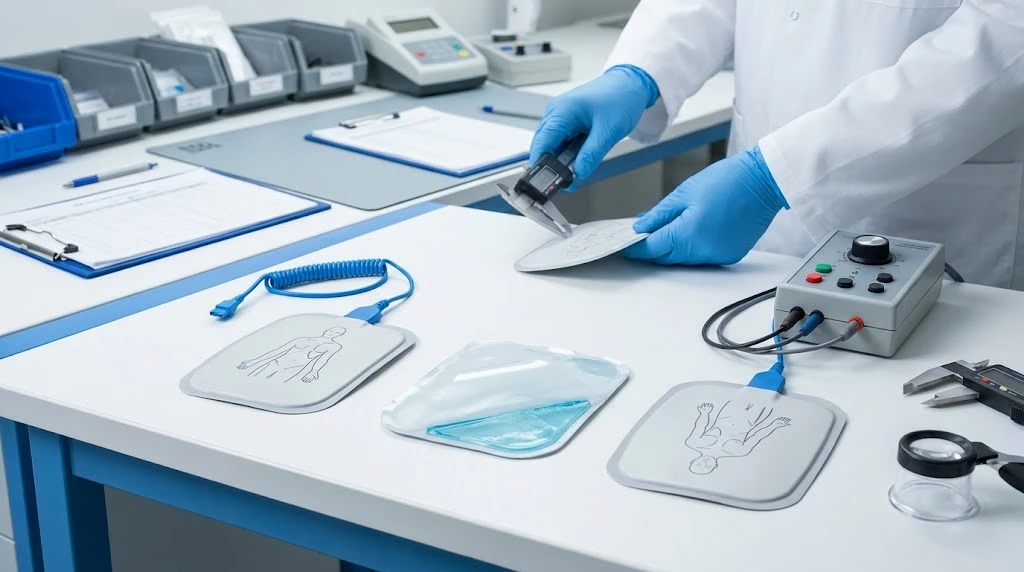
7. Review Product Testing and Quality Requirements
Patient return electrodes are medical devices or medical device accessories depending on their regulatory classification and intended use in the relevant market.
Their evaluation should be based on applicable regulatory requirements, recognized standards, and product-specific specifications.
The exact testing program should be determined by the manufacturer according to the product's intended use and regulatory pathway.
Electrical evaluation
Depending on the product, relevant evaluations may include specified electrical characteristics and the behavior of the electrode interface under defined conditions.
Adhesive and physical evaluation
Potential areas of evaluation include:
- Adhesive performance
- Material integrity
- Dimensional consistency
- Connector integrity
- Visual defects
- Physical durability under specified conditions
Biological safety
For products intended to contact the patient's skin, applicable biological evaluation requirements should be considered.
The scope depends on the nature and duration of contact, materials, intended use, and relevant regulatory framework.
Manufacturing consistency
The manufacturer should also establish appropriate controls to ensure that finished products meet their approved specifications.
For buyers, relevant documentation may include product specifications, inspection records, test reports, and applicable quality-system documentation.
A supplier's certification alone does not replace product-specific evidence.
8. What OEM/ODM Buyers Should Confirm Before Purchasing
Before selecting a patient return electrode supplier, buyers should prepare a clear technical and commercial specification.
The following checklist can support initial supplier evaluation.
|
Evaluation Item |
Questions to Confirm |
|---|---|
|
Product type |
Conventional or split return electrode? |
|
Generator compatibility |
Which electrosurgical system will use the product? |
|
Connector |
Does the connector match the required interface? |
|
Dimensions |
What are the required product dimensions and contact area? |
|
Materials |
What conductive, adhesive, and backing materials are specified? |
|
Adhesion |
What performance requirements and evaluation methods apply? |
|
Packaging |
What individual and bulk packaging configurations are required? |
|
Regulatory requirements |
Which markets will the product be sold in? |
|
Quality documentation |
What product-specific test and quality records are available? |
|
Customization |
Are private labeling, custom dimensions, or packaging changes required? |
Questions to ask the manufacturer
Beyond product specifications, buyers should also understand the manufacturer's actual capabilities.
Consider asking:
- Does the manufacturer have experience producing patient return electrodes?
- Can the manufacturer support both conventional and split configurations?
- Are material development and electrode manufacturing capabilities available in-house?
- How are product specifications and manufacturing changes controlled?
- What technical documentation can be provided?
- Can the manufacturer support OEM/ODM customization?
These questions help buyers distinguish between a supplier that simply resells finished products and a manufacturer with relevant technical and production capabilities.
9. How TOP-RANK Healthcare Supports Patient Return Electrode Manufacturing
TOP-RANK Healthcare provides medical electrode manufacturing capabilities across multiple product categories, including patient return electrodes, TENS/EMS electrodes, ECG electrodes, and conductive gels.
For patient return electrode projects, the important starting points are the intended electrosurgical system, electrode configuration, connector requirements, product dimensions, material construction, and applicable market requirements.
These details help establish the technical scope of the project and identify the manufacturing and evaluation requirements that need to be addressed.
For OEM/ODM buyers, the objective is to align product specifications, material selection, manufacturing feasibility, and quality requirements before moving into larger production commitments.
To learn more about TOP-RANK Healthcare's medical electrode products and manufacturing capabilities, visit:
Frequently Asked Questions
1. What is a patient return electrode?
2. What is the difference between a conventional and a split patient return electrode?
3. Are patient return electrodes compatible with all electrosurgical generators?
4. Why is contact area important in patient return electrode design?
5. What materials are used in patient return electrodes?
6. What should buyers evaluate when selecting an electrosurgical grounding pad manufacturer?