

ECG Electrode Selection Guide for Patient Monitoring

Electrocardiogram (ECG) electrodes are essential components in cardiac monitoring systems. They provide the skin-contact interface through which electrical signals generated by the heart are acquired by monitoring equipment.
However, not all ECG monitoring applications have the same requirements.
A disposable ECG electrode used for short-term bedside monitoring may have different design priorities from an electrode intended for 24-hour Holter monitoring or extended ambulatory recording. Patient age, movement, skin characteristics, monitoring duration, and device configuration can all influence product selection.
For medical device manufacturers, healthcare brands, and medical consumables distributors, understanding these differences is important when specifying ECG electrodes for different markets and applications.
This guide explains how to evaluate ECG electrodes across common patient monitoring scenarios and what OEM buyers should consider when selecting a manufacturing partner.
Quick Answer: How Do You Choose ECG Electrodes for Different Monitoring Applications?
The appropriate ECG electrode depends on the monitoring application, intended wear duration, patient population, activity level, and monitoring equipment.
- Bedside monitoring: Prioritize reliable skin contact, appropriate adhesion, connector compatibility, and practical replacement.
- Holter monitoring: Consider longer wear duration, movement-related performance, comfort, and material compatibility.
- Ambulatory monitoring: Evaluate adhesion under daily activity, flexibility, and suitability for the intended recording period.
- Pediatric monitoring: Consider electrode dimensions, skin-contact materials, application area, and age-specific product requirements.
- Resting ECG: Focus on electrode placement, signal acquisition requirements, connector compatibility, and workflow efficiency.
There is no single electrode design that is automatically suitable for every monitoring scenario. Selection should be based on the intended device, application, and validated product specifications.
1. Understanding the Main ECG Patient Monitoring Applications
Before comparing electrode specifications, buyers should identify how the electrodes will be used.
Different monitoring environments create different requirements for electrode design and material selection.
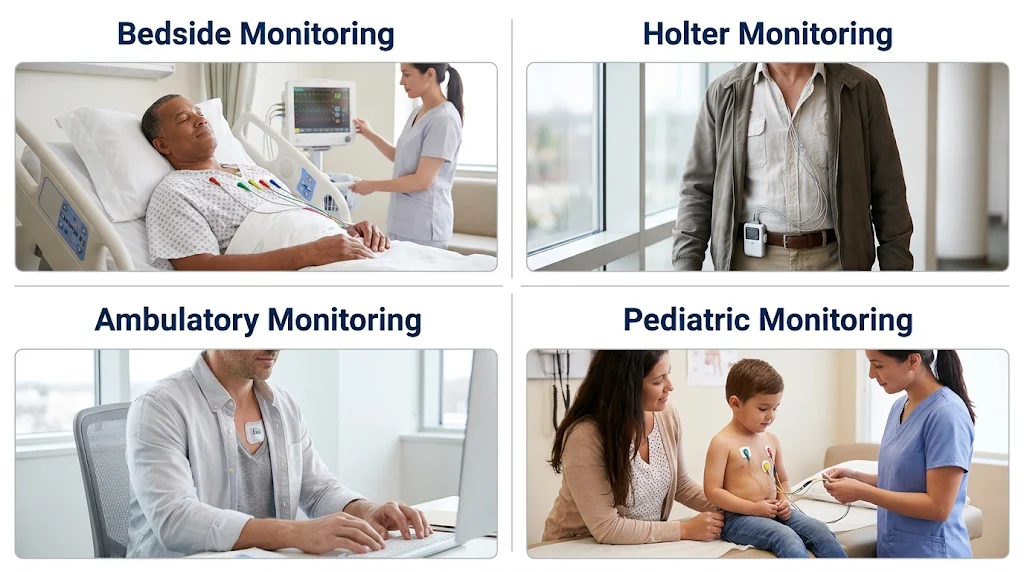
1.1 Bedside Patient Monitoring
Bedside monitoring is commonly used in hospitals, intensive care units, emergency departments, and other clinical environments where patients are connected to monitoring equipment.
ECG electrodes are typically attached to the patient's chest or other specified electrode placement locations and connected to a monitoring system through lead wires.
Important considerations include:
- Compatibility with the monitoring cable and connector system
- Appropriate adhesion for the expected monitoring period
- Stable skin contact under normal patient movement
- Easy application and replacement by healthcare professionals
- Consistent product dimensions and electrical interface specifications
For bedside applications, ease of use and compatibility with existing monitoring equipment are important procurement considerations.
1.2 Holter Monitoring
Holter monitoring records cardiac electrical activity over an extended period, commonly 24 to 48 hours, although longer monitoring protocols may also be used.
Unlike stationary bedside monitoring, Holter electrodes must remain attached while patients perform normal daily activities, including walking, sitting, sleeping, and changing positions.
This creates additional design considerations:
- Adhesion throughout the intended recording period
- Flexibility during body movement
- Resistance to normal daily activity conditions
- Skin-contact comfort
- Compatibility with Holter recorder lead wires
- Appropriate electrode dimensions and placement
For Holter applications, buyers should evaluate electrode performance under conditions representative of the intended wear duration rather than relying only on initial adhesion measurements.
1.3 Ambulatory ECG Monitoring
Ambulatory ECG monitoring includes wearable cardiac monitoring systems designed to record heart activity while patients move through their daily routines.
Depending on the device and clinical protocol, monitoring may last from hours to several days or longer.
Compared with conventional bedside applications, ambulatory monitoring places greater emphasis on the interaction between the electrode, skin, clothing, and body movement.
Key evaluation factors include:
- Adhesion during normal physical activity
- Flexibility and conformity to body contours
- Skin-contact material suitability
- Compatibility with wearable device configurations
- Product performance over the intended monitoring period
Buyers should distinguish between different ambulatory monitoring technologies. A conventional wired Holter system, a patch-based ECG monitor, and a wearable cardiac sensor may require different electrode structures and connection designs.
1.4 Resting ECG and Diagnostic ECG
Resting ECG examinations are generally performed in a controlled clinical setting, where healthcare professionals position electrodes according to the required ECG lead configuration.
These applications often prioritize:
- Consistent electrode positioning
- Reliable electrical contact
- Compatibility with ECG lead wires
- Convenient application and removal
- Efficient clinical workflow
For high-volume diagnostic environments, packaging format, product handling, and consistent supply can also influence purchasing decisions.
1.5 Pediatric ECG Monitoring
Pediatric ECG monitoring requires additional attention to patient size, skin characteristics, and the intended clinical application.
Electrode dimensions and adhesive properties should be appropriate for the specified patient population and use conditions.
Important considerations include:
- Suitable electrode size and geometry
- Appropriate skin-contact materials
- Compatibility with pediatric monitoring equipment
- Secure placement without unnecessary coverage
- Product specifications supported by relevant testing
A smaller adult electrode is not automatically an appropriate pediatric electrode. Buyers should evaluate products against their intended age group, application, and applicable requirements.
2. Comparing ECG Electrode Requirements Across Applications
The following table provides a practical starting point for OEM product planning and procurement discussions.
| Monitoring Application | Main Design Considerations | Important Procurement Factors |
|---|---|---|
| Bedside Monitoring | Skin contact, adhesion, connector compatibility | Device interface, replacement workflow, specifications |
| Holter Monitoring | Extended wear, flexibility, movement | Wear-duration testing, lead compatibility |
| Ambulatory Monitoring | Movement, comfort, application conditions | Device design, wear conditions, material suitability |
| Resting ECG | Positioning, electrical contact, handling | Connector type, dimensions, packaging |
| Pediatric Monitoring | Electrode size, skin-contact suitability | Intended age group, material evaluation, product validation |
These are general design considerations, not universal performance specifications. Actual requirements should be established according to the device design, intended use, and applicable testing criteria.
3. Five Technical Factors to Evaluate When Selecting ECG Electrodes
After identifying the application, buyers should assess the electrode itself.
3.1 Electrode Structure and Materials
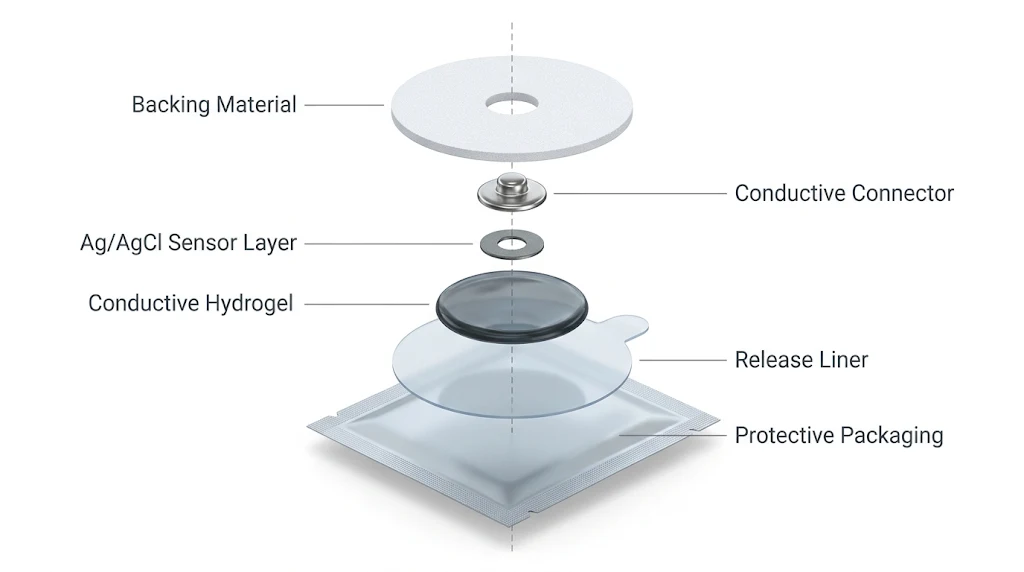
A typical disposable ECG electrode may contain several functional components:
- Backing material: Provides structural support and helps maintain the electrode's shape.
- Conductive hydrogel: Creates the conductive interface between the electrode and the skin.
- Connector or conductive interface: Transfers the acquired electrical signal to the monitoring cable or device.
- Release liner: Protects the adhesive or hydrogel surface before application.
- Packaging: Protects the product during storage, handling, and distribution.
Each component influences product design and performance.
For example, backing material selection may affect flexibility and conformity, while hydrogel formulation influences skin contact, adhesion, and electrical interface characteristics.
The materials should be evaluated as a complete product system rather than independently.
3.2 Conductive Hydrogel Performance
Hydrogel is an important component of many disposable ECG electrodes.
It provides the skin-contact interface needed for electrical signal acquisition.
When evaluating ECG electrode hydrogel, buyers should consider:
- Electrical properties under defined test conditions
- Adhesion characteristics
- Initial skin contact
- Performance over the intended monitoring period
- Compatibility with the selected backing and conductive structure
- Storage stability and packaging protection
Importantly, hydrogel performance should not be judged by conductivity or adhesion alone.
An electrode must be evaluated as a complete assembly under representative application conditions.
3.3 Connector Compatibility
Connector design is one of the most important factors in ECG electrode selection.
Common disposable ECG electrode configurations include:
- Snap connectors: Designed for compatible snap-style ECG lead wires.
- Tab connectors: Designed for compatible tab-style lead wire systems.
Other device-specific interfaces may also exist.
Buyers should confirm:
- Connector type and dimensions
- Lead wire compatibility
- Mechanical connection requirements
- Electrical interface specifications
- Device manufacturer's requirements
A connector that appears physically similar may not necessarily be interchangeable.
For OEM projects, connector drawings, samples, or existing product references should be provided during the initial design stage.
3.4 Adhesion and Skin-Contact Characteristics
Adhesion requirements vary significantly between short-term and extended monitoring applications.
For example, an electrode intended for a short resting ECG examination may have different requirements from one designed for continuous ambulatory recording.
Evaluation should consider:
- Initial adhesion
- Adhesion over the intended wear period
- Performance during normal movement
- Skin conformity
- Ease of removal
- Residue and skin-contact considerations
Product suitability should be established through appropriate testing for the intended population and use conditions.
3.5 Electrode Dimensions and Design Geometry
Electrode dimensions affect the available contact area, placement, and compatibility with the monitoring system.
Different applications may require different shapes and sizes.
For OEM buyers, customized dimensions and geometries may be considered based on:
- Device configuration
- Intended placement location
- Patient population
- Monitoring duration
- Product packaging requirements
- Manufacturing feasibility
Custom shapes should be assessed not only for appearance but also for material utilization, die-cutting feasibility, and consistent production.
4. How Monitoring Duration Influences ECG Electrode Selection
Monitoring duration is one of the most practical ways to narrow down electrode requirements.
However, longer monitoring does not simply mean choosing an electrode with stronger initial adhesion.
The complete electrode system must be evaluated under the intended conditions.
| Monitoring Scenario | Typical Application Context | Evaluation Priorities |
|---|---|---|
| Short-term ECG | Resting diagnostic examination | Application convenience, electrical contact |
| Continuous bedside monitoring | Hospital patient monitoring | Stable attachment, cable compatibility |
| 24–48-hour Holter monitoring | Extended ambulatory recording | Adhesion, movement, skin-contact suitability |
| Multi-day ambulatory monitoring | Wearable cardiac monitoring | Extended-use evaluation, flexibility, material stability |
The time periods shown are illustrative application contexts, not guaranteed product wear-time claims.
When specifying an electrode, buyers should define the intended wear duration and testing conditions rather than relying on general labels such as "long-lasting" or "extended wear."
5. What Should OEM Buyers Provide When Requesting ECG Electrode Samples?
For medical device OEMs and private-label brands, sample evaluation is more efficient when the product requirements are clearly defined.
Before requesting samples, buyers should prepare the following information:
| Information | Why It Matters |
|---|---|
| Intended monitoring application | Determines the primary design requirements |
| Patient population | Helps define dimensions and material considerations |
| Expected wear duration | Establishes the required evaluation period |
| Electrode dimensions | Supports product design and tooling assessment |
| Connector type | Ensures compatibility with monitoring equipment |
| Backing material preference | Helps determine flexibility and product structure |
| Hydrogel requirements | Supports material and performance evaluation |
| Packaging format | Defines storage, handling, and distribution needs |
| Target market | Helps identify relevant regulatory and documentation requirements |
| Estimated annual demand | Supports manufacturing and supply planning |
If an existing electrode is already being used, providing a physical sample or technical drawing can significantly improve the efficiency of product matching.
For custom development, it is also helpful to provide the monitoring device model, lead wire reference, and any available interface specifications.
6. Choosing an ECG Electrode Manufacturer for OEM and Private-Label Projects
Selecting an ECG electrode manufacturer involves more than comparing unit prices.
For OEM and private-label projects, buyers should evaluate the manufacturer's ability to support the complete product development and supply process.
6.1 Material and Hydrogel Capabilities
A manufacturer with experience in conductive hydrogel and electrode materials may offer greater flexibility in product development.
Buyers should understand whether the manufacturer can support material selection, hydrogel formulation, backing materials, and product customization.
6.2 Product Customization
OEM requirements may involve:
- Electrode dimensions and shapes
- Snap or tab connector configurations
- Backing material options
- Hydrogel specifications
- Private-label packaging
- Customized product configurations
Manufacturing feasibility and validation requirements should be reviewed before confirming the final design.
6.3 Quality Management and Documentation
For medical consumables, buyers should review the manufacturer's quality management system and relevant product documentation.
Depending on the market and product, this may include:
- ISO 13485 quality management system information
- Product specifications
- Material information
- Relevant test reports
- Shelf-life and stability documentation
- Traceability and batch records
- Applicable regulatory documentation
A manufacturer's certification should be checked for its actual scope and validity. It should not be assumed to cover every product or intended use.
6.4 Manufacturing Consistency
For repeat orders, maintaining consistent product specifications is essential.
Buyers should discuss how the manufacturer manages:
- Incoming material inspection
- Manufacturing process controls
- In-process quality checks
- Finished product inspection
- Batch identification and traceability
- Change management
These processes help establish a more predictable supply relationship.
6.5 Communication and Technical Support
A capable OEM partner should be able to understand product requirements and communicate clearly throughout development.
This includes reviewing drawings, identifying potential design constraints, coordinating samples, and supporting technical discussions before mass production.
7. ECG Electrode OEM Manufacturing at TOP-RANK Healthcare
TOP-RANK Healthcare focuses on medical conductive electrodes and related medical consumables, supporting OEM and ODM projects for international medical device and healthcare brands.
With experience in conductive hydrogel development and electrode manufacturing, TOP-RANK supports product customization based on customer requirements.
For ECG electrode projects, potential customization areas include:
- Electrode shape and dimensions
- Backing material selection
- Conductive hydrogel configuration
- Connector specifications
- Product structure
- Packaging and private-label requirements
Our manufacturing and quality management approach is designed to support the requirements of medical consumable products, from product specification discussions and sample evaluation to production and ongoing supply.
For buyers developing new ECG monitoring products or sourcing disposable ECG electrodes, sharing the intended application, device interface, and technical requirements is a practical first step toward evaluating a suitable OEM solution.
Looking for an ECG electrode manufacturing partner?
Contact TOP-RANK Healthcare to discuss your product specifications, customization requirements, and OEM/ODM project.
Frequently Asked Questions
1. Are all ECG electrodes suitable for every patient monitoring application?
2. What is the difference between bedside ECG electrodes and Holter electrodes?
Bedside ECG electrodes are commonly used in hospital monitoring environments, while Holter electrodes are designed for extended ambulatory recording. Holter applications generally require additional evaluation of adhesion, flexibility, and performance during daily movement.
3. What type of ECG electrode is used for long-term monitoring?
4. What is the difference between snap and tab ECG electrodes?
5. What materials are commonly used in disposable ECG electrodes?
Disposable ECG electrodes may contain a backing material, conductive hydrogel, conductive connector interface, release liner, and protective packaging. Specific material combinations vary by product design and intended application.
6. Can ECG electrodes be customized for different monitoring devices?