OEM Plantar / Foot TENS Electrodes | Arch & Heel Electrotherapy Pads | TOP-RANK
B2B contract manufacturing of Plantar / Foot TENS Electrodes for plantar fasciitis and diabetic foot neuropathy. Engineered with 1.15 mm high-chloride hydrogel to penetrate 1,000 um plantar keratin, concave arch-fitting footprints, and anti-emulsification crosslink networks.
Product Overview
Plantar / Foot TENS Electrodes operate as anatomically contoured transcutaneous biopotential delivery consumables engineered specifically for the plantar surface of the human foot, covering the calcaneal tuberosity (heel pad), medial longitudinal arch, plantar aponeurosis (fascia), and metatarsal heads. Connected to digital transcutaneous electrical nerve stimulators (TENS), neuromuscular stimulators (EMS), or interferential consoles via 2.0 mm pin receptacles or 3.5 mm snap studs, these electrodes transmit charge-balanced biphasic pulse trains (1 Hz to 150 Hz, pulse durations 100 to 400 microseconds, amplitudes up to 90 mA) across dense plantar keratin barriers to depolarize medial and lateral plantar nerve branches.
Applying conventional flat rectangular or square TENS pads onto the sole of the foot triggers three specific anatomical, electro-physical, and fluid-mechanical failures:
- Hyperkeratotic Stratum Corneum Blockade and Micro-Fissure Current Funneling: Unlike trunk or limb skin where the stratum corneum measures 10 to 20 um thick, weight-bearing plantar skin features a hyperkeratotic dead-skin barrier measuring 600 to 1,400 um thick, composed of dense disulfide-crosslinked keratin layers punctuated by microscopic heel fissures. Standard 0.75 mm hydrogels containing 1.0% to 1.5% salt fail to hydrate this thick keratin wall, maintaining a contact impedance above 15,000 Ohms. When a constant-current stimulator boosts output voltage to overcome this resistance, electrical charge funnels violently down isolated microscopic skin cracks, inflicting sharp, needle-like shock spikes while leaving the underlying plantar fascia unstimulated.
- Concave Medial Longitudinal Arch Bridging ("Arch Tenting"): The plantar surface combines a spherical calcaneal heel pad with a deeply concave medial longitudinal arch (arch depth 15 to 22 mm, longitudinal radius of curvature 35 to 55 mm). Standard rectangular or oval pads fabricated on stiff non-woven or PE foam backings cannot conform into this three-dimensional concavity. The pad bridges across the hollow arch like a suspended hammock, leaving only the heel and forefoot edges adhered while creating a 5 to 12 mm air void beneath the central conductive zone.
- Eccrine Hyper-Secretion Emulsification and Slippage: The plantar sole contains over 600 eccrine sweat glands per square centimeter-more than six times the density of the lumbar back-secreting continuous hypotonic saline perspiration even when the patient is seated. Low-crosslink commercial hydrogels absorb this free sweat rapidly, swelling and emulsifying into a low-viscosity slime that loses cohesive shear strength and slides off the foot during ankle flexion or partial weight shifts.
The Plantar / Foot TENS Electrode platform addresses these field conditions through targeted polymer, geometric, and conductor engineering: an extruded 1.15 mm solid polyacrylate hydrogel compounded with 3.2% dissociated sodium-potassium chloride ions and low-surface-tension polyol humectants to wick through thick keratin layers and lower trans-plantar impedance below 450 Ohms at 1 kHz; an asymmetric kidney-contoured and arch-waisted footprint die-cut onto a high-drape 85 g/m2 bi-directional stretch spunlace backing that seats directly into the concave medial arch; and a high-crosslink covalent polymer network (dynamic shear storage modulus G' > 4,600 Pa) that resists saline swelling over 60-minute protocols. We contract-manufacture private-label plantar and heel electrode sets for podiatry equipment OEMs, physical rehabilitation clinic networks, and diabetes care distributors globally.
Technical & Engineering Description
The industrial production of Plantar / Foot TENS Electrodes executes inside ISO 13485-certified Class 8 cleanrooms across continuous web-converting lines integrating low-modulus fabric unwinding, polyurethane moisture-barrier priming, silver-carbon circuit screen-printing, thick-caliper slot-die hydrogel extrusion, and rotary tungsten-carbide die-cutting. The manufacturing sequence proceeds through five synchronized stages:
- Stage 1: High-Drape Spunlace Unwinding & Fluid-Tight Barrier Priming: Master rolls of 85 g/m2 bi-directional stretch spunlace non-woven fabric (65% viscose / 35% polyester micro-filament blend, tensile modulus <0.18 MPa at 20% strain) unwind under closed-loop servo dancer tension control to eliminate mechanical pre-stretching. The web traverses a micro-gravure roll-coating module that deposits an aqueous elastomeric polyurethane barrier film across the inner contact face at a dry coat weight of 18 g/m2. Cured inside an infrared drying tunnel at 85C, this continuous polymer barrier blocks external sweat and internal hydrogel moisture from wicking through to the outer textile face.
- Stage 2: Screen-Printing of Low-Resistance Silver-Carbon Dispersion Matrix: The primed fabric web advances into a flatbed precision silk-screen printing station. A conductive thick-film ink-compounding sub-micron silver flakes and furnace carbon black within a flexible thermoplastic polyurethane binder-is printed across the active electrode zones. The web passes through a multi-zone hot-air convection sintering tunnel at 125C for 25 minutes, crosslinking the resin and locking surface sheet resistance strictly below 15 Ohm/sq so electrical current distributes evenly across elongated arch-to-heel footprints.
- Stage 3: 1.15 mm Thick-Caliper High-Chloride Hydrogel Extrusion & UV Curing: An aqueous monomer mixture compounding acrylic acid, 3.2% by weight pharmaceutical-grade sodium and potassium chloride salts, low-molecular-weight polyethylene glycol (PEG-400) wetting agents, vegetable glycerol, and a high fraction of bi-functional covalent crosslinkers is metered through a precision slot-die head directly onto the silver-carbon layer at a calibrated wet thickness of 1.15 mm (+/- 0.03 mm). The coated web immediately traverses an enclosed nitrogen-blanketed ultraviolet (UV) curing tunnel, driving free-radical double-bond conversion past 99.6% within 50 seconds to form a high-cohesion solid gel slab.
- Stage 4: Automated Terminal Cold-Staking, Dielectric Sealing & Liner Lamination: Multi-strand tinned copper leadwires terminated with injection-molded 2.0 mm female phosphor-bronze sockets (or 3.5 mm surgical stainless steel snap studs) feed into automated pneumatic riveting heads. The eyelets pierce the spunlace backing and clamp onto the silver-carbon busbar under 1,200 N axial force. An inline dispensing needle deposits a UV-curable dielectric epoxy drop over the internal metallic eyelet face to eliminate bare metal-to-skin current spikes. The 1.15 mm hydrogel surface consolidates against a 75 um fluorosilicone-coated transparent PET release liner.
- Stage 5: Asymmetric Plantar Contour Kiss-Cutting & Nitrogen Foil Pouching: The laminated web feeds into a rotary converting station equipped with hardened tungsten-carbide cutting cylinders. The rotary dies kiss-cut the asymmetric arch-waisted sole profile (110x55 mm) and calcaneal heel crescent profile (65x45 mm) down to the PET liner, stripping away the skeletal waste matrix via continuous vacuum manifolds. Line-scan optical cameras perform 100% inspection of perimeter geometry, eyelet placement, and gel thickness uniformity. Finished sets of four electrodes mount onto dual-sided release cards, enter multi-layer PET/AL/PE barrier pouches under dry nitrogen purge, and undergo hermetic heat-sealing. The baseline contract manufacturing MOQ is 5,000 packs.
Key Features
-
1.15 mm High-Chloride Capillary Wetting Matrix (Penetrating 1,000 um Plantar Keratin Barriers Without Micro-Fissure Shock Spikes)
Delivering transcutaneous electrical stimulation across the sole of the foot requires overcoming the thickest epidermal barrier on the human body:
1. The Dielectric Resistance of Hyperkeratotic Plantar Skin: While the stratum corneum on the forearm or back measures 10 to 20 um thick, the weight-bearing plantar heel and metatarsal pads develop a hyperkeratotic stratum corneum measuring 600 to 1,400 um thick. Composed of tightly stacked, dehydrated keratinocytes stabilized by disulfide bonds, this keratin wall exhibits a dry impedance exceeding 15,000 Ohms and frequently contains microscopic heel fissures.
2. Micro-Fissure Current Funneling in Standard Pads: Conventional TENS electrodes utilize thin 0.75 mm hydrogels with low electrolyte concentrations (1.0% to 1.5% salt). Placed on dry plantar skin, the gel fails to hydrate the thick keratin barrier. When a constant-current stimulator elevates its compliance voltage (up to 100V) to push current through the high load, electricity bypasses the intact keratin and funnels violently down isolated microscopic skin fissures. Current density inside these tiny cracks spikes past 3.0 mA/cm2, inflicting sharp, needle-like electric shock spikes while leaving the underlying plantar aponeurosis unrecruited.
3. Our 1.15 mm Capillary-Wetting Formulation: Plantar / Foot TENS Electrodes lower trans-plantar impedance through three coupled mechanisms:
• 1.15 mm High-Mass Hydrogel Reservoir: Extruded at 1.15 mm thickness (53% thicker than standard pads), the gel slab holds an expanded mobile water and ion reservoir that sustains continuous hydration across rough keratin scales.
• Low-Surface-Tension PEG-400 Wetting Phase: Incorporating low-molecular-weight polyethylene glycol (PEG-400) alongside vegetable glycerol lowers interfacial surface tension, driving capillary wicking deep into stacked keratin lamellae.
• 3.2% Dissociated Sodium-Potassium Chloride Load: High-mobility sodium, potassium, and chloride ions saturate the hydrated keratin micro-channels within 45 seconds of placement, dropping trans-plantar AC impedance below 450 Ohms at 1 kHz and dispersing electrical vectors evenly into the deep plantar fascia.
-
Concave Medial-Arch Contouring & Low-Modulus Bi-Directional Drape (Eliminating Arch Tenting Voids Across 18 mm Plantar Concavities)
Conforming an adhesive electrode to the underside of the human foot presents an inverse-curvature challenge opposite to convex limb joints:
1. The Geometry of Concave Arch Bridging: The plantar surface transitions abruptly from the rounded, weight-bearing calcaneal heel pad into a deeply recessed medial longitudinal arch (measuring 15 to 22 mm deep with a concave longitudinal radius of 35 to 55 mm) before meeting the transverse metatarsal ball. When a standard rectangular or wide oval pad is pressed into this hollow arch, the spring-back stiffness of standard non-woven or PE foam backings pulls the center of the pad straight across the cavity. The electrode spans the arch like a suspension bridge ("arch tenting"), leaving a 5 to 12 mm air gap beneath the center while concentrating all mechanical peel stress at the heel and forefoot margins.
2. Reduced Active Area and Edge Delamination: Arch tenting shrinks effective skin contact area by up to 50%, concentrating current onto the heel border and causing premature edge-peeling within minutes of application.
3. Our Concave Arch-Waisted Die-Cut & High-Drape Engineering: Plantar / Foot TENS Electrodes match three-dimensional plantar topography through coupled structural mechanics:
• Asymmetric Kidney & Arch-Waisted Footprint: Die-cut into a 110x55 mm curved sole profile with a narrowed medial waist (38 mm width at the arch apex) alongside a dedicated 65x45 mm calcaneal heel crescent, eliminating excess lateral material that buckles inside the arch curve.
• Ultra-Low Tensile Modulus Backing (<0.18 MPa): Fabricated on an 85 g/m2 bi-directional stretch spunlace non-woven carrier exhibiting an elastic modulus below 0.18 MPa at 20% strain, eliminating fabric spring-back tension.
• 4.6 N to 5.8 N / 25 mm Peel Tack: The calibrated polyacrylate tack holds the 1.15 mm gel slab flush against the 18 mm deep concave arch roof with zero air voids across 3D plantar phantom testing.
-
Covalent Anti-Swelling Network Under 600+ Glands/cm2 Eccrine Perspiration (Maintaining G' > 4,600 Pa Shear Rigidity Without Saline Emulsification)
High-density sweat secretion on the plantar sole degrades standard adhesive hydrogels through rapid osmotic swelling:
1. Plantar Eccrine Hyper-Secretion Mechanics: The plantar epidermis houses over 600 eccrine sweat glands per square centimeter-the highest density anywhere on the human body-secreting continuous hypotonic saline perspiration even when a patient sits stationary during electrotherapy.
2. Osmotic Swelling and Cohesive Emulsification in Standard Gels: Conventional TENS hydrogels are lightly crosslinked to maximize initial surface tack. When exposed to continuous plantar sweat pooling, the hydrophilic polymer network absorbs free water rapidly. The gel swells by 40% to 70% in volume, causing the polymer chains to separate and lose intermolecular entanglement. Within 15 to 20 minutes, the contact face emulsifies into a slippery, low-viscosity slurry that shears off the sole when the patient flexes their toes or shifts foot pressure.
3. Our High-Crosslink Anti-Swelling Polyacrylate Matrix: Plantar / Foot TENS Electrodes preserve structural cohesion under continuous saline exposure:
• Elevated Bi-Functional Covalent Crosslink Density: The polyacrylate backbone is synthesized with a calibrated stoichiometric excess of triethylene glycol dimethacrylate crosslinkers, restricting mesh expansion.
• Saline Mass Swelling Capped Below 18%: Gravimetric immersion testing in 0.9% physiological saline at 35C for 60 minutes confirms mass swelling stays strictly below 18%, preventing surface liquefaction.
• Dynamic Shear Storage Modulus G' > 4,600 Pa: Rheological frequency sweeps at 1 Hz confirm an elastic shear modulus exceeding 4,600 Pa, holding the pad anchored against ankle dorsiflexion and plantar shear forces with zero residue upon removal.
Applications
Chronic Plantar Fasciitis & Calcaneal Spur Rehabilitation Clinics
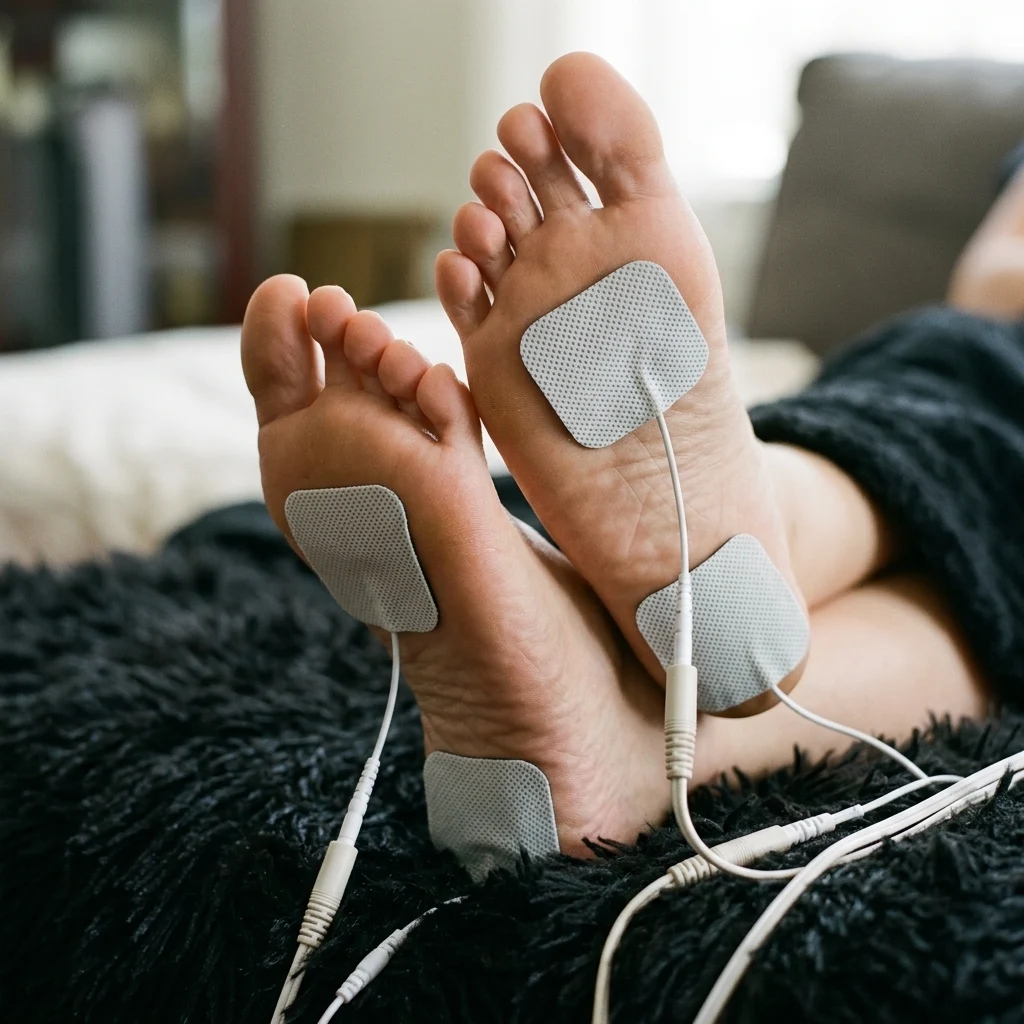
Sourced in high volume by podiatry clinics, orthopedic foot-and-ankle rehabilitation departments, and physical therapy networks treating recalcitrant plantar fasciitis; paired 110x55 mm arch-waisted sole pads and 65x45 mm calcaneal heel crescents seat simultaneously over the medial calcaneal tubercle and plantar aponeurosis; the 1.15 mm high-chloride gel penetrates thick heel keratin to deliver 80 to 120 Hz sensory pain-gating and 2 to 10 Hz intrinsic foot muscle pumping without heel-fissure shock spikes.
Diabetic Peripheral Neuropathy (DPN) & Tarsal Tunnel Syndrome Home-Care Programs
Deployed by durable medical equipment (DME) suppliers, endocrinology diabetes care networks, and home-health electrotherapy brands managing burning paresthesia and nocturnal foot pain in diabetic cohorts; the low-impedance capillary-wetting formulation achieves therapeutic current penetration at lower stimulator voltage rails, avoiding high-voltage skin stress while the anti-swelling hydrogel detaches cleanly without stripping fragile neuropathic plantar skin.
Athletic Plantar Recovery, Marathon Running & High-Impact Court Sports
Sourced by collegiate athletic training facilities, running recovery brands, and sports physiotherapy equipment OEMs; applied to athletes' arches and heels following high-impact running or court training; the fluid-tight polyurethane backing primer and anti-swelling hydrogel matrix (G' > 4,600 Pa) maintain full adhesion across sweat-saturated plantar skin during 45-to-60-minute neuromuscular recovery sessions.
OEM & Private Label
-
Custom Plantar Tooling, Connector Interfaces & Private Brand Packaging : We provide comprehensive contract manufacturing and custom die-cutting configurations for podiatry device OEMs, orthopedic brands, and medical consumable distributors:
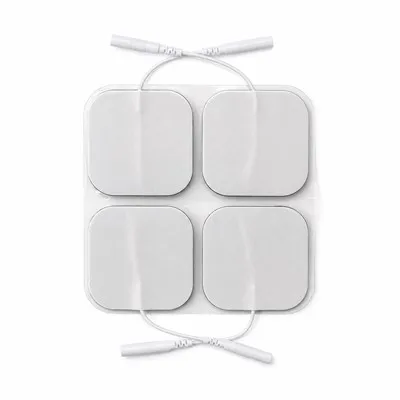
• Plantar Geometry Matrix: Full-Sole Arch-Waisted Contour (110x55 mm, waisted to 38 mm at the medial arch); Calcaneal Heel Crescent (65x45 mm, curved to wrap the posterior and inferior heel pad); Forefoot Metatarsal Oval (45x75 mm); and Combined 4-Pad Foot Therapy Kits (2 sole pads + 2 heel crescents per pouch).
• Backing Textile Options: High-drape 85 g/m2 white bi-directional stretch spunlace non-woven cloth (standard); tan/flesh-tone 4-way stretch elastic tricot knit; and 1.0 mm flexible closed-cell white PE foam.
• Leadwire Terminations: Precision molded 2.0 mm female phosphor-bronze sockets (retention force calibrated to 15N–25N); 3.5 mm and 4.0 mm surgical stainless steel snap studs; and custom integrated dual-lead pigtail harnesses.
• Turnkey Packaging Solutions: 4 pads (2 pairs) mounted per double-sided PET release card inside resealable multi-layer PET/AL/PE barrier foil pouches; custom full-color retail pouches and folding cartons with plantar placement diagrams; Amazon FNSKU barcoding; and serialized GS1/UDI medical traceability coding.
-
Two-Center Supply Chain Mechanics : High-drape fabric barrier priming, low-resistance silver-carbon circuit screen-printing, and 1.15 mm high-chloride polyacrylate hydrogel UV polymerization execute natively inside our primary China facility (ISO 13485:2016 and FDA registered under 21 CFR 820). High-speed rotary tungsten-carbide die-cutting of asymmetric plantar contours, automated terminal cold-staking, release card mounting, nitrogen-flushed foil pouching, and palletized ocean container export route through our Vietnam industrial hub, shielding international
Certifications
-
ISO 10993 Comprehensive Dermal Biocompatibility : Master production lots undergo testing in accredited independent GLP testing laboratories confirming strict compliance with ISO 10993-5 (In Vitro Cytotoxicity: Grade 0, non-cytotoxic to L929 fibroblasts), ISO 10993-10 (Skin Sensitization: 0% allergic response in guinea pig maximization assays), and ISO 10993-23 (Primary Dermal Irritation Index = 0.0, non-irritating). Certified 100% free of natural rubber latex, colophony rosin tackifiers, and phthalate plasticizers, permitting prolonged contact across sweat-saturated plantar skin.
-
ANSI/AAMI EC12 & IEC 60601-2-10 Specialized Electrical Standards : Formulated and converted to satisfy international electrotherapy criteria:
• Trans-plantar AC Small-Signal Impedance across 900 um hyperkeratotic heel skin holds strictly below 450 Ohms at 1 kHz within 45 seconds of application.
• Hydrogel bulk volume resistivity remains strictly below 12.0 Ohm-cm at 1 kHz across 60-minute continuous stimulation.
• Direct-Current (DC) Offset Voltage across resting electrode pairs remains below 10.0 mV.
• Delivers uniform electrical current density below 2.0 mA RMS/cm2 across the entire plantar contour under maximum 90 mA stimulator output.
-
Mechanical Adhesion & Saline Swelling Resistance Standards : Tested in accordance with ASTM D3330 (Peel Adhesion) and ASTM D4964 (Elastic Fabric Tensile Properties). Adhesion to steel demonstrates stable peel tack between 4.6 N and 5.8 N / 25 mm. Gravimetric immersion in 0.9% physiological saline at 35C for 60 minutes confirms mass swelling strictly below 18%, while terminal leadwire assemblies withstand axial pull forces exceeding 40.0 N without mechanical fracture or electrical disconnection.
-
MDSAP & ISO 13485 Manufacturing System Controls : Continuous coating bays, rotary screen-printing suites, automated riveting workcells, and cleanroom pouching lines operate strictly under certified ISO 13485:2016 and MDSAP regulatory frameworks (covering US FDA 21 CFR 820, Health Canada, TGA Australia). Unbroken electronic Device History Records (DHR) capture web tension profiles, silver-carbon sheet resistance values, 1.15 mm hydrogel caliper tolerances, dynamic shear storage moduli (G' > 4,600 Pa), lead pull strengths (>40 N), and packaging seal burst pressures across every manufactured production lot.
Technical FAQ
Q: Why do standard TENS pads cause sharp electric shock spikes on the heel without relieving plantar fasciitis pain, and how does the 1.15 mm high-chloride hydrogel penetrate thick plantar keratin?
A: The sharp biting shocks and poor deep tissue penetration on the heel are caused by the extreme thickness of plantar stratum corneum interacting with dry micro-fissures: The Dielectric Barrier of Plantar Hyperkeratosis: While skin on the back or forearm has a stratum corneum thickness of 10 to 20 um, weight-bearing heel and forefoot pads develop a hyperkeratotic dead-skin layer measuring 600 to 1,400 um thick. Stacked with dry, disulfide-crosslinked keratin plates, this barrier presents a dry impedance exceeding 15,000 Ohms and frequently contains microscopic heel fissures. Micro-Fissure Current Funneling in Standard Pads: Standard 0.75 mm hydrogels containing 1.0% to 1.5% salt lack sufficient moisture reserve and wetting kinetics to hydrate a 1.0 mm keratin layer. When a constant-current stimulator boosts output voltage (up to 100V) to overcome this high resistance, electrical charge bypasses the dry keratin plates and funnels violently down isolated microscopic cracks. Current density inside these fissures spikes past 3.0 mA/cm2, firing superficial pain nociceptors and inflicting sharp electric shock spikes while starving the deep plantar fascia of therapeutic current. Our 1.15 mm Capillary-Wetting Solution: Plantar / Foot TENS Electrodes overcome hyperkeratotic resistance through three coupled mechanisms: 1. 1.15 mm High-Mass Gel Slab: Extruded at 1.15 mm thickness (53% thicker than standard pads), the gel stores a large mobile water reservoir that fills rough plantar skin ridges completely. 2. PEG-400 Low-Surface-Tension Wetting Phase: Low-molecular-weight polyethylene glycol (PEG-400) combined with vegetable glycerol reduces interfacial surface tension, driving capillary wicking deep between stacked keratin plates. 3. 3.2% Dissociated Sodium-Potassium Chloride Load: High-mobility ions saturate hydrated keratin channels within 45 seconds, dropping trans-plantar AC impedance below 450 Ohms at 1 kHz and dispersing current evenly into the deep plantar aponeurosis.
Q: Why do regular electrode pads detach from the arch of the foot or slide off during stimulation, and how do the arch-waisted die-cut and anti-swelling hydrogel prevent this?
A: Premature detachment on the foot is driven by two separate physical mechanisms: concave arch tenting and eccrine sweat emulsification: The Mechanics of Concave Arch Tenting: The human sole transitions from the rounded calcaneal heel pad into a deeply concave medial longitudinal arch (15 to 22 mm deep, 35 to 55 mm concave radius). Standard rectangular pads laminated onto stiff non-woven or PE foam backings possess high bending spring-back stiffness. When pressed into the hollow arch, the backing pulls straight across the cavity like a bridge, creating a 5 to 12 mm air void beneath the center and concentrating peeling tension at the heel and forefoot margins. Eccrine Sweat Emulsification: The sole contains over 600 eccrine sweat glands per square centimeter-more than six times the density of the back-secreting continuous saline perspiration even at rest. Lightly crosslinked standard hydrogels absorb this sweat, swelling by 40% to 70% in volume and emulsifying into a low-viscosity slime that slides off the foot during ankle flexion. Our Coupled Structural and Polymer Solution: Plantar / Foot TENS Electrodes resolve both failure modes simultaneously: 1. Arch-Waisted Die-Cut & Low-Modulus Drape Backing: Die-cut into a 110x55 mm sole contour narrowed to 38 mm at the arch waist on an 85 g/m2 bi-directional stretch spunlace backing (tensile modulus <0.18 MPa at 20% strain), eliminating spring-back lift and seating flush into 18 mm deep arch concavities. 2. High-Crosslink Anti-Swelling Network (G' > 4,600 Pa): Synthesized with elevated bi-functional covalent crosslinkers, capping mass swelling below 18% after 60-minute immersion in 0.9% saline at 35C while holding dynamic shear storage modulus above 4,600 Pa at 1 Hz.
Podiatry device manufacturers, physical rehabilitation clinic purchasing directors, diabetic care DME suppliers, and sports recovery brand managers can request official Certificates of Analysis (COA), 1 kHz trans-plantar hyperkeratotic impedance test traces (<450 Ohms verification), 3D plantar arch conformity laser scans, 60-minute saline swelling gravimetric logs, ISO 10993 dermal biocompatibility dossiers, and unbranded evaluation sample packs (containing 110x55 mm arch-waisted sole pads and 65x45 mm calcaneal heel crescents with 2.0 mm socket or 3.5 mm snap terminations).
👉 [Request Plantar / Foot TENS Electrode Evaluation Packs]
Hot Tags: plantar / foot tens electrodes, China plantar / foot tens electrodes manufacturers, suppliers, factory, stimulation pads, TENS Machine Sticky Pads, TENS Pads, TENS self adhesive electrodes, TENS therapy pads, TENS unit sticky pads
Specifications
| Analytical Parameter | Engineering Baseline | Testing Standard |
| Footprint Geometry | Asymmetric Arch-Waisted Sole (110x55 mm) & Calcaneal Heel Crescent (65x45 mm) | Ergonomic die-cut tooling |
| Arch Concavity Conformity | Conforms to 18 mm Concave Arch Depth (35 mm Radius) with Zero Void Lift | 3D plantar foot phantom |
| Hydrogel Slab Caliper | 1.15 mm (+/- 0.03 mm) High-Mass Polyacrylate Hydrogel Slab | Precision dial gauge |
| Electrolyte Concentration | 3.2% Wt Balanced Sodium-Potassium Chloride + PEG-400 Wetting Phase | Titration & conductivity assay |
| Trans-Plantar AC Impedance | < 450 Ohms at 1 kHz across 900 um Hyperkeratotic Plantar Skin | Four-electrode LCR bridge |
| Bulk Volume Resistivity | < 12.0 Ohm-cm at 1 kHz (Batch run median: 9.8 Ohm-cm) | ASTM D257 |
| Saline Swelling Resistance | Mass Swelling Ratio < 18% after 60-min Immersion in 0.9% Saline at 35C | Gravimetric immersion test |
| Dynamic Shear Modulus | Shear Storage Modulus G' > 4,600 Pa at 1 Hz | Rheometer frequency sweep |
| Skin Adhesion Peel Tack | 4.6 N to 5.8 N / 25 mm on Stainless Steel Coupon | ASTM D3330 (180° Peel) |
| Backing Substrate | 85 g/m2 High-Drape Bi-Directional Stretch Spunlace Non-Woven | ASTM D4964 |
| Conductive Collector | Screen-Printed Isotropic Silver-Carbon Bus Matrix (< 15 Ohm/sq) | Four-point probe |
| Connector Interface | Molded 2.0 mm Female Socket (Phosphor Bronze) or 3.5 mm Stainless Snap | ANSI/AAMI EC53 |
| Terminal Pull-Out Force | Axial Tensile Pull-Out Strength > 40.0 N | Tensile pull bench |
| Application Lifespan | 25 to 30 Sessions with Water-Drop Rehydration Maintenance | Clinical cycle trial |
| Primary Packaging & MOQ | 4 Pads (2 Pairs) per Hermetic Ziploc Foil Pouch; MOQ: 5,000 Packs | 36-Month shelf life |