OEM 2"x4" Rectangular TENS Electrodes | 50x100mm Electrotherapy Pads | TOP-RANK
B2B contract manufacturing of 2"x4" (50x100mm) Rectangular TENS Electrodes. Engineered with balanced longitudinal current dispersion, cross-direction flexible spunlace backing, differential release liners, and 30+ cycle polyacrylate hydrogels.
Product Overview
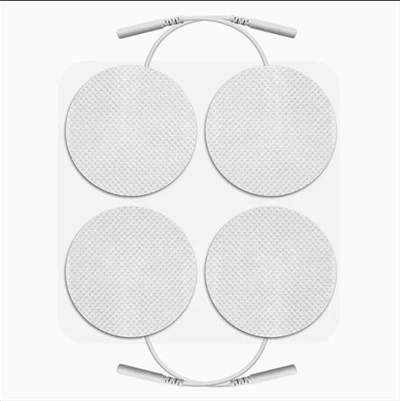
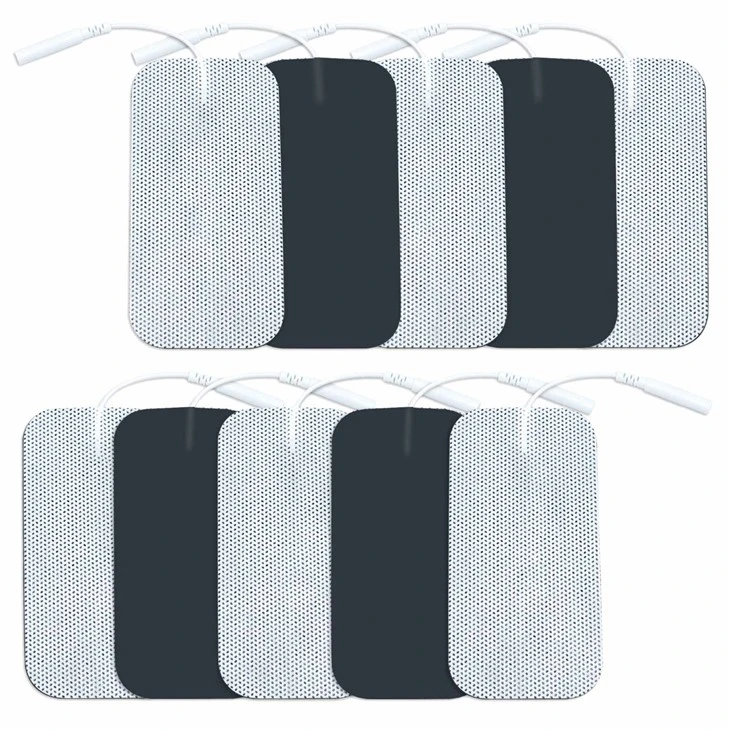
2"x4" Rectangular TENS Electrodes (nominal 50x100 mm or 50x90 mm metric equivalent, providing an active conductive footprint of 45 to 50 cm2) operate as elongated transcutaneous biopotential delivery consumables engineered to span the longitudinal axis of fusiform and bipennate skeletal muscles. Deployed across the lumbar erector spinae, rectus femoris, hamstrings, and gastrocnemius, this 2:1 aspect-ratio geometry bridges both proximal and distal motor end-plate zones within a single pad footprint. Connected to digital transcutaneous electrical nerve stimulators (TENS), neuromuscular stimulators (EMS), or interferential units via 2.0 mm pin receptacles or 3.5 mm snap studs, these electrodes conduct charge-balanced biphasic pulse trains (1 Hz to 150 Hz, pulse widths 50 to 400 microseconds, amplitudes up to 80 mA) along targeted muscle fiber trajectories.
Scaling an electrode from a 2"x2" square to an elongated 2:1 rectangular profile introduces three distinct electrical, textile-mechanical, and converting failure modes:
- Longitudinal Voltage Drop and Proximal-to-Distal Twitch Asymmetry: In standard 2"x4" pads where the leadwire terminates near one end or feeds into an uncalibrated high-resistance carbon film (>60 Ohm/sq), electrical potential decays steeply along the 100 mm length. Current discharges heavily into tissue within 25 mm of the wire entry point while current density at the far distal end drops by 35% to 45%. This imbalance triggers sharp cutaneous stinging beneath the lead junction while leaving the distal half of the muscle belly unrecruited.
- Anisotropic Fiber Stiffness Causing Narrow-Edge "End-Flagging" Lift: Spunlace non-woven fabrics exhibit directional mechanical anisotropy: tensile stiffness along the machine direction (MD) is typically 2.5 to 3.5 times higher than along the cross direction (CD). When converters nest 2"x4" dies with the stiff MD axis aligned parallel to the 100 mm length, applying the pad vertically along the inward curve of the lumbar spine or across a contracting thigh creates levered spring-back tension. The narrow 50 mm ends lift away from the skin ("end-flagging"), reducing contact area and concentrating charge onto the remaining bonded zone.
- High-Perimeter Blade Drag and Liner-Peel Stretching Distortion: A 2"x4" rectangle presents 300 mm of perimeter die-cut length per pad (50% more blade contact than a 2"x2" square). During multi-lane rotary die-cutting through tacky 0.90 mm hydrogels, warm blade friction drags and extrudes soft gel onto the release liner margins. Furthermore, if the PET liner's release force exceeds 0.45 N/25mm, pulling the 100 mm strip off the card stretches the fabric longitudinally, fracturing the brittle carbon film before the pad even reaches the patient's skin.
The 2"x4" Rectangular TENS Electrode platform addresses these conditions through specific layout, textile, and converting controls: a centered, fan-splayed tinned copper busbar bonded to an isotropic carbon-polyolefin conductor (28 to 38 Ohm/sq) that holds end-to-end current variance below 12% across the 100 mm span; cross-direction (CD) rotary die nesting that aligns the low-modulus stretch axis along the 100 mm length to prevent end-flagging on curved anatomy; and chilled-anvil (12C) rotary kiss-cutting paired with a differential fluorosilicone PET release liner (0.15 to 0.25 N/25mm release force) that eliminates edge ooze and peel-off stretching. We contract-manufacture private-label 2"x4" rectangular electrodes for physical therapy supply distributors, DME insurance networks, and OTC electrotherapy brands globally.
Technical & Engineering Description
The industrial production of 2"x4" Rectangular TENS Electrodes executes inside ISO 13485-certified Class 8 cleanrooms across continuous multi-lane web-converting lines integrating cross-direction fabric unwinding, aqueous dielectric barrier priming, offset-center leadwire staking, slot-die hydrogel polymerization, and chilled-anvil rotary die-cutting. The manufacturing sequence proceeds through five coordinated engineering stages:
- Stage 1: Cross-Direction (CD) Spunlace Unwinding & Dielectric Barrier Priming: Master rolls of 75 g/m2 hydroentangled spunlace non-woven cloth (70% viscose / 30% polyester blend) are slit and mounted so the low-modulus cross-direction (CD) stretch axis runs perpendicular to the machine web travel, aligning with the 100 mm length of the nested rectangular dies. Closed-loop servo dancer rollers maintain web tension below 15 N to prevent static elongation. A micro-gravure roll-coater deposits an aqueous polyurethane dielectric barrier layer (14 g/m2 dry weight) across the inner face, cured in an 85C infrared tunnel to seal textile pores against hydrogel strike-through.
- Stage 2: Offset-Center Copper Busbar Staking & Carbon-Polyolefin Lamination: Multi-strand tinned copper leadwire assemblies (terminated in injection-molded 2.0 mm female phosphor-bronze sockets) feed into automated wire-stripping and fan-splaying fixtures. Instead of terminating near the narrow end, the stripped copper filaments are splayed across a 12x20 mm anchor zone positioned at the geometric center of the 50x100 mm footprint. A 20 kHz ultrasonic horn welds the copper fan onto a 45 um conductive carbon-loaded polyolefin film (isotropic sheet resistance 28 to 38 Ohm/sq), and a 125 um polyester dielectric reinforcement patch is laminated over the joint, holding axial pull strength above 40.0 N.
- Stage 3: 0.90 mm Polyacrylate Hydrogel Slot-Die Extrusion & UV Curing: An aqueous monomer formulation compounding acrylic acid, pharmaceutical vegetable glycerol, propylene glycol, purified water, 1.5% sodium chloride electrolyte, and bi-functional covalent crosslinkers is metered through a precision slot-die extrusion head directly onto the conductive carbon web at a calibrated caliper of 0.90 mm (+/- 0.02 mm). The wet-coated web traverses an inert-gas nitrogen-blanketed ultraviolet (UV) curing tunnel, driving free-radical double-bond conversion past 99.6% within 45 seconds to form a high-cohesion solid polyacrylate gel slab.
- Stage 4: Differential Fluorosilicone 75 um PET Release Liner Consolidation: The cured hydrogel web laminates against a 75 um transparent PET release liner coated on both sides with differential fluorosilicone release agents. The primary contact face is calibrated to a release force of 0.15 to 0.25 N/25mm (establishing a >18:1 differential against the 4.0 to 5.2 N/25mm skin peel tack), while the reverse face is calibrated to 0.45 N/25mm so paired electrodes remain anchored during pouch extraction.
- Stage 5: Chilled-Anvil (12C) Multi-Lane Rotary Kiss-Cutting & Nitrogen Pouching: The consolidated laminate feeds into a 4-lane rotary converting station equipped with hardened tungsten-carbide cutting cylinders and internally water-chilled anvil rollers maintained at 12C. Chilling the anvil roll elevates the elastic storage modulus of the 0.90 mm hydrogel during blade strike, preventing lateral gel extrusion and holding edge ooze below 0.30 mm across the 300 mm pad perimeter. Line-scan vision cameras inspect cut geometry, corner radii (4.0 mm), and wire alignment at 100% web speed. Finished pads are collated two per double-sided release card (4 pads per pack), sealed inside multi-layer PET/AL/PE zip-closure pouches under dry nitrogen purge, and serialized with GS1/UDI barcodes. The baseline contract manufacturing MOQ is 5,000 packs.
Key Features
-
Offset-Center Fan Busbar & Calibrated Sheet Resistivity (Holding End-to-End Current Variance Below 12% Across 100 mm Muscle Spans)
Elongated 2:1 rectangular electrodes face a specific planar resistance gradient along their 100 mm major axis:
1. The 100 mm Planar Resistance Gradient: In a standard 2"x4" (50x100 mm) pad, if the copper leadwire terminates 15 mm from one short edge (a common low-cost manufacturing shortcut to save wire length), electrical current must travel 85 mm through the carbon film to reach the opposite end. When using standard high-resistance carbon films (60 to 80 Ohm/sq), planar voltage drops steeply along that 85 mm path. Current exits preferentially into the skin within a 25 mm radius of the wire junction, dropping current density at the far end by 35% to 45%. During EMS quadriceps or lumbar stimulation, the proximal muscle fibers contract forcefully while the distal fibers beneath the far end of the pad remain unstimulated.
2. Center-Feed Geometric Symmetry & Isotropic Carbon Calibration: Our 2"x4" electrode platform eliminates end-to-end current asymmetry without requiring costly silver-ink flood coats:
• Geometric Center Busbar Placement: The stripped multi-strand copper wire is splayed into a 12x20 mm conductive fan anchored at the exact geometric center (50 mm from both short ends, 25 mm from both long edges) of the 50x100 mm footprint, cutting maximum planar travel distance in half to 50 mm.
• Calibrated 28 to 38 Ohm/sq Polyolefin Carbon Film: The 45 um carbon-loaded polyolefin conductor is compounded with high-structure furnace black to hold isotropic sheet resistance between 28 and 38 Ohm/sq.
• Measured End-to-End Uniformity: Multi-sensor current density mapping at 80 mA output confirms that current density across the distal ends stays within 12% of the central zone (variance < 12%), producing balanced, synchronous muscle recruitment across the entire 100 mm length.
-
Cross-Direction Spunlace Web Orientation (Eliminating Short-Edge "End-Flagging" Lift Across Lordotic Lumbar and Flexing Limb Contours)
Non-woven electrode backings possess pronounced directional stiffness that directly governs whether an elongated 100 mm pad stays adhered on curved anatomy:
1. Machine-Direction vs. Cross-Direction Anisotropy: During hydroentangled spunlace manufacturing, viscose and polyester fibers align predominantly along the machine direction (MD). Consequently, tensile modulus along the MD axis is 2.5 to 3.5 times stiffer than along the cross direction (CD). When 2"x4" rectangular pads are die-cut with their 100 mm length parallel to the stiff MD axis and applied vertically along the concave lumbar lordosis or across a bulging hamstring, the stiff longitudinal fibers resist bending. Elastic spring-back torque levers the two narrow 50 mm ends upward off the skin ("end-flagging"), shrinking active contact area and triggering edge biting.
2. Cross-Direction (CD) Die Nesting & 4.0 mm Corner Radii: Our converting lines eliminate end-flagging through controlled web orientation:
• CD-Aligned 100 mm Axis: Master rolls are slit and fed into the rotary die station so the low-modulus cross-direction (CD) stretch axis (tensile modulus < 0.22 MPa at 15% strain) runs parallel to the 100 mm length of the pad.
• 4.0 mm Perimeter Corner Radii: All four vertices are stamped with a continuous 4.0 mm radius arc rather than sharp 90-degree corners, eliminating corner snagging beneath waistbands and compression shorts.
• Zero End-Lift on Concave Lumbar Phantoms: In 30-degree spinal flexion-extension cycling on a lordotic lumbar test fixture, CD-oriented 2"x4" pads maintained 100% end-to-end contact with zero short-edge lifting.
-
Chilled-Anvil Rotary Converting & 18:1 Differential Release Ratio (Preventing Edge Gel Ooze and Liner-Peel Stretching)
Converting 2"x4" pads at commercial speeds requires controlling shear extrusion along a 300 mm perimeter and balancing release tension across a 100 mm peel stroke:
1. Perimeter Blade Drag and Liner-Peel Deformation: Each 2"x4" pad requires 300 mm of rotary blade cut length. At web speeds of 25 to 35 meters per minute, frictional heat from the cutting dies softens standard polyacrylate hydrogels, squeezing viscous gel beyond the backing edge (edge ooze). Additionally, when a patient peels a 100 mm long pad off a standard release card (release force > 0.45 N/25mm), the sustained pulling force stretches the non-woven backing by 8% to 12%, fracturing the underlying carbon conductor film before skin application.
2. 12C Chilled Anvil & 18:1 Differential Fluorosilicone Liner: Our converting line eliminates edge ooze and peel-off stretching through thermal and interfacial release control:
• 12C Water-Chilled Rotary Anvil Roll: The hardened anvil cylinder beneath the rotary die is internally cooled to 12C, instantaneously raising the hydrogel's elastic shear modulus during blade impact so the gel shears cleanly without lateral cold flow, capping edge ooze strictly below 0.30 mm.
• 0.15 to 0.25 N/25mm Differential Release Liner: The 75 um PET card uses a low-surface-energy fluorosilicone coating calibrated to 0.15 to 0.25 N/25mm release force-creating an >18:1 differential against the 4.0 to 5.2 N/25mm skin peel tack-so the 100 mm pad lifts off the card effortlessly with zero longitudinal stretching or carbon micro-cracking.
Applications
Lumbar Erector Spinae & Thoracolumbar Paraspinal Pain Therapy
Sourced in high volume by physical therapy clinics, chiropractic rehabilitation centers, and DME home-care distributors; two 2"x4" (50x100 mm) rectangular pads are applied vertically alongside the L1 to L5 spinal column; the CD-oriented low-modulus spunlace backing conforms smoothly into the concave lumbar lordosis without short-edge end-flagging, while the 48.5 cm2 active area disperses 60 to 80 mA analgesic pulses across multiple spinal nerve roots simultaneously.
Quadriceps Femoris & Hamstring Neuromuscular Electrical Stimulation (NMES)
Deployed across orthopedic post-surgical rehabilitation wards (ACL reconstruction, total knee arthroplasty) and sports medicine conditioning facilities; placed longitudinally over the rectus femoris, vastus lateralis, and biceps femoris muscle bellies; the centered fan-splayed copper busbar maintains end-to-end current variance below 12%, driving synchronized tetanic contractions across both proximal and distal motor points to accelerate muscle strength recovery without proximal hot spots.
OTC Pharmacy & E-Commerce Dual-Size Combination Refill Kits
Sourced by private-label consumer wellness brands and Amazon/Shopify e-commerce sellers bundling multi-size replacement electrode assortments (typically 16 pcs of 2"x2" squares paired with 8 pcs of 2"x4" rectangles); chilled-anvil die-cutting caps edge ooze below 0.30 mm so multi-pad pouches remain clean without pads sticking to inner foil walls during warm warehouse storage and retail shelf display.
OEM & Private Label
-
Dimensional Variants, Backing Textiles & Private Brand Packaging : We provide contract manufacturing and custom converting configurations for electrotherapy device OEMs, DME suppliers, and retail brands:
• Rectangular Size Matrix: True Imperial 2"x4" (50x100 mm, 48.5 cm2 active area); Metric Standard 50x90 mm (43.5 cm2 active area); Slim Paraspinal 45x95 mm; and Contoured Waist-Cut 50x100 mm.
• Backing Substrate Options: 75 g/m2 CD-oriented white spunlace non-woven cloth (breathable, high-drape); Tan/flesh-tone 4-way stretch elastic tricot knit (discreet daytime wear under clothing); and 1.0 mm closed-cell white PE foam (fluid-impermeable, wipe-clean surface for multi-patient clinic use).
• Connector Terminations: Injection-molded 2.0 mm female phosphor-bronze sockets (retention force calibrated to 15N–25N, standard 100 mm or 150 mm lead length); 3.5 mm and 4.0 mm medical stainless steel snap studs (centered or dual-snap); and custom color-coded lead jackets.
• Turnkey Packaging Formats: 2 pads mounted per double-sided differential PET release card; 4 pads (2 cards) sealed inside resealable multi-layer PET/AL/PE barrier foil pouches; multi-pack retail boxes (8-pack, 16-pack, 24-pack, or 40-pack assortments); Amazon FNSKU barcoding; and serialized GS1/UDI medical traceability coding.
-
Two-Center Supply Chain Mechanics : Cross-direction spunlace barrier priming, conductive carbon-polyolefin sheet compounding, offset-center ultrasonic copper busbar staking, and 0.90 mm polyacrylate hydrogel UV polymerization execute natively inside our primary China facility (ISO 13485:2016 and FDA registered under 21 CFR 820). Chilled-anvil multi-lane rotary die-cutting, differential release card mounting, nitrogen-flushed foil pouching, and palletized ocean container export route through our Vietnam industrial hub, shielding international B2B buyers from Section 301 tariffs and regional medical consumable import barriers.
Certifications
-
ISO 10993 Comprehensive Dermal Biocompatibility : Master production lots undergo testing in accredited independent GLP testing laboratories confirming strict compliance with ISO 10993-5 (In Vitro Cytotoxicity: Grade 0, non-cytotoxic to L929 fibroblasts), ISO 10993-10 (Skin Sensitization: 0% allergic response in guinea pig maximization assays), and ISO 10993-23 (Primary Dermal Irritation Index = 0.0, non-irritating). Certified 100% free of natural rubber latex, colophony rosin tackifiers, and phthalate plasticizers.
-
ANSI/AAMI EC12 & IEC 60601-2-10 Specialized Electrical Standards : Formulated and converted to satisfy international electrotherapy criteria:
• AC Small-Signal Interfacial Impedance across human lumbar and limb skin holds strictly below 25.0 Ohms at 1 kHz.
• Direct-Current (DC) Offset Voltage across resting electrode pairs remains below 10.0 mV.
• Longitudinal current density variance across the 100 mm span holds below 12%, maintaining maximum local current density below 2.0 mA RMS/cm2 under 80 mA stimulator output.
-
Mechanical Adhesion & Differential Release Verification : Tested in accordance with ASTM D3330 (Peel Adhesion) and FINAT FTM 3 (Low-Speed Release Force). Skin-side peel tack on stainless steel holds within 4.0 N to 5.2 N / 25 mm, while PET release liner peel force holds within 0.15 N to 0.25 N / 25 mm (>18:1 differential ratio). Terminal leadwire assemblies withstand axial pull forces exceeding 40.0 N without mechanical fracture or electrical disconnection.
-
MDSAP & ISO 13485 Manufacturing System Controls : Continuous coating bays, ultrasonic busbar staking workcells, chilled-anvil rotary die-cutting lines, and cleanroom pouching suites operate strictly under certified ISO 13485:2016 and MDSAP regulatory frameworks (covering US FDA 21 CFR 820, Health Canada, TGA Australia). Unbroken electronic Device History Records (DHR) capture web tension profiles, carbon sheet resistance values, chilled-anvil temperature logs (12C), edge ooze measurements (<0.30 mm), lead pull strengths (>40 N), and packaging seal burst pressures across every manufactured production lot.
Technical FAQ
Q: Why do 2"x4" rectangular TENS pads often produce uneven muscle contractions between the two ends of the pad, and how does busbar placement correct this?
A: Uneven muscle recruitment along a 100 mm rectangular pad is driven by planar voltage drop when the current injection point is offset toward one end: The Physics of Planar Voltage Drop in 2:1 Rectangles: In standard conductive carbon films (sheet resistance 60 to 80 Ohm/sq), electrical resistance increases linearly with travel distance. When low-cost manufacturers terminate the leadwire 15 mm from one short edge to save wire length, electrical current must travel 85 mm across the resistive carbon plane to reach the opposite end. Current follows the path of least resistance, discharging heavily into the skin within 25 mm of the wire entry point while current density at the far end drops by 35% to 45%. The proximal muscle fibers experience sharp stinging and forceful contractions while the distal muscle belly receives sub-threshold current. Our Geometric Center Busbar & Isotropic Carbon Solution: 1.Center-Point Fan-Splayed Busbar: The stripped tinned copper filaments are splayed into a 12x20 mm conductive fan welded at the exact geometric center of the 50x100 mm footprint (50 mm from both short edges), cutting maximum planar travel distance in half to 50 mm. 2.Calibrated 28 to 38 Ohm/sq Carbon Polyolefin Film: Compounded with high-structure furnace black to lower isotropic planar sheet resistance below 38 Ohm/sq. 3. Measured <12% End-to-End Variance: Multi-sensor grid mapping at 80 mA confirms that distal-to-proximal current density variance holds strictly under 12% across the entire 100 mm length.
Q: Why do long rectangular electrodes peel up at the narrow 2-inch ends on curved backs or thighs, and how does fabric fiber orientation prevent end-flagging?
A: Narrow-edge lifting ("end-flagging") on curved anatomy is governed by the directional fiber stiffness of the non-woven backing substrate: Anisotropic Stiffness in Spunlace Non-Wovens: During spunlace web formation, viscose and polyester fibers align predominantly along the machine direction (MD), making MD tensile stiffness 2.5 to 3.5 times higher than the cross direction (CD). When 2"x4" dies are nested with the stiff MD fibers running parallel to the 100 mm length, bending the pad along the concave lumbar curve or convex thigh creates elastic spring-back torque that levers the narrow 50 mm ends upward off the skin. Our Cross-Direction (CD) Die Nesting & 4.0 mm Corner Radius Controls: 1.CD-Aligned 100 mm Axis: Master rolls are oriented so the low-modulus cross-direction (CD) stretch axis (tensile modulus < 0.22 MPa at 15% strain) runs parallel to the 100 mm length, eliminating longitudinal spring-back resistance. 2. 4.0 mm Perimeter Corner Radii: All four vertices are die-cut with 4.0 mm radius curves to prevent waistband and clothing friction from snagging corners. 3. Differential Release Liner (0.15 to 0.25 N/25mm): Prevents the user from stretching the 100 mm backing during removal from the card, preserving dimensional stability and full border adhesion across 30-degree lumbar flexion cycles.
Physical therapy supply distributors, DME insurance replenishment networks, and private-label electrotherapy brand managers can request official Certificates of Analysis (COA), 100 mm longitudinal current-density mapping traces (<12% variance verification), ASTM D3330 peel adhesion and FINAT FTM 3 differential liner release logs, ISO 10993 dermal biocompatibility dossiers, and unbranded 2"x4" (50x100 mm and 50x90 mm) evaluation sample packs with 2.0 mm socket or 3.5 mm snap terminations.
👉 [Request 2"x4" Rectangular TENS Electrode Evaluation Packs]
Hot Tags: 2"x4" rectangular tens electrodes, China 2"x4" rectangular tens electrodes manufacturers, suppliers, factory, adhesive electrode pads, electrode self adhesive, muscle stim pads, Neck Relax Electrode Pads, Replacement Gel Pads for TENS Machine, TENS Therapy Replacement Pads
Specifications
| Analytical Parameter | Engineering Baseline | Testing Standard |
| Footprint Dimensions | 50x100 mm (True 2"x4" Imperial) or 50x90 mm (Metric Standard) | Optical comparator |
| Active Conductive Area | 48.5 cm2 (50x100 mm with 4.0 mm Corner Radii) | CAD geometric integration |
| Corner Radius Profile | 4.0 mm Continuous Corner Radius across All Four Vertices | Rotary die-cut tooling |
| Conductive Collector | Isotropic Carbon-Loaded Polyolefin Film (28 to 38 Ohm/sq) | Four-point probe (ASTM D257) |
| Longitudinal Current Variance | End-to-End Current Density Variance < 12% across 100 mm Span | Multi-sensor grid mapping |
| AC Interfacial Impedance | < 25.0 Ohms at 1 kHz across Human Lumbar/Limb Skin | Precision LCR Meter |
| Hydrogel System & Caliper | Extruded Solid Polyacrylate Hydrogel (Caliper: 0.90 mm) | Precision thickness gauge |
| Skin Adhesion Peel Tack | 4.0 N to 5.2 N / 25 mm on Stainless Steel Coupon | ASTM D3330 (180° Peel) |
| Liner Release Force | 0.15 N to 0.25 N / 25 mm (>18:1 Skin-to-Liner Release Ratio) | FINAT FTM 3 |
| Die-Cut Edge Ooze | < 0.30 mm Lateral Gel Extrusion beyond Backing Perimeter | Chilled-anvil (12C) converting |
| Backing Substrate | 75 g/m2 CD-Oriented Spunlace Non-Woven, Tan Tricot, or PE Foam | ASTM D3776 / 100 mm |
| Terminal Connector | Molded 2.0 mm Female Socket (Phosphor Bronze) or 3.5 mm Snap | ANSI/AAMI EC53 |
| Leadwire Pull Strength | Wire-to-Pad Tensile Pull-Out Strength > 40.0 N Axial Force | Tensile pull bench |
| Application Lifespan | 30 to 45 Application Cycles with Water-Drop Maintenance | Clinical cycle trial |
| Primary Packaging & MOQ | 2 Pads/Card, 4 Pads/Ziploc Foil Pouch; MOQ: 5,000 Packs | 36-Month shelf life |