

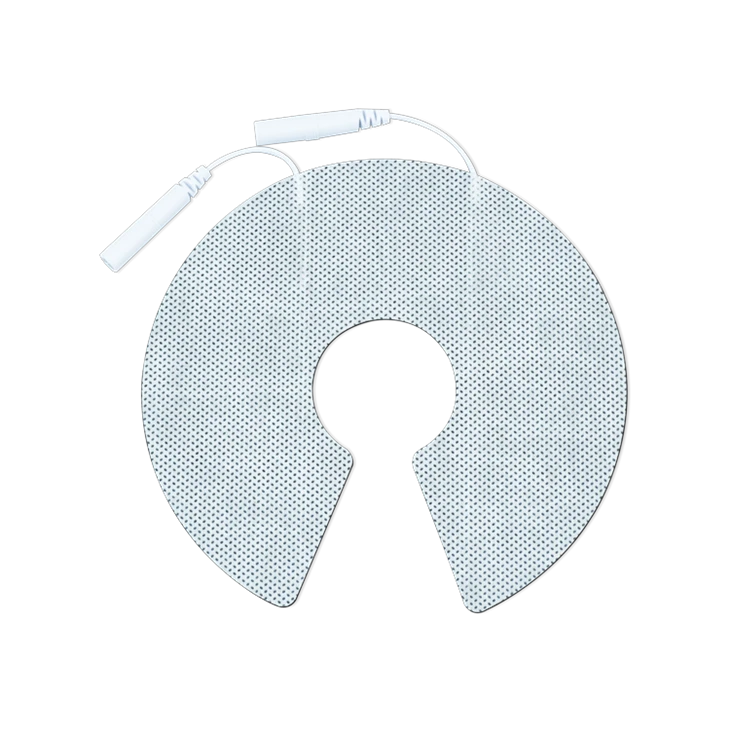
OEM Shoulder & Scapula Contoured TENS Electrodes | Rotator Cuff Pads | TOP-RANK
B2B contract manufacturing of Shoulder & Scapula Contoured TENS Electrodes for rotator cuff rehab and frozen shoulder therapy. Engineered with tri-lobe Y-wing geometry, acromial relief cutouts, 1:1 isotropic tricot backing, and balanced silver-carbon busbars.
Product Overview
Shoulder & Scapula Contoured TENS Electrodes operate as multi-lobed transcutaneous biopotential delivery consumables engineered specifically for the compound anatomy of the human shoulder girdle, spanning the anterior deltoid, lateral acromial dome, posterior deltoid, and scapular spine/infraspinatus fossa. Connected to digital transcutaneous electrical nerve stimulators (TENS), neuromuscular stimulators (EMS), or interferential consoles via 2.0 mm pin receptacles or 3.5 mm snap studs, these electrodes deliver charge-balanced biphasic pulse trains (1 Hz to 150 Hz, pulse widths 50 to 400 microseconds, amplitudes up to 80 mA) to recruit rotator cuff musculature and gate nociceptive pain pathways across the glenohumeral and scapulothoracic joints.
Applying standard rectangular, square, or oval electrode pads onto the shoulder complex triggers three specific geometric, kinematic, and neuro-anatomical failures:
- Double-Convex Humeral Dome Pleating and Bony Acromion Periosteal Shock: Unlike cylindrical limbs that curve along a single axis, the shoulder forms a compound double-convex spherical dome over the humeral head (radius of curvature 50 to 65 mm) intersected by the sharp subcutaneous bony ridges of the acromion process and the spine of the scapula. Pressing a flat rectangular sheet onto this spherical dome forces excess outer perimeter material into radial pleats and tented ridges. Meanwhile, conductive gel sitting directly over the thin skin covering the bony acromion (<3 mm subcutaneous thickness) discharges high-density current straight into periosteal nociceptors, causing sharp bone-surface stinging before deeper deltoid fibers depolarize.
- Scapulohumeral Rhythm Gliding Shear During 0°–180° Arm Elevation: The shoulder joint executes the widest multi-axis range of motion in the human body, combining 180° abduction/flexion with internal and external rotation. Under normal scapulohumeral rhythm (a 2:1 ratio of glenohumeral elevation to upward scapular rotation), the underlying scapular blade glides upward and rotates laterally beneath the skin while the anterior and posterior deltoid skins stretch in opposing directions. Standard spunlace non-woven backings exhibit directional stiffness anisotropy, generating interfacial shear stress above 210 Pa that peels perimeter margins off the posterior scapula during overhead arm elevation.
- Asymmetric Lobe Resistance Causing Proximal Current Dumping: Multi-wing shoulder electrodes span distances exceeding 140 mm from the acromial apex to the distal infraspinatus border. When manufactured with a single central wire crimp feeding an unreinforced carbon film (>45 Ohm/sq), electrical current drains out into the skin within a 25 mm radius of the terminal stud. Current density near the lateral deltoid entry spikes past 2.2 mA RMS/cm2 while the posterior scapular wing receives less than 45% of target current density, leaving the infraspinatus and teres minor unrecruited.
The Shoulder & Scapula Contoured TENS Electrode platform resolves these field conditions through targeted structural, textile, and circuit engineering: a die-cut tri-lobe Y-wing footprint (155x145 mm) featuring a central acromial clearance notch that eliminates spherical dome pleating and isolates the bony acromion; an isotropic 1:1 warp-knit nylon-elastane tricot carrier (tensile modulus <0.20 MPa in both warp and weft axes) laminated to a high-cohesion solid polyacrylate hydrogel (G' > 4,100 Pa at 1 Hz) that tracks scapular gliding through 180° circumduction; and a screen-printed tri-furcated silver-carbon busbar network that holds lobe-to-lobe current variance below 10%. We contract-manufacture private-label shoulder and scapular electrode sets for orthopedic rehabilitation OEMs, sports medicine device brands, and physical therapy clinic chains globally.
Technical & Engineering Description
The industrial manufacture of Shoulder & Scapula Contoured TENS Electrodes executes inside ISO 13485-certified Class 8 cleanrooms across continuous web-converting lines integrating low-tension tricot unwinding, polyurethane barrier priming, tri-furcated silver-carbon screen-printing, slot-die hydrogel polymerization, and rotary tungsten-carbide die-cutting. The manufacturing sequence proceeds through five coordinated processing stages:
- Stage 1: Isotropic 1:1 Warp-Knit Tricot Unwinding & Dielectric Barrier Priming: Master rolls of 135 g/m2 medical-grade warp-knit tricot fabric (82% high-filament nylon / 18% elastane spandex, engineered with a 1.05:1 warp-to-weft modulus ratio) unwind under closed-loop servo dancer tension control below 12 N to prevent pre-stretching. The web passes through an atmospheric corona treater (elevating surface energy past 52 dynes/cm) into a micro-gravure roll-coater that applies an aqueous elastomeric polyurethane barrier film across the inner contact face at 16 g/m2 dry weight. Cured in a 90C infrared tunnel, this flexible barrier seals textile pores against hydrogel strike-through without stiffening the knit.
- Stage 2: Screen-Printing of Tri-Furcated Silver-Carbon Busbar & Carbon Collector: The primed elastic web indexes into a two-stage flatbed precision silk-screen printing press. Station 1 deposits a high-conductivity silver-carbon thick-film ink (sheet resistance < 12 Ohm/sq) in a tri-furcated Y-shaped busbar geometry extending 55 mm into each of the three anatomical lobes while routing around the central acromial relief notch. Station 2 overprints an isotropic carbon-polymer dispersion field (30 to 38 Ohm/sq) across the entire active area. The web cures in a 125C hot-air convection tunnel for 25 minutes.
- Stage 3: 0.95 mm High-Shear Polyacrylate Hydrogel Extrusion & Nitrogen-UV Curing: An aqueous monomer formulation compounding acrylic acid, pharmaceutical vegetable glycerol, propylene glycol, purified water, 1.5% sodium chloride electrolyte, and bi-functional covalent crosslinkers is metered through a precision slot-die head onto the conductive carbon web at a calibrated wet caliper of 0.95 mm (+/- 0.02 mm). The coated web immediately traverses an enclosed nitrogen-blanketed ultraviolet (UV) curing tunnel, achieving >99.6% double-bond conversion within 45 seconds to establish a high-cohesion solid gel slab (G' > 4,100 Pa).
- Stage 4: Automated Terminal Cold-Staking, Dielectric Isolation & Liner Lamination: Multi-strand tinned copper leadwires terminated with injection-molded 2.0 mm female phosphor-bronze sockets (or 3.5 mm surgical stainless steel snap studs) feed into pneumatic riveting heads. The eyelets pierce the tricot backing at the junction hub of the tri-furcated silver-carbon busbar under 1,250 N clamping force, reinforced by a 125 um polyester collar. An inline dispensing head applies a UV-curable dielectric epoxy seal over the internal metallic eyelet face. The 0.95 mm hydrogel laminates against a 75 um fluorosilicone-coated transparent PET release liner (release force 0.18 to 0.28 N/25mm).
- Stage 5: Tri-Lobe Y-Wing Rotary Kiss-Cutting & Nitrogen Barrier Pouching: The laminated web enters a rotary converting station equipped with hardened tungsten-carbide cutting cylinders. The rotary dies kiss-cut the outer tri-lobe Y-wing perimeter (155x145 mm) while simultaneously punching out the interior 28x22 mm acromial relief notch down to the PET liner, extracting the skeletal waste web via continuous vacuum manifolds. Line-scan optical cameras inspect cut geometry, acromial notch clearance, and busbar alignment at 100% web speed. Finished left/right pairs mount onto dual-sided release cards, enter multi-layer PET/AL/PE zip-closure barrier pouches under dry nitrogen purge, and undergo hermetic heat-sealing. The baseline contract manufacturing MOQ is 5,000 pairs.
Key Features
-
Tri-Lobe Y-Wing Geometry & Acromial Relief Notch (Eliminating Double-Convex Humeral Dome Pleating and Periosteal Acromion Shock)
Conforming a planar adhesive pad onto the human shoulder requires resolving a double-convex spherical curvature mismatch alongside a prominent subcutaneous bony ridge:
1. Gaussian Spherical Curvature Mismatch and Acromial Periosteal Stinging: Unlike the forearm or thigh (which approximate single-axis cylinders), the lateral shoulder forms a double-convex spherical dome over the humeral head (radius 50 to 65 mm). When a continuous rectangular or oval sheet is pressed onto a spherical dome, the outer perimeter circumference exceeds the surface area of the sphere beneath it, forcing the backing to buckle into radial pleats and hollow air tunnels. Simultaneously, the bony acromion process and lateral scapular spine sit directly beneath thin, fat-free skin (<3 mm subcutaneous thickness). Hydrogel resting directly over the acromion dumps high-density current straight into superficial periosteal pain receptors, triggering sharp bone-surface stinging before deeper deltoid motor units depolarize.
2. Tri-Lobe Y-Wing Split & 28x22 mm Acromial Relief Cutout: Our contoured shoulder pad resolves both geometric and anatomical conflicts through dedicated die-cut topology:
• Three Independent Anatomical Lobes: The 155x145 mm footprint divides into an anterior deltoid wing, a lateral deltoid wing, and a posterior scapular/infraspinatus wing separated by deep radial relief sinuses, allowing each lobe to wrap onto its local muscle plane without radial perimeter pleating.
• Central 28x22 mm Acromial Relief Notch: A die-cut dielectric window frames the superior-lateral apex directly over the acromion process and acromioclavicular joint, keeping conductive gel off the bony prominence and eliminating periosteal electrical biting.
-
Isotropic 1:1 Warp-Knit Tricot & High-Cohesion Hydrogel Matrix (Accommodating 0°–180° Scapulohumeral Rhythm Gliding Without Margin Roll-Up)
The glenohumeral and scapulothoracic joints generate multi-directional epidermal strain and bony gliding shear during upper-extremity rehabilitation:
1. Scapulohumeral Rhythm Shear Mechanics: During active or passive arm elevation from 0° to 180°, the shoulder operates under scapulohumeral rhythm (2:1 glenohumeral-to-scapular upward rotation). As the arm abducts overhead and rotates internally/externally, the flat scapular blade glides upward and laterally beneath the posterior skin while the anterior and posterior deltoid skins undergo simultaneous orthogonal stretching. Conventional non-woven backings exhibit a 3:1 directional stiffness ratio, creating interfacial shear stress exceeding 210 Pa that peels the posterior scapular borders away from the skin.
2. Isotropic 1:1 Warp-Knit Carrier & G' > 4,100 Pa Shear Matrix: Our shoulder pad platform accommodates multi-planar circumduction through coupled textile and polymer mechanics:
• 1.05:1 Warp-to-Weft Modulus Balance (<0.20 MPa): The 135 g/m2 nylon-elastane tricot knit exhibits near-identical tensile moduli (<0.20 MPa at 25% strain) across both warp and weft directions, stretching uniformly across anterior, lateral, and posterior vectors during 180° overhead abduction.
• Dynamic Shear Storage Modulus G' > 4,100 Pa: The 0.95 mm crosslinked polyacrylate hydrogel maintains an elastic shear storage modulus exceeding 4,100 Pa at 1 Hz alongside a 4.0 to 5.2 N/25mm peel tack, holding all three lobes anchored across the gliding scapula through 500 continuous circumduction cycles with zero margin roll-up.
-
Tri-Furcated Silver-Carbon Busbar Network (Holding Lobe-to-Lobe Current Variance Below 10% Across Anterior Deltoid, Lateral Deltoid, and Infraspinatus Fossae)
Distributing pulsed current evenly across a 155x145 mm three-winged footprint requires compensating for unequal planar path lengths:
1. Proximal Current Dumping in Single-Point Carbon Pads: In an asymmetric shoulder pad spanning 145 mm from the lateral deltoid hub to the distal medial border of the scapula, standard carbon collector films (sheet resistance 45 to 65 Ohm/sq) impose substantial planar voltage drop. Electrical charge exits preferentially within a 25 mm radius of the terminal stud over the lateral deltoid, spiking local current density above 2.2 mA RMS/cm2 while starving the posterior infraspinatus lobe of more than 55% of target stimulation current.
2. Tri-Furcated Low-Resistance Silver-Carbon Busbar Architecture: Our two-stage screen-printed conductor equalizes current delivery across all three anatomical wings:
• Three-Branch Y-Shaped Busbar (<12 Ohm/sq): High-conductivity silver-carbon thick-film traces (sheet resistance <12 Ohm/sq, trace width 3.0 mm) radiate 55 mm from the central terminal hub directly into the core of the anterior deltoid lobe, lateral deltoid lobe, and posterior scapular lobe.
• Isotropic Carbon Dispersion Overprint (30 to 38 Ohm/sq): A secondary carbon-polymer dispersion layer bridges across the silver-carbon skeleton to diffuse current smoothly to the outer margins.
• Measured <10% Inter-Lobe Variance: Multi-sensor current mapping at 80 mA output confirms that current density variance across all three lobes holds strictly below 10%, delivering synchronous neuromuscular recruitment across the anterior deltoid, middle deltoid, and infraspinatus rotator cuff musculature.
Applications
Rotator Cuff Repair & Arthroscopic Bankart Post-Operative Rehabilitation
Sourced in high volume by orthopedic shoulder surgery centers, outpatient physical therapy networks, and DME post-op recovery suppliers; applied around the surgical shoulder following arthroscopic rotator cuff or labral reconstruction; the 28x22 mm acromial relief notch avoids superior arthroscopic portals and bony prominences, while the tri-furcated silver-carbon busbar delivers synchronous NMES recruitment to the anterior deltoid, middle deltoid, and infraspinatus to reverse arthrogenic muscle inhibition.
Adhesive Capsulitis (Frozen Shoulder) & Subacromial Impingement Analgesia
Deployed across hospital rehabilitation departments, chiropractic clinics, and chronic pain management centers treating frozen shoulder and calcific supraspinatus tendinitis; the isotropic 1:1 warp-knit tricot backing and high-shear hydrogel (G' > 4,100 Pa) stay bonded across the gliding scapula while clinicians perform passive joint mobilization and pendulum exercises, delivering 80 to 120 Hz sensory pain gating without edge peeling.
Overhead Throwing Athlete Conditioning & Scapular Dyskinesis Recovery
Sourced by professional sports franchises, collegiate athletic training rooms, and sports recovery hardware OEMs; worn by baseball pitchers, tennis players, and swimmers during scapular stabilization drills and post-throwing recovery protocols; the tri-lobe Y-wing geometry conforms across the double-convex humeral dome without radial pleating through full 180° circumduction.
OEM & Private Label
-
Anatomical Geometry Matrix, Backing Textiles & Private Brand Packaging : We provide contract manufacturing and custom die-cutting configurations for orthopedic device OEMs, sports medicine brands, and clinical supply distributors:
• Shoulder & Scapula Geometry Matrix: Adult Tri-Lobe Y-Wing Glenohumeral Wrap (155x145 mm with 28x22 mm acromial relief notch); Compact Pediatric/Petite Tri-Lobe Wrap (125x115 mm); Posterior Scapular & Rhomboid Dual-Wing Pad (140x115 mm); and Left/Right Mirror-Matched Pairs.
• Backing Textile Options: 135 g/m2 isotropic 1:1 white nylon-elastane tricot knit (standard high-recovery stretch); tan/flesh-tone 4-way stretch elastic tricot knit (discreet under sleeveless athletic apparel); and charcoal black sporty tricot knit with multi-color custom brand silk-screening.
• Connector Terminations: Injection-molded 2.0 mm female phosphor-bronze sockets (retention force calibrated to 15N–25N, standard 120 mm or 160 mm lead length); 3.5 mm and 4.0 mm surgical stainless steel snap studs (single central hub or dual-channel split-wing snaps); and custom color-coded lead jackets.
• Turnkey Packaging Solutions: 2 pads (1 left + 1 right mirror pair) mounted per double-sided differential PET release card inside resealable multi-layer PET/AL/PE barrier foil pouches; custom full-color retail pouches and folding cartons with shoulder/scapula placement diagrams; Amazon FNSKU barcoding; and serialized GS1/UDI medical traceability coding.
-
Two-Center Supply Chain Mechanics : Isotropic 1:1 tricot corona activation, elastomeric polyurethane barrier roll-coating, two-stage tri-furcated silver-carbon busbar screen-printing, and 0.95 mm high-shear polyacrylate hydrogel UV polymerization execute natively inside our primary China facility (ISO 13485:2016 and FDA registered under 21 CFR 820). High-speed rotary tungsten-carbide die-cutting of tri-lobe contours and acromial relief notches, automated terminal cold-staking, release card mounting, nitrogen-flushed foil pouching, and palletized ocean container export route through our Vietnam industrial hub, shielding international B2B buyers from Section 301 tariffs and regional medical consumable import barriers.
Certifications
-
ISO 10993 Comprehensive Dermal Biocompatibility : Master production lots undergo testing in accredited independent GLP testing laboratories confirming strict compliance with ISO 10993-5 (In Vitro Cytotoxicity: Grade 0, non-cytotoxic to L929 fibroblasts), ISO 10993-10 (Skin Sensitization: 0% allergic response in guinea pig maximization assays), and ISO 10993-23 (Primary Dermal Irritation Index = 0.0, non-irritating). Certified 100% free of natural rubber latex, colophony rosin tackifiers, and phthalate plasticizers.
-
ANSI/AAMI EC12 & IEC 60601-2-10 Specialized Electrical Standards : Formulated and converted to satisfy international electrotherapy criteria:
• AC Small-Signal Interfacial Impedance across human deltoid and scapular skin holds strictly below 28.0 Ohms at 1 kHz.
• Direct-Current (DC) Offset Voltage across resting electrode pairs remains below 10.0 mV.
• Inter-lobe current density variance across all three wings holds strictly below 10%, maintaining localized current density below 2.0 mA RMS/cm2 under 80 mA stimulator output.
-
Mechanical Isotropy, Adhesion & Shear Verification : Tested in accordance with ASTM D4964 (Elastic Fabric Tensile Properties) and ASTM D3330 (Peel Adhesion). The 135 g/m2 tricot carrier demonstrates warp and weft elastic moduli below 0.20 MPa at 25% strain (1.05:1 isotropy ratio). Skin-side peel tack holds within 4.0 N to 5.2 N / 25 mm, dynamic shear storage modulus exceeds 4,100 Pa at 1 Hz, and terminal leadwire assemblies withstand axial pull forces exceeding 42.0 N without mechanical fracture or electrical disconnection.
-
MDSAP & ISO 13485 Manufacturing System Controls : Continuous coating bays, two-stage rotary/flatbed screen-printing suites, automated riveting workcells, and cleanroom pouching lines operate strictly under certified ISO 13485:2016 and MDSAP regulatory frameworks (covering US FDA 21 CFR 820, Health Canada, TGA Australia). Unbroken electronic Device History Records (DHR) capture web tension profiles, silver-carbon busbar sheet resistance (<12 Ohm/sq), dynamic shear moduli (G' > 4,100 Pa), lead pull strengths (>42 N), and packaging seal burst pressures across every manufactured production lot.
Technical FAQ
Q: Why do flat rectangular or oval TENS pads wrinkle over the shoulder and cause sharp pain over the top of the shoulder bone, and how does the tri-lobe Y-wing geometry prevent this?
A: Wrinkling and sharp bone pain on the shoulder stem from double-convex spherical curvature mismatch and current discharge directly over the subcutaneous acromion process: Double-Convex Humeral Dome Pleating & Acromial Periosteal Shock: Unlike the forearm or calf (which curve along a single cylindrical axis), the lateral shoulder forms a double-convex spherical dome over the humeral head (radius of curvature 50 to 65 mm). When a continuous rectangular or oval sheet is pressed onto a spherical dome, the outer perimeter circumference exceeds the underlying spherical surface area, forcing the backing to buckle into radial pleats and hollow air tunnels. Simultaneously, the bony acromion process and lateral spine of the scapula sit directly beneath thin, fat-free skin (<3 mm subcutaneous thickness). Hydrogel resting directly over the acromion dumps high-density current straight into superficial periosteal nociceptors, causing sharp bone-surface stinging before deeper deltoid muscle fibers depolarize. Our Tri-Lobe Y-Wing & Acromial Relief Cutout Engineering: 1.Three Independent Anatomical Lobes: The 155x145 mm footprint divides into an anterior deltoid lobe, a lateral deltoid lobe, and a posterior scapular lobe separated by deep radial relief sinuses, allowing each wing to conform to its local plane without perimeter pleating. 2. Central 28x22 mm Acromial Relief Notch: A precision die-cut window frames the superior apex directly over the acromion process and acromioclavicular joint, keeping conductive hydrogel off the bony ridge and eliminating periosteal electrical biting.
Q: Why do large three-wing shoulder pads often deliver strong stimulation to the side of the arm while leaving the back of the shoulder blade unstimulated, and how does the busbar network balance current?
A: Unequal stimulation across multi-wing shoulder electrodes is caused by planar voltage drop across long, asymmetric conductor paths: Proximal Current Dumping in Unreinforced Carbon Pads: Across a 155x145 mm shoulder pad, the distance from the lateral deltoid wire terminal to the distal border of the posterior scapular lobe exceeds 95 mm. When using standard carbon films (sheet resistance 45 to 65 Ohm/sq), planar resistance attenuates electrical potential along the longer posterior wing. Current exits preferentially within a 25 mm radius of the wire hub over the lateral deltoid (spiking local current density past 2.2 mA RMS/cm2), while current density in the posterior scapular lobe drops by more than 55%, leaving the infraspinatus unrecruited. Our Tri-Furcated Silver-Carbon Busbar & Isotropic Overprint Solution: 1. Tri-Furcated Silver-Carbon Busbar (<12 Ohm/sq): Screen-printed silver-carbon thick-film traces (sheet resistance <12 Ohm/sq, trace width 3.0 mm) extend 55 mm from the central terminal hub directly into the core of the anterior deltoid lobe, lateral deltoid lobe, and posterior scapular lobe. 2. Isotropic Carbon Overprint (30 to 38 Ohm/sq): A secondary carbon-polymer layer distributes current smoothly from the low-resistance busbars out to the wing margins. 3. Measured <10% Lobe-to-Lobe Variance: Multi-sensor current density mapping at 80 mA confirms that current density variance across all three lobes holds strictly below 10%, delivering balanced neuromuscular recruitment across both the deltoid and posterior rotator cuff.
Orthopedic shoulder rehabilitation OEMs, physical therapy clinic purchasing directors, sports medicine device brands, and DME consumable distributors can request official Certificates of Analysis (COA), tri-lobe current density mapping traces (<10% inter-lobe variance verification), 3D humeral dome conformity scans, ASTM D4964 isotropic tricot tensile logs, ISO 10993 dermal biocompatibility dossiers, and unbranded evaluation sample packs (containing 155x145 mm tri-lobe Y-wing shoulder pads and 140x115 mm scapular wing pads with 2.0 mm socket or 3.5 mm snap terminations).
👉 [Request Shoulder & Scapula Contoured TENS Electrode Evaluation Packs]
Hot Tags: shoulder & scapula contoured tens electrodes, China shoulder & scapula contoured tens electrodes manufacturers, suppliers, factory, Electro Pads for TENS Unit, Electrode Pad, electronic pulse pads, TENS Pads, TENS Unit Electrodes, TENS Unit Pads
Specifications
| Analytical Parameter | Engineering Baseline | Testing Standard |
| Footprint Form Factor | Tri-Lobe Y-Wing Glenohumeral Wrap (155x145 mm) & Scapular Wing (140x115 mm) | Ergonomic die-cut tooling |
| Acromial Relief Geometry | Central 28x22 mm Dielectric Relief Notch over Acromion Process | Anatomical template |
| Compound Dome Conformity | Conforms to 55 mm Double-Convex Humeral Dome without Radial Pleats | 3D shoulder phantom |
| Conductive Busbar Network | Screen-Printed Tri-Furcated Silver-Carbon Bus Matrix (< 12 Ohm/sq) | Four-point probe (ASTM D257) |
| Lobe-to-Lobe Current Variance | Inter-Lobe Current Density Variance < 10% across 145 mm Span | Multi-sensor grid array |
| AC Interfacial Impedance | < 28.0 Ohms at 1 kHz across Deltoid & Scapular Skin | Precision LCR Meter |
| Backing Textile Substrate | 135 g/m2 Isotropic 1:1 Warp-Knit Tricot (82% Nylon / 18% Spandex) | ASTM D4964 |
| Substrate Tensile Modulus | Warp & Weft Modulus < 0.20 MPa at 25% Strain (1.05:1 Isotropy Ratio) | ASTM D412 |
| Hydrogel System & Caliper | High-Cohesion Crosslinked Polyacrylate Gel Slab (Caliper: 0.95 mm) | Precision dial gauge |
| Dynamic Shear Modulus | Shear Storage Modulus G' > 4,100 Pa at 1 Hz | Rheometer frequency sweep |
| Skin Adhesion Peel Tack | 4.0 N to 5.2 N / 25 mm on Stainless Steel Coupon | ASTM D3330 (180° Peel) |
| Connector Interface | Molded 2.0 mm Female Socket (Phosphor Bronze) or 3.5 mm Stainless Snap | ANSI/AAMI EC53 |
| Leadwire Pull Strength | Axial Tensile Pull-Out Strength > 42.0 N | Tensile pull bench |
| Application Lifespan | 30 to 40 Sessions with Water-Drop Rehydration Maintenance | Clinical cycle trial |
| Primary Packaging & MOQ | 2 Pads (Left/Right Pair) per Hermetic Ziploc Foil Pouch; MOQ: 5,000 Pairs | 36-Month shelf life |


