

Pre-Gelled vs. Wet ECG Electrodes: A Buyer's Guide

Electrocardiogram (ECG) electrodes play an essential role in acquiring electrical signals generated by the heart. By establishing an electrical interface between the patient's skin and an ECG monitoring system, these electrodes help transmit cardiac signals to the connected monitoring equipment.
The quality of this interface depends on several factors, including electrode materials, conductive media, skin contact, electrode design, and application conditions.
When sourcing disposable ECG electrodes, buyers may encounter terms such as pre-gelled ECG electrodes, wet ECG electrodes, and hydrogel ECG electrodes. Although these terms are sometimes used interchangeably, they do not always describe exactly the same product characteristics.
A pre-gelled ECG electrode generally refers to an electrode supplied with conductive gel already applied. A wet ECG electrode is a broader term describing an electrode design that uses a conductive gel or electrolyte medium at the skin interface. In many commercial products, a pre-gelled electrode is also a type of wet electrode.
For medical device manufacturers and OEM buyers, understanding this terminology is important when evaluating electrode construction, hydrogel formulation, product performance, and manufacturing requirements.
This guide explains the differences in practical design terms and outlines the key considerations for sourcing ECG electrodes.
Quick Answer: What Is the Difference Between Pre-Gelled and Wet ECG Electrodes?
A pre-gelled ECG electrode is supplied with conductive gel already applied to the electrode surface, making it ready for use according to its instructions for use.
A wet ECG electrode uses a conductive gel or electrolyte medium to establish electrical contact with the skin. This medium may be applied during manufacturing or separately during preparation, depending on the electrode design.
Therefore, the two terms are not mutually exclusive. Most pre-gelled ECG electrodes are also wet-type electrodes.
| Comparison | Pre-Gelled ECG Electrode | Wet ECG Electrode |
|---|---|---|
| Definition | Electrode supplied with conductive gel already applied | Electrode using a conductive gel or electrolyte at the skin interface |
| Gel preparation | Generally completed during manufacturing | May be pre-applied or separately applied, depending on design |
| Ready-to-use format | Typically yes | Depends on the product configuration |
| Conductive medium | Commonly hydrogel or another specified conductive gel | Conductive gel or electrolyte medium |
| Product construction | Backing, conductive interface, gel, and protective components as applicable | Depends on the specific electrode design |
| Storage requirements | Must protect the pre-applied gel and maintain product stability | Depends on whether the gel is integrated or separately supplied |
| Common applications | Routine ECG monitoring and other applications specified by the manufacturer | Various ECG applications using gel-based skin contact |
The most useful purchasing distinction is not simply whether an electrode is called wet or pre-gelled. Buyers should confirm how the conductive medium is supplied, how the electrode is constructed, and whether its specifications match the intended monitoring application.
1. What Are Pre-Gelled ECG Electrodes?
Pre-gelled ECG electrodes are disposable or reusable electrodes supplied with conductive gel already applied to the skin-contacting surface.
They are widely used in ECG monitoring because the conductive medium is integrated into the product format, reducing the need for separate gel preparation during routine application.
1.1 How Do Pre-Gelled ECG Electrodes Work?
An ECG electrode detects electrical potential differences at the skin surface and transfers the resulting signals through its conductive interface to the ECG lead wire.
The conductive gel helps establish electrical contact between the electrode and the skin.
During application, the electrode is positioned on the prepared skin surface. The gel creates a conductive interface that supports signal acquisition by reducing the electrical impedance associated with the skin-electrode contact.
The complete signal acquisition process depends on several interacting factors:
- Skin preparation and contact conditions
- Electrode-skin impedance
- Conductive gel properties
- Electrode material and construction
- Connector and lead wire compatibility
- Movement and environmental conditions
A pre-gelled electrode is therefore not defined by its gel alone. Its performance depends on the complete electrode system.
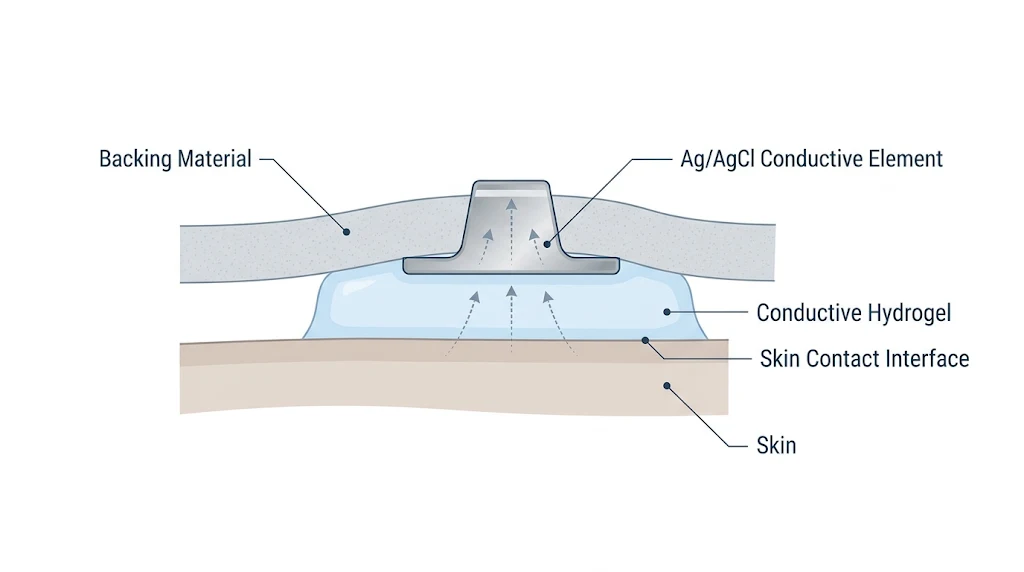
1.2 Common Components of a Pre-Gelled ECG Electrode
A typical disposable pre-gelled ECG electrode may include several functional layers or components.
Backing material
The backing provides mechanical support and helps maintain the electrode's shape. Depending on the design, it may use foam, nonwoven material, or a flexible film.
Conductive element
The conductive element provides the electrical connection between the skin-contacting interface and the ECG lead wire. Silver/silver chloride (Ag/AgCl) is a commonly used electrode material for disposable ECG electrodes.
Conductive hydrogel
The hydrogel provides a moist conductive interface between the electrode and the skin. Its formulation can influence electrical contact, adhesion, handling, and product stability.
Protective liner
A release liner may cover the gel before application to protect the contact surface and help preserve product condition during storage.
Not every ECG electrode uses the same construction. Material selection and layer configuration should be determined by the product's intended application and design requirements.
2. What Are Wet ECG Electrodes?
Wet ECG electrodes are electrodes that use a conductive gel or electrolyte medium to establish the electrical interface with the skin.
The term describes the presence and function of a conductive medium rather than one specific manufacturing configuration.
For example, a disposable ECG electrode supplied with pre-applied hydrogel can also be described as a wet electrode.
In other designs, a conductive medium may be applied separately before the electrode is used.
2.1 How Does a Wet ECG Electrode Work?
The conductive medium helps establish electrical contact between the electrode and the skin.
The skin's outermost layer, particularly the stratum corneum, can contribute substantially to electrode-skin impedance. A suitable conductive medium helps form the electrical interface required for ECG signal acquisition.
The quality of this interface can be affected by:
- Conductive medium composition
- Contact area
- Skin preparation
- Application consistency
- Electrode material
- Contact pressure and movement
The term wet electrode should not be interpreted as a guarantee of a specific signal quality or impedance value. Actual performance must be evaluated using appropriate test methods.
2.2 Common Wet Electrode Configurations
Wet ECG electrodes can be supplied in different configurations.
Pre-applied gel electrodes
The conductive medium is applied during manufacturing. The finished product is packaged with the gel protected until use.
Separately applied conductive medium
In certain electrode systems, the conductive medium is supplied separately and applied during preparation. This configuration may be used where the electrode design or procedure requires separate gel application.
The choice between these configurations depends on the monitoring system, workflow, intended use, and product design.
3. Pre-Gelled vs. Wet ECG Electrodes: Practical Design Differences
Because pre-gelled electrodes are generally a subset of wet ECG electrodes, the comparison is best understood in terms of gel preparation and product configuration.
3.1 Gel Application and Preparation
A pre-gelled ECG electrode has its conductive medium applied during manufacturing.
This creates a ready-to-use product format, subject to the product's instructions for use and storage conditions.
A separately prepared wet electrode requires the conductive medium to be applied before or during the procedure.
For manufacturers and healthcare buyers, this difference may affect application workflow, packaging design, and product handling requirements.
3.2 Product Consistency
In a pre-gelled electrode, the amount and distribution of conductive gel can be controlled during manufacturing.
This provides an opportunity to establish defined production specifications for gel application, coverage, and finished-product inspection.
When gel is applied separately, the final amount and distribution may depend more heavily on the preparation process.
However, pre-gelling alone does not guarantee consistent performance. Gel formulation, application control, material compatibility, and finished-product testing remain important.
3.3 Storage and Packaging
Pre-gelled electrodes require packaging that helps maintain the condition of the conductive medium throughout the validated shelf life.
Packaging design should consider:
- Moisture retention
- Material compatibility
- Seal integrity
- Environmental exposure
- Storage conditions
- Product identification and traceability
For separately applied gel configurations, the electrode and conductive medium may have different packaging and storage requirements.
OEM buyers should evaluate the complete packaging system rather than considering only the electrode backing material.
3.4 Workflow and Handling
Pre-gelled electrodes can simplify routine preparation because the conductive interface is already integrated into the product.
Separately prepared wet electrode systems require an additional preparation step.
The appropriate format depends on the intended application, the healthcare workflow, and the device manufacturer's instructions.
3.5 Product Development Considerations
For pre-gelled ECG electrodes, development work often focuses on the interaction between hydrogel formulation, electrode material, adhesive properties, and packaging.
For separately prepared systems, formulation compatibility and the application process may require additional attention.
In both cases, the complete electrode interface must be evaluated under the conditions of intended use.
4. The Role of Hydrogel in ECG Electrodes
Hydrogel is one of the most important functional materials in many disposable pre-gelled ECG electrodes.
It is a water-containing polymer network designed to provide a conductive interface between the electrode and the skin.
However, not all hydrogels have identical compositions or performance characteristics. Their properties depend on polymer selection, electrolyte composition, crosslinking structure, water content, and manufacturing processes.
4.1 Electrical Conductivity and Skin-Electrode Contact
The conductive properties of hydrogel help establish an electrical pathway between the skin and the electrode's conductive element.
A suitable formulation can support stable skin-electrode contact under the intended conditions.
Relevant evaluation parameters may include:
- Electrical conductivity
- Electrode-skin impedance
- Gel distribution
- Contact area
- Signal stability under defined test conditions
It is important to distinguish the conductivity of the gel material from the overall performance of the finished electrode. The backing, conductive element, skin condition, and application method also influence the final result.
4.2 Adhesion and Contact Stability
In many pre-gelled ECG electrode designs, hydrogel also contributes to skin adhesion.
The formulation must balance several properties:
- Adequate adhesion during the intended monitoring period
- Conformability to skin contours
- Sufficient cohesive strength
- Appropriate moisture retention
- Manageable residue during removal
A hydrogel that is too soft, too fluid, or insufficiently cohesive may create handling or stability challenges.
Conversely, a formulation with unsuitable adhesion characteristics may not maintain the required contact throughout use.
The ideal balance depends on the intended application and wear duration.
4.3 Moisture Retention and Shelf Life
Water content is an important characteristic of many conductive hydrogels.
Moisture loss during storage can change the gel's physical properties and affect its contact behavior.
For pre-gelled ECG electrodes, manufacturers should evaluate the relationship between hydrogel formulation, packaging materials, sealing performance, and storage conditions.
Shelf-life claims should be supported by stability data for the finished electrode in its final packaging configuration.
4.4 Skin Compatibility
Because ECG electrodes contact the patient's skin, material selection should consider the intended contact type and duration.
Relevant considerations may include:
- Material composition
- Skin-contact duration
- Potential irritation and sensitization
- Biocompatibility evidence
- Adhesive and hydrogel compatibility
ISO 10993-related biological evaluation may be relevant depending on the product's intended use and applicable regulatory requirements.
A material's suitability should be supported by appropriate evidence rather than assumed from its general classification as medical-grade hydrogel.
5. Key Design Considerations for ECG Electrode Manufacturers
Developing a reliable ECG electrode requires coordination between conductive materials, mechanical structure, hydrogel formulation, and manufacturing processes.
The following factors are particularly important for product developers and OEM manufacturers.
5.1 Hydrogel Formulation
Hydrogel formulation affects electrical, mechanical, and physical properties.
During development, manufacturers may evaluate:
- Polymer composition
- Electrolyte content
- Water retention
- Viscosity or gel consistency
- Adhesion and cohesion
- Stability under defined storage conditions
The formulation should be selected according to the intended application rather than optimized around a single property.
For example, improving adhesion without considering moisture retention and removal behavior may create other product challenges.
5.2 Electrode Backing Materials
The backing material provides mechanical support and influences product flexibility and handling.
Common material options may include:
- Foam
- Nonwoven fabric
- Flexible polymer films
- Other application-specific substrates
Material selection should consider flexibility, dimensional stability, skin compatibility, manufacturing compatibility, and packaging requirements.
5.3 Conductive Element and Interface
The conductive element provides the electrical connection between the skin-contacting medium and the monitoring device.
Ag/AgCl is commonly used in disposable ECG electrode designs because of its established electrochemical characteristics.
The conductive element's dimensions, surface condition, and connection to the lead wire interface should be evaluated as part of the complete electrode design.
5.4 Electrode Geometry and Contact Area
Electrode shape and size influence the available contact area and mechanical interaction with the skin.
Design parameters may include:
- Electrode diameter or overall dimensions
- Gel contact area
- Conductive element position
- Backing flexibility
- Edge configuration
These specifications should be aligned with the intended monitoring application and device requirements.
5.5 Manufacturing Consistency
Hydrogel-based ECG electrodes require control over material preparation, gel application, component alignment, converting, and packaging.
For OEM manufacturers, important quality control areas may include:
- Incoming material inspection
- Hydrogel formulation control
- Gel application consistency
- Electrode dimensional inspection
- Connector and component verification
- Packaging integrity
- Batch traceability
A structured quality system helps manufacturers maintain defined product specifications across production batches.
6. OEM/ODM Considerations for ECG Electrode Buyers
For medical device brands and distributors, selecting an ECG electrode manufacturer involves more than comparing unit prices.
The supplier should be able to understand the intended application and translate technical requirements into a manufacturable product specification.
6.1 Confirm the Intended Application
Before requesting quotations, buyers should define the product's intended use.
Relevant information may include:
- Resting ECG or continuous monitoring
- Intended wear duration
- Adult or pediatric use
- Disposable or reusable configuration
- Monitoring device compatibility
- Target sales market
These details help determine suitable electrode materials and construction.
6.2 Define Material and Product Specifications
A clear product specification should include the main structural and functional requirements.
For example:
| Specification | Information to Confirm |
|---|---|
| Electrode type | Pre-gelled or separately prepared configuration |
| Conductive medium | Hydrogel or specified conductive gel |
| Conductive element | Ag/AgCl or other specified material |
| Backing | Foam, nonwoven, film, or custom substrate |
| Connector | Snap, tab, or other specified interface |
| Dimensions | Shape, diameter, length, and width |
| Gel properties | Coverage, adhesion, and relevant electrical requirements |
| Packaging | Individual pouch, multi-pack, or bulk format |
| Shelf life | Required shelf life and supporting evidence |
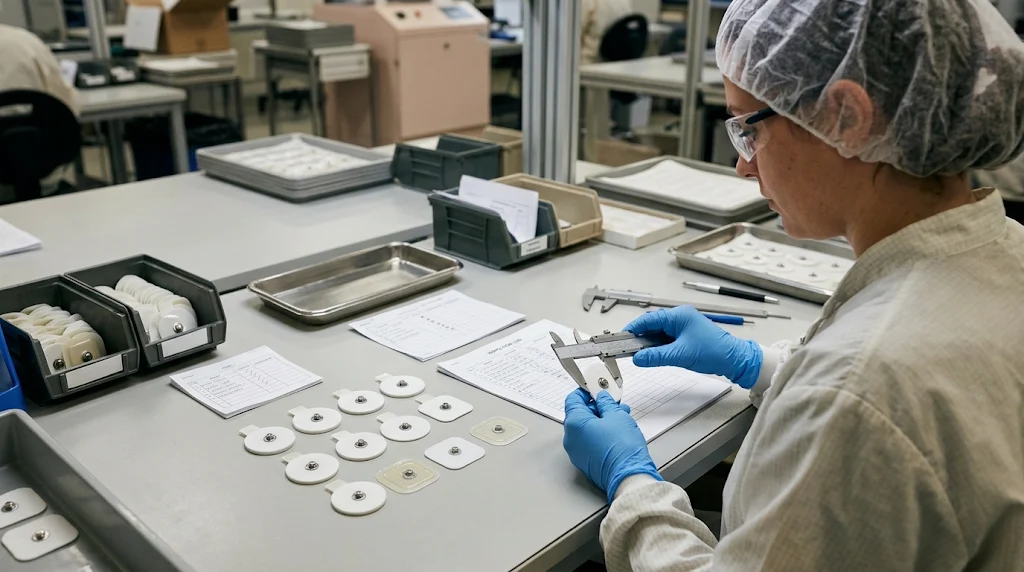
6.3 Evaluate Samples Before Mass Production
Sample evaluation is an important stage in OEM development.
Buyers should compare samples against the agreed specifications and intended use.
Depending on the project, evaluation may include:
- Physical appearance and dimensions
- Gel distribution and surface condition
- Connector compatibility
- Adhesion and removal characteristics
- Electrode-skin impedance
- Signal acquisition performance
- Packaging integrity
Any required changes should be documented and verified before mass production approval.
6.4 Review Quality and Regulatory Documentation
For medical device procurement, buyers should review the supplier's quality management system and product-specific technical documentation.
Relevant information may include:
- Quality management system certification
- Product specifications
- Material documentation
- Biocompatibility evidence, where applicable
- Performance verification reports
- Risk management documentation
- Manufacturing and batch traceability
Regulatory requirements vary by target market and product classification. Buyers should verify the actual regulatory status of the specific product rather than assume that a manufacturer's general certification covers every product.
6.5 Assess the Manufacturer's Development Capabilities
A capable OEM/ODM partner should support more than standard product supply.
Important evaluation points include:
- Hydrogel development and material control
- Electrode structure customization
- Product dimension and shape customization
- Connector compatibility assessment
- Packaging development
- Production quality control
- Technical communication and sample iteration
For products involving hydrogel, the manufacturer's understanding of material behavior and finished-product stability is particularly important.
6.6 Working with TOP-RANK Healthcare
TOP-RANK Healthcare specializes in medical conductive products and healthcare consumables, with experience in hydrogel development and electrode manufacturing.
Our product development capabilities support different electrode configurations and OEM/ODM requirements, including material selection, hydrogel-related product development, structural customization, and manufacturing quality control.
For ECG electrode projects, the development process begins with understanding the intended application and technical requirements.
This includes evaluating the electrode structure, conductive interface, backing materials, connector specifications, and packaging configuration.
By connecting material development with manufacturing processes, TOP-RANK aims to support medical device brands and distributors seeking a long-term manufacturing partner for ECG electrodes and related medical consumables.
Frequently Asked Questions
1. Are pre-gelled ECG electrodes the same as wet ECG electrodes?
2. What type of gel is used in pre-gelled ECG electrodes?
Many disposable pre-gelled ECG electrodes use conductive hydrogel. Hydrogel typically contains water, polymers, and electrolyte components. The exact formulation varies by manufacturer and product requirements.
3. What is the function of hydrogel in ECG electrodes?
4. Are Ag/AgCl electrodes always used with hydrogel?
5. What factors affect the performance of pre-gelled ECG electrodes?
Important factors include hydrogel formulation, electrode-skin impedance, conductive element design, backing material, contact area, skin preparation, application conditions, and storage stability.
6. How should OEM buyers evaluate ECG electrode hydrogel?