

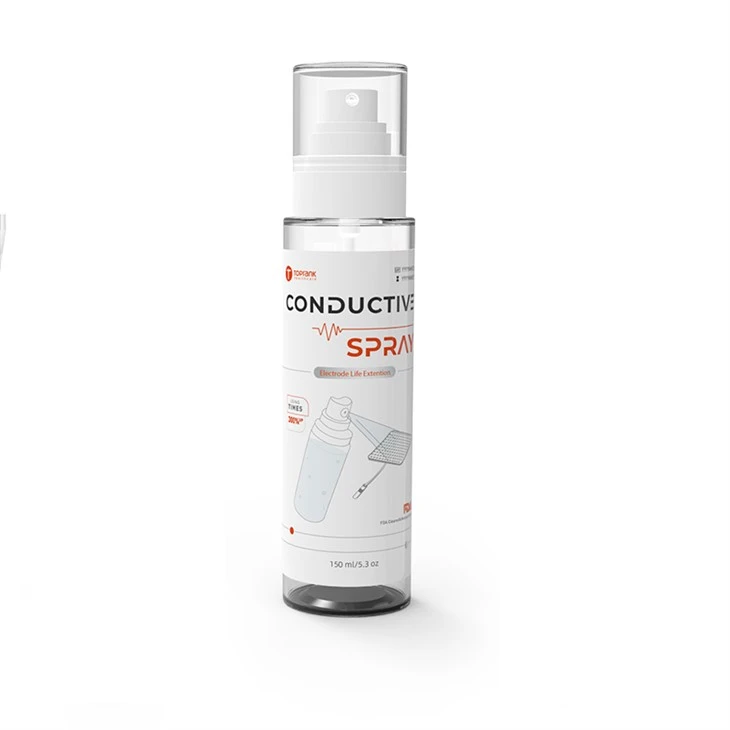
OEM TENS Electrode Conductive Spray | Hydrogel & Garment Mist | TOP-RANK
B2B contract manufacturing of TENS Electrode Conductive Spray for pad tack rejuvenation and conductive TENS garments. Engineered with 32 mN/m low-surface-tension wetting, iso-osmolar sorbitol-lactate buffering, and 0.22 um clog-free filtration.
Product Overview
TENS Electrode Conductive Spray is a metered, low-surface-tension aqueous electrolyte mist formulated for two routine clinical and home electrotherapy tasks: restoring surface tack and ionic conductivity to partially desiccated self-adhesive TENS hydrogel pads, and instantaneously wetting conductive textile garments (silver-nylon gloves, socks, knee sleeves) or dry carbon-silicone lumbar belts prior to stimulation. Delivered through a 0.28 mm swirl-chamber fine-mist actuator (0.12 mL per actuation, 45 to 65 um droplet diameter), the fluid spreads into a continuous 15 um conductive film across hairy limbs, calloused palms, and aged hydrogel slabs without dripping or leaving thick gel buildup.
Rehydrating TENS pads with tap water or spraying generic salt solutions onto wearable TENS garments triggers three distinct physical and mechanical failures:
- Osmotic Over-Swelling and Slurry Breakdown from Tap Water: Pure tap water carries near-zero osmotic pressure compared to a partially dried polyacrylate hydrogel pad. When users wet an aged pad with tap water, the steep chemical-potential gradient forces water uncontrollably into the collapsed polymer matrix, rupturing covalent crosslinks and turning the solid gel face into a slimy, non-adhesive slurry within two to three rinses.
- Droplet Beading on Sebum-Coated Skin and Conductive Knits: Unmodified water exhibits a high surface tension of 72.8 mN/m. Sprayed onto hydrophobic skin lipids, dense limb hair, or knitted conductive TENS sleeves, plain aqueous mist beads into isolated micro-droplets separated by dry air gaps. Under 50 to 80 mA TENS pulses, current concentrates through those discrete wet dots, producing sharp pin-prick stinging.
- Salt-Crystal Nozzle Seizure During Intermittent Storage: Conventional sprays rely on dissolved inorganic sodium chloride (NaCl) or potassium chloride (KCl) for conductivity. Between weekly treatments, residual liquid evaporates inside the 0.25 mm spray orifice and check-valve spring, precipitating hard salt crystals that permanently plug the actuator head.
Our TENS Electrode Conductive Spray resolves these breakdown modes through calibrated surface chemistry and liquid-phase organic electrolytes: an iso-osmolar sorbitol, betaine, and potassium lactate matrix (water activity Aw = 0.78) that re-swells dry TENS hydrogel pads back to equilibrium tack (>82% peel recovery) without network rupture; 0.18% non-ionic alkyl polyglucoside surfactant dropping surface tension to 32–36 mN/m for instant sheet wetting across hair and conductive knits; and zero-crystallizing deliquescent electrolytes filtered to 0.22 um so spray nozzles never crust or jam across 180 days of intermittent use. We supply private-label 60 mL, 120 mL, and 250 mL mist bottles and bulk refill jugs for DME resupply networks, TENS garment brands, and physical therapy distributors.
Technical & Engineering Description
Manufacturing of TENS Electrode Conductive Spray executes inside ISO 13485-certified Class 8 cleanrooms across closed 316L stainless steel compounding tanks, dual-stage sterile membrane filtration skids, and rotary liquid-filling monoblocks. Because mist performance depends directly on particle-free clarity and precise surface-tension control, production runs through four sequential engineering stages:
- EDI Water Purification & Iso-Osmolar Organic Solvation: Feedwater passes through dual-stage reverse osmosis and continuous electrodeionization (>18.0 MOhm-cm) to remove divalent calcium and magnesium carbonates that scale spray nozzles. Inside a 316L vessel at 30C, liquid-phase potassium lactate, sodium PCA, zwitterionic betaine, and D-sorbitol dissolve under gentle paddle mixing until inline four-electrode meters lock bulk conductivity between 12.0 and 16.0 mS/cm and water activity within 0.76 to 0.80.
- Non-Ionic Wetting Surfactant Blending & pH Buffering: Pharmaceutical-grade alkyl polyglucoside (0.18% wt) and a paraben-free phenoxyethanol/ethylhexylglycerin preservative pair meter into the vortex at low speed (<300 RPM) to prevent foaming while lowering surface tension to 32–36 mN/m. Citric acid titrates final pH to 5.60–6.20.
- Dual-Stage 0.22 um PES Membrane Filtration: Before holding-tank transfer, the entire batch pumps through a 1.0 um pleated polypropylene pre-filter followed by a 0.22 um polyethersulfone (PES) sterilizing-grade cartridge. Stripping sub-micron particulate and microbial load prevents physical blockage of 0.28 mm swirl-chamber orifices during field use.
- Automated Rotary Filling, Torque Capping & Spray-Pattern Verification: Positive-displacement stainless filling nozzles dose 60 mL, 120 mL, or 250 mL into chemical-resistant HDPE or PET bottles. Automated torque cappers seat 24/410 ribbed fine-mist spray pumps (0.12 mL/stroke, stainless steel 316 spring isolated from the fluid path) over induction-sealed tamper-evident necks. Inline statistical sampling checks spray cone angle (55° +/- 5°) and Sauter mean droplet diameter (45–65 um) on every production lot (MOQ: 5,000 bottles).
Key Features
-
Iso-Osmolar Hydrogel Rehydration (Restoring >82% Peel Tack on Aged TENS Pads Without Osmotic Slurry Collapse)
Self-adhesive TENS electrodes lose surface tack over 10 to 15 uses primarily through moisture evaporation from the top 0.15 mm of the crosslinked polyacrylate slab. When patients rinse or spray dry pads with plain tap water, the near-zero osmotic potential of pure water creates a steep thermodynamic driving gradient into the dry gel. Uncontrolled water influx over-swells the polymer mesh past its elastic yield limit, severing covalent crosslinks and turning the solid gel into a slippery, non-sticky paste.
Our spray matches the internal solvent phase of commercial polyacrylate hydrogels via a calibrated sorbitol, betaine, and potassium lactate balance (Aw = 0.76 to 0.80). Applying 1 to 2 fine mists (0.12 to 0.24 mL) across a dried 50x50 mm pad re-hydrates the collapsed surface layer gradually back to equilibrium mesh spacing while flushing surface skin lipids-restoring >82% of baseline 180° peel tack across 15+ extra applications without softening the bulk slab.
-
32–36 mN/m Low-Surface-Tension Micro-Atomization (Instant Sheet Wetting Across Hairy Limbs and Conductive Knits)
Plain water and basic saline solutions possess high surface tension (72.8 mN/m), causing sprayed droplets to bead up on hydrophobic skin oils, dense leg or arm hair, and knitted silver-nylon TENS garments (gloves, socks, and knee sleeves). Those isolated water beads leave dry dielectric air pockets between droplets; when a TENS console delivers a 60 mA pulse, current funnels violently through the wet beads, triggering acute stinging shocks.
Adding 0.18% non-ionic alkyl polyglucoside surfactant lowers surface tension by over 50% to 32–36 mN/m. Atomized through a 0.28 mm swirl-chamber nozzle into 45 to 65 um micro-droplets, the mist collapses immediately upon contact into a continuous 15 um conductive film across hair shafts and tight silver-yarn interstices, dropping 1 kHz skin-garment contact impedance below 35 Ohms within 3 seconds.
-
Deliquescent Liquid-Phase Organic Electrolytes (Zero Salt-Crust Nozzle Clogging and Halide-Free Silver Protection)
Standard conductive sprays dissolve inorganic NaCl or KCl salts that crystallize into hard white crusts whenever water evaporates at the 0.25 mm spray orifice between treatments, jamming check valves and forcing premature bottle disposal. Simultaneously, concentrated chloride ions corrode the silver plating on reusable TENS gloves and socks under electrical bias.
Formulating with deliquescent, non-crystallizing liquid organic electrolytes (potassium lactate and sodium PCA, total chloride <20 ppm) paired with 0.22 um PES membrane filtration keeps the spray orifice completely free of dry salt crusts across 180 days of intermittent 40C/25% RH bench cycling, while preventing anodic pitting on silver-nylon garments and carbon-silicone belts.
Applications
Conductive Silver-Fiber TENS Garments (Gloves, Socks, Knee & Elbow Sleeves)
Sourced by DME neuropathy distributors, arthritis care brands, and conductive garment OEMs bundling spray bottles with reusable silver-nylon gloves and socks; the 32–36 mN/m mist penetrates dense knitted silver yarns instantly without leaving sticky gel residue inside the fabric, while <20 ppm chloride purity protects silver coatings across 500+ wash-and-wear cycles.
Self-Adhesive TENS Pad Life-Extension & DME Home-Care Replenishment Kits
Deployed as a high-margin add-on consumable by OTC pain-relief brands, pharmacy chains, and e-commerce TENS unit sellers; misting 1 to 2 strokes onto partially dried hydrogel pads restores >82% of original peel adhesion without osmotic slurry breakdown, cutting patient pad-replacement complaints and boosting accessory attachment rates.
Dry Carbon-Silicone TENS Lumbar Belts & Hairy-Limb Sports Rehab
Utilized by wearable TENS/EMS lumbar belt manufacturers and outpatient physical therapy clinics treating male athletes with dense limb hair; the 45–65 um micro-mist wets beneath hair shafts and across dry carbon-silicone belt electrodes evenly without staining waistbands or requiring post-session towel wash-offs.
OEM & Private Label
-
Bottle Sizing, Actuator Hardware & Private-Label Serialization :
• Standard Container Sizes: 60 mL (2 oz) pocket travel HDPE/PET mist bottles (ideal for retail TENS unit starter kits); 120 mL (4 oz) and 250 mL (8.5 oz) ergonomic fine-mist spray bottles; and 1-Liter / 5-Liter clinic bulk refill jugs.
• Actuator & Valve Hardware: 24/410 ribbed fine-mist spray pumps (0.12 mL/stroke, 0.28 mm swirl orifice, isolated 316 stainless spring outside fluid path); optional trigger sprayers for 250 mL clinic bottles; clear protective over-caps and tamper-evident shrink sleeves.
• Private-Label Printing & Compliance: Waterproof matte/gloss BOPP wrap labels, direct screen printing, multi-language clinical IFUs, Amazon FNSKU barcoding, and GS1/UDI batch serialization (baseline MOQ: 5,000 bottles).
-
China-Vietnam Dual-Center Supply Chain Allocation : EDI water conditioning, iso-osmolar potassium lactate/betaine compounding, non-ionic surfactant blending, and 0.22 um PES sterile membrane filtration execute inside our ISO 13485:2016 and FDA 21 CFR 820 registered China plant. Automated bottle filling, isolated-spring mist pump capping, induction foil sealing, labeling, and palletized ocean export route through our Vietnam manufacturing hub to shield North American and European buyers from Section 301 tariffs.
Certifications
-
ISO 10993 Dermal Biocompatibility & Chemical Purity : Production lots pass independent GLP laboratory screening confirming ISO 10993-5 (In Vitro Cytotoxicity: Grade 0), ISO 10993-10 (Skin Sensitization: 0% allergic response), and ISO 10993-23 (Primary Dermal Irritation Index = 0.0). Certified free of ethyl/isopropyl alcohol, inorganic chloride salts (<20 ppm Cl-), parabens, synthetic fragrances, and mineral oils.
-
Surface Tension, Atomization & Microbiological Verification : Verified per Wilhelmy plate tensiometry (32.0–36.0 mN/m), laser diffraction droplet sizing (45–65 um SMD), four-electrode conductivity (12.0–16.0 mS/cm), USP <791> (pH 5.60–6.20), USP <51> (28-day antimicrobial effectiveness), and USP <61>/<62> (<10 CFU/mL bioburden, zero pathogens).
-
ISO 13485:2016 & MDSAP Electronic Traceability : Compounding tanks, 0.22 um PES filtration skids, and Class 8 liquid filling lines operate under ISO 13485:2016 and MDSAP audits. Electronic Device History Records (DHR) archive EDI water resistivity, filter integrity pressure-hold logs, surface tension readings, conductivity titration logs, and torque-cap seal checks per production lot.
Technical FAQ
Q: Why does spraying plain tap water onto a drying TENS pad ruin the hydrogel after 2–3 uses, whereas this iso-osmolar conductive spray restores tack for 15+ extra sessions?
Solid self-adhesive TENS hydrogels are covalently crosslinked polyacrylate networks equilibrated with specific humectants and salts. Pure tap water has near-zero osmotic pressure compared to a partially dehydrated gel slab. Spraying tap water creates an uncontrolled osmotic influx that stretches polymer chains beyond their mechanical rupture threshold, breaking covalent crosslinks and turning the gel into a slimy, non-sticky paste. Our TENS Electrode Conductive Spray uses an iso-osmolar sorbitol, betaine, and potassium lactate balance (Aw = 0.76 to 0.80) that matches the pad's internal solvent equilibrium. One to two light mists (0.12 to 0.24 mL) re-swell collapsed surface chains gently without exceeding crosslink limits, recovering >82% of original 180° peel tack.
Q: What stops the 0.28 mm fine-mist nozzle from clogging with salt crystals when a clinic or home user leaves the bottle sitting between treatments?
Conventional conductive sprays rely on crystalline inorganic salts (NaCl or KCl) that precipitate into solid white crusts inside the 0.25 mm spray orifice and check-valve spring whenever water evaporates between uses. Our formulation replaces crystalline halides entirely with deliquescent, liquid-phase organic electrolytes (potassium lactate and sodium PCA, total chloride <20 ppm) and passes the finished liquid through a 0.22 um PES membrane filter. Combined with an isolated 316 stainless spring pump that keeps metal parts outside the fluid channel, the nozzle remains crust-free and delivers consistent 45–65 um atomization across 180 days of intermittent storage.
DME replenishment distributors, conductive TENS garment brands, and electrotherapy device OEMs can request batch Certificates of Analysis (COA), Wilhelmy plate surface tension logs (32–36 mN/m), laser diffraction droplet sizing reports (45–65 um SMD), 15-cycle hydrogel tack recovery curves (>82%), 180-day nozzle anti-clog test data, ISO 10993 biocompatibility files, and unbranded 60 mL or 120 mL fine-mist evaluation bottles.
👉 [Request 120 mL TENS Electrode Conductive Spray Evaluation Bottles]
Hot Tags: tens electrode conductive spray, China tens electrode conductive spray manufacturers, suppliers, factory
Specifications
| Engineering Domain | Target Specification | Verification Protocol |
| Electrolyte Chemistry | Potassium Lactate + Sodium PCA + Betaine (Chloride < 20 ppm) | Ion chromatography |
| Bulk Conductivity | 12.0 to 16.0 mS/cm at 25C (Volume Resistivity: 62–83 Ohm-cm) | Four-electrode conductivity cell |
| Surface Tension | 32.0 to 36.0 mN/m at 25C (0.18% Non-Ionic Alkyl Polyglucoside) | Wilhelmy plate tensiometer |
| Atomized Droplet Size | Sauter Mean Diameter (SMD): 45 to 65 um; 0.12 mL/Stroke | Laser diffraction analyzer |
| Iso-Osmolar Water Activity | Water Activity Aw = 0.76 to 0.80 (Osmolarity Matched to Pads) | Chilled-mirror dew point |
| Hydrogel Tack Recovery | > 82% Baseline 180° Peel Tack Recovery after 15 Re-Mists | ASTM D3330 bench trial |
| Kinematic Viscosity | 1.8 to 2.6 cP at 25C (Newtonian Sprayable Fluid) | Ubbelohde viscometer |
| Nozzle Anti-Clog Endurance | Zero Orifice Crusting or Valve Seizure after 180-Day Intermittent Use | Dry-down cycling bench (40C / 25% RH) |
| Sterile Membrane Filtration | Dual-Stage 1.0 um Polypropylene + 0.22 um PES Membrane | Inline integrity pressure-hold test |
| Physiological pH Window | pH 5.60 to 6.20 at 25C (Lactate-Citrate Buffer) | USP <791> pH meter |
| Textile & Metal Passivity | Zero Silver-Yarn Oxidation or Carbon-Belt Swelling after 500 Cycles | 40C immersion & DC bias assay |
| Microbial Bioburden | Total Aerobic Count < 10 CFU/mL; Zero Pathogens | USP <61> / <62> & USP <51> |
| Packaging & Order MOQ | 60 mL / 120 mL / 250 mL HDPE Mist Bottles, 5 L Refills; MOQ: 5,000 | 36-Month shelf life |


