

Ultrasound Gel Pad vs. Ultrasound Gel: Key Differences
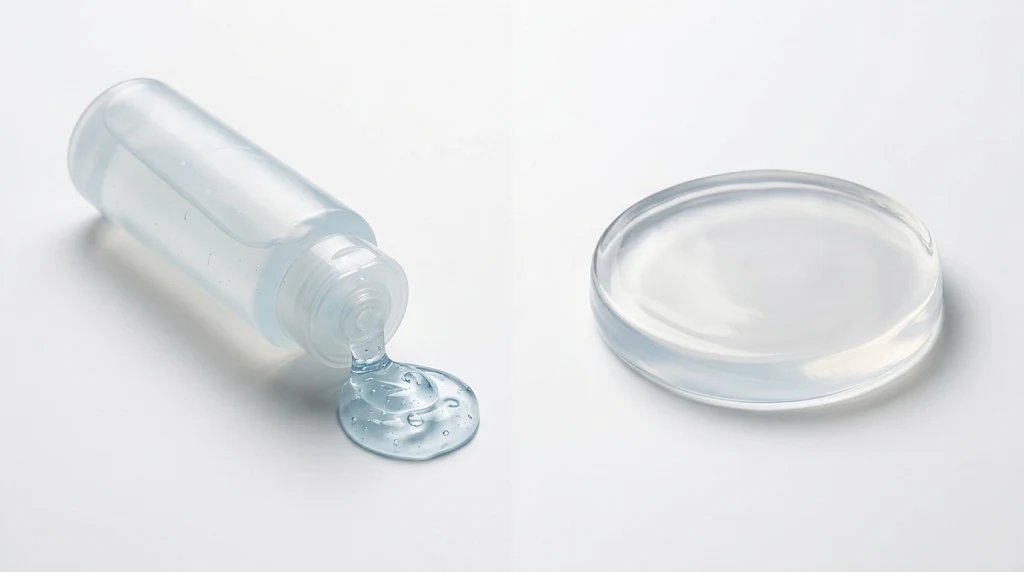
Ultrasound imaging and ultrasound-based medical applications rely on effective acoustic coupling between the transducer and the patient's body. Because air trapped between the transducer and the skin can interfere with sound wave transmission, a suitable coupling medium is essential for reducing the acoustic mismatch at the contact interface.
Two commonly discussed coupling solutions are conventional ultrasound gel and preformed ultrasound gel pads.
Although both are designed to support acoustic coupling, they differ in physical form, application method, handling requirements, and potential use cases. Understanding these differences is important for medical device manufacturers, healthcare product developers, and procurement teams evaluating coupling solutions for specific applications.
For OEM and ODM buyers, the decision involves more than choosing between a liquid gel and a preformed pad. Product dimensions, acoustic properties, material compatibility, packaging, intended use, and regulatory requirements must also be considered.
This guide compares ultrasound gel pads and conventional ultrasound gel, explains their respective applications, and outlines key factors to evaluate when sourcing ultrasound coupling products.
Quick Answer: What Is the Difference Between an Ultrasound Gel Pad and Conventional Ultrasound Gel?
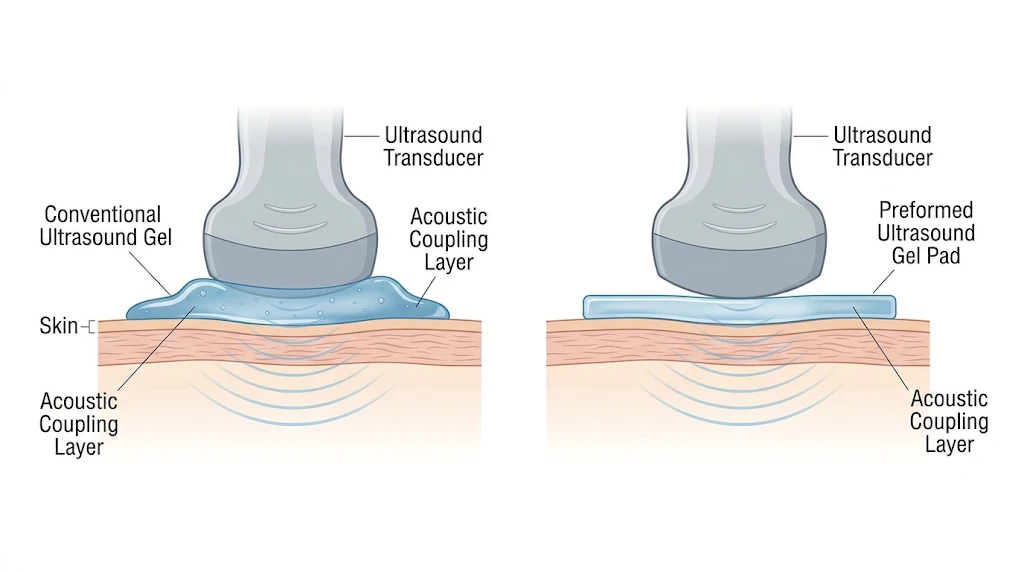
An ultrasound gel pad is a preformed coupling medium supplied in a defined shape and thickness. Conventional ultrasound gel is generally a liquid or semi-liquid gel applied directly to the skin or transducer during use.
Both products help establish an acoustic coupling interface, but they are not automatically interchangeable.
| Comparison | Ultrasound Gel Pad | Conventional Ultrasound Gel |
|---|---|---|
| Physical form | Preformed gel pad | Liquid or semi-liquid gel |
| Application method | Positioned between the transducer and the target surface according to product instructions | Applied directly to the skin or transducer |
| Shape and dimensions | Available in defined configurations | Dispensed and spread during use |
| Handling | Requires placement and appropriate positioning | Requires dispensing and spreading |
| Product consistency | Manufactured to specified dimensions and material properties | Formulation and dispensing characteristics determine consistency |
| Packaging | Often individually packaged or supplied in designated packaging formats | Commonly supplied in bottles, tubes, or containers |
| Product customization | May include thickness, dimensions, shape, and packaging options | May include formulation, viscosity, container, and volume options |
| Selection priority | Application-specific geometry, acoustic performance, and handling | Acoustic coupling, spreadability, viscosity, and ease of removal |
The appropriate choice depends on the ultrasound system, intended application, device instructions, and required workflow.
1. What Is Conventional Ultrasound Gel?
Conventional ultrasound gel is a coupling medium commonly used during diagnostic ultrasound examinations and other ultrasound applications.
It is typically a water-based formulation designed to reduce air gaps between the ultrasound transducer and the skin. By creating a continuous contact medium, the gel helps ultrasound waves pass through the interface more effectively.
1.1 How Does Conventional Ultrasound Gel Work?
When an ultrasound transducer is placed against the skin, microscopic air gaps can remain between the two surfaces.
Because air has a substantially different acoustic impedance from human tissue, these gaps can cause significant reflection of ultrasound energy.
Conventional ultrasound gel fills the space between the transducer and the skin, helping establish a more continuous acoustic pathway.
Its effectiveness depends on factors such as:
- Acoustic properties of the formulation
- Viscosity and spreadability
- Contact between the transducer and the skin
- Application amount and coverage
- Compatibility with the intended ultrasound procedure
1.2 Common Characteristics
Conventional ultrasound gel is generally valued for its straightforward application and broad availability.
Typical characteristics include:
- Easy dispensing from bottles or tubes
- Flexible coverage of different skin areas
- Ability to spread across irregular contact surfaces
- Availability in different viscosities and packaging sizes
- Convenient use in routine ultrasound examinations
However, the application process requires dispensing and spreading the gel. The amount used and coverage achieved may vary depending on the operator and procedure.
2. What Is an Ultrasound Gel Pad?
An ultrasound gel pad is a preformed coupling medium manufactured into a defined shape and thickness.
Unlike conventional gel, which is dispensed during application, a gel pad is supplied as a ready-to-position product.
Depending on its design and intended use, the pad may be placed between an ultrasound transducer and the target surface to establish the required coupling interface.
2.1 How Does an Ultrasound Gel Pad Work?
An ultrasound gel pad provides a defined physical layer between the transducer and the target surface.
Its acoustic function depends on the material formulation, thickness, contact conditions, and compatibility with the intended ultrasound system.
Important product characteristics may include:
- Acoustic impedance
- Attenuation characteristics
- Material homogeneity
- Thickness consistency
- Surface contact properties
- Mechanical stability during handling
A properly designed pad must be evaluated as part of the complete ultrasound system and its intended application.
2.2 Common Characteristics
Compared with conventional gel, a preformed gel pad offers a different product format and handling approach.
Depending on the product design, potential characteristics include:
- Defined dimensions and thickness
- Ready-to-use product format
- Consistent physical geometry
- Application-specific shapes
- Individually packaged configurations
- Customizable product specifications for OEM programs
Not every ultrasound gel pad has the same material composition, adhesive properties, or intended use. Buyers should evaluate the actual product specifications rather than assume that all gel pads share identical characteristics.
3. Ultrasound Gel Pads vs. Conventional Ultrasound Gel: Key Differences
Although both products serve acoustic coupling purposes, their differences can influence product design, clinical workflow, and procurement decisions.
3.1 Physical Form and Product Structure
The most visible difference is the physical form.
Conventional ultrasound gel is a dispensable material. Its coverage is determined during application.
An ultrasound gel pad is manufactured into a defined physical format. Its dimensions, thickness, and shape can be specified during product development.
For OEM buyers, this distinction affects product design, manufacturing requirements, packaging, and user instructions.
3.2 Application and Handling
Conventional gel is dispensed and spread before the transducer is positioned.
A preformed gel pad is positioned according to the instructions for its intended application. Its placement and contact conditions are important to achieving the required acoustic interface.
Neither format is universally easier or better. The preferred option depends on the procedure, equipment design, and operator workflow.
3.3 Acoustic Coupling Performance
Acoustic coupling is a critical consideration for both products.
However, the physical format alone does not determine performance.
Relevant evaluation parameters may include:
- Acoustic impedance
- Attenuation at the intended operating frequencies
- Transmission characteristics
- Thickness and dimensional consistency
- Contact quality and air-gap control
- Stability under specified storage and use conditions
For a gel pad, thickness and material uniformity are especially important design considerations. For conventional gel, formulation properties, coverage, and application consistency are important.
Performance should be validated under representative operating conditions rather than inferred from product appearance or material category.
3.4 Packaging and Storage
Packaging requirements can differ significantly between the two product formats.
Conventional ultrasound gel is commonly packaged in bottles, tubes, or larger containers. Its packaging is designed for dispensing, storage, and repeated handling where applicable.
Ultrasound gel pads may require packaging that protects their shape, surface condition, and material properties during transportation and storage.
For OEM programs, packaging considerations may include:
- Individual or bulk packaging
- Moisture and environmental protection
- Material compatibility
- Packaging integrity
- Labeling and traceability
- Shelf-life validation
The appropriate packaging configuration should be determined by the product's validated stability requirements and intended distribution conditions.
3.5 Customization and OEM Development
Both products can be developed for different customer requirements, but their customization priorities are different.
For conventional ultrasound gel, customization may focus on formulation, viscosity, packaging volume, and dispensing format.
For ultrasound gel pads, development may focus on:
- Pad dimensions
- Thickness
- Shape and cutting specifications
- Material formulation
- Surface characteristics
- Packaging configuration
- Product labeling
For medical device brands, the ability to define and consistently manufacture these specifications is an important part of supplier evaluation.
4. When Should You Choose an Ultrasound Gel Pad?
An ultrasound gel pad may be considered when an application requires a preformed coupling interface with defined physical dimensions.
Potential selection scenarios include:
Application-specific coupling requirements
Some ultrasound applications may require a coupling medium with a defined shape or thickness. A preformed pad can be developed around those requirements.
Standardized product configurations
For medical device manufacturers, a defined product format may simplify product specification, packaging design, and manufacturing control.
OEM product integration
When an ultrasound accessory is being developed as part of a larger medical device or equipment package, a gel pad can be designed around the device's interface requirements.
Specific handling and workflow requirements
Where the intended procedure and validated instructions call for a preformed coupling product, a gel pad may be more appropriate than a dispensable gel.
However, conventional ultrasound gel remains a widely used solution for routine ultrasound examinations and applications where flexible dispensing and coverage are required.
The final decision should always be based on the intended use, equipment compatibility, and validated performance requirements.
5. Key Considerations for Medical Device OEM Buyers
Selecting an ultrasound gel pad for an OEM or ODM project requires a systematic evaluation of product design, material performance, manufacturing consistency, and regulatory documentation.
5.1 Acoustic Performance
Acoustic properties should be among the first evaluation criteria.
Depending on the intended application, buyers may request data related to:
- Acoustic impedance
- Attenuation
- Transmission performance
- Frequency range
- Thickness consistency
Test methods and acceptance criteria should be defined based on the actual ultrasound system and intended use.
A supplier should be able to explain how product specifications relate to the application rather than simply provide a general claim of high acoustic performance.
5.2 Material Composition and Biocompatibility
The material composition of an ultrasound gel pad can influence its acoustic properties, mechanical behavior, stability, and skin-contact suitability.
OEM buyers should evaluate:
- Material composition and consistency
- Relevant biocompatibility evidence
- Skin-contact duration and contact type
- Potential irritation or sensitization concerns
- Compatibility with packaging materials
Biocompatibility requirements should be determined according to the intended use and applicable regulatory framework. Do not assume that testing performed on one material or product automatically applies to another formulation.
5.3 Dimensions and Thickness Tolerances
Dimensions and thickness should be defined before production.
Important specifications may include:
- Length and width
- Thickness
- Shape and edge profile
- Dimensional tolerances
- Surface uniformity
These parameters should be controlled during manufacturing and verified through an appropriate inspection process.
5.4 Packaging and Shelf-Life Validation
Packaging should protect the product throughout manufacturing, transportation, storage, and distribution.
Buyers should review:
- Packaging material specifications
- Seal integrity
- Environmental protection
- Storage conditions
- Shelf-life evidence
- Batch identification and traceability
Shelf-life claims should be supported by appropriate stability data for the finished product and its packaging configuration.
5.5 Regulatory Documentation
Regulatory requirements depend on the product's intended use, classification, market, and applicable regulations.
OEM buyers should confirm which regulatory documentation applies to the specific product being sourced.
Potential documents to review include:
- Product specifications
- Material information
- Risk management documentation
- Biocompatibility evidence, where applicable
- Performance verification reports
- Manufacturing quality system documentation
- Applicable regulatory clearance or registration information
An FDA 510(k) clearance is specific to the cleared device and its documented indications for use. It should not be interpreted as blanket clearance for every product manufactured by the same supplier.
6. OEM/ODM Ultrasound Gel Pad Manufacturing
For medical device brands and distributors, selecting an ultrasound gel pad manufacturer is not simply a matter of comparing unit prices.
A qualified manufacturing partner should understand the relationship between material formulation, product geometry, acoustic requirements, packaging, and production consistency.
6.1 Product Development and Specification Confirmation
Before production, the manufacturer and buyer should confirm the key product requirements.
These may include:
- Intended application
- Target ultrasound equipment or transducer
- Required dimensions and thickness
- Material characteristics
- Acoustic performance requirements
- Packaging and labeling specifications
Clear specifications help reduce misunderstandings during sampling and mass production.
6.2 Sample Evaluation and Design Verification
Samples should be evaluated against agreed product specifications.
Depending on the project, evaluation may include:
- Dimensional inspection
- Thickness measurement
- Material appearance and uniformity
- Acoustic performance testing
- Packaging compatibility
- Stability evaluation
Any design changes should be documented and assessed before production approval.
6.3 Manufacturing Consistency and Quality Control
For OEM projects, repeatability across production batches is essential.
Manufacturing controls should address relevant stages, including material preparation, forming or processing, dimensional control, packaging, and final inspection.
A supplier should be able to demonstrate how product specifications are monitored and how nonconforming products are managed.
6.4 FDA 510(k) Clearance and Product-Specific Verification
Regulatory status is an important consideration when sourcing medical device products for the US market.
TOP-RANK Healthcare's AutoGel Pad has received FDA 510(k) clearance under K260575.
The cleared device is identified as AutoGel Pad, with model numbers 400-046 and 400-005.
Buyers should review the official FDA database entry and confirm that the specific device, model, intended use, and regulatory documentation match their project requirements.
FDA 510(k) clearance applies to the identified cleared device and should not be generalized to other products or configurations.
Official FDA database:
https://www.accessdata.fda.gov/scripts/cdrh/cfdocs/cfTPLC/tplc.cfm?ID=5911
6.5 Working with TOP-RANK Healthcare
TOP-RANK Healthcare develops and manufactures medical conductive products and healthcare consumables, with experience in hydrogel-based product development and OEM/ODM manufacturing.
For ultrasound gel pad projects, our focus includes product specification alignment, material development, dimensional requirements, packaging, and manufacturing quality control.
With manufacturing operations in China and Vietnam, TOP-RANK supports business partners seeking a manufacturing supplier for medical coupling products and related healthcare consumables.
Whether you are developing a new ultrasound accessory or evaluating an existing product for a private-label program, clearly defined technical requirements are the starting point for a reliable OEM partnership.

Frequently Asked Questions
1. What is the main difference between an ultrasound gel pad and ultrasound gel?
2. Can an ultrasound gel pad replace conventional ultrasound gel?
Not in every application. Whether a gel pad can replace conventional ultrasound gel depends on the ultrasound equipment, intended procedure, product specifications, and manufacturer instructions. The two products should not be treated as universally interchangeable.
3. Are ultrasound gel pads used for diagnostic ultrasound?
4. What specifications should buyers evaluate when sourcing ultrasound gel pads?
5. Can ultrasound gel pads be customized for OEM projects?
Yes. Depending on the manufacturer's capabilities, OEM customization may include dimensions, thickness, shape, material formulation, packaging, labeling, and other agreed product specifications.
6. What regulatory documentation should an ultrasound gel pad manufacturer provide?