
OEM Silver-Conductive Carbon TENS Electrodes | Low-Resistance Pads | TOP-RANK
B2B contract manufacturing of Silver-Conductive Carbon TENS Electrodes. Engineered with a bilayer silver-lattice on conductive carbon-polyolefin (<4.5 Ohm/sq), carbon-veil AgCl passivation, and <1.2C thermal rise under 100 mA EMS loads.
Product Overview
High-output neuromuscular stimulation (EMS/NMES), Russian current, and 4,000 Hz interferential therapy push 60 mA to 100 mA pulses through cutaneous electrodes for 30 to 60 minutes per session. Standard extruded carbon-only pads (40 to 60 Ohm/sq sheet resistance) dissipate excessive I2R heat around the leadwire hub under these loads, while flood-coated full-silver electrodes printed on non-conductive PET crack along bend lines and oxidize into dark silver chloride (AgCl) stains during shelf storage. Silver-Conductive Carbon TENS Electrodes bridge that gap by pairing a ductile 50 um carbon-loaded polyolefin film with a sparse geometric silver-flake lattice, delivering <4.5 Ohm/sq planar conductance at roughly 35% of the precious-metal material cost of full-silver pads.
Using single-layer carbon films or unpassivated full-silver inks across high-current rehabilitation and athletic conditioning exposes three distinct electromechanical failures:
- Hub-Zone Joule Heating & Waveform Attenuation in Carbon-Only Pads: At 80 to 100 mA peak current, passing charge across a 50 Ohm/sq carbon film generates localized I2R heating directly beneath the wire junction. Surface temperature rises 4C to 6C within 20 minutes, softening the hydrogel locally and blunting steep pulse rise times required for fast-twitch motor unit recruitment.
- Flex-Crease Open-Circuit Islands in Full-Silver PET Electrodes: Silver thick-film inks are rigid, flake-filled composites. When printed directly onto non-conductive PET or cloth and flexed repeatedly over shoulders, knees, or quadriceps, hairline cracks propagate across the silver layer, isolating entire quadrants into non-conductive dead zones.
- Chloride-Driven Silver Oxidation (AgCl Blackening) in Storage: When aqueous chloride hydrogels sit directly against exposed metallic silver traces, free chloride ions oxidize metallic silver into non-conductive dark brown AgCl within 6 to 9 months, driving pad impedance past 150 Ohms prior to clinical use.
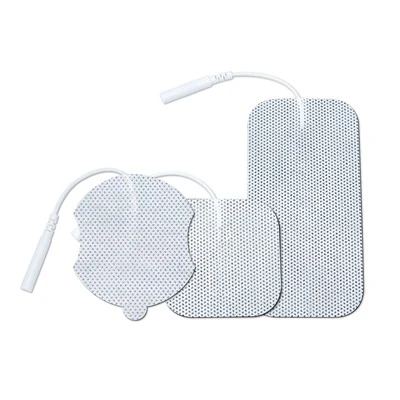
Our bilayer conductor resolves these limits by printing a radial hexagonal silver-flake lattice directly onto the backing face of an already conductive carbon-polyolefin film (35 to 45 Ohm/sq), or sealing the printed silver grid beneath a 12 um conductive carbon passivation veil. The silver lattice drops planar resistance below 4.5 Ohm/sq to cut I2R heat loss by over 90%, the ductile carbon sheet acts as a fail-safe shunt across any flex micro-fissures, and the hydrophobic carbon barrier isolates metallic silver from direct hydrogel chloride contact across a 36-month shelf life. We supply private-label silver-carbon electrodes in 50x50 mm, 50x90 mm, 75x130 mm, and custom die-cut shapes with 2.0 mm pin sockets or 3.5 mm snap studs for clinical electrotherapy OEMs, sports medicine brands, and hospital distributors.
Technical & Engineering Description
Production of Silver-Conductive Carbon TENS Electrodes runs inside ISO 13485-certified Class 8 cleanrooms across automated flatbed/rotary screen-printing bays, controlled-atmosphere thermal sintering ovens, and high-speed rotary converting lines. Unlike full-silver electrodes printed on insulating PET film, this assembly integrates metallic silver ink directly with an extruded conductive polyolefin sheet across five sequential manufacturing stages:
- Conductive Carbon-Polyolefin Cast Extrusion: Medical-grade low-density polyethylene compounded with high-structure conductive furnace black is cast-extruded into a 50 um pinhole-free film held to an isotropic sheet resistance of 35 to 45 Ohm/sq. Both surfaces undergo inline corona discharge treatment (>50 dynes/cm) to anchor silver thick-film binder resins without adhesive primers.
- Geometric Silver-Flake Lattice Printing & Sintering: A precision rotary screen deposits a 65%-solids micronized silver-flake polymer ink (dry thickness 10 to 12 um, trace width 0.5 mm) in a radial hexagonal lattice across the carbon film, covering 18% to 24% of the surface area rather than a costly 100% flood coat. The web cures through a three-zone convection tunnel ramping from 95C to 135C over 18 minutes, fusing silver flakes into a <4.5 Ohm/sq low-resistance grid bonded molecularly to the carbon sheet.
- Inverted-Side Orientation or 12 um Carbon Passivation Veil: To halt chloride-driven AgCl blackening during 36-month storage, the printed silver lattice is either oriented facing away from the hydrogel (sealed against the outer backing adhesive while electrons transfer vertically through the 50 um conductive carbon film) or over-coated with a 12 um hydrophobic conductive carbon passivation ink cured at 115C. Both architectures isolate metallic silver from direct aqueous chloride exposure while preserving <4.5 Ohm/sq lateral conductance.
- Ultrasonic Busbar Staking & Textile Lamination: Multi-strand tinned copper leadwires terminated with injection-molded 2.0 mm female phosphor-bronze sockets (or cold-headed 3.5/4.0 mm stainless steel snap studs) are ultrasonically welded directly onto a central 14x14 mm solid silver hub pad and reinforced with a 125 um polyester anchor collar rated above 45.0 N axial pull force. The outer carrier (75 g/m2 white spunlace, 130 g/m2 tan tricot, or 1.0 mm closed-cell PE foam) laminates onto the backing face using 40 g/m2 medical acrylic transfer adhesive.
- Polyacrylate-AMPS Hydrogel Casting & Optical Rotary Blanking: A 0.90 mm (+/- 0.02 mm) crosslinked polyacrylate-AMPS hydrogel (volume resistivity <16 Ohm-cm, dynamic shear modulus G' > 4,400 Pa) is slot-cast onto the carbon skin-contact face, cured in 40 seconds inside a nitrogen-purged UV tunnel (<2 ppm residual monomer), and mated to a 75 um fluorosilicone PET release card (0.16 to 0.24 N/25mm release force). Hardened tungsten-carbide rotary dies blank 50x50 mm, 50x90 mm, or 75x130 mm profiles with 4.0 mm corner radii while inline eddy-current sensors verify <4.5 Ohm/sq sheet resistance across 100% of production lanes prior to nitrogen-flushed foil pouching (MOQ: 5,000 packs).
Key Features
-
Fail-Safe Bilayer Flex Redundancy (Conductive Carbon Shunt Backing Eliminating Dead Zones After 10,000 Bend Cycles)
Rigid silver-flake thick-film inks suffer from mechanical fatigue cracking when printed on non-conductive substrates. On standard full-silver PET or cloth pads, folding the electrode across a flexing knee, elbow, or shoulder fractures the metallic trace along the crease line; because the carrier underneath is an electrical insulator, the severed silver section turns into an open-circuit dead island, diverting full output current into the remaining intact half and causing stinging.
Printing our 0.5 mm radial silver lattice directly onto a ductile 50 um conductive carbon-polyolefin sheet creates two parallel electrical paths. During 10,000 cyclic bends over a 15 mm mandrel, if localized stress opens a microscopic fissure in a silver line, electrical charge bridges seamlessly across the underlying carbon sheet (35 to 45 Ohm/sq) into the adjacent silver mesh node-holding total pad resistance drift below 8% with zero dead zones.
-
Carbon-Isolated Silver Passivation (Halting Chloride-Driven AgCl Blackening Across 36-Month Shelf Storage)
Metallic silver oxidizes rapidly when placed in direct contact with aqueous chloride-doped hydrogels. In conventional silver-printed pads, free Cl- ions migrate across the gel boundary and react spontaneously with exposed silver flakes to precipitate dark brown, non-conductive silver chloride (AgCl). Within 6 to 9 months of warehouse storage, sheet resistance climbs from <2 Ohm/sq past 60 Ohm/sq while unsightly black-brown stains bleed through white cloth backings.
Our inverted-side orientation places the printed silver lattice on the backing side of the 50 um hydrophobic carbon-polyolefin film (or encapsulates it under a 12 um conductive carbon passivation veil). Electrons travel freely across the low-resistance silver grid (<4.5 Ohm/sq) and pass vertically through the thin carbon sheet into the hydrogel, while the dense polyolefin carbon barrier physically blocks aqueous chloride migration-passing 36-month accelerated aging at 40C with zero AgCl discoloration and <5% impedance drift.
-
Sub-4.5 Ohm/sq High-Current Thermal Control (<1.2C Surface Rise & <2 us Pulse Edge Fidelity at 100 mA RMS)
High-intensity clinical NMES, Russian stimulation (2,500 Hz burst), and 4,000 Hz interferential therapy expose electrode conductors to sustained RMS currents up to 100 mA. Standard carbon-only films (45 to 60 Ohm/sq) convert significant pulse energy into I2R Joule heat around the wire junction, raising local pad temperature by 4C to 6C over 45 minutes while rounding off sharp rectangular pulse edges.
Dropping composite sheet resistance to 3.0–4.5 Ohm/sq via our 18%–24% coverage silver-flake lattice cuts planar I2R power dissipation by over 90% and achieves <7.5% spatial current density variance from center hub to corner edges. FLIR infrared thermography under continuous 100 mA RMS output for 45 minutes confirms maximum surface temperature rise stays below 1.2C, while oscilloscope load testing holds square-wave rise-time lag under 2.0 microseconds.
Applications
High-Intensity Athletic EMS & Russian Stimulation Conditioning
Sourced by professional sports medicine brands, athletic recovery franchises, and high-output EMS hardware OEMs (such as 100–120 mA wireless/wired muscle stimulators); the <4.5 Ohm/sq silver-carbon bilayer delivers uniform, sting-free motor unit recruitment across large quadriceps, gluteal, and hamstring bellies with <1.2C thermal rise.
Clinical Hospital NMES, Stroke Dysphagia & Post-Op Quadriceps Re-Education
Deployed in hospital physical medicine departments and orthopedic clinics operating clinical multi-waveform workstations; low series impedance (<14 Ohms at 1 kHz) and <2.0 us pulse edge fidelity allow rapid depolarization of atrophied Type II fast-twitch muscle fibers after ACL reconstruction or knee arthroplasty without triggering superficial pain receptors.
Long-Term Battery-Powered Portable TENS & DME Premium Replenishment
Sourced by DME resupply distributors and medical device OEMs seeking a premium upgrade tier over standard carbon pads; reducing total pad-skin series impedance lowers the compliance voltage demanded from portable battery-powered stimulators, extending lithium-ion battery runtime per charge by 18% to 25% while surviving 35 to 45 reuse cycles.
OEM & Private Label
-
Silver-Grid Pattern Customization, Footprint Library & Private Brand Packaging :
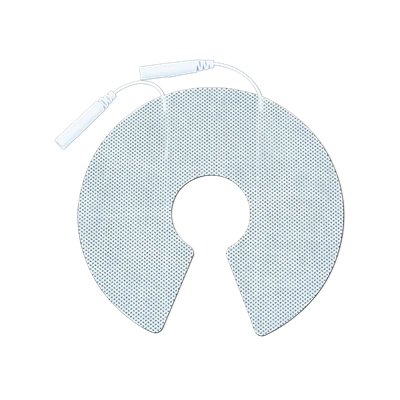
• Standard & Custom Footprints: 50x50 mm Square (2"x2"), 50x90 mm / 50x100 mm Rectangle (2"x4"), 75x130 mm Macro-Rectangle (3"x5"), Dia 50 mm Round, and custom butterfly or long-strip spinal dies.
• Conductor & Backing Selection: Configurable silver-lattice coverage (18% standard, 24% ultra-low-resistance <3.0 Ohm/sq) paired with 75 g/m2 white spunlace, 130 g/m2 tan warp-knit tricot (C6 soil-release), or 1.0 mm closed-cell PE foam; terminated with 2.0 mm female phosphor-bronze sockets or 3.5/4.0 mm stainless steel snap studs.
• Retail & Clinical Packaging: 4 pads mounted per double-sided differential PET release card inside nitrogen-flushed multi-layer PET/AL/PE zip-closure foil pouches; custom 6-color retail pouches and folding cartons; Amazon FNSKU barcoding; and serialized GS1/UDI medical traceability coding.
-
China-Vietnam Dual-Center Manufacturing Allocation : Conductive carbon-polyolefin cast extrusion, radial silver-flake lattice screen-printing, three-zone thermal sintering, carbon passivation over-coating, ultrasonic hub staking, and UV hydrogel casting execute inside our ISO 13485:2016 and FDA 21 CFR 820 registered China plant. High-speed rotary tungsten-carbide blanking, inline eddy-current resistance verification, nitrogen foil pouching, and palletized container export route through our Vietnam manufacturing hub to shield North American and European B2B buyers from Section 301 tariffs.
Certifications
-
ISO 10993 Biological Safety Screening : Production lots pass independent GLP laboratory assays confirming ISO 10993-5 (In Vitro Cytotoxicity: Grade 0), ISO 10993-10 (Skin Sensitization: 0% allergic response), and ISO 10993-23 (Primary Dermal Irritation Index = 0.0). Formulated without natural rubber latex, rosin tackifiers, or phthalate plasticizers, with residual acrylic monomers clamped below 2 ppm via GC-MS.
-
IEC 60601-2-10, ANSI/AAMI EC12 & ASTM F390 Electrical Verification : Verified for 3.0–4.5 Ohm/sq bilayer sheet resistance (ASTM F390), <14.0 Ohm interfacial impedance at 1 kHz, <10.0 mV resting DC offset, <7.5% spatial current density variance (keeping peak density <1.4 mA RMS/cm2 at 100 mA), <1.2C thermal rise over 45 minutes, and <8% resistance drift after 10,000 mandrel bend cycles.
-
ISO 13485:2016 & MDSAP Electronic Traceability : Screen-printing suites, convection sintering ovens, UV coating bays, and cleanroom converting lines operate under ISO 13485:2016 and MDSAP audits. Electronic Device History Records (DHR) archive inline eddy-current sheet resistance logs, 40C AgCl aging stability data, peel adhesion curves (4.2–5.4 N/25mm), terminal pull strengths (>45.0 N), and pouch burst pressures per lot.
Technical FAQ
Q: How does a silver-lattice carbon electrode achieve nearly the same low resistance as a full-silver pad while costing 65% less in precious metal and surviving 10,000 bends?
Full-silver pads waste expensive silver flake ink across 100% of the footprint on top of a non-conductive PET sheet. Because electrical current in a TENS/EMS electrode only needs low-resistance horizontal distribution highways to feed the vertical hydrogel layer, printing a 0.5 mm radial hexagonal silver lattice covering just 18% to 24% of the area drops composite sheet resistance from 45 Ohm/sq down to 3.0–4.5 Ohm/sq-cutting precious-metal ink consumption by roughly 65% while holding spatial current variance under 7.5%. More importantly, printing that silver lattice onto an already conductive 50 um carbon-polyolefin film provides bilayer redundancy: if heavy joint bending micro-cracks a silver trace, the ductile carbon sheet underneath bridges the gap electrically, preventing the open-circuit dead zones common in full-silver PET pads.
Q: Why do ordinary silver-printed TENS pads turn dark brown or black in the pouch after 6 months, and how does carbon passivation stop AgCl oxidation?
Silver discoloration in storage is caused by direct electrochemical contact between metallic silver flakes and free chloride ions (Cl-) dissolved in standard polyacrylate hydrogels. Over 6 to 9 months at warehouse temperatures, Cl- ions react with exposed silver to form dark brown, insulating silver chloride (AgCl), driving pad resistance past 150 Ohms. In our Silver-Conductive Carbon electrodes, the silver lattice is either printed on the backing face of the 50 um hydrophobic carbon-polyolefin film (isolated from the hydrogel side) or sealed under a 12 um conductive carbon passivation veil. Electrons pass vertically through the thin carbon barrier with negligible resistance (<14 Ohm total impedance at 1 kHz), while aqueous chloride ions are physically blocked from reaching the silver flakes-preserving bright silver conductivity across 36 months of storage.
Clinical electrotherapy device OEMs, sports medicine brands, and hospital consumable distributors can request batch Certificates of Analysis (COA), 16-point spatial current density maps (<7.5% variance at 100 mA), FLIR 45-minute thermal rise reports (<1.2C), 10,000-cycle bend fatigue logs, 40C AgCl non-blackening aging dossiers, and unbranded Silver-Conductive Carbon evaluation sample packs (50x50 mm, 50x90 mm, or 75x130 mm with 2.0 mm pin sockets or 3.5 mm snap studs).
👉 [Request Silver-Conductive Carbon TENS Electrode Sample Packs]
Hot Tags: silver-conductive carbon tens electrodes, China silver-conductive carbon tens electrodes manufacturers, suppliers, factory
Specifications
| Engineering Domain | Target Specification | Verification Protocol |
| Bilayer Conductor Stack | 50 um Carbon-Polyolefin Film + 12 um Screen-Printed Silver Lattice | Cross-section microscopy |
| Composite Sheet Resistance | 3.0 to 4.5 Ohm/sq Across Full Active Footprint | Four-point planar probe (ASTM F390) |
| AgCl Corrosion Passivation | 12 um Hydrophobic Carbon Passivation Veil (or Inverted-Side Print) | 36-Month 40C accelerated aging |
| High-Current Thermal Rise | Surface Temperature Rise < 1.2C under 100 mA RMS for 45 Minutes | FLIR infrared thermography |
| Pulse Rise-Time Fidelity | < 2.0 us Rise-Time Lag on 100 mA Biphasic Square Pulses | Oscilloscope load bench |
| Flex-Fatigue Continuity | Resistance Drift < 8% after 10,000 Cycles over 15 mm Mandrel | Cyclic bend tester |
| AC Interfacial Impedance | < 14.0 Ohms at 1 kHz (50x50 mm Standard Footprint) | Precision LCR bridge |
| Current Density Uniformity | Spatial Variance < 7.5% from Center Hub to Perimeter Corners | 16-point array mapping at 100 mA |
| Hydrogel Layer & Caliper | 0.90 mm (+/- 0.02 mm) Crosslinked Polyacrylate-AMPS Hydrogel | Dial micrometer; <16 Ohm-cm bulk resistivity; G' > 4,400 Pa at 1 Hz |
| Skin Peel Adhesion | 4.2 N to 5.4 N / 25 mm on Stainless Steel Coupon | ASTM D3330 (180° Peel) |
| Outer Carrier Backing | 75 g/m2 White Spunlace, 130 g/m2 Tan Tricot, or 1.0 mm PE Foam | ASTM D4964 |
| Connector & Pull Strength | 2.0 mm Female Phosphor-Bronze Socket or 3.5/4.0 mm Stainless Snap | ANSI/AAMI EC53; >45.0 N axial wire pull-out / >50.0 N snap retention |
| Packaging & Order MOQ | 4 Pads per Nitrogen-Flushed Foil Ziploc Pouch; MOQ: 5,000 Packs | 36-Month shelf life |