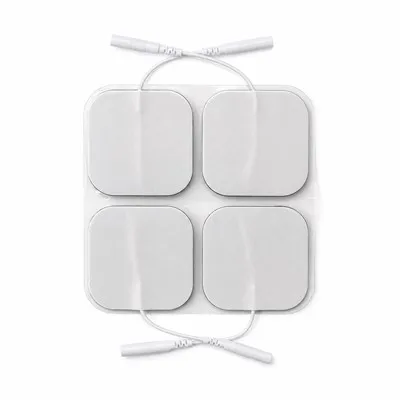

Wholesale Multi-Reuse TENS Pads | Long-Life Electrodes | TOP-RANK
B2B multi-reuse TENS pads for physical therapy clinics and GPO procurement. Formulated with high-density cross-linked hydrogels that maintain 5.0N peel tack across 60+ washable therapy cycles.
Product Profile
These multi-reuse TENS pads function as high-lifecycle, washable transdermal consumable interfaces engineered explicitly for physical therapy wards, chiropractic clinics, and cost-sensitive healthcare Group Purchasing Organizations (GPOs). Standard single-patient electrodes experience rapid loss of adhesion after 10 to 15 applications due to the accumulation of skin lipids, dead stratum corneum squames, and environmental dust on the hydrogel surface. This loss of contact increases skin-to-sensor AC impedance, causing electric stinging and machine output errors. Our multi-reuse hydrogel matrix incorporates a high-density, covalently cross-linked biopolymer network that resists structural emulsification, allowing clinical staff or home users to strip accumulated sebum with a brief water rinse and reactivate surface tack. We mass-produce these 60+ cycle pads for clinical supply stockists, durable medical equipment (DME) distributors, and e-commerce private-label brands.
Continuous Lamination & Re-Tackifying Gel Chemistry
The industrial fabrication of multi-reuse electrodes passes a heavy-duty spunlace non-woven or poly-cloth web through multi-station flexographic printing, slot-die hydrogel extrusion, and rotary die-cutting stations. To ensure the hydrogel can endure repeated water contact without liquefying or expanding out of its die-cut borders, the formulation utilizes an elevated cross-linking monomer ratio. During slot-die coating, an aqueous monomer solution containing alkali chloride electrolytes and polyhydric humectants is extruded onto a conductive silver-printed carbon backing. Online UV photopolymerization locks the polymer chains into a rigid 3D elastic mesh that traps water within a low-swell matrix. Standard unprinted transparent bags: 4 per pack, minimum order of 5,000 packs , Printed PE bags: 4 per pack, minimum order of 20,000 packs.
Core Engineering Assets
-
High-Density Covalent Network (Low-Swell Hydraulic Sebum Stripping)
Standard short-life hydrogels use low-density linear polymer chains that absorb water rapidly. When users attempt to wash off skin oils, the gel swells, turns cloudy, and dissolves into a sticky paste. Our multi-reuse hydrogel incorporates a high covalent cross-linking density. When rinsed under cold tap water, the tight crystalline polymer matrix resists water absorption (volumetric swell <12%). The hydraulic shear of the water stream strips away surface sebum and dead skin cells without breaking the polymer backbone, restoring initial surface tack (4.5N–6.5N /25mm) upon air-drying.
-
Interface Anchor Interlocking (Zero Carbon Delamination During Washing)
Repeated washing and dynamic skin peeling subject the hydrogel-to-carbon film interface to intense moisture shear. If the bond between the gel and conductive carbon trace is weak, water migrates into the interfacial boundary, causing the gel layer to slide off the carbon film. We resolve this failure mode by treating the conductive carbon film with a microscopic surface anchor primer prior to hydrogel extrusion. During UV curing, the hydrogel monomers polymerize directly into the functional groups of the carbon trace, forming a chemical interlock that resists delamination across 60+ hydration and washing cycles.
-
Low Impedance-Drift Matrix (Stable AC Conduction Over Extended Cycles)
As an electrode undergoes repeated uses, evaporation and ionic loss usually cause baseline resistance to spike, causing the TENS machine to trigger load-error alarms or generate localized current stinging. Our multi-reuse hydrogel is formulated with a 15% polyhydric humectant complex that locks electrolytes within the crystalline matrix. The AC bridge impedance remains consistently below 30 Ohms across 60 therapy uses, preventing current tunneling and ensuring smooth, sting-free pulse delivery throughout the product's extended service life.
B2B Procurement Deployments
Institutional Physical Therapy & Rehabilitation Wards
Reusable electrodes selected by physical therapy departments to lower per-session consumable costs and manage heavy daily patient turnover without constant pad replenishment.
DME Home-Care Long-Term Therapy Bundling
Long-life accessories supplied in home-use pain management kits for chronic pain patients requiring multi-month therapy without frequent pad reordering.
DTC E-Commerce Long-Life Private Label Extensions
Premium multi-pack replacement kits packaged in custom-printed foil pouches, targeting value-conscious DTC home-care therapy brands.
Packaging & Transnational Logistics Routing
-
Zero-MVTR Barrier Pouching : Multi-reuse hydrogel pads require exact internal moisture retention to preserve their initial water-washability and tack. We package completed pads on automated horizontal flow-wrappers into heavy PET/AL/PE foil pouches with 8mm solid heat-seals. This technical barrier drives the Moisture Vapor Transmission Rate (MVTR) near zero, preventing hydrogel crystallization and guaranteeing a 24-month shelf life.
-
Supply Chain Resilience Routing : Polymer synthesis, carbon ink screen-printing, and continuous web lamination run inside our primary China facility. High-speed shape die-cutting, terminal pigtail/snap crimping, and automated pouching execute at our Vietnam hub, providing supply chain redundancy and protecting international distributors from regional import trade tariffs.
Regulatory & Quality Safeguards
-
ISO 10993 Dermal Safety Validation : Finished multi-layer laminates (spunlace backing, conductive carbon trace, and multi-reuse hydrogel) undergo continuous batch testing against strict ISO 10993-5 (Cytotoxicity Grade 0) and ISO 10993-10 (Primary Dermal Irritation Index <0.1) boundaries to eliminate skin allergy and redness risks.
-
MDSAP & ISO 13485 Systems : Manufacturing and cleanroom converting bays function securely under ISO 13485:2016 and MDSAP regulatory frameworks, delivering unbroken lot-serialization from raw monomer synthesis to final shipping cartons.
Technical FAQ
Q: How should clinical staff or patients wash these pads to ensure they achieve 60+ therapy uses?
A: To wash the pad, hold it under a gentle stream of cool tap water for 5 seconds and rub the gel surface lightly with a clean fingertip to strip accumulated skin oils and dust. Do not use soap, alcohol, or abrasive sponges. Shake off excess water, place the pad gel-side-up on its release card, and allow it to air-dry naturally for 2 to 3 hours in a dust-free environment. Surface tack will restore completely once the excess surface moisture evaporates.
Q: Can these multi-reuse pads be configured with both 2.0mm female lead wires and 3.5mm snap connectors?
A: Yes. We offer the multi-reuse pad geometry with either a standard 2.0mm female pigtail socket or a stainless steel 3.5mm/4.0mm snap stud. The connection terminal is integrated into the printed carbon busbar using a strain-relieved, insert-molded plastic housing that prevents cable tugging from pulling the terminal out of the gel layer.
DME procurement networks, medical equipment brand owners, and GPO distributors can request wash-cycle impedance degradation logs, dynamic adhesion test data, and unbranded multi-reuse evaluation samples.
👉 [Request Multi-Reuse TENS Pad Samples]
Hot Tags: multi-reuse tens pads, China multi-reuse tens pads manufacturers, suppliers, factory, electrode self adhesive, Electrotherapy Replacement Pads, TENS Machine Electrode Pads, TENS Machine Sticky Pads, TENS Unit Pads for Sensitive Skin, TENS Unit Patches
Technical Specifications
| Structural Parameter | Metric Target | Engineering Test Standard |
| Lifecycle Rating | 60+ Washable Cycles | Standardized lipid-soiling & rinse protocol |
| Post-Rinse Peel Tack | 4.5N - 6.5N / 25mm | ASTM D3330 dynamic peel test post-50th wash |
| Volumetric Swell Ratio | < 12% after water immersion | Low-swell covalent cross-linking |
| Z-Axis Impedance | < 30 Ohms (100Hz AC bridge) | Stable impedance drift over 60 cycles |
| Backing Substrate | Heavy Spunlace / PU Layer | High dimensional stability |