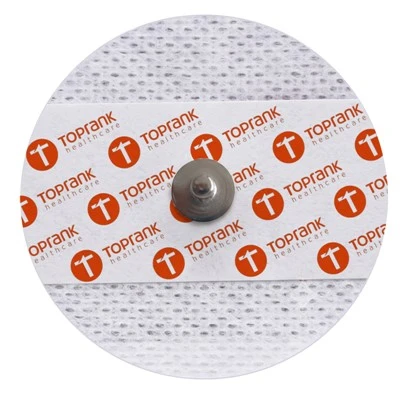

OEM Neonatal Pre-Wired ECG Electrodes | Low-Trauma NICU Sensors | TOP-RANK
B2B contract manufacturing of pre-wired neonatal ECG electrodes for NICU and incubator monitoring. Features a snap-free flat profile to eliminate focal decubitus ulcers, low-peel hydrogel (<1.2N/25mm) preventing epidermal stripping, and 1.5mm safety DIN leadwires.
Product Overview
Neonatal pre-wired low-trauma ECG electrodes operate as continuous biopotential sensing interfaces for Neonatal Intensive Care Units (NICU), Special Care Baby Units (SCBU), and pediatric transport incubators. These sensors capture electrocardiographic rhythms and thoracic impedance pneumography (apnea monitoring) across extremely low birth weight (ELBW, <1,000 g) and very low birth weight (VLBW, <1,500 g) pre-term infants. The assembly completely eliminates the rigid metallic snap stud common to adult electrodes, bonding flexible multi-strand copper or carbon leadwires directly to a conductive Ag/AgCl sensing trace beneath a cushioned non-woven or hydrocolloid substrate.
Clinical deployment inside neonatal incubators exposes conventional monitoring electrodes to severe failure mechanisms:
- Focal Ischemic Decubitus Ulcers: Traditional adult and pediatric electrodes utilize rigid brass or nickel-plated snap buttons. In low-mass pre-term infants positioned prone or lateral, the infant's body weight drives the rigid snap stud into the fragile cutaneous tissue. The resulting localized pressure exceeds arteriolar-capillary closing pressure (32 mmHg), occluding dermal perfusion and inducing full-thickness pressure necrosis within 6 to 12 hours.
- Epidermal Avulsion from Immature Dermal Cleavage: In premature infants under 32 weeks of gestation, the stratum corneum is less than 10 um thick or functionally absent. Anchoring fibrils (Type VII collagen) connecting the hemidesmosomes of the basal keratinocytes to the underlying papillary dermis are sparse and structurally immature. Peeling standard medical adhesives generates shear forces (>3.0N / 25mm) that exceed this basement membrane bonding strength, resulting in complete epidermal stripping, weeping wounds, and increased systemic infection risks.
- Thermal Liquefaction and Desiccation in Incubators: NICU warmers maintain ambient air temperatures between 34C and 37C with relative humidity up to 80% to 85% to combat neonatal trans-epidermal water loss (TEWL). Generic hydrogels absorb excess ambient moisture, undergo cohesive breakdown, and liquefy, spreading laterally across the chest to create short circuits between adjacent electrodes. Conversely, open radiant warmers can rapidly desiccate the hydrogel, driving electrical impedance past the input threshold of neonatal telemetry monitors.
This pre-wired electrode platform resolves these points through a flat-profile junction where multi-strand 28 AWG leadwires are staked directly to Ag/AgCl conductive traces, sealed under a 0.8 mm closed-cell PE foam or breathable spunlace web. The skin interface incorporates an isotonic, high-bound-water polyacrylate hydrogel calibrated with a 90-degree peel adhesion between 0.8N and 1.4N / 25mm to eliminate epidermal stripping. The hydrogel crosslink network is thermally stabilized to resist phase breakdown across 34C to 37C operating temperatures. We contract-manufacture these sensors in 3-lead and 4-lead configurations for pediatric consumable brands, hospital supply networks, and clinical monitoring OEMs globally.
Technical & Engineering Description
The industrial fabrication of neonatal pre-wired low-trauma ECG electrodes executes within ISO 13485-certified Class 8 cleanrooms. The physical architecture integrates an impermeable outer carrier, a strain-relief encapsulation anchor, an Ag/AgCl sensor element, a specialized low-shear hydrogel layer, and a fluorosilicone polyester release film.
The functional sensing layer comprises a 75 um biaxially oriented polyester (PET) base film screen-printed with a stabilized silver/silver-chloride (Ag/AgCl) ink matrix holding a strict 80:20 or 70:30 metal-to-salt ratio. The Ag/AgCl ink thickness is held between 8 um and 12 um, minimizing batch-to-batch half-cell potential variations to maintain an initial DC offset below 1.5 mV.
Leadwire attachment eliminates standard mechanical crimp eyelets. Instead, high-flexibility 28 AWG multi-strand tinned copper wires (or conductive carbon fiber yarn for radiolucent variants) are joined to the Ag/AgCl traces via multi-point automated pneumatic ultrasonic staking or high-conductivity silver-filled epoxy bonding. The electrical connection is potted beneath an ultra-low-profile dielectric elastomer bridge, keeping total junction height below 1.5 mm. A secondary strain-relief ring fabricated from high-density cross-linked polyethylene foam anchors the wire to the primary backing, absorbing axial pull forces up to 15N without transferring stress to the thin-film sensor interface.
The patient interface incorporates an isotonic, high-bound-water polyacrylate hydrogel extruded via automated slot-die coating at a thickness of 0.85 mm to 1.10 mm. The hydrogel formulation blends a low-density covalent crosslinked polyacrylate network with pharmaceutical-grade glycerol (35% to 45% by weight) and physiological buffer salts. The ionic conductivity is tuned to yield a bulk volume resistivity below 40 Ohm-cm, maintaining small-signal AC impedance below 200 Ohm at 10 Hz.
The hydrogel perimeter is framed by a 0.8 mm closed-cell polyethylene foam backing or medical-grade porous spunlace non-woven tape, coated with a breathable, hypoallergenic pure acrylic adhesive. The assembly is validated across human skin models to maintain a 90-degree peel force strictly between 0.8N and 1.4N / 25mm. Finished electrodes are mounted on split-release fluorosilicone-treated PET liners, bundled in sets of 3 or 4 color-coded leadwires, and heat-sealed into multi-layer PET/AL/PE barrier pouches with nitrogen backfill. The standard minimum OEM contract production run is 300,000 sets.
Key Features
-
Zero-Profile Ultrasonic Leadwire Welding (Eliminating Mechanical Pressure Point Necrosis in Prone-Positioned ELBW Infants)
Standard adult and pediatric ECG electrodes feature a raised metal snap stud extending 3.5 mm to 5.0 mm above the carrier surface. In an extremely low birth weight neonate (<1,000 g) lying in a prone or lateral position, the infant's mass concentrates across this hard contact area. The pressure exerted on the skin reaches local pressures exceeding 60 mmHg-far above the 32 mmHg capillary closing pressure. This persistent ischemia shuts off microvascular supply, resulting in deep decubitus pressure ulcers within hours. We resolve this by ultrasonically welding flexible, multi-strand 28 AWG leadwires directly to the flat Ag/AgCl sensor layer. The mechanical junction is fully encapsulated within the footprint of a 0.8 mm closed-cell cushion backing, maintaining an overall cross-sectional height below 1.5 mm with no hard metal edges. The infant's body weight distributes evenly across the entire surface area, keeping cutaneous contact pressure far below microvascular collapse levels and eliminating pressure necrosis during prolonged prone positioning.
-
Low-Shear Isotonic Hydro-Elastomer (Peel Tack Under 1.4N/25mm to Protect Underdeveloped Basal Membrane Cleavage Lines)
In premature infants born prior to 32 weeks, the epidermal-dermal junction is structurally fragile: anchoring fibrils of Type VII collagen and hemidesmosome adhesion complexes are sparse. When standard medical acrylic adhesives (peel adhesion >3.0N / 25mm) are removed, the mechanical shear force exceeds the cohesive strength of the lamina lucida and lamina densa within the basement membrane zone. The epidermis tears away with the adhesive, resulting in widespread epidermal stripping and weeping lesions. We engineer our contact interface with a high-bound-water polyacrylate hydro-elastomer. The formulation limits the cross-link network density while maintaining an internal polyol humectant ratio between 35% and 45%. This creates a non-interlocking conformal contact layer: under a 90-degree post-monitoring peel vector, the interface releases smoothly within a calibrated tension envelope of 0.8N to 1.4N / 25mm. Dermal shear stresses remain well below the mechanical rupture limit of the neonatal dermo-epidermal junction, preventing epidermal tearing, maceration, and post-monitoring contact erythema.
-
Hygrothermal Network Stabilization (Phase Integrity and Respiration Tracking Under 37C and 85% RH Microclimates)
Modern closed-loop neonatal incubators maintain environmental conditions at 34C to 37C with relative humidity reaching 80% to 85% to halt dehydration in pre-term infants. Generic electrode hydrogels placed in this climate undergo osmotic swelling: the polymer network absorbs ambient water vapor until cohesive failure occurs, liquefying the gel into an uncontained fluid. This fluid runs across the chest, shorting adjacent ECG leads and obliterating the low-amplitude (delta R = 0.1 to 1.0 Ohm) impedance changes required for thoracic pneumography apnea detection. We resolve this by formulating an interpenetrating polymer network crosslinked via narrow-band UV-A photopolymerization. The gel maintains an equilibrium water activity (Aw) matching the saturated incubator atmosphere, eliminating osmotic water uptake. The hydrogel preserves its solid-state viscoelastic matrix (storage modulus G' > 2.0 kPa) across 72 hours of uninterrupted incubator dwell. Bulk volume resistivity stays stable below 40 Ohm-cm, ensuring continuous high-fidelity ECG rhythm capture and accurate detection of neonatal central apnea events without signal loss or lead bridging.
Applications
Level III & Level IV Neonatal Intensive Care Units (NICU)
Continuous non-invasive bio-potential telemetry for extremely low birth weight (ELBW) pre-term infants in closed warmers, providing real-time heart rate tracking and thoracic impedance apnea monitoring without epidermal breakdown.
Emergency Pediatric Air & Ground Transport Incubators
Ruggedized, pre-wired monitoring sets utilized in mobile transport incubators, resisting motion-induced lead detachment, vibration artifacts, and rapid environmental shifts between field ambulances and hospital wards.
Pediatric Sleep Diagnostic & Cardiorespiratory Monitoring Labs
Low-profile electrodes applied for multi-channel polysomnography (PSG) to evaluate neonatal central apnea, periodic breathing patterns, and congenital hypoventilation syndromes, preventing pressure marks during all-night sleep studies.
OEM & Private Label
- Leadwire Geometries, DIN Terminals & Kitting Customization : Electrodes are configured in sets of 3, 4, or 5 pre-wired channels mounted on split-release fluorosilicone carrier strips. We offer custom wire length calibrations (45 cm, 60 cm, and 90 cm) jacketed in medical-grade, highly flexible TPU:
· Color coding: AAMI standard (White, Black, Green, Red) or IEC standard (Red, Yellow, Green, Black).
· Connector terminations: Standard 1.5 mm touch-proof safety DIN sockets (DIN 42802), right-angle connectors, or multi-pin modular sub-miniature header blocks matching proprietary patient cable adapters.
· Radiolucent configurations: Conductive carbon fiber lead cores combined with carbon sensor tabs to provide 100% X-ray transparency, preventing radiographic shadowing during portable neonatal chest X-rays.
· Packaging: Pre-packaged in hermetic, nitrogen-purged multi-layer foil pouches with tamper-evident tear notches, custom printed with neonatal anatomical placement schematics.
-
Two-Center Supply Chain Mechanics : Micro-precision Ag/AgCl conductive web printing, nitrogen-inerted UV hydrogel continuous slot-die polymerizing, and high-speed cleanroom die-cutting execute natively inside our primary China facility. Wire harness automated stripping, micro-ultrasonic staking, terminal low-pressure overmolding, full electrical impedance verification, packaging seal integrity testing, and ocean palletization route through our Vietnam hub, shielding international B2B buyers from regional medical consumable tariffs and Section 301 duties.
Certifications
-
ANSI/AAMI EC12 & IEC 60601-2-27 Electrical Verification : Master production lots undergo testing in accredited independent testing laboratories confirming strict compliance with ANSI/AAMI EC12 (Disposable ECG electrodes) and IEC 60601-2-27. Test protocols confirm initial DC offset voltage remains below 5.0 mV (typical <1.5 mV), small-signal AC impedance remains below 200 Ohm at 10 Hz, and post-defibrillation overload recovery settles below 25 mV within 5.0 seconds.
-
ISO 10993 Dermal Biocompatibility Rigor : Direct skin-contact hydrogels and perimeter foam tapes undergo batch validation against ISO 10993-5 (In Vitro Cytotoxicity Grade 0), ISO 10993-10 (Skin Sensitization: 0% allergic response), and ISO 10993-23 (Primary Dermal Irritation Index = 0.0). The complete assembly is 100% natural rubber latex-free, DEHP-free, and phthalate-free.
-
MDSAP & ISO 13485 Manufacturing System Controls : Cable assembly bays, ultrasonic welding stations, and cleanroom packaging suites operate strictly within facilities certified to ISO 13485:2016 and MDSAP regulatory frameworks (covering US FDA 21 CFR 820, Health Canada, TGA Australia). Unbroken electronic Device History Records (DHR) capture raw material lots, ultrasonic staking pull-force logs, and batch seal integrity testing.
Technical FAQ
Q: Why does thoracic impedance pneumography (apnea monitoring) fail when using generic neonatal hydrogels, and how does this electrode maintain low contact impedance across 20 kHz to 100 kHz carrier frequencies?
A: Neonatal apnea monitors do not measure physical lung movement directly; they inject a high-frequency, sub-sensory alternating carrier current (typically between 20 kHz and 100 kHz at <100 uA) between the ECG electrodes. As the neonate breathes, thoracic expansion alters internal conductive tissue paths, generating micro-impedance changes (delta R = 0.1 to 1.5 Ohm) that the monitor translates into a respiratory waveform. If the electrode hydrogel presents high baseline AC impedance or phase-angle instability, the amplifier's dynamic range becomes dominated by the hydrogel-skin interface impedance, swamping the fractional delta R signal. The monitor interprets this lost signal as respiratory arrest, triggering false apnea alarms. Generic hydrogels fail because their ionic carrier pathways are uncalibrated: loose hydration shells and unoptimized chloride concentrations yield high charge-transfer resistance (Rct) at high frequencies. We resolve this by compounding the hydrogel with a controlled physiological sodium chloride buffer (2.0% to 2.8% by weight) within a low-tortuosity polymer matrix. The free ionic mobility allows high-frequency displacement and conduction currents to pass with minimum dielectric loss. AC impedance is held strictly below 50 Ohm across the 20 kHz to 100 kHz range with a phase angle variance under 5 degrees. The monitor's demodulator isolates the micro-Ohm thoracic baseline variations clearly, maintaining uninterrupted apnea detection without false alarm trips.
Q: How does the leadwire strain-relief junction withstand 15N pulling forces without delaminating or fracturing the thin-film Ag/AgCl conductive trace beneath?
A: Premature infants in intensive care exhibit spontaneous reflex movements, and clinical staff frequently reposition patients or adjust medical tubing. When a leadwire is tugged, an unprotected solder or crimp connection transfers peeling torque directly to the flexible PET substrate. Because screen-printed Ag/AgCl conductive ink layers are only 8 to 12 um thick, localized shear forces cause mechanical necking, trace fracture, or complete delamination from the polyester base, interrupting the monitoring circuit. We eliminate this mechanical failure point through a three-stage mechanical strain relief architecture. First, the stranded 28 AWG wire is joined via pneumatic multi-point ultrasonic staking to a tinned copper reinforcing tab before contacting the printed Ag/AgCl trace, spreading mechanical energy across a wider bonding plane. Second, the junction is encapsulated in a low-viscosity, UV-cured structural cyanoacrylate potting bridge. Third, a 0.8 mm high-density closed-cell polyethylene foam anchor tape is laminated over the potted terminal, extending 12 mm beyond the connection zone. When an axial or transverse tensile load is applied to the wire, the outer foam anchor and potting bridge absorb the strain energy through viscoelastic deformation, transferring the mechanical load across the entire surface of the foam backing. Peak stress reaching the underlying Ag/AgCl trace remains below 0.5N even under a sustained 15N pull on the leadwire, preventing conductive micro-fractures and signal dropouts.
NICU medical procurement directors, pediatric hospital biomedical engineers, and specialty monitoring brand operators can request accredited ANSI/AAMI EC12 electrical performance dossiers, 72-hour incubator environmental stability logs, and unbranded 3-lead/4-lead evaluation samples fitted with standard 1.5 mm touch-proof safety DIN connectors.
👉 [Request Neonatal Pre-Wired ECG Electrode Evaluation Kits]
Hot Tags: neonatal pre-wired low-trauma ecg electrodes, China neonatal pre-wired low-trauma ecg electrodes manufacturers, suppliers, factory, Ecg Electrode, Ecg Electrode Stickers, electrode stickers
Specifications
| Analytical Parameter | Engineering Baseline | Testing Standard |
| Safety Mandate | ANSI/AAMI EC12, IEC 60601-2-27, ISO 10993 | Disposable ECG electrodes |
| Electrode Footprint |
Round: 22 mm to 30 mm dia.
Teardrop / Rectangle: 20 mm x 25 mm |
Anatomical fit for ELBW neonates |
| Leadwire Termination | Pre-attached 45 cm to 90 cm Low-Noise Leadwires | Sub-1.5 mm profile |
| Connector Plug | Standard 1.5 mm Touch-Proof Safety DIN Sockets | IEC 60601-1 DIN 42802 |
| Leadwire Core | Multi-Strand Tinned Copper or Conductive Carbon Fiber | High flex life |
| Cable Jacket | Biocompatible Medical TPU or Medical-Grade PVC | DEHP-free, Phthalate-free |
| Substrate Backing | 0.8 mm Closed-Cell PE Foam or Breathable Spunlace Web | High moisture resistance |
| Conductive Layer | Screen-Printed Solid Ag/AgCl on Dimensional PET | Low noise |
| Adhesive Hydrogel | Isotonic Crosslinked Acrylic Hydrogel (1.0 mm thickness) | Ultra-mild skin bond |
| 90-Degree Peel Force | 0.8N to 1.4N / 25 mm (on Polished Stainless Steel) | ASTM D3330 |
| DC Offset Voltage | < 5.0 mV (Typical < 1.5 mV, EC12 baseline: < 100 mV) | Baseline stability |
| AC Small-Signal Impedance | < 200 Ohm at 10 Hz (EC12 baseline: < 3,000 Ohm) | Bio-signal fidelity |
| Defibrillation Recovery | Overload residual offset < 25 mV after 5.0 seconds | Post-shock pacing |
| Incubator Stability | Operational at 34C to 37C and 85% RH for 72 Hours | No syneresis or liquefaction |
| Packaging | 3 or 4 Electrodes per Sealed Moisture-Barrier Card | Color-coded leadwires |