
OEM Coronary Ischemia Diagnostic Electrodes | CAD ECG Pads | TOP-RANK
B2B wholesale coronary ischemia diagnostic ECG electrodes for chest pain centers, CCUs, and stress testing labs. Formulated with sub-3mV DC offset and sub-2s post-defibrillation baseline recovery.
Clinical & Physical Profile
These coronary ischemia diagnostic electrodes operate as high-precision, low-noise bio-potential sensor interfaces engineered explicitly for Chest Pain Centers, Coronary Care Units (CCU), cardiac catheterization recovery (post-PCI), and exercise stress testing laboratories. Diagnosing Coronary Artery Disease (CAD), transmural ischemia, and Acute Coronary Syndromes (ACS) requires capturing minute microvolt-level ST-segment deviations (≤ 0.05mV / 50μV) across 12-lead, 15-lead, or 18-lead configurations. In conventional general-purpose monitoring electrodes, unstable metal-electrolyte polarization creates baseline wander that easily mimics or obscures pathological ST-segment depressions, T-wave inversions, and hyperacute T-wave morphology. Furthermore, during sudden ventricular fibrillation events, emergency DC defibrillation saturates standard electrodes, blinding monitors for up to 10 seconds. This specialized CAD diagnostic sensor integrates a micro-sputtered, high-purity silver/silver-chloride (Ag/AgCl) sensing core with a fast-depolarizing wet-gel/hyper-conductive hydrogel well. The architecture holds post-defibrillation baseline recovery strictly under 2.0 seconds while maintaining a sub-20 μV baseline noise floor. We manufacture these sterile-ready sensor arrays for emergency cardiology networks, stress-system hardware OEMs, and hospital GPO supply chains globally.
Precision Ag/AgCl Sintering & Cleanroom Converting
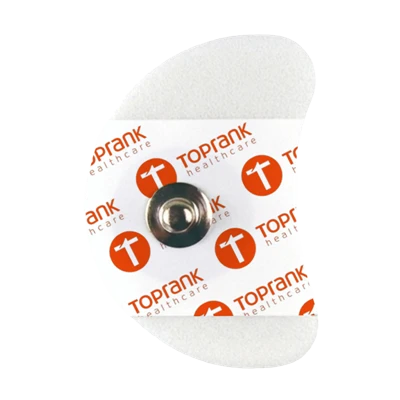
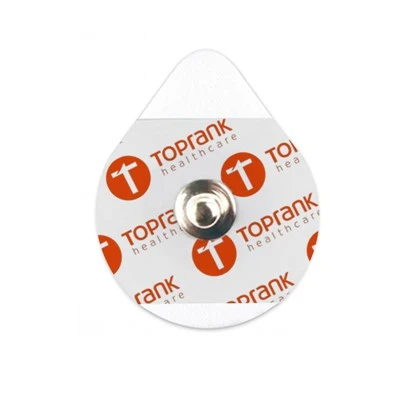
The industrial synthesis of coronary ischemia diagnostic electrodes paths medical-grade closed-cell polyethylene (PE) foam webs through multi-head screen-printing, automated Ag/AgCl micro-sputtering, and high-speed cleanroom gel dispensing. To prevent baseline drift during dynamic ischemic changes, pure metallic silver ink is micro-sputtered onto conductive ABS eyelets, followed by controlled chemical chloridation to form an ultra-pure silver/silver-chloride crystal layer. Sintering inside multi-zone thermal tunnels locks the electrochemical half-cell potential (Eº = +0.222V) with stoichiometric uniformity across every lot. A high-mobility chloride-rich liquid gel or fast-wetting solid ionic hydrogel is precision-dispensed into a central open-cell sponge reservoir. The foam carrier-coated with a medical-grade, hypoallergenic acrylic pressure-sensitive adhesive (PSA)-is laminated to lock the conductive core. The continuous web is precision die-cut into circular (50mm) or teardrop profiles, mounted on siliconized PET release cards, and heat-sealed in zero-MVTR AL/PE foil pouches under ISO 13485 cleanroom standards, enforcing a 300,000-unit minimum order threshold.
Core Engineering Assets
-
Sub-20uV Baseline Stability (Accurate Discrimination of 0.05mV Ischemic ST Deviations)
Clinical identification of acute coronary occlusion relies on detecting minimal ST-segment elevations (e.g., ≥ 0.1mV in limb leads, ≥ 0.05mV in posterior leads V7–V9) and sub-endocardial ischemic ST depressions. Low-purity electrodes suffer from fluctuating half-cell potentials that introduce random 0.05–0.1mV baseline drifts, generating false-positive STEMI alerts or masking true acute ischemia. Our sensor utilizes a stoichiometrically balanced, sintered Ag/AgCl matrix that limits internal voltage noise below 20μV. The ultra-flat baseline eliminates signal distortion, allowing computerized EKG algorithms and cardiologists to evaluate subtle ischemic vectors and reciprocal ST depressions with absolute diagnostic confidence.
-
Rapid Sub-2s Post-Defibrillation Recovery (Immediate Reperfusion & Arrhythmia Tracking)
In acute myocardial infarction patients, sudden ventricular tachycardia or ventricular fibrillation requires immediate transthoracic DC defibrillation (200J to 360J). High-voltage shocks dump massive capacitive charge into standard ECG electrodes, generating prolonged DC offset polarization that saturates the monitor's input amplifiers and blanks the screen for 5 to 10 seconds-a critical window where lethal post-shock arrhythmias can occur. Our Ag/AgCl sensor utilizes a low-polarization formulation coupled with high-conductivity ionic fluid that rapidly discharges residual capacitive energy. The electrode restores the ECG trace to baseline within 2.0 seconds post-shock, enabling resuscitation teams to verify return of spontaneous circulation (ROSC) and assess post-reperfusion ST changes immediately.
-
Dynamic Stress Motion-Decoupling (Anti-Artifact Retention During Treadmill Protocols)
Evaluating exercise-induced coronary ischemia via treadmill or bicycle ergometry involves vigorous patient chest expansion, heavy sweating, and severe lead-wire bouncing. Standard electrodes lift at the borders, generating baseline wander that mimics ischemic ST depression. We formulate our stress-test CAD electrodes with an aggressive, sweat-resistant acrylic adhesive ring delivering >6.5N/25mm peel tack, backed by an impermeable closed-cell PE foam carrier. The central sponge gel well remains mechanically isolated from the outer adhesive perimeter, preventing cable tugs from disturbing the skin-gel interface and delivering clean ST-segment tracings at peak heart rate (>150BPM) under maximal Bruce protocol exertion.
Clinical & Screening Deployments
Chest Pain Centers & Emergency Triage Units
Fast-applying, high-fidelity diagnostic electrodes deployed by emergency physicians for immediate 12-lead/18-lead ACS screening and continuous door-to-balloon time telemetry.
Cardiac Stress Testing & Ergometry Laboratories
High-tack, motion-immune electrodes used in cardiology testing labs to capture uncorrupted ST-segment depression during diagnostic exercise stress protocols.
Coronary Care Units (CCU) & Post-PCI Telemetry
Impermeable, long-wear electrodes deployed in CCU wards for continuous multi-lead ST-segment monitoring to detect acute re-occlusion or stent thrombosis following coronary stenting.
Precision Packaging & Global Logistics Routing
-
Zero-MVTR Barrier Pouching : Coronary diagnostic liquid and ionic hydrogels require strict water activity preservation to maintain sub-60 Ohm impedance (Z10Hz) and rapid post-defibrillation recovery. Electrodes are packaged on automated horizontal packaging lines into heavy PET/AL/PE foil pouches with 8mm hermetic thermal seals, driving Moisture Vapor Transmission Rates (MVTR) near zero to guarantee a 24-month warehouse shelf life.
-
Transnational Supply Resilience : Ag/AgCl sensor sputtering, stoichiometric sintering, and cleanroom gel compounding execute natively inside our primary China facility. High-speed foam converting, snap-stud insertion, and automated sterile packaging route through our Vietnam hub, protecting global B2B procurement networks from regional medical device trade tariffs.
Regulatory & Quality Safeguards
-
ANSI/AAMI EC12 & IEC 60601-2-25 Clearance : Electrode lots undergo continuous batch testing against ANSI/AAMI EC12 diagnostic performance requirements, post-defibrillation recovery limits, as well as ISO 10993-5 (Cytotoxicity Grade 0), ISO 10993-10 (Sensitization), and ISO 10993-23 (Primary Dermal Irritation Index <0.1) boundaries, confirming zero skin irritation during extended CCU monitoring.
-
MDSAP Certified Cleanroom Converting : Micro-sputtering, gel dispensing, and pouching bays operate strictly under ISO 13485:2016 and MDSAP regulatory frameworks, delivering unbroken lot-serialization from raw silver pastes to outbound shipping pallets.
Technical FAQ
Q: Why is sub-2.0s post-defibrillation recovery critical for CAD diagnostic electrodes in acute chest pain units?
A: When an acute myocardial infarction patient develops ventricular fibrillation, defibrillation applies high-energy shocks (200 - 360J) that inject heavy charge into the electrode, causing severe capacitive polarization. Generic electrodes stay saturated for 5 to 10 seconds, leaving the monitor screen blank. Our sensor utilizes a low-polarization Ag/AgCl crystal layer paired with a fast-depolarizing electrolyte system that dissipates residual charge, restoring the ECG baseline in under 2.0 seconds so resuscitation teams can verify heart rhythm and post-shock reperfusion immediately.
Q: How does electrochemical half-cell stability prevent false-positive ST-segment depression during cardiac stress tests?
A: In cardiac stress tests, diagnosis of exercise-induced ischemia relies on identifying ≥ 0.1mV horizontal or downsloping ST-segment depression. If the electrode's Ag/AgCl chemistry is poorly sintered, friction and temperature changes create voltage drift that shifts the ST segment downward, creating false-positive ischemia readouts. Our sensor features a sintered, stoichiometrically pure Ag/AgCl layer (Eº = +0.222V) with a noise floor under 20μV, ensuring that any recorded ST deviation reflects true myocardial ischemia rather than electrode polarization artifacts.
Cardiology procurement directors, chest pain center network managers, and cardiac diagnostic hardware OEMs can request ANSI/AAMI EC12 post-defibrillation recovery test logs, ST-segment fidelity validation reports, and unbranded evaluation sample packs.
👉 [Request Coronary Ischemia Diagnostic Electrode Samples]
Hot Tags: coronary ischemia diagnostic electrodes, China coronary ischemia diagnostic electrodes manufacturers, suppliers, factory
Technical Specifications
| Analytical Parameter | Target Baseline | Testing Standard |
| Operational Standard | ANSI/AAMI EC12 & IEC 60601-2-25 | Dedicated diagnostic electrocardiograph standard |
| ST-Segment Resolution Error | < 20μV (0.02 mV) | Ischemic baseline drift assay |
| Post-Defibrillation Recovery | < 2.0 Seconds to Steady State | 200J Biphasic discharge test |
| DC Offset Voltage | < 3.0 mV | Micro-sputtered Ag/AgCl stoichiometric balance |
| AC Impedance (10Hz) | < 60 Ohms | Four-point probe planar measurement |
| Exercise Stress Tack | > 6.5N / 25mm (Sweat-Resistant) | Bruce treadmill exercise protocol |
| Substrate Carrier | Impermeable Closed-Cell PE Foam | Fluid & blood barrier for Cath Lab/ICU |