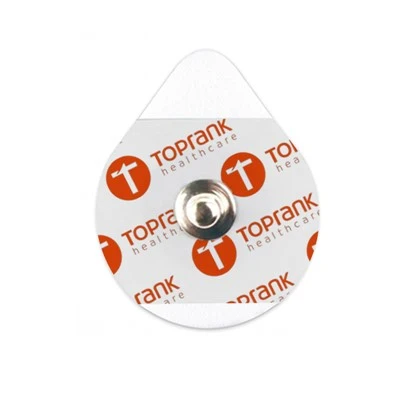

OEM Ambulatory ECG Electrodes | Holter Monitoring Pads | TOP-RANK
Wholesale ambulatory ECG electrodes for 24-168 hour Holter monitoring and mobile cardiac telemetry (MCT). Engineered with floating Ag/AgCl sensors and sweat-resistant hydrogels.
Product Profile
These ambulatory ECG electrodes operate as high-stability, extended-wear bio-potential sensor interfaces engineered explicitly for 24-to-168 hour continuous Holter recording, Mobile Cardiac Telemetry (MCT), and ambulatory arrhythmia screening. Capturing diagnostic-grade microvolt electrograms (0.5mV to 5mV) from active, mobile patients presents a severe electrical engineering challenge: dynamic bodily movement, sleep friction, and perspiration generate intense mechanical shear on lead wires, disrupting the skin-electrode junction and producing baseline wander, muscle noise, and false ventricular tachycardia alarms. This ambulatory electrode integrates a mechanically decoupled "floating" Ag/AgCl sensor core paired with a high-tack, sweat-impermeable solid hydrogel matrix. The architecture isolates axial wire pulling from the central sensing pool while providing unbroken ionic conductivity through showers and exercise. We manufacture these converting-ready sensor blanks for Holter diagnostic laboratories, telemetry hardware OEMs, and hospital clinical supply chains.
Manufacturing Kinetics & Multi-Layer Converting
The industrial fabrication of ambulatory ECG electrodes paths multi-layer PE foam or high-tensile spunlace carrier webs through continuous roll-to-roll micro-sputtering, concentric strain-relief die-cutting, and cleanroom hydrogel extrusion. The core sensing element uses high-purity silver/silver-chloride (Ag/AgCl) ink micro-sputtered onto an ABS stud to fix the half-cell potential (Eº = +0.222V). To prevent cable tugs from displacing the central sensor, a concentric circular moat is rotary die-cut into the carrier foam, creating a mechanical decoupling buffer between the outer adhesive skirt and the inner sensing eyelet. A high-cohesion, polyacrylamide solid hydrogel loaded with humectants is slot-die extruded over the sensing well, while the surrounding outer skirt is coated with a cross-linked medical acrylic pressure-sensitive adhesive (PSA). The continuous web is precision die-cut, mounted on fluorosilicone PET release cards, and heat-sealed in zero-MVTR AL/PE pouches under ISO 13485 cleanroom standards, enforcing a 500,000-unit minimum order threshold.
Key Technical Assets
-
Concentric Floating Snap Core (Mechanical Lead-Wire Strain Decoupling)
During ambulatory monitoring, routine patient movements (walking, turning during sleep, swinging arms) transmit kinetic tension directly down the lead wires into the electrode connector. In standard solid-body electrodes, this wire pull lifts the edge of the sensing element, causing instantaneous capacitive impedance spikes that generate false arrhythmias on the ECG trace. Our electrode incorporates a floating-center architecture: the central snap stud is mechanically separated from the outer adhesive perimeter by a 360-degree stress-absorbing foam channel. When the lead wire tugs the outer border, the kinetic force dissipates across the perimeter foam, leaving the central Ag/AgCl sensor anchored in planar contact with the skin.
-
Long-Wear Anti-Desiccation Hydrogel Matrix (Zero Impedance Drift Over 7 Days)
Liquid wet-gel electrodes dry out within 24 to 48 hours, causing baseline impedance to spike past 500 Ohms and triggering persistent "lead-off" system alarms on digital Holter monitors. We formulate our ambulatory electrode with a dense, covalently cross-linked solid hydrogel matrix containing a 20% polyhydric humectant complex. The polymer lattice locks moisture molecules inside a low-vapor-pressure network, capping moisture loss under 5% over 168 hours of continuous body-heat exposure (37℃). The AC bridge impedance remains flat (<80Ω at 10Hz) throughout multi-day monitoring, eliminating baseline wander and dry-out failures.
-
High-MVTR Sweat-Channeling Perimeter (Maceration & Delamination Defense)
Continuous multi-day wear traps metabolic perspiration underneath the pad, softening the stratum corneum and causing both tissue maceration and premature adhesive detachment during daily showers. We engineer the outer anchoring ring with a microporous, water-resistant PE foam backing backed by a high-tack acrylic adhesive pattern, delivering an MVTR exceeding 1600g/m²/24h. The microporous structure allows sweat vapor to escape into the atmosphere while presenting an impermeable barrier to external water droplets, keeping the pad anchored during showers without edge lifting.
B2B Procurement Deployments
Outpatient Holter & Telemetry Diagnostic Labs
Long-wear sensor electrodes deployed by diagnostic technicians for 24-hour, 48-hour, and 7-day continuous ambulatory ECG recordings to detect intermittent atrial fibrillation and syncope.
Mobile Cardiac Telemetry (MCT) Hardware OEM Bundling
Pre-packaged electrode packs supplied directly to wireless MCT device manufacturers as verified consumable kits shipped with cellular monitoring hardware.
Sports Cardiology & Stress Treadmill Testing
High-tack, motion-resilient electrodes used in sports medicine clinics to capture clean EKG tracings during heavy treadmill stress protocols with severe patient perspiration.
Precision Packaging & Global Supply Routing
-
Zero-MVTR Barrier Pouching : Ambulatory solid hydrogels require exact moisture preservation to maintain their long-wear conductivity and 5.5N–7.5N adhesion. Completed electrode strips are packaged on automated high-speed packaging lines into multi-layer PET/AL/PE foil pouches with 8mm solid heat-seals, keeping the Moisture Vapor Transmission Rate (MVTR) near zero to guarantee a 24-month warehouse shelf life.
-
Transnational Supply Chain Resilience : Ag/AgCl sensor sputtering, long-wear hydrogel synthesis, and continuous web lamination run natively inside our primary China facility. Precision floating-core die-cutting, terminal crimping, and automated pouching execute at our Vietnam hub, providing supply chain redundancy and protecting global B2B buyers from regional medical device trade tariffs.
Regulatory & Quality Safeguards
-
ANSI/AAMI EC12 & Extended Wear Validation : Cured electrode lots undergo continuous batch testing against ANSI/AAMI EC12 electrical requirements, as well as ISO 10993-5 (Cytotoxicity Grade 0), ISO 10993-10 (Sensitization), and ISO 10993-23 (Primary Dermal Irritation Index < 0.1) boundaries, confirming zero skin sensitization across full 7-day wear cycles.
-
MDSAP Certified Cleanroom Converting : Sputtering, hydrogel extrusion, and pouching lines operate strictly under ISO 13485:2016 and MDSAP regulatory frameworks, delivering unbroken lot-serialization from raw silver inks to outbound shipping pallets.
Technical FAQ
Q: Why do standard resting ECG tab electrodes fail in 24-to-48 hour ambulatory Holter monitoring?
A: Resting tabs are engineered for short 10-second diagnostic recordings in stationary patients. They lack mechanical strain isolation and high-tack adhesives. When an ambulatory patient walks or perspires, wire weight creates mechanical leverage that pulls the tab off the skin, while sweat dissolves the thin gel layer, spiking impedance (>1000Ω) and causing complete signal dropout.
Q: How does the floating sensor geometry physically eliminate motion artifacts caused by patient movement?
A: Motion artifacts occur when physical pulling on lead wires alters the thickness or surface area of the conductive gel boundary, producing rapid capacitive voltage fluctuations. Our floating design places a 360-degree die-cut stress relief moat between the central sensor stud and the outer adhesive ring. Kinetic tugs from the wire deform the perimeter foam without transmitting mechanical shear to the central gel pool, keeping the contact plane completely stationary.
Pediatric cardiology procurement networks, NICU nurse managers, and medical device OEMs can request ANSI/AAMI EC12 electrical test reports, ISO 10993 biocompatibility summary reports, and unbranded evaluation sample sets for hardware clinical trials.
👉 [Request Pediatric ECG Electrode Samples]
Hot Tags: ambulatory ecg electrodes, China ambulatory ecg electrodes manufacturers, suppliers, factory, Ecg Electrode, Ecg Electrode Stickers, electrode stickers
Technical Specifications
| Analytical Parameter | Target Baseline | Testing Standard |
| Wear Duration | 24 to 168 Hours (1 to 7 Days) | In-vivo dynamic stress & shower testing |
| DC Offset Drift | < 10 mV across 72h continuous load | ANSI/AAMI EC12 long-term stability |
| AC Impedance (10Hz) | < 80 Ohms | Four-point probe planar measurement |
| Dynamic Peel Adhesion | 5.5N - 7.5N / 25mm | ASTM D3330 dynamic high-tack protocol |
| Dermal MVTR | > 1600 g/m²2/24h | In-vitro moisture breathability scan |
| Sensor Decoupling | Concentric Floating Snap Core | Mechanical strain-isolation barrier |