

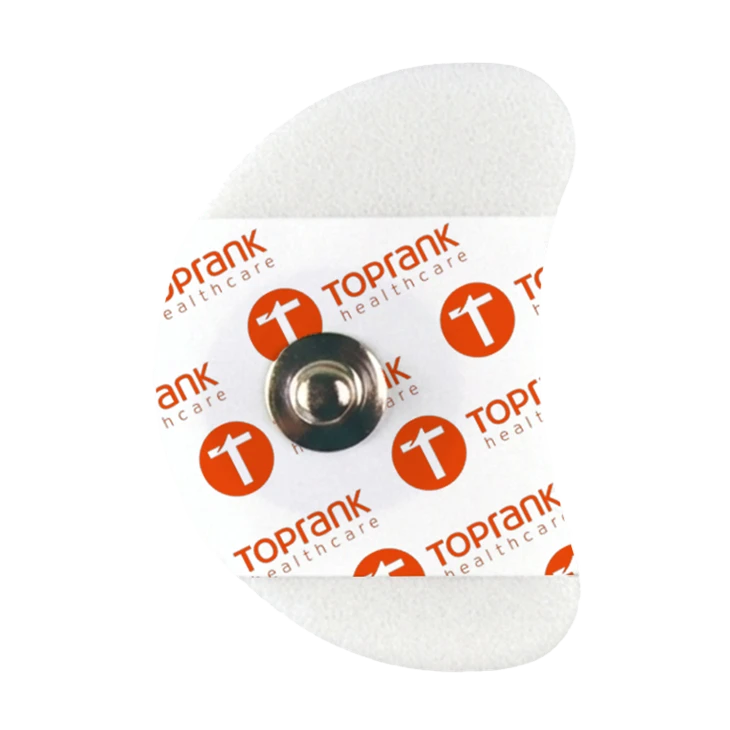
OEM Disposable Non-Invasive EEG Electrodes | VEP & ERG | TOP-RANK
B2B disposable non-invasive EEG electrodes for visual electrophysiology systems (VEP, ERG). Engineered with micro-sputtered Ag/AgCl sensors to isolate 5-15 uV cortical signals with sub-2kOhm impedance.
Clinical & Physical Profile
These disposable non-invasive EEG electrodes operate as high-precision, low-noise bio-potential sensor interfaces engineered explicitly for visual electrophysiology diagnostic instruments, including Pattern-Reversal Visual Evoked Potential (PR-VEP), Flash VEP (F-VEP), and Electroretinography (ERG) systems. Extracting minute visual cortex responses (5μV to 15μV) across the occipital scalp (Oz) and frontal reference points (Fz) presents extreme electro-physical hurdles: optical flash artifacts, patient micro-saccades, and scalp hair barriers generate noise that swamps diagnostic P100 peak latency measurements. Traditional re-usable gold cups require abrasive skin scrubbing and collodion glue, while invasive subdermal needles introduce patient pain and cross-infection risks. This single-use sensor integrates a micro-sputtered silver/silver-chloride (Ag/AgCl) planar element paired with an ultra-low-impedance, light-shielded hydrogel reservoir. It establishes rapid electrical coupling (<2.5kΩ at 30Hz) through fine occipital hair without skin puncture. We manufacture these converting-ready sensor arrays for ophthalmic diagnostic OEMs, neurology clinics, and visual electrophysiology device manufacturers.
Sensor Micro-Deposition & Cleanroom Converting
The industrial fabrication of disposable non-invasive EEG electrodes paths optical-grade polyester (PET) or flexible polyurethane webs through continuous roll-to-roll micro-sputtering, laser-guided sensor positioning, and cleanroom gel injection. The sensing core centers on a high-purity Ag/AgCl matrix screen-printed with stoichiometric precision to lock the half-cell potential (Eº = +0.222V). To suppress photovoltaic artifacts induced by high-intensity strobe flashes (3.0 cd·s/m²) during F-VEP testing, the outer carrier film incorporates a laminated carbon-black photon-blocking barrier. A high-mobility, hyper-conductive ionic hydrogel is extruded into the central sensing reservoir, while the surrounding perimeter is coated with a high-tack medical acrylic pressure-sensitive adhesive (PSA) that anchors through fine hair onto the scalp. The web is rotary die-cut into teardrop or rounded geometries with integrated conductive leadwire tabs or 1.5mm DIN-standard touchproof connections. Completed lots are sealed into airtight AL/PE foil pouches inside ISO Class 7 cleanroom bays under an MOQ threshold of 300,000 units.
Core Engineering Assets
-
Sub-Microvolt Noise Floor & High-CMRR Symmetry (Precision P100 Wave Extraction)
Visual Evoked Potentials generate tiny microvolt waveforms (5 - 15μV) buried inside massive background EEG activity and electromagnetic ambient interference (50 - 60Hz). If the electrode pair between the occipital active channel (Oz) and the forehead ground (Fz) exhibits mismatched impedance or electrochemical phase lag, the visual diagnostic instrument's differential amplifier loses its Common-Mode Rejection Ratio (CMRR), distorting the critical P100 peak latency (normal ≈ 100ms). We resolve this by enforcing strict stoichiometric Ag/AgCl ink uniformity, keeping sensor-to-sensor DC offset variance below 1.0mV. The symmetric low-impedance channel preserves >110dB system CMRR, isolating the P100 wave and N75/N145 components with sub-millisecond temporal resolution.
-
Photovoltaic Transient Suppression (Optical Flash Immunity in ERG/F-VEP)
During Flash VEP and full-field ERG stimulation, high-intensity optical flashes directly strike the periorbital and frontal scalp electrodes. Standard bare metallic or clear-backed electrodes absorb photon energy, triggering transient photovoltaic electron surges (Becquerel effect) at the metal-electrolyte interface that appear as massive 50μV+ baseline spikes on the recording trace, masking early retinal and cortical potentials. Our electrode integrates a multi-layer opaque carbon-shielded carrier with a light-insensitive organic ionic gel. The physical barrier blocks >99.8% of incident light transmission, suppressing photic artifacts below 1.2μV under intense xenon strobe conditions.
-
Non-Invasive Occipital Wetting Dynamics (Rapid Scalp De-Ohmic Coupling)
Capturing occipital visual potentials requires placing electrodes over hairy scalp regions at the inion. Invasive needle electrodes penetrate the scalp but cause bleeding, pain, and patient movement artifacts, while standard EEG paste requires time-consuming manual skin abrasion. We formulate our non-invasive visual electrode with a high-mobility chloride-rich hydrogel that features low surface tension. Under light pressure, the fluid phase penetrates around fine hair shafts to wet the scalp epidermis, lowering contact impedance below 2.5kΩ within 10 seconds without skin-stripping abrasives or intradermal needle insertion.
Clinical Deployments & Ophthalmic Integration
Pattern-Reversal & Flash VEP Testing
Non-invasive scalp sensors positioned over Oz, O1, O2, and Fz by technicians to evaluate optic nerve conduction velocity, optic neuritis, and multiple sclerosis demyelination.
Electroretinography (ERG) & Electrooculography (EOG) Reference Arrays
Low-noise cutaneous electrodes applied to outer canthi, temples, and forehead as stable, non-polarizing reference points during retinal function and retinal pigment epithelium testing.
Ophthalmic Diagnostic Equipment OEM Kits
Pre-packaged, sterile 3-electrode and 5-electrode arrays supplied directly to visual electrophysiology hardware manufacturers as pre-calibrated single-use consumable packs.
Precision Packaging & Global Supply Routing
-
Zero-MVTR & Photochemical Barrier Pouching : Bio-potential hydrogels for visual electrophysiology require strict moisture and halide ionic stability to guarantee sub-2.5 kOhm impedance. Electrodes are packaged on high-speed flow lines into multi-layer PET/AL/PE foil pouches with 8mm hermetic thermal seals, driving Moisture Vapor Transmission Rates (MVTR) near zero while blocking ambient UV/light degradation to ensure a 24-month shelf life.
-
Transnational Logistics Resilience : Ag/AgCl micro-sputtering, optical-barrier lamination, and precision cleanroom gel synthesis execute natively inside our primary China facility. High-speed die-cutting, terminal connector crimping, and automated sterile packaging route through our Vietnam hub, prot
Regulatory & Quality Safeguards
-
ISCEV & ANSI/AAMI EC12 Clearance : Electrode batches undergo continuous independent testing against ISCEV signal accuracy guidelines and ANSI/AAMI EC12 electrical requirements, as well as ISO 10993-5 (Cytotoxicity Grade 0) and ISO 10993-10 (Primary Dermal Irritation Index <0.1) boundaries, verifying zero skin irritation under prolonged pediatric or geriatric visual recording.
-
MDSAP Certified Cleanroom Manufacturing : Micro-sputtering, gel injection, and pouching lines operate strictly under ISO 13485:2016 and MDSAP regulatory frameworks, delivering unbroken lot-serialization from raw silver pastes to outbound pallets.
Technical FAQ
Q: Why is optical/photic artifact suppression critical in visual electrophysiology (VEP/ERG) electrodes compared to standard clinical EEG pads?
A: Standard clinical EEG records spontaneous cerebral oscillations without direct optical stimulation. In VEP and ERG diagnostics, high-intensity strobes flash directly toward the patient. If the electrodes on the forehead or outer canthi lack optical shielding, light photons penetrate the gel and metal interface, generating transient photovoltaic currents (the Becquerel effect) of 20 - 50μV. This false optical artifact completely obscures the tiny 5 - 15μV cortical P100 wave. Our light-blocking carbon barrier holds photic transients under 1.2μV, preserving true neuro-electrical data.
Q: How do non-invasive disposable electrodes achieve the signal fidelity of traditional subdermal needle electrodes during occipital VEP recordings?
A: Invasive needles bypass stratum corneum impedance by puncturing the scalp, but they introduce pain and movement spikes. Our non-invasive electrode achieves equivalent <2.5kΩ contact impedance by utilizing a high-mobility chloride-rich hydrogel with optimized surface wetting that penetrates between occipital hair follicles. Paired with a micro-sputtered Ag/AgCl sensing element, it delivers an extremely flat noise floor (<0.5μVRMS) and sub-millisecond P100 latency repeatability without piercing the skin.
Visual electrophysiology instrument manufacturers, ophthalmic diagnostic clinics, and neurology GPO directors can request ISCEV compliance test logs, noise-floor spectral analysis datasheets, and unbranded evaluation sample sets for clinical trial benchmarking.
👉 [Request Visual EEG Electrode Samples]
Hot Tags: disposable non-invasive eeg electrodes, China disposable non-invasive eeg electrodes manufacturers, suppliers, factory
Technical Specifications
| Analytical Parameter | Target Baseline | Testing Standard |
| System Compliance | ISCEV & ANSI/AAMI EC12 Compliant | International Society for Clinical Electrophysiology of Vision |
| AC Contact Impedance | < 2.5 kΩ at 30Hz | Ultra-fast skin-barrier breakdown |
| Noise Floor | < 0.5μVRM (0.1--100Hz) | High-gain differential amplifier verification |
| DC Offset Voltage | < 3.0 mV | Reversible Ag/AgCl non-polarizing junction |
| P100 Peak Latency Jitter | < 0.8 ms | High-fidelity waveform repeatability |
| Photostimulation Artifact | < 1.2μV under 3.0 cd·s/m² | Light-shielded black backing |


