


Selecting an electrode pad supplier is one of the most important decisions an OEM buyer can make.
While price and product specifications often receive the most attention, they rarely provide the full picture.
A supplier who offers competitive pricing today may struggle to maintain consistent quality, meet delivery schedules, or support future product development.
On the other hand, a reliable manufacturing partner can help reduce supply chain risks, improve product consistency, and support long-term business growth.
This guide provides a practical evaluation checklist to help OEM buyers compare electrode pad suppliers more effectively.
Quick Answer
When comparing electrode pad suppliers, buyers should evaluate:
- Quality management systems
- Manufacturing capabilities
- Product consistency
- Technical expertise
- Customization capabilities
- Regulatory compliance
- Communication efficiency
- Supply chain reliability
- Long-term partnership potential
Rather than focusing on a single factor, buyers should consider the supplier's overall capability.
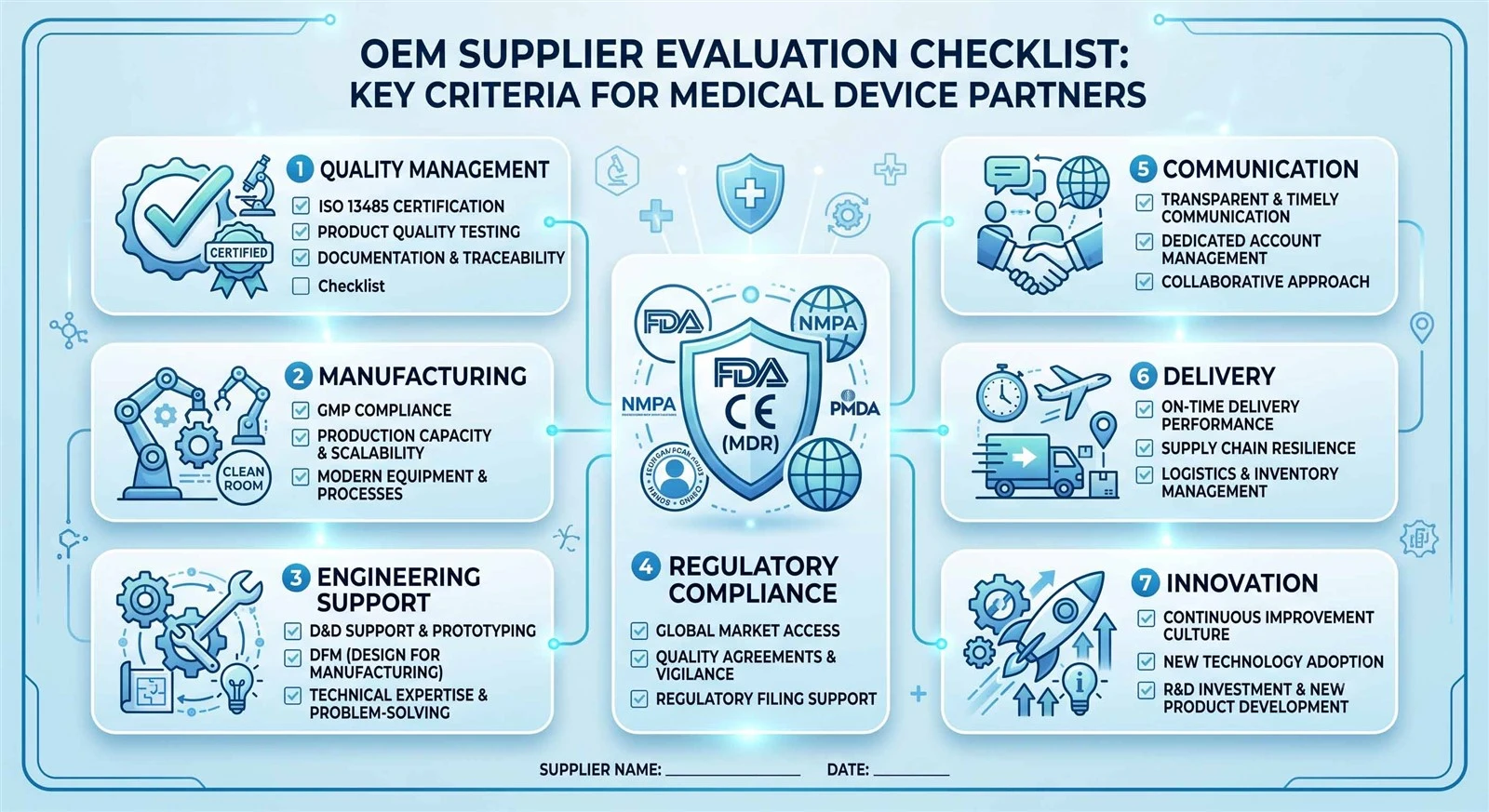
1. Evaluate the Quality Management System
Quality should be built into the manufacturing process-not inspected only at the end.
Questions to ask include:
- Is the manufacturer certified to ISO 13485?
- Are production procedures documented?
- Is batch traceability available?
- How are non-conforming products handled?
- Is there a continuous improvement process?
A mature quality system demonstrates that the manufacturer is committed to consistent performance.
A reliable quality management system reduces production variability and helps ensure consistent product quality over time.
2. Assess Manufacturing Capabilities
Production capacity is just as important as product quality.
Consider:
- Automated production lines
- Cleanroom manufacturing
- Production capacity
- Equipment maintenance
- Process validation
Manufacturers with well-controlled production systems are often better equipped to support growing OEM projects.

3. Look Beyond Product Specifications
Specifications describe a product.
They do not describe the manufacturer's ability to produce it consistently.
When comparing suppliers, ask:
- How stable is conductivity across production batches?
- How consistent is hydrogel performance?
- What testing is performed before shipment?
- How are process variations controlled?
Consistency is often more valuable than impressive specifications.
4. Review Technical Support
A supplier should contribute more than manufacturing capacity.
Strong technical support may include:
- Product design recommendations
- Material selection guidance
- Connector compatibility advice
- Packaging optimization
- Engineering collaboration
Technical expertise becomes especially valuable during custom OEM projects.

5. Consider Customization Capabilities
Every OEM project is different.
Evaluate whether the supplier can customize:
- Pad dimensions
- Shapes
- Hydrogel formulations
- Connector types
- Packaging
- Branding
- User instructions
The ability to adapt products to specific market requirements is often a sign of a mature manufacturing partner.
6. Verify Regulatory Support
Regulatory knowledge can simplify product launches.
Ask whether the supplier can support:
- Technical documentation
- Product testing
- Applicable certifications
- Labeling requirements
- Market-specific compliance
Manufacturers familiar with international markets often help reduce regulatory delays.
7. Evaluate Communication
Communication is often underestimated.
Ask yourself:
- Do they respond promptly?
- Are technical questions answered clearly?
- Are project timelines realistic?
- Are challenges communicated transparently?
Strong communication helps prevent misunderstandings throughout the project.
8. Assess Supply Chain Stability
Long-term supply reliability is critical.
Questions to consider:
- Are raw material sources stable?
- Is inventory management well organized?
- Can production scale with demand?
- What is the average lead time?
Reliable supply chains reduce business risks and improve planning.
9. Think Beyond the First Order
Choosing a supplier is not only about today's project.
It's about future collaboration.
Consider whether the manufacturer demonstrates:
- Continuous improvement
- Investment in R&D
- Stable management
- Long-term business vision
- Willingness to grow with customers
The strongest partnerships are built over years-not individual orders.
Practical Supplier Evaluation Checklist
|
Evaluation Area |
Questions to Ask |
|---|---|
|
Quality System |
Is ISO 13485 implemented? |
|
Manufacturing |
Are production processes standardized? |
|
Product Performance |
Is batch consistency demonstrated? |
|
Engineering |
Can technical support be provided? |
|
Customization |
Are OEM requirements supported? |
|
Compliance |
Can regulatory documentation be supplied? |
|
Communication |
Is the response professional and timely? |
|
Supply Chain |
Can delivery remain stable over time? |
|
Partnership |
Does the supplier invest in long-term collaboration? |
Tip: Instead of choosing the supplier with the highest score in one category, look for balanced performance across all evaluation areas.
Frequently Asked Questions
01.What is a Chain Sprocket?
02.Is metric roller chain sprocket universal?
03.What is the difference between ANSI and Metric Roller Chain Sprockets?
04.How does sprocket size affect torque?