

Conductive hydrogel is one of the most important materials used in modern medical electrode pads.
Although it is rarely visible to the end user, this soft polymer layer determines how effectively electrical stimulation is delivered from a device to the skin.
Its performance directly influences conductivity, adhesion, comfort, moisture retention, and product consistency.
But how is conductive hydrogel actually made?
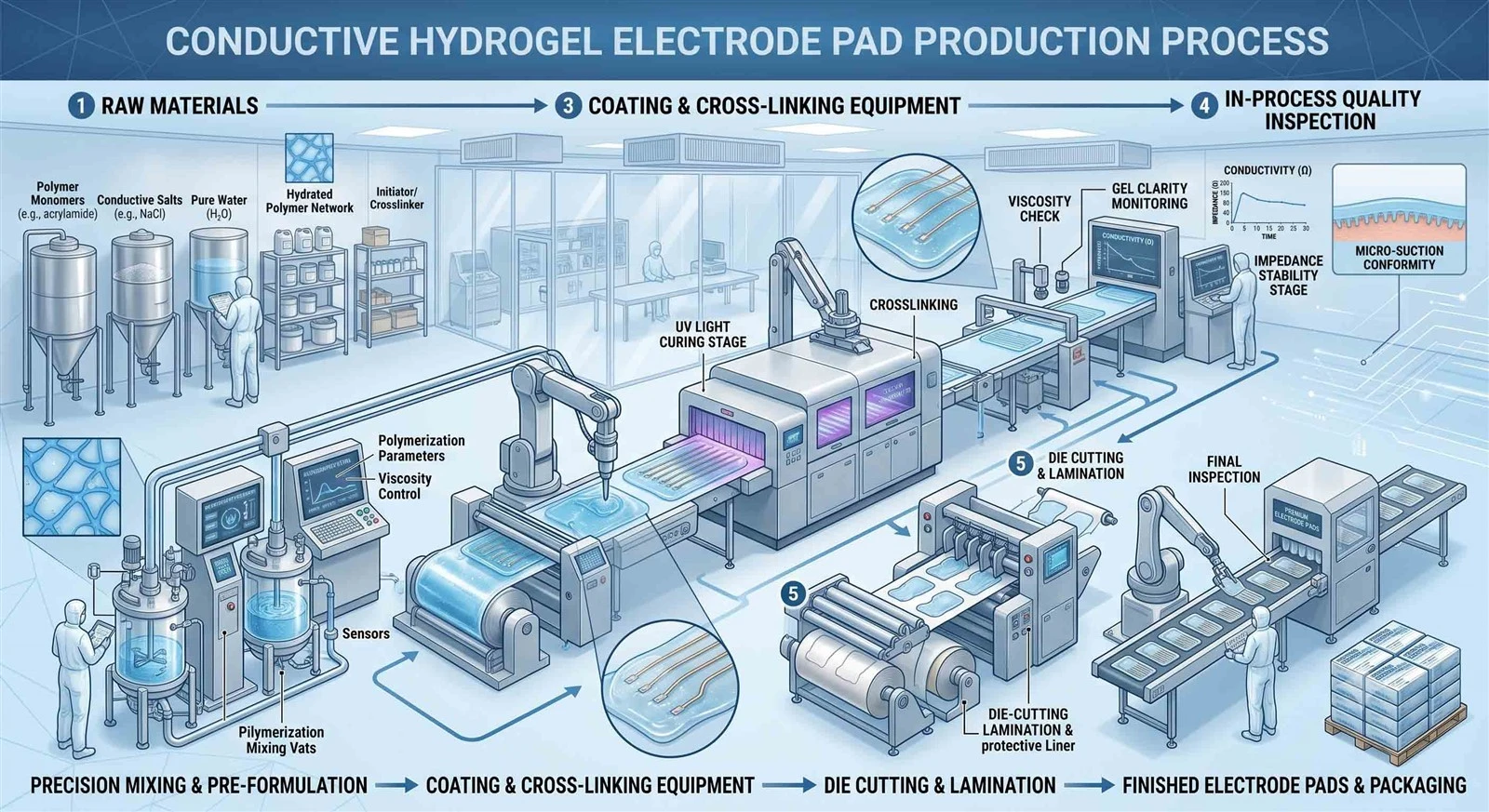
While individual formulations vary between manufacturers, the production process generally follows a series of carefully controlled steps designed to ensure consistent quality and reliable performance.
This article provides an overview of how conductive hydrogel is manufactured and why each stage matters.
Quick Answer
The manufacturing of conductive hydrogel typically includes:
- Raw material selection
- Precision formulation
- Mixing and dispersion
- Hydrogel formation
- Coating onto the backing material
- Drying or curing (depending on the formulation)
- Die cutting and lamination
- Quality inspection and packaging
Each step contributes to the final electrical and mechanical performance of the electrode pad.

Step 1: Selecting High-Quality Raw Materials
Every conductive hydrogel begins with carefully selected raw materials.
Depending on the formulation, these may include:
- Medical-grade polymers
- Purified water
- Conductive salts or ionic compounds
- Humectants to retain moisture
- Crosslinking agents
- Functional additives for stability or skin comfort
The exact composition varies according to the intended application, such as reusable TENS pads or single-use clinical electrodes.
Why It Matters
The choice of raw materials affects:
- Electrical conductivity
- Moisture retention
- Skin compatibility
- Shelf life
- Mechanical stability
The performance of conductive hydrogel begins with the quality and consistency of its raw materials.
Step 2: Precision Formulation
Once the raw materials are selected, they are combined according to a carefully controlled formulation.
Unlike ordinary adhesives, conductive hydrogel requires a balance between multiple properties.
Engineers must optimize:
- Conductivity
- Adhesion
- Elasticity
- Moisture content
- Mechanical strength
Even small changes in formulation can influence the final performance of the electrode pad.
Step 3: Mixing and Dispersion
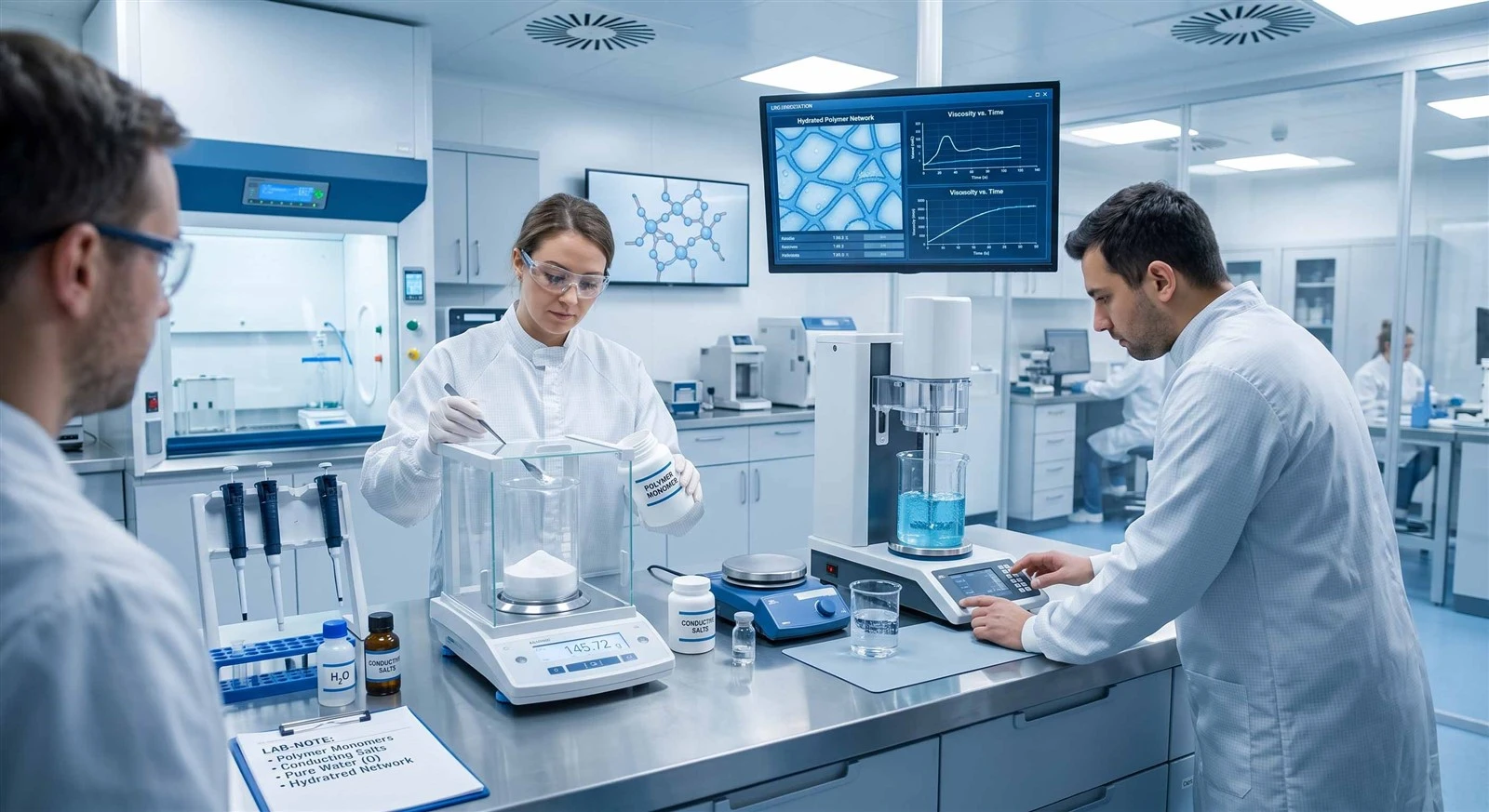
The ingredients are blended using precision mixing equipment.
The objective is to create a homogeneous hydrogel without air bubbles or uneven distribution of conductive components.
Key considerations include:
- Mixing speed
- Temperature
- Mixing duration
- Material dispersion
Uniform mixing contributes to consistent conductivity across every electrode pad.
Step 4: Hydrogel Formation
Depending on the technology used, the mixed material is transformed into a stable hydrogel network.
This process creates the characteristic soft, flexible structure that:
- Holds moisture
- Supports ion movement
- Maintains skin contact
- Allows repeated electrical stimulation
Rather than functioning as a simple adhesive, the hydrogel forms an engineered material designed specifically for medical electrotherapy applications.
Step 5: Coating onto the Backing Material
After the hydrogel is prepared, it is applied to the selected backing material.
Common backing materials include:
- Non-woven fabric
- Foam
- PET film
- Other medical-grade substrates
Coating thickness must be carefully controlled to achieve consistent product performance.
Variations may affect:
- Adhesion
- Electrical resistance
- User comfort
- Product appearance

Step 6: Drying or Stabilization
Some hydrogel systems require controlled drying, curing, or stabilization before further processing.
The objective is to:
- Preserve moisture
- Improve structural stability
- Prepare the material for converting operations
Environmental conditions such as temperature and humidity are closely monitored throughout this stage.
Step 7: Die Cutting and Lamination
The hydrogel-coated material is then converted into finished electrode pads.
Typical processes include:
- Die cutting into different shapes
- Laminating protective liners
- Installing connector components
- Individual pouch packaging
This stage enables manufacturers to produce a wide variety of standard and custom electrode pad designs.
Quality Control Throughout the Process
Quality is not evaluated only after production-it is monitored throughout the manufacturing process.
Typical quality control measures include:
- Raw material verification
- In-process inspection
- Coating thickness measurement
- Conductivity testing
- Adhesion evaluation
- Visual inspection
- Final packaging inspection
These checks help ensure that each production batch meets predefined quality standards.
Consistent hydrogel performance depends on continuous quality control throughout manufacturing rather than final inspection alone.
Why Manufacturing Consistency Matters
For OEM customers, the challenge is not producing one excellent sample.
The challenge is producing thousands-or millions-of electrode pads with the same performance.
Manufacturing consistency helps ensure:
- Stable conductivity
- Reliable adhesion
- Predictable treatment performance
- Reduced product variation
- Improved customer satisfaction
This is why robust process control is often just as important as material selection.
Frequently Asked Questions
Is conductive hydrogel manufacturing the same as making ordinary adhesive?
Why is coating thickness important?
Can hydrogel formulations be customized?
Why is quality control performed during multiple production stages?