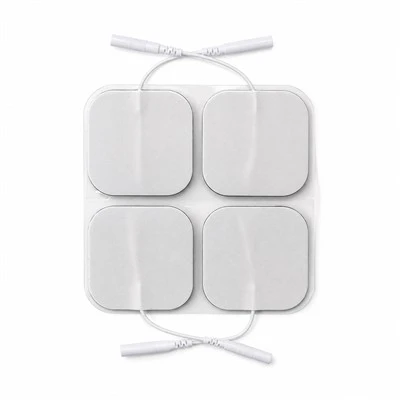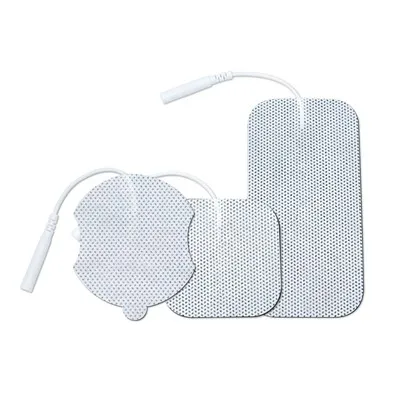
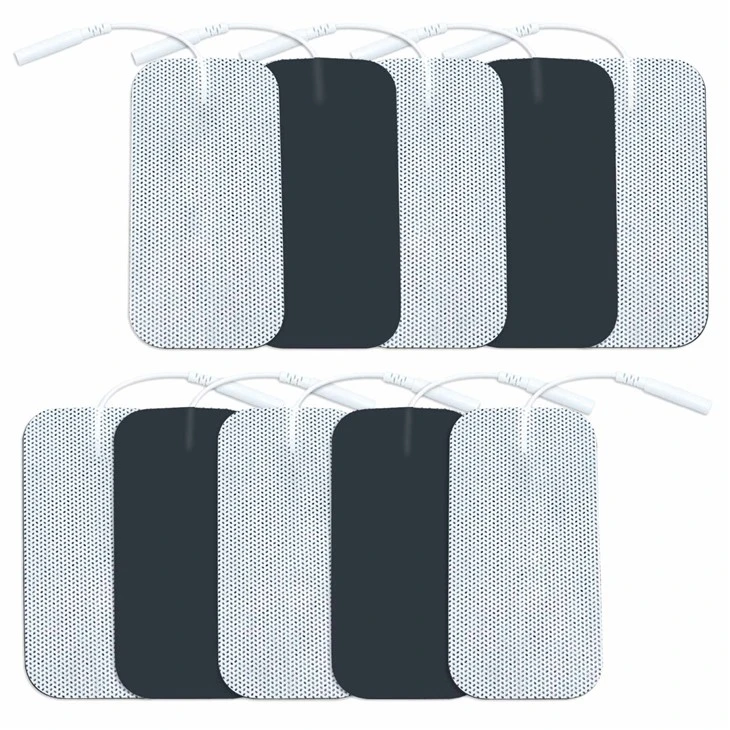
OEM 2x4 TENS Electrodes | 50x100mm Rectangular Pads | TOP-RANK
Bulk 2x4 inch (50x100mm) rectangular TENS electrodes. Engineered with long-axis carbon trace compensation and high-modulus ionic hydrogels to prevent current attenuation during paraspinal and quadriceps motor recruitment.
Product Overview
The 2x4 inch (50x100mm) rectangular template represents the primary elongated transdermal consumable utilized for broad muscle group neuromodulation. Configured specifically to bridge paraspinal, sciatica, and quadriceps motor unit paths, this dimension avoids the placement latency of multiple small formats. Rather than a static geometric enlargement, this substrate carrier tracks complex planar voltage gradients along its 100mm continuous axis. We manufacture these bulk blanks for DME reimbursement networks, hospital warehouse suppliers, and private-label physical therapy brands.
Technical Fabrication & Voltage-Drop Balancing
The automated production of 2x4 inch substrates pairs a continuous calender laminator flow with high-speed flexographic web tensioners. In an elongated footprint, the primary engineering breakdown is the linear sheet resistance of standard carbon film. When a TENS controller fires current through a single centered terminal (pin or snap rivet), the electrons tunnel vertically beneath the anvil, causing a sharp planar voltage drop before reaching the 100mm distal tips. To flatten this attenuation curve, our slot-die printing line deposits a gradient-compensated silver-carbon hybrid layer, creating a low-resistance busbar that balances the electric potential. The skin-facing polymer is a cross-linked polyacrylamide biopolymer formulated inside vacuum homogenizers to eradicate ambient air-voids. Rotary conversion splits the spools on multi-cavity nested anvils to control edge-ooze under <0.2mm. Wholesale runs require a minimum MOQ of 20,000 spools.
Core Engineering Assets
-
Long-Axis Carbon Compensation (Focal Hotspot Erasure)
Elongated pads without planar circuit adjustments funnel current immediately beneath the wire insertion root, leaving the outer margins under-stimulated. This electrical bottleneck creates a focal thermal hotspot that triggers severe skin biting during high-mA protocols. We re-engineer the circuit path using an advanced silver-trace gradient matrix. By matching the sheet resistance inversely to the distance from the centered rivet, electrons are forcefully scattered laterally across the entire 100mm length before migrating down the Z-axis gel layer. This establishes an isotropic, mathematically uniform current density field (mA/㎝²) across the entire rectangle.
-
Deep Neuromuscular Alignment
The large paraspinal muscle groups and thighs feature a dense, highly insulative subcutaneous fat barrier that resists low-frequency vectors. Small standard square pads distribute current in a broad, shallow pool, failing to recruit deep motor nerves. The 2x4 format aligns physically with the long axis of the muscle belly or the sciatic nerve path. Our gel formulation is heavily doped with high-mobility alkali electrolytes to lower the interfacial resistance. This specific geometry forces the electrical vector to flow parallel to the muscle fibers, achieving deep tissue polarization and stable motor recruitment at lower generator voltages.
-
Multi-Directional Kinetic Strain Recovery
When applied over the lower back, the lumbar region generates intense multidirectional skin shearing during active bending or walking. Flimsy synthetic backings lack the elastic recovery to absorb this tensile strain, causing the pad edges to buckle and lift. We laminate our 50x100mm matrix using a heavy-weft spunlace non-woven fabric bound to a high-storage-modulus (G' > 24,000Pa) cohesive gel lattice. Under kinetic loading, the fabric grid stretches and recovers symmetrically alongside the epidermis, dampening the longitudinal shear force and maintaining an unbroken 4.5N grip without edge curling or structural delamination.
Target Deployment
Paraspinal Pain Gating
Parallel placement along the L4-S1 vertebrae to cross broad pain dermatomes without requiring multiple separate lead lines.
High-mA Sports Conditioning
Heavy-duty motor unit recruitment for the quadriceps, hamstrings, and gluteal bellies during intense resistance stimulation cycles.
DME Reimbursement Bundling
High-volume standard replace-pack configurations Lot-tracked and sealed for serialized medical insurance compliance.
Custom Engineering & Logistics
-
Multi-Cavity Zero-Gap Tooling : The rectangular 2x4" geometry is highly optimized for roll-to-roll manufacturing efficiency. We employ zero-gap nesting on our rotary die toolings, completely eliminating hydrogel web scrap between individual pad margins. This allows us to offer global distributors a significantly lower per-pack baseline cost compared to custom butterfly profiles.
-
Tariff Resilience Shunting Shroud : Raw biopolymer polymerization, carbon trace silk-screening, and continuous coating lines runnative within our primary China factories. Precision multi-anvil shape cutting, terminal crimping, and automated vacuum hermetic packaging path through our Vietnam manufacturing hub, sheltering Western B2B procurement chains from regional duty fluctuations.
Quality Architecture
-
ISO 10993 Compliance: Cured gel matrices and non-woven sub-sheets undergo complete laboratory extraction logs, cleared strictly against ISO 10993-5 (Cytotoxicity Grade 0) and ISO 10993-10 (Primary Irritation Index < 0.1) boundaries.
-
QMS Infrastructure: Continuous lamination and packing lines function securely inside facilities registered and audited to ISO 13485:2016 and MDSAP regulatory frameworks, facilitating seamless customs verification.
Technical FAQ
Q: Why does a 2x4 rectangular pad require lower device output voltage to stimulate deep back muscles compared to a 2x2 square pad?
A: This is an electro-physical consequence of electrode orientation and tissue impedance. A 2x2 square pad spreads current symmetrically, forcing electrical vectors across the skin barrier into non-targeted lateral tissues. The 2x4 rectangle provides a directed 100mm planar line that aligns parallel with the paraspinal muscle fiber orientation. This directional vector lowers the total biological loop resistance, bypassing the insulative adipose (fat) layer at lower generator voltages and achieving deep neuromuscular recruitment without surface stinging.
Q: Does the non-breathable PET liner used for large 2x4 spools affect the stability of the gel during long-distance ocean shipping?
A: The PET liner functions purely as a protective layer during die-cutting and is removed by the user. Long-distance shipping stability is completely determined by the hermetic seal of the secondary AL/PE foil pouch. If vapor transmission (MVTR) is not restricted by a thick aluminum barrier, the localized temperature spikes inside a shipping container (>50℃) will force humidity migration across the film, slowly desiccating the gel and causing crystal salt fallout. High-barrier foil seals isolate the polymer's internal thermodynamic equilibrium.
B2B procurement networks, physical therapy supply chains, and durable medical equipment (DME) distributors can request multi-point planar resistance charts, lot-tracked COA sheets, and unbranded 2x4 physical samples for clinical testing.
👉 [Request 2x4 Rectangular Pad Samples]
Hot Tags: 2x4 tens electrodes, China 2x4 tens electrodes manufacturers, suppliers, factory, Back Massager Electrodes, Electro Pads for TENS Unit, large TENS pads, TENS electrodes, TENS unit gel pads, Wireless Electrode Pads
Specifications
| Component Parameter | Standard Metric | Engineering Detail |
| Dimensions | 2" x 4" (50mm x 100mm) |
Elongated rectangular topography |
| Long-Axis Resistivity | < 40 Ohms (End-to-End) | Gradient-screened conductive layer |
| Current Payload | Optimized for 80mA - 120mA Peak | Supports deep neuromuscular recruitment |
| Peel Adhesion | 3.5N - 5.5N / 25mm | Verified under ASTM D3330 protocols |
| Carrier Backing | Spunlace Non-Woven / PE Foam | Multi-directional stretch recovery |