

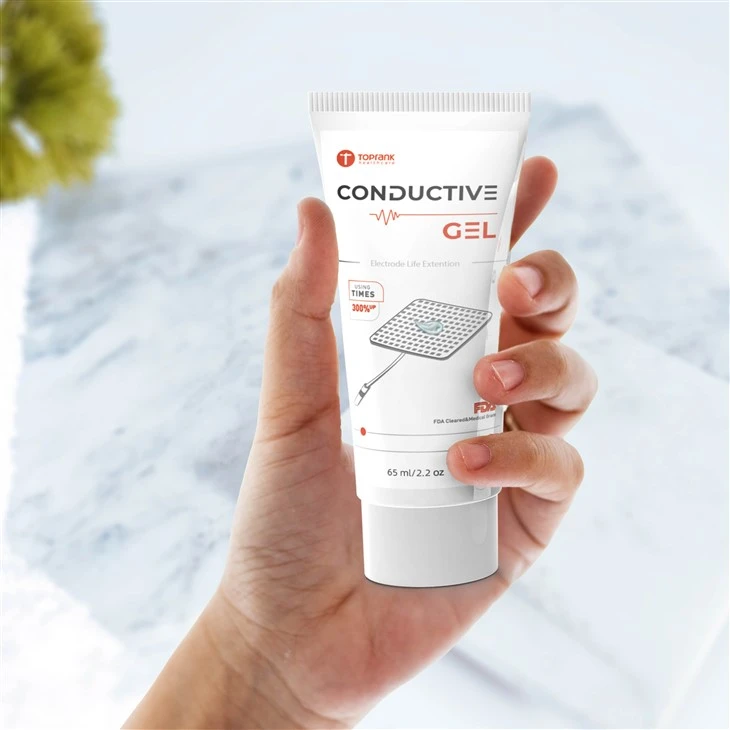
OEM Squeeze Tube Conductive Gel | 250ml Squeeze Bottle | TOP-RANK
Wholesaling bulk squeeze tube conductive gels for TENS, EMS, and diagnostic electrodes. Vacuum-homogenized carbomer matrix packed in high-barrier LDPE tubes with zero-leak ultrasonic tail seals.
Product Profile
This squeeze tube conductive gel represents the global commercial benchmark configuration engineered for over-the-counter (OTC) retail kitting, e-commerce distribution, and clinical physical therapy replenishment. Packaged in highly flexible, resilient low-density polyethylene (LDPE) tubes, this water-soluble electrolyte fluid functions as a seamless, zero-void ionic transduction bridge between skin-contact hardware and the human epidermis. The structural engineering of this specific assembly focuses on the dynamic mechanical rheology inside narrow orifices, ensuring precise clinical portioning without continuous trailing fluid or packaging seam failure under repetitive compression loading. We compound and extrude this hardware-safe couplant for medical distributors, cosmetic machine brands, and rehab supply chains.
Technical Fabrication & Ultrasonic Sealing
The mass processing of squeeze tube conductive mediums combines automated high-vacuum planetary batch compounding with continuous inline tube-filling tracks. A carbomer 940/980 crystalline skeleton is fully gelled in reverse-osmosis (RO) water, titrated with organic neutralizers, and optimized with alkali chloride carriers to flatten the electrical impedance below 50 Ohms. Crucially, the liquid matrix undergoes high-shear vacuum homogenization at 0.08 MPa to strip entrained air voids before filling. Trapped micro-bubbles act as dielectric insulators; under typical TENS pulse amplitudes, they provoke microscopic current arcing that stings the patient. Extruded through synchronized pneumatic nozzles into the open bottom of the LDPE sleeve, the container shell is sealed via a high-frequency ultrasonic anvil. The tool transfers localized kinetic energy to melt and fuse the polyethylene plies across a strict 3.5mm knurled line, avoiding the brittle thermal scorch points common in low-cost heat-wire sealers. MOQ: 3,000 white bottles + stickers, 10,000 custom-printed bottles.
Engineered Material Advantages
-
Thixotropic Orifice Delivery (Anti-Drip Physics)
When a therapist snaps open a 250ml tube dispenser, the gel layer must not sag or flow under its own head-weight, preventing immediate dripping from the nozzle. However, when the user applies manual compression to the tube body, the fluid must migrate through the 3mm flip-top orifice effortlessly. We build this mechanical preference by tuning the polymer's pseudoplastic cross-linking density. Under the structural shear force of tube squeezing, the carbomer bonds temporarily align, dropping the dynamic viscosity to facilitate smooth dispensing. The exact millisecond the user stops squeezing, the matrix snaps back to its high-viscosity lattice, arresting trailing strands and keeping the container neck perfectly sterile.
-
Thermal Viscosity Stabilization Countering Body-Heat Runoff
Standard, low-tier gels formulation experience polymer chain relaxation when exposed to 37°C skin heat, liquefying into a watery pool over a 45-minute therapeutic routine. This slump failure causes the medium to leak away from the electrode interface, creating dry-air micro-gaps that cause painful current tracking and trigger host device open-circuit errors. We stabilize the molecular lattice with high-storage-modulus organic fixators. The gel holds its structural profile and mechanical positioning across the 20°C to 45°C spectrum, preserving an unbroken planar conduit that confines the electrical vector strictly to the target muscular group without side migration.
-
Non-Corrosive Halide Titration for Permanent Hardware
Many GPO procurement stockists utilize reusable, non-adhesive carbon-rubber pads or intracorporeal rehabilitation probe that require continuous liquid gel wetting. Coating these high-value assets with aggressive, low-cost salt lubricants initiates rapid galvanic oxidation, destroying the metal plating and pitting the carbon conductivity. Our formulation restricts inorganic chlorides to safe electro-repulsion thresholds while buffered with organic alkanolamines to maintain a skin-neutral pH of 6.3 (±0.5). The chemical matrix remains completely passive to chromium coatings, stainless steel, and doped silicones, safeguarding the clinic's permanent assets over thousands of sanitation cycles.
B2B Procurement Deployments
OTC Handheld Device Kitting
Squeeze tubes packed directly inside retail box kits of handheld consumer TENS/EMS devices to build a shelf-ready accessory line and drive post-sale consumable recurring revenue.
Rehabilitation Clinic Volume Turnover
Highly conformable fluid media selected for high-traffic physical therapy groups using permanent carbon electrodes that require rapid patient turnover without pad delamination costs.
DME Reimbursement Supply Chains
Batch-serialized and lot-tracked tube arrays optimized for durable medical equipment (DME) distributors requiring serialization verification logs for serialized insurance compliance.
Custom Engineering & Logistics
-
Inline High-Definition Tube Decoration : Applying multi-color private label logos directly onto flexible LDPE tube bodies dictates strict surface energy control. Our extrusion bay runs high-speed inline flexographic printers coupled with intensive UV flame-treatment pins. The medical-grade resin inks chemically bite into the outer plastic wall, producing razor-sharp technical descriptions and private graphics that will not crack, flake, or bleed when clinicians repeatedly fold, crush, and empty the container down to the seal line.
-
supply chain Resilience Routing : Raw polymer complex titration, vacuum homogenization, and master gel batching function natively within our primary China facilities. High-speed container forming, automated volumetric fill, and high-frequency ultrasonic tail crimping execute through our Vietnam manufacturing hub, isolating Western B2B distributors from regional import duties on medical fluid formulations.
Certifications & Regulatory Passports
-
ISO 10993 Biocompatibility Validation : Fluid lots undergo complete independent laboratory extractions, cleared strictly against ISO 10993-5 (Cytotoxicity Grade 0) and ISO 10993-10 (Primary Dermal Irritation Index <0.1, Non-Sensitizing) boundaries to shield White-label brands from skin reactivity legal liability.
-
MDSAP Registered Quality Management : The chemical compounding lines and high-velocity tube bays run securely inside manufacturing environments certified and audited to ISO 13485:2016 and MDSAP regulatory frameworks, facilitating full, lot-serialized tracking from raw monomer storage to the outbound trade container.
Technical FAQ
Q: Why does a 250ml squeeze tube require a significantly higher formulation viscosity than gel delivered in a 5L bulk container?
A: This is an explicit response to delivery logistics and structural shear forces. 5L bulk jugs are dispensed via a spring-action vertical piston pump; if the gel viscosity climbs past 50,000 cPs, the fluid cavitation inside the tube causes pump binding and back-EMF valve blocking. Squeeze tubes, conversely, are operated manually with single-hand pressure. A lower 25,000 cPs fluid would instantly run out of a flipped cap under gravity, causing massive portioning waste. Elevating the carbomer density to 40,000 cPs provides non-slump hold on vertical limbs, while the shear-thinning thixotropy allows it to thin out perfectly only under the manual crushing force of the user.
Q: Does the high-frequency ultrasonic energy used to seal the tube tail degrade the electrical resistance parameters of the neighboring gel?
A: No, because ultrasonic sealing utilizes cross-plane mechanical vibration rather than external thermal elements. Standard thermal wire sealers project radiant heat through the plastic walls, cooking the localized gel phase trapped in the seal zone (>120°C). This extreme thermal blast evaporates the water carrier and breaks down the carbomer grid into a charred, carbonized residue that permanenty increases electrical impedance. Ultrasonic anvils hammer the plastic plies at 20kHz for milliseconds; the friction only vaporizes the polymer layers at the localized plastic-to-plastic junction, while the neighboring gel matrix remains physically cold, ensuring zero chemical degradation or baseline electrical drift.
B2B clinical distributors, physical therapy device manufacturers, and consumer medical brand buyers can request batch-specific Certificates of Analysis (COA), tail-weld Destructive Pressure sheets, and 250ml unbranded squeeze tubes for factory evaluation.
👉 [Request Squeeze Tube Gel Samples]
Hot Tags: squeeze tube conductive gel, China squeeze tube conductive gel manufacturers, suppliers, factory, Contact Gel for TENS Unit, ekg gel, Electrode Contact Gel, emg gel, TENS Electrode Adhesive Gel, TENS machine gel
Technical Specifications
| Property | Target Baseline | Analytical Context |
| Packaging Volume | 100ml / 250ml (8.5 oz) Standard |
Calibrated for ergonomic single-hand extrusion |
| Viscosity Matrix | 35,000 - 45,000 cPs |
Brookfield RVT (25°C, Spindle 6, 20 RPM) |
| AC Impedance | < 50 Ohms (at 500Hz AC bridge) |
Saturated chloride ion electron mobility |
| Orifice Adaption | 3.0mm - 4.0mm Flip-Top Nozzle |
Prevents dynamic fluid run-on |
| Tail Seal Strength | Exceeds 60N (Pneumatic Destructive) |
Ultrasonic high-frequency phase fusion |


