Wholesale 50x50mm TENS Pads | Square Electrodes | TOP-RANK
B2B volume-produced 50x50mm square TENS electrodes. Engineered with rounded-vertex carbon films and high-cohesion hydrogels to limit edge-ooze under < 0.2mm during high-speed die-cutting.
Product Profile
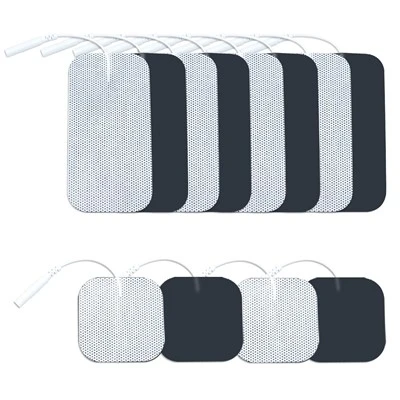
The 50x50mm square electrode pad represents the definitive (Metric) baseline transdermal consumable utilized across global clinical healthcare and over-the-counter (OTC) electrotherapy distribution channels. Explicitly configured to establish balanced electrical return loops over medium-sized muscle complexes (such as the deltoids, calves, and upper traps), this geometric template is the foundational high-turnover component of device accessory kits. Rather than relying on rigid or hand-layered films, our 50x50mm carrier substrates are optimized for mass automated converting, balancing surface current gradients while minimizing per-unit procurement overhead. We manufacture these blank-canvas templates for medical equipment GPOs, durable medical equipment (DME) stockists, and e-commerce private-label networks.
Manufacturing Kinetics & Edge-Ooze Prevention
The mass converting of 50x50mm square pads paths a continuous spunlace or PE foam carrier web through high-pressure rotary die stations at processing speeds exceeding 30 meters per minute. When stamp-cutting a sharp 90-degree corner at high velocity, the primary technical failure mode is edge-ooze (cold-flow displacement). Under subsequent carton stacking and container-freight static compression, standard liquid-phase gels migrate horizontally past the fabric backing, creating sticky rings that lock the pads to the master release liner. We counter this processing failure by increasing the covalent bond density of our polymer matrix during ultraviolet (UV) polymerization. This establishes an elevated storage modulus (G'), imbuing the hydrogel with an elastomeric memory. The gel locks its exact die-cut boundary under physical load, restricting border migration to <0.2mm. Completed runs route into airtight PET/AL/PE foil pouches. Wholesale contracts carry a 50,000-unit minimum run threshold per SKU.
Core Engineering Assets
-
Corner Current Density Mitigation (Hotspot Erasure)
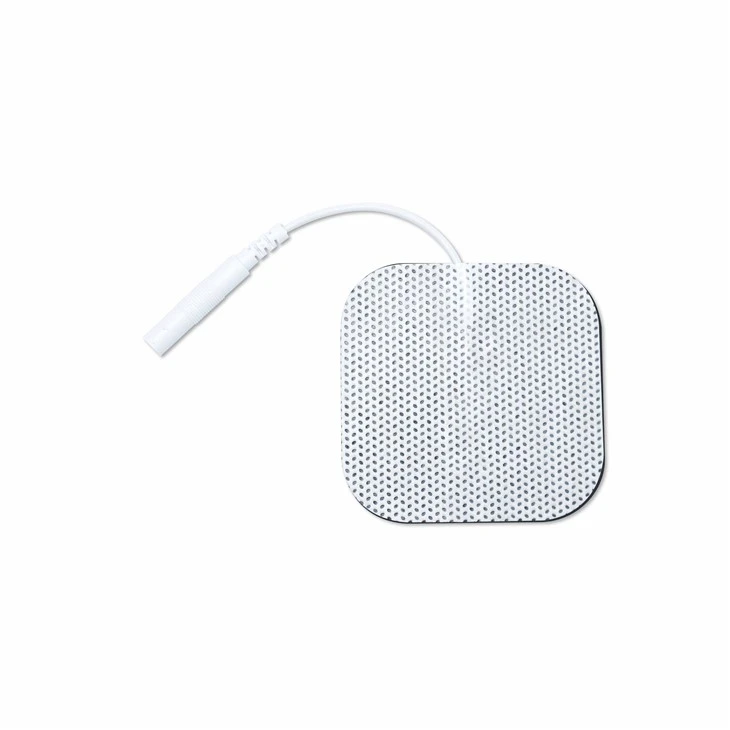
Standard square electrodes featuring sharp 90-degree internal carbon film cutouts suffer from intense current crowding. In electrophysics, electrons naturally migrate toward sharp metallic or conductive vertices; when a TENS generator fires, the current density (mAcm²) spikes violently at the four corner points of the 50x50mm square, bypassing the center and causing localized epidermal stinging. We erase this electrical bottleneck by screen-printing a proprietary carbon pattern with rounded micro-radius vertices. This structural modification scatters the electrons symmetrically across the entire 25cm² area, establishing a mathematically flat current density profile and allowing the safe transmission of high therapeutic current payloads without localized skin biting.
-
Mathematical Constant-Current Matching
The vast majority of commercial TENS and EMS pulse generators map their internal closed-loop constant-current (CC) algorithms based on a standard 4-square-inch (approx. 25cm²) electrical load .If a replacement pad's surface resistance exhibits batch-level variations, the device's microcontroller unit (MCU) overcompensates, emitting erratic voltage spikes to the tissue. We implement continuous online planetary viscometer titrations and multi-point bridge resistance scanners. By locking the AC volume impedance flatly below 50 Ohms with a strict lot-to-lot tolerance limit of <±5%, the 50x50mm blanks synchronize flawlessly with the default output parameters of 90% of global medical electrotherapy devices.
-
Hydroentangled Fiber Lock Against Shear Delamination
A persistent failure mode for high-volume square pads under dynamic physical therapy is layer-to-layer delamination. When a patient bends or twists, the kinetic shear force tries to tear the adhesive hydrogel layer away from the screen-printed carbon substrate, halting the treatment loop. Our white spunlace backing material undergoes complete hydroentanglement, where polyester-viscose strands are mechanically intertwined by high-pressure water needles to create an open micro-porous lattice. During UV thermal curing, our liquid polymer flows completely around these open yarn structures before solidifying. This establishes a dense mechanical interlock that physically traps the fabric inside the cross-linked network, preventing phase separation under high anatomical stretching.
Downstream B2B Deployments
Institutional Rehabilitation Tenders
The primary baseline 50x50mm consumable selected for heavy daily patient rotations in public physical therapy wards, where clinical cost-per-use must be minimized through high multi-use lifecycle stability.
Consumer Device OEM Inclusions
Standard-issue 50x50mm square accessories packaged directly inside retail box kits of handheld TENS/EMS devices to establish an aesthetic and highly compliant starter accessory pack.
OTC Pharmacy Private Labeling
Bulk pre-packaged arrays configured on siliconized release carriers, lot-serial tracked and optimized for regional brand packaging and automated peg-hook retail cartons.
Packing Customization & Supply Chain Shunting
-
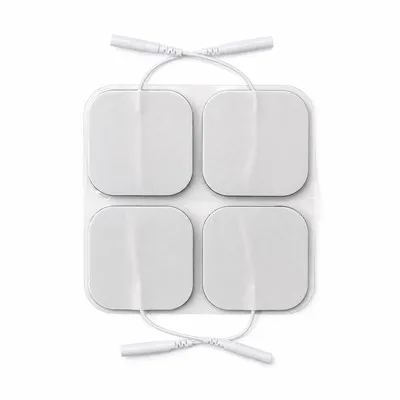
Hermetic Moisture-Lock Sleeve Pouching : For volume runs, we package the electrodes in sets of four on a single siliconized release card, hermetically sealed inside thick, high-density PET/AL/PE foil pouches with 8mm solid seals. This technical barrier completely blocks vapor transmission (MVTR ≈ 0), preserving the thermodynamic water-to-glycerol balance and preventing hydrogel crystallization over a 24-month field shelf life.
-
Resilient Global Logistics Optimization : Raw macromolecular synthesis, chemical titration, silver-carbon ink mixings, and continuous web lamination coatings run native inside our primary China plant. Precision high-speed rotary shape blanking, lead wire or snap riveting assembly, automated vacuum sealing, and container palletization are shunted via our Vietnam hub, protecting global B2B procurement chains from regional duty fluctuations on medical components.
Quality Compliance Safeguards
-
Independent Biocompatibility Audit : Finalized multi-layer conformal matrices (polyester webs, conductive carbon patterns, and polymer hydrogels) undergo continuous independent clinical laboratory extractions, verified strictly against ISO 10993-5 (Cytotoxicity Grade 0) and ISO 10993-10 (Primary Dermal Irritation Index <0.1, Non-Sensitizing) boundaries.
-
MDSAP Registered Industrial Operations : Every mass-production run operates securely within manufacturing cleanrooms certified and registered to ISO 13485:2016 and MDSAP regulatory frameworks, executing unbroken lot-serialized traceability from liquid chemical monomer logs to the logistics shipping dock.
Technical FAQ
Q: Why does a 50x50mm square pad exhibit a lower risk of early late-stage resistance fatigue compared to an oversized butterfly pad?
A: This is an electro-physical result of layout symmetry and planar voltage drop. In an oversized electrode (like a 150mm butterfly layout), current attenuates rapidly as it travels linearly away from the single lead entry toward the wing margins, forcing higher device driving voltages which accelerates gel degradation. A 50x50mm format creates an isotropic square plane where all points are equidistant from the centered wire terminal. The electrical potential gradient is mathematically minimized, reducing localized power consumption and preserving the ionic mobility of the polymer across its entire lifespan.
Q: Does the public tolerance variance of the 50x50mm backing layer cut alter the volume resistivity metrics?
A: Dimension variances alter mechanical surface adhesion limits, but electrical conductivity is completely independent of backing perimeter specs. Sheet resistance and volume resistivity are entirely determined by the mass deposition density of the underlying carbon black screen-printed film and the saturated alkali ion titration of the hydrogel lattice. Even if a die blade experiences a sub-millimeter tracking variance, the electrical transduction wave remains un-shifted, provided the internal conductive matrix layers maintain uniform thickness values.
Medical procurement networks, durable medical equipment (DME) wholesalers, and clinical hardware OEMs can request multi-point surface impedance mapping grids, independent ISO 10993 clearing sheets, and 50x50mm unbranded sample evaluation bricks.
👉 [Request 50x50mm Pad Samples]
Hot Tags: 50x50mm tens pads, China 50x50mm tens pads manufacturers, suppliers, factory, Electro Pads for TENS Unit, Electrotherapy Replacement Pads, Neck Relax Electrode Pads, TENS Machine Sticky Pads, TENS therapy pads, TENS Unit Patches
Technical Specifications
| Physical Property | Metric Value | Engineering Test Standard |
| Dimensions | 50mm x 50mm (Square) |
Calibrated baseline active footprint |
| Corner Profile | Micro-Radius Rounded Vertices |
Mitigates geometric current spikes |
| Z-Axis Impedance | < 50 Ohms |
Measured at 100Hz AC |
| Hydrogel Modulus | High Cross-Linked ($G' > 26,000\text{ Pa}$) |
Blocks dynamic lateral cold-flow |
| Ooze Tolerance | < 0.2mm at processing speed |
Rotary tool calibrated |
| Release Liner | 75-micron Dual PET Liner |
Fluorosilicone double-coated release |