
Wholesale Large TENS Pads for Back Pain | Lumbar Electrodes | TOP-RANK
B2B large TENS pads for lower back pain. Engineered with branched carbon-ink busbars and high-modulus ionic hydrogels to eliminate center hotspots across 50x100mm lumbar footprints.
Product Profile
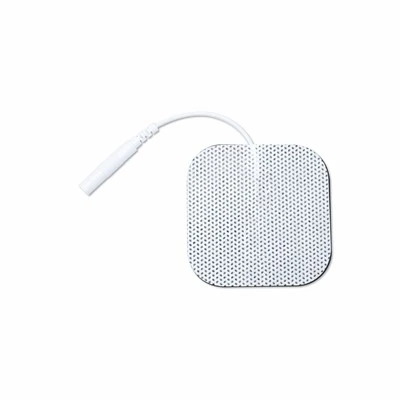
These large-format TENS pads function as specialized transdermal consumable interfaces engineered for lower back pain (LBP), sciatica, and paraspinal muscle spasms. Applying transcutaneous stimulation over broad anatomical zones like the lumbar erector spinae requires a much larger surface footprint (typically 50x100mm or 70x120mm) compared to standard 50x50mm square pads. However, expanding the surface length creates an electrical physics hazard: electrons bottleneck directly beneath the lead wire rivet, creating focal thermal hotspots while leaving the outer pad margins un-stimulated. Our large lumbar pads integrate a branched conductive busbar network to balance electrical flux across the entire plane. We mass-produce these high-turnover blanks for medical equipment GPOs, durable medical equipment (DME) stockists, and e-commerce private-label brands.
Continuous Lamination & Planar Current Distribution
The industrial fabrication of large back pads passes a spunlace non-woven web through multi-stage flexographic printing, slot-die hydrogel extrusion, and rotary die-cutting stations. When passing a high milliampere (mA) current required to penetrate thick subcutaneous adipose (fat) layers on the lower back, standard thin-film carbon traces experience linear voltage drop over a 100mm distance. To force isotropic charge distribution without creating a hot center point, our converting line screen-prints a primary carbon layer overlaid with a high-conductivity, branched silver-ink busbar pattern. This internal geometric layout acts as an electrical distribution funnel, driving electrons horizontally to the extreme extremities of the pad before they pass vertically through the Z-axis hydrogel. The completed laminates are die-cut with rounded radii to prevent corner charge buildup and sealed in airtight tri-laminated AL/PE foil pouches. Standard wholesale contracts carry a 20,000-unit minimum run threshold.
Core Engineering Assets
-
Branched Carbon Trace Compensation (Center Hotspot Erasure)
Standard large rectangular electrodes without circuit path compensation funnel electrical current directly beneath the central wire or snap terminal. This voltage bottleneck transforms the terminal root into a localized heater, causing severe skin stinging and burns during high-output pain gating protocols. We eliminate this current tunneling hazard by printing a branched, resistance-compensated conductive ink pattern. The physical layout forces electrons to disperse laterally to the outer margins of the 50x100mm footprint before crossing the skin barrier, creating a mathematically uniform current density field (mA/cm²) that allows safe high-mA stimulation.
-
Spinal Process Clearance Geometry (Zero-Arcing Bridge)
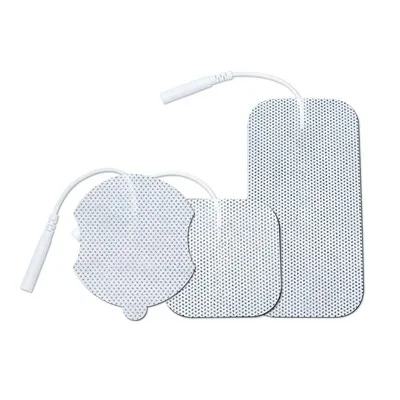
Applying a continuous, rigid rectangular pad straight across the midline of the lower back leaves an unavoidable air gap directly over the bony spinal column (spinous processes). Air is a strong dielectric insulator; when high-voltage TENS pulses encounter these dry air pockets, the current arcs across the remaining wet contact points, triggering device load-errors. Our large lumbar pads utilize a specialized, central-recessed or dual-lobed die-cut geometry. The physical cutouts bypass the unyielding vertebrae, maintaining 100% planar contact strictly over the left and right paraspinal muscle bellies without air gap formation.
-
Anti-Shear Hydrogel Cohesion During Lumbar Flexion
When a patient sits, bends forward, or twists their torso, the skin on the lower back undergoes intense three-dimensional mechanical stretching. Standard low-modulus gels suffer internal cohesive cleavage under this dynamic strain, tearing away from the carbon film and causing edge curling. We formulate our skin-facing hydrogel with a high covalent cross-linking density and elevated storage modulus (G'). The gel stretches and recovers synchronously with the spunlace non-woven backing, absorbing the kinetic shear stress and preserving its 4.5N–6.5N peel anchor throughout a 12-hour active wear cycle.
B2B Procurement Deployments
Institutional Lumbar Pain Gating
Large-format 50x100mm pads deployed in physical therapy and chiropractic clinics to cover broad paraspinal dermatomes (L1-L5) without requiring four separate 50x50mm lead wire setups.
Post-Discectomy Orthopedic Rehab
Heavy-duty, high-impedance-compensated pads used during non-narcotic post-surgical pain management and paraspinal muscle re-education routines.
OTC Retail Back Pain Kitting
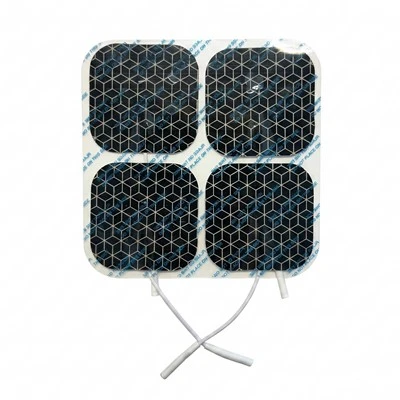
Pre-packaged 4-pack replacement kits branded for pharmacy chains and e-commerce DTC sellers targeting the global lower back pain (LBP) accessory market.
Packaging & Transnational Logistics Routing
-
Zero-MVTR Foil Barrier Pouching : Large hydrogel surface areas are susceptible to humidity loss during warehouse storage. We package completed 50x100mm pads on automated horizontal flow-wrappers into heavy PET/AL/PE foil pouches with 8mm solid heat-seals. This barrier drives the Moisture Vapor Transmission Rate (MVTR) near zero, preventing gel dehydration and ensuring a 24-month shelf life.
-
Supply Chain Resilience Routing : Polymer synthesis, carbon ink screen-printing, and continuous web lamination run inside our primary China facility. Automated large-format shape die-cutting, terminal pigtail/snap crimping, and packaging execute at our Vietnam hub, providing supply chain redundancy and protecting international distributors from regional import tariffs.
Regulatory & Quality Safeguards
-
ISO 10993 Dermal Safety Validation : Finished multi-layer laminates (spunlace backing, carbon trace, and active hydrogel) undergo continuous batch testing against strict ISO 10993-5 (Cytotoxicity Grade 0) and ISO 10993-10 (Primary Dermal Irritation Index <0.1) boundaries to eliminate skin allergy risks.
-
MDSAP & ISO 13485 Manufacturing : Manufacturing and cleanroom converting bays function securely under ISO 13485:2016 and MDSAP regulatory frameworks, delivering unbroken lot-serialization from raw monomer synthesis to final shipping cartons.
Technical FAQ
Q: Why do regular 50x50mm square pads sting when patients turn up the power to treat lower back pain?
A: Lower back tissue features thicker subcutaneous fat, presenting a significantly higher baseline electrical resistance than the arm or wrist. To force the electrical vector deep into the paraspinal nerves, patients must turn up the host's output voltage. On a small 50x50mm pad (25cm²), this high mA output pushes the current density (mA/cm²) past the pain threshold, causing current tunneling and focal burning. Large 50x100mm pads (50cm²) with branched carbon traces dilute the charge over twice the surface area, penetrating deep fat layers without localized skin stinging.
Q: Does sweat accumulation during a 60-minute back therapy session cause large hydrogel pads to delaminate from the carbon film?
A: On low-grade pads, yes. Sweat contains sodium chloride, which acts as a plasticizer that dissolves low-crosslinked hydrogels, causing the gel to liquefy and slide off the carbon substrate. Our large back pads utilize a high-density, cross-linked polymer network with a low swell ratio. The hydrogel absorbs microscopic perspiration without losing its elastomeric memory or cohesive bond to the carbon trace, ensuring zero delamination throughout a 60-minute continuous session.
DME procurement networks, medical equipment brand owners, and GPO distributors can request planar impedance distribution mapping, dynamic shear test logs, and unbranded 50x100mm evaluation samples.
👉 [Request Large Back Pad Samples]
Hot Tags: large tens pads for back pain, China large tens pads for back pain manufacturers, suppliers, factory, Electrode Pad, Electronic Pulse Massager Pads, Muscle Stimulator Electrode Pads, stimulation pads, TENS Machine Electrode Pads, TENS Unit Electrodes
Technical Specifications
| Structural Parameter | Metric Target | Engineering Test Standard |
| Active Surface | 50cm² - 84cm² (50x100mm / 70x120mm) | Single-piece paraspinal muscle mapping |
| Planar Variance | < 8% across 100mm long axis | Four-point probe multi-location scan |
| Z-Axis Resistance | < 35 Ohms (100Hz AC bridge) | Measured at center and extreme margins |
| Hydrogel Peel Force | 4.5N - 6.5N / 25mm | ASTM D3330 high-tack lumbar protocol |
| Backing Substrate | Spunlace Non-Woven (60g/m²) | Multi-directional kinetic yield |