


Medical electrodes are manufactured through a combination of material selection, conductive interface design, precision converting, assembly, and quality control. Because these elements work together to determine the performance of the finished product, even a seemingly minor change can have consequences beyond the individual component being modified.
For example, changing a hydrogel formulation may affect adhesion, conductivity, skin contact, or storage stability. Adjusting a converting process may influence dimensional accuracy or the consistency of the finished electrode. Replacing a raw material supplier may also introduce differences that are not immediately visible during routine inspection.
This is why change control matters in medical electrode manufacturing.
For medical device companies and OEM/ODM buyers, understanding how a manufacturer manages changes is an important part of evaluating production reliability. The objective is not to prevent every change. It is to ensure that changes are assessed systematically, supported by appropriate evidence, and implemented without introducing unacceptable risks.
What Is Change Control in Medical Electrode Manufacturing?
Change control in medical electrode manufacturing is a structured process for reviewing, approving, implementing, and verifying changes that could affect product quality, performance, safety, or regulatory compliance.
Typical changes include:
- Raw material or supplier substitutions
- Hydrogel formulation adjustments
- Electrode design or dimensional changes
- Manufacturing process parameter changes
- Production equipment or tooling modifications
- Packaging material changes
- Manufacturing site transfers
An effective change control process identifies the potential impact of a change, determines whether additional testing or validation is necessary, documents the decision, and verifies that the modified product or process meets its applicable requirements.
For OEM/ODM projects, change control also helps manufacturers and customers maintain alignment when product specifications, approved materials, or production arrangements evolve.
1. Why Change Control Matters in Medical Electrode Manufacturing
A medical electrode is not simply a collection of individual materials. Its performance depends on how those materials and manufacturing processes interact.
Consider a typical hydrogel-based electrode. The conductive interface, backing material, connector, adhesive properties, and protective liner must function together as an integrated product.
A change to one element may influence another.
For example, a new backing material could have different surface characteristics. Even if the material appears visually similar to the original, it may behave differently during lamination, die-cutting, or use.
Likewise, an adjustment to a hydrogel formulation may affect more than one performance characteristic. Adhesion, cohesive strength, electrical properties, and aging behavior may all need consideration, depending on the nature of the change.
Without a structured review, these effects may not be identified until the product reaches a later production stage or, in some cases, the customer.
Change control helps manufacturers identify potential risks before a change becomes part of routine production.
The difference between making a change and controlling a change
A manufacturing change is the physical or procedural modification itself.
Change control is the management process surrounding that modification.
It establishes:
- What is changing and why
- Which products and processes may be affected
- What risks need to be evaluated
- Who must review and approve the change
- What testing or validation is required
- How the change will be implemented
How successful implementation will be verified
The distinction is important because a technically reasonable change may still be inappropriate if it is introduced without adequate evaluation or authorization.
2. What Types of Changes Should Be Evaluated?
Not every manufacturing adjustment carries the same level of risk. The required review should reflect the nature of the change, its potential impact, and the product's intended use.
For medical electrode manufacturers, changes generally fall into several categories.
2.1 Raw Material Changes
Raw material changes may involve:
- Conductive hydrogel ingredients or formulations
- Conductive films and backing materials
- Fabric or foam substrates
- Connectors and conductive components
- Release liners
- Packaging materials
A substitute material should not automatically be considered equivalent simply because it has a similar appearance or nominal specification.
Depending on its function, the material may require evaluation for physical properties, electrical performance, compatibility with adjacent layers, processing behavior, or stability.
For hydrogel-based products, for example, a formulation change may influence adhesion and conductivity simultaneously. The assessment should therefore consider the properties relevant to the finished electrode rather than relying solely on an incoming material specification.
2.2 Product Design Changes
Design changes may include:
- Electrode dimensions
- Product shape
- Contact area
- Connector configuration
- Layer structure
- Substrate thickness
- Packaging configuration
Some design changes are relatively straightforward. Others may affect product performance, compatibility with the intended device, or existing verification evidence.
For example, changing an electrode's dimensions may affect the contact area and its interaction with the skin. Changing the connector may influence compatibility with the intended stimulation or monitoring equipment.
The manufacturer should determine whether the existing product verification remains sufficient or whether additional evaluation is necessary.
2.3 Manufacturing Process Changes
Process changes may involve:
- Coating parameters
- Lamination conditions
- Drying or curing conditions, where applicable
- Die-cutting methods
- Assembly procedures
- Inspection methods
- Production line configuration
A change may improve efficiency without altering the product's intended design. However, the manufacturer still needs to evaluate whether the revised process can consistently produce conforming products.
For example, a revised lamination process may improve throughput, but its effect on layer bonding and dimensional consistency should be assessed when those characteristics are relevant to the product.
2.4 Equipment, Tooling, and Manufacturing Site Changes
Equipment replacement, tooling modification, and production transfers can also affect manufacturing consistency.
Even when the same approved materials and product specifications are retained, differences in equipment capability, process settings, operator methods, or environmental conditions may influence production outcomes.
Moving a product to another production line or manufacturing site may therefore require a documented assessment of the transfer plan, process capability, inspection requirements, and any necessary verification or validation.
2.5 Supplier Changes
Supplier changes deserve particular attention when the material performs a critical function in the finished electrode.
A new supplier may provide material that meets the same headline specification but differs in other relevant characteristics.
Depending on the material and application, the manufacturer may need to review:
- Material specifications and technical documentation
- Supplier qualification records
- Incoming inspection requirements
- Material compatibility
- Existing test data
- Potential effects on the finished product
The appropriate level of review depends on the change's risk and the evidence already available.
3. How Does a Medical Electrode Change Control Process Work?
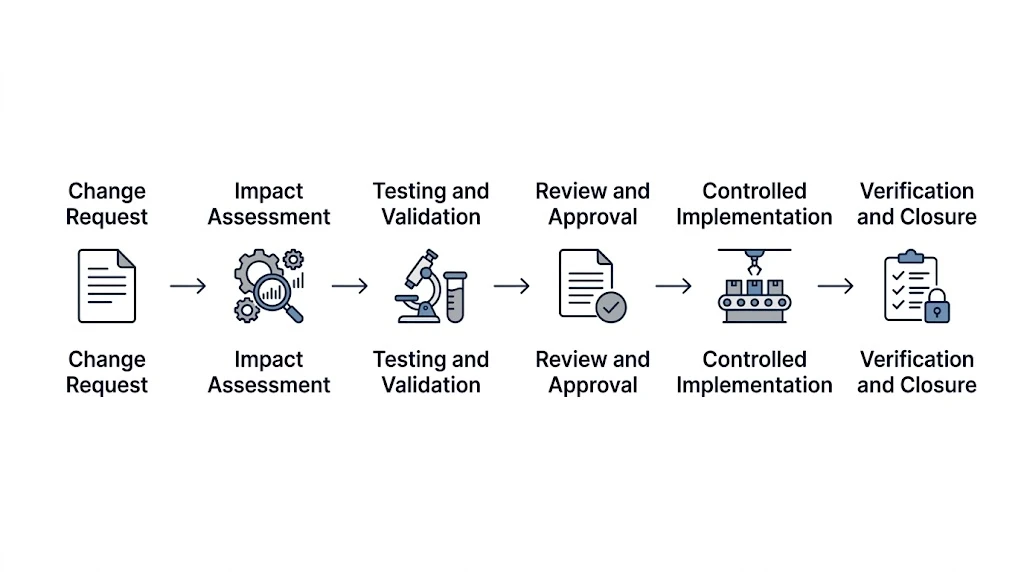
A practical change control process can be divided into six stages.
Stage 1: Initiate and Document the Change
The process begins with a clearly defined change request.
The request should explain what is changing, why the change is proposed, and which products, materials, processes, or manufacturing locations may be affected.
Common reasons include material availability, product improvement, equipment upgrades, manufacturing efficiency, and corrective actions.
The request should identify the current approved condition and the proposed replacement or modification. This provides a clear basis for evaluating the change.
Stage 2: Assess the Potential Impact
The next step is to determine how the proposed change could affect the product or its manufacturing process.
Relevant questions include:
- Could the change affect electrical performance?
- Could it alter adhesion or material integrity?
- Could it influence dimensional accuracy?
- Could it affect compatibility with the intended device?
- Could it change packaging protection or product stability?
- Could it affect biocompatibility or other safety-related evidence?
- Could it influence regulatory documentation or customer approvals?
Not every question will apply to every change.
For example, replacing a non-product-contact shipping carton may require a different assessment from changing a material that directly contacts the skin.
The purpose is to identify relevant risks rather than apply the same checklist mechanically to every situation.
Stage 3: Determine Testing and Validation Requirements
Once the potential impact is understood, the manufacturer determines what evidence is needed before implementation.
Depending on the change, this may include:
- Incoming material testing
- Dimensional inspection
- Adhesion or material integrity testing
- Electrical performance evaluation
- Compatibility testing
- Packaging evaluation
- Aging or stability studies
- Process verification or validation
The testing plan should be linked to the identified risks.
For example, if a hydrogel formulation changes, reviewing only its visual appearance may not provide sufficient evidence of equivalence.
Relevant properties of the finished electrode may also need to be evaluated.
Similarly, changing a manufacturing process may require evidence that the revised process consistently produces products meeting the established acceptance criteria.
The key principle is that the extent of testing should be justified by the nature and risk of the change.
Stage 4: Review and Approve the Change
Before implementation, the change should undergo the required internal review and approval.
Depending on the organization and the change, relevant functions may include:
- Quality assurance
- Research and development
- Engineering
- Manufacturing
- Regulatory affairs
- Supply chain management
For OEM/ODM products, customer approval may also be necessary when the change affects customer-approved specifications, materials, drawings, labeling, packaging, or other agreed requirements.
Internal approval does not automatically replace customer authorization where the customer contract or quality agreement requires it.
Stage 5: Implement the Approved Change
After approval, the manufacturer can implement the change according to a controlled plan.
Implementation may involve updating:
- Material specifications
- Product drawings
- Bills of materials
- Manufacturing instructions
- Inspection procedures
- Supplier records
- Packaging specifications
- Training documentation
The organization should also establish how existing inventory, work in progress, and newly produced batches will be managed.
This is particularly important when the original and revised versions of a material or product must be distinguished.
Clear implementation rules help prevent unapproved materials, outdated instructions, or mixed product configurations from entering routine production.
Stage 6: Verify Implementation and Close the Change
The final stage is to confirm that the change was implemented as intended and that the required evidence has been completed.
Depending on the change, verification may include reviewing production results, inspection records, test reports, or process performance data.
The change record should identify the approved version, implementation date, relevant production batches, completed actions, and any outstanding follow-up activities.
Where additional monitoring is justified, the manufacturer should define the monitoring period and acceptance criteria.
A change should not be considered complete merely because the revised process has started running. Its completion should be supported by documented evidence.
4. What Should Be Tested When an Electrode Material Changes?
Material changes are especially important in hydrogel-based medical electrodes because the materials interact within a layered structure.
The exact test plan depends on the electrode category, intended application, material function, and existing evidence. Nevertheless, several evaluation areas may be relevant.
|
Evaluation area |
What it helps assess |
When it may be relevant |
|---|---|---|
|
Electrical performance |
Whether the electrode continues to meet applicable electrical requirements |
Changes to conductive materials, hydrogel, or contact structures |
|
Adhesion performance |
Whether attachment and removal characteristics remain acceptable |
Changes to hydrogel, backing, or adhesive-related components |
|
Material integrity |
Whether layers remain adequately bonded and the product retains its intended structure |
Changes to lamination, substrates, or bonding processes |
|
Dimensional accuracy |
Whether the finished product remains within established dimensional requirements |
Changes to tooling, converting processes, or product design |
|
Skin-contact safety |
Whether the change affects the existing biological safety assessment |
Changes to relevant skin-contact materials or their processing |
|
Packaging and stability |
Whether product protection and relevant performance characteristics are maintained during storage |
Changes to packaging materials, sealing, or storage conditions |
|
Process performance |
Whether the revised process can consistently produce conforming products |
Changes to equipment, settings, production lines, or manufacturing sites |
These categories are not a universal mandatory test list.
A qualified team should determine which evaluations are necessary based on the product's risk profile, applicable requirements, and the evidence supporting the proposed change.
Why testing the raw material alone may not be sufficient
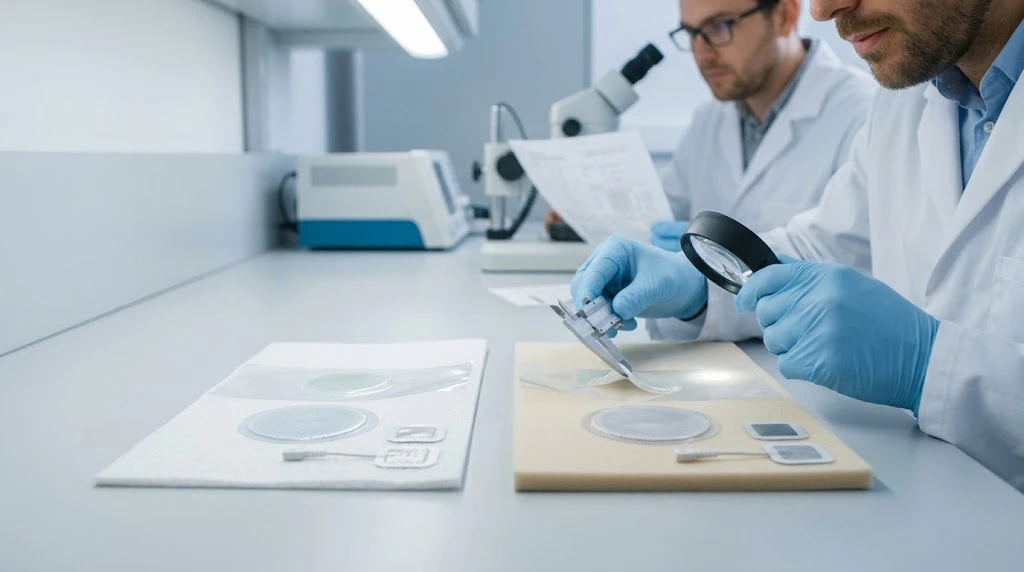
An incoming material may meet its own specification but still behave differently when combined with other components.
For example, a substrate may pass an incoming inspection but interact differently with the hydrogel during lamination. The finished electrode could consequently exhibit different bonding characteristics or dimensional behavior.
This is why material change assessments should distinguish between raw material acceptance and finished product performance.
Where a material contributes to a critical product characteristic, evaluation of the complete product or relevant manufacturing process may be necessary.
5. How Change Control Supports OEM/ODM Projects
Change control is particularly relevant to OEM/ODM manufacturing because the manufacturer and customer may share responsibility for different parts of the product lifecycle.
The manufacturer may manage material sourcing, production processes, inspection, and manufacturing documentation. The customer may control product branding, intended market, approved specifications, or device compatibility requirements.
A change that appears minor from one perspective may have consequences for the other party.
Consider three examples.
Example 1: A substitute hydrogel material
A manufacturer proposes a new hydrogel material because the original supplier has changed its supply arrangements.
The manufacturer evaluates the proposed material, identifies the relevant finished-product tests, and documents the results. If the material change affects customer-approved specifications, the customer reviews and approves the change before implementation.
Example 2: A revised electrode shape
A customer requests a new electrode outline to fit a redesigned product.
The parties review the drawing, manufacturing feasibility, dimensional tolerances, and any performance characteristics affected by the new geometry. Required verification is completed before the revised design enters routine production.
Example 3: A manufacturing line transfer
A product is transferred to another production line to support manufacturing requirements.
The manufacturer evaluates differences in equipment, process parameters, inspection arrangements, and production capability. Additional verification or validation is performed where necessary before routine production begins.
These examples illustrate why change control should be integrated into the OEM/ODM working relationship rather than treated as an internal administrative procedure alone.
What should be agreed upon at the beginning of an OEM/ODM project?
To reduce ambiguity, customers and manufacturers should establish the following expectations early in the project:
- Which specifications and documents constitute the approved product baseline.
- Which types of changes require customer notification or approval.
- Who is responsible for assessing and approving each category of change.
- What evidence is expected before a revised version is released.
- How revised drawings, materials, and specifications will be controlled.
- How existing inventory and the transition between versions will be managed.
- How records will be retained and made available when required.
These arrangements are especially valuable for products manufactured over multiple years or supplied to customers with formal quality management requirements.

6. Change Control and Regulatory Compliance
Change control can also affect regulatory documentation and product lifecycle management.
However, not every manufacturing change automatically requires regulatory submission, product re-registration, or a new certification.
The applicable requirements depend on the product, the change, the intended market, and the regulatory framework under which the product is supplied.
For example, a change to a skin-contact material may require a different assessment from a change to a non-product-contact external carton. A manufacturing site transfer may raise different questions from a minor administrative document update.
A manufacturer should therefore evaluate regulatory implications as part of its change review rather than assume that every change has the same consequences.
Relevant considerations may include:
- Whether the change affects approved product specifications
- Whether existing verification or validation remains adequate
- Whether biological safety evidence needs to be reviewed
- Whether risk management documentation requires updating
- Whether labeling or technical documentation must be revised
- Whether a customer notification or authorization is required
- Whether applicable regulatory notification or submission obligations are triggered
For organizations operating under a quality management system aligned with ISO 13485, change-related controls should be integrated with the organization's applicable document control, design and development, purchasing, production, and risk management processes.
7. What Are the Most Common Change Control Mistakes?
Even when manufacturers have documented procedures, implementation can become inconsistent if important details are overlooked.
Mistake 1: Treating Similar Materials as Automatically Equivalent
Two materials may have similar descriptions or headline specifications without being interchangeable in the finished product.
Better approach: Evaluate the properties relevant to the material's function and its interaction with the complete product.
Mistake 2: Approving a Change Without Defining the Evidence Required
A change may be approved based on assumptions rather than a clear assessment of the evidence needed.
Better approach: Establish the testing, verification, or validation requirements before implementation.
Mistake 3: Updating Production Without Updating Documentation
A revised material or process may be introduced while older drawings, specifications, or work instructions remain in circulation.
Better approach: Link implementation to controlled document updates and the removal or identification of obsolete versions.
Mistake 4: Overlooking Customer Approval Requirements
A manufacturer may consider a change technically acceptable even though the customer's quality agreement requires notification or prior approval.
Better approach: Define customer involvement and approval requirements in the OEM/ODM agreement or applicable quality documentation.
Mistake 5: Failing to Manage the Transition Between Versions
The original and revised versions may coexist during a transition period.
Without clear controls, different materials or product configurations may be mixed unintentionally.
Better approach: Establish effective dates, batch identification rules, inventory disposition, and any necessary segregation procedures.
Mistake 6: Closing the Change Without Verifying the Result
A change request may be marked complete once the new material or process is introduced, even though the required evidence has not been fully reviewed.
Better approach: Make documented verification and completion of required actions part of the formal closure criteria.
8. How Should Buyers Evaluate a Manufacturer's Change Control Capability?
When evaluating a medical electrode manufacturer, buyers often focus on unit price, production capacity, certifications, and product specifications.
These factors matter, but they do not fully explain how a supplier manages changes throughout a product's lifecycle.
Buyers can ask several targeted questions.
|
Question to ask |
What it helps clarify |
|---|---|
|
How are material substitutions reviewed and approved? |
Whether supplier or material changes are systematically assessed |
|
How do you determine whether additional testing is required? |
Whether testing decisions are linked to risk and product requirements |
|
How are manufacturing process changes documented? |
Whether approved process conditions are controlled |
|
How are customer-specific approval requirements managed? |
Whether the manufacturer understands its OEM/ODM obligations |
|
How are revised specifications and work instructions released? |
Whether document versions remain consistent with actual production |
|
How are production transfers evaluated? |
Whether changes in equipment or manufacturing location are appropriately assessed |
|
What evidence is retained after a change is implemented? |
Whether the decision and implementation can be reviewed later |
Buyers do not necessarily need unrestricted access to every internal quality record. Confidentiality, intellectual property, and the manufacturer's quality procedures may limit what can be shared.
The goal is to establish whether the manufacturer has a defined, documented process and can provide appropriate evidence that relevant changes are controlled.
For long-term OEM/ODM partnerships, this capability can be as important as the ability to manufacture the original approved product.
9. How TOP-RANK Healthcare Approaches Manufacturing Quality
For medical electrode manufacturers, change control is closely connected to material knowledge, manufacturing process control, and quality management.
TOP-RANK Healthcare's manufacturing portfolio includes TENS/EMS electrodes, ECG/EKG electrodes, grounding pads, conductive gels, and related medical conductive products. The company also describes in-house hydrogel research and manufacturing capabilities, alongside electrode manufacturing operations in China and Vietnam.
These capabilities provide relevant context when evaluating how material and manufacturing decisions interact across different product categories.
For example, a change involving a conductive hydrogel may require a different technical assessment from a change involving an electrode connector or die-cutting process. The appropriate evaluation depends on the material or process being changed and its effect on the finished product.
For OEM/ODM projects, buyers should establish clear requirements for approved materials, product specifications, change notification, customer authorization, and verification evidence.
Rather than assuming that a manufacturer's certifications or production scale automatically demonstrate effective change control, buyers should evaluate the actual procedures and records relevant to their products.
10. Final Takeaway: A Controlled Change Is a Managed Risk
Changes are inevitable in medical electrode manufacturing.
Materials evolve, suppliers change, equipment is upgraded, products are redesigned, and manufacturing arrangements develop over time.
The important question is not whether a manufacturer makes changes. It is whether those changes are evaluated, approved, implemented, and verified in a controlled manner.
An effective change control process helps connect material selection, product design, manufacturing operations, quality management, and customer requirements.
For medical device companies selecting an OEM/ODM partner, understanding this process provides a more complete picture of manufacturing capability and long-term product support.
The goal of change control is not to eliminate change. It is to ensure that every relevant change is understood before it becomes part of routine production.
Frequently Asked Questions
1. What is change control in medical device manufacturing?
2. Why is change control important for medical electrode manufacturers?
3. What types of changes require evaluation in electrode manufacturing?
4. Does changing an electrode material require new testing?