


A medical electrode pad may be a small product, but the manufacturing history behind it can be much larger.
Before an electrode pad reaches the finished-product stage, it may pass through multiple manufacturing steps involving different materials, machines, tooling, operators, inspections, and production records.
If something needs to be investigated later, knowing only the product name is not enough.
Manufacturers may need to understand:
Which materials were used?
When was the product manufactured?
Which production line or equipment was involved?
Which tooling was used?
What inspections were performed?
Which production batch did the product belong to?
Were there any relevant process events during production?
This is where manufacturing traceability becomes important.
Traceability creates a connection between a finished product and the manufacturing information associated with it.
1. What Does Traceability Mean in Manufacturing?
Traceability does not necessarily mean that every single movement of every component must be recorded individually.
Instead, it means establishing a reliable relationship between a product and relevant information about its manufacturing history.
For example, a finished electrode pad may have an identification code associated with a production batch.
That batch may then be associated with:
- Material lot information
- Production date
- Manufacturing records
- Equipment information
- Tooling information
- Inspection results
- Packaging records
- Release information
The result is a connected manufacturing record.
Conceptually:
Finished Product ID
↓
Production Batch
↓
Production Records
↓
Material / Process / Inspection Records
This connection is what makes traceability useful.
2. Why Is Traceability Important for Medical Electrode Pads?
Medical electrode pads can involve multiple materials and manufacturing operations.
A typical product may include components such as:
- Backing material
- Conductive layer
- Hydrogel or conductive adhesive
- Connector components
- Release liner
- Packaging materials
The actual construction varies by product.
Because multiple components and processes are involved, being able to connect finished products with relevant manufacturing information can help manufacturers investigate issues more efficiently.
Traceability can support activities such as:
- Manufacturing investigations
- Nonconformance analysis
- Corrective actions
- Process improvement
- Production history review
- Customer support
- Complaint investigation
- Product or batch identification
The key value is simple:
It reduces the distance between a finished product and the information needed to understand its history.
3. What Information Can Be Traced?
The exact scope of traceability depends on the manufacturer's system.
However, a manufacturing traceability structure may include several categories.
Material Traceability
Information about relevant incoming material lots.
Production Traceability
Information about when and where a product or batch was manufactured.
Process Traceability
Information associated with important production operations.
Equipment Traceability
Information connecting production to relevant machines or equipment.
Tooling Traceability
Information about production tooling when it is relevant to the process.
Inspection Traceability
Records showing what inspections or measurements were performed.
Packaging Traceability
Information connecting finished products with their packaging and identification.
Not every product requires the same level of detail.
A practical system defines what information is important enough to be linked.
4. Material Lot Traceability
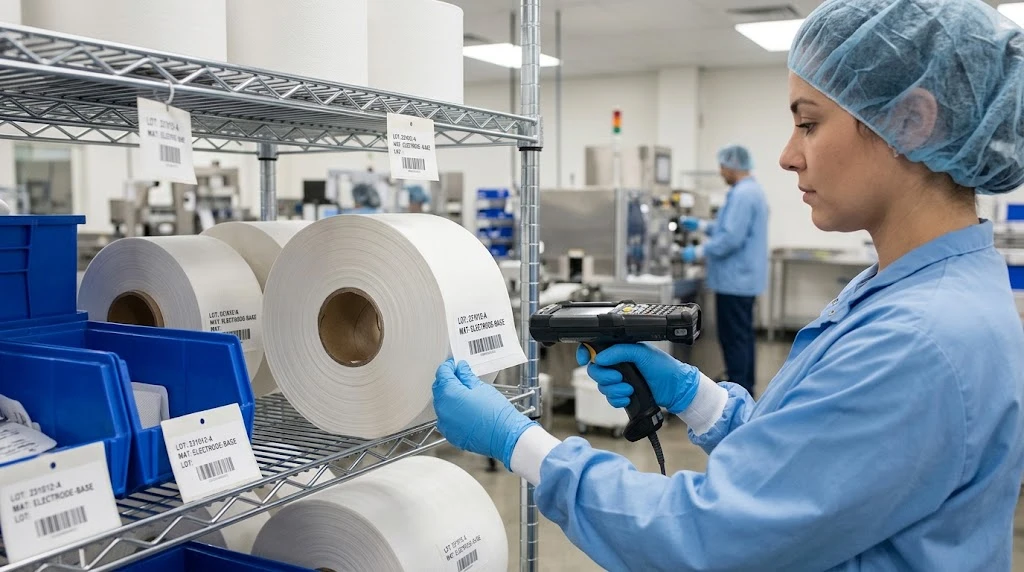
One of the fundamental parts of manufacturing traceability is connecting production with incoming material information.
Imagine that a particular electrode pad batch uses several different material lots.
The manufacturing record can associate those material lots with the production batch.
This creates a relationship such as:
Material Lot A + Material Lot B + Material Lot C
↓
Production Batch 2026-XXX
The purpose is not simply to create more paperwork.
If an investigation later identifies a potential issue associated with a particular material lot, the manufacturer has a structured way to determine which production records may be relevant.
This can make investigation more focused than reviewing production history without any batch relationships.
5. Production Batch Traceability
A production batch provides another important connection point.
A batch identifier can associate products with a defined manufacturing period or production run.
Depending on the manufacturing system, relevant information may include:
- Production date
- Product model
- Manufacturing line
- Production quantity
- Material lots
- Relevant process records
- Inspection results
- Release status
The exact structure varies between manufacturers.
The important principle is that a batch identifier should allow authorized personnel to locate the relevant manufacturing information efficiently.
This becomes especially useful when the same product is manufactured repeatedly over months or years.
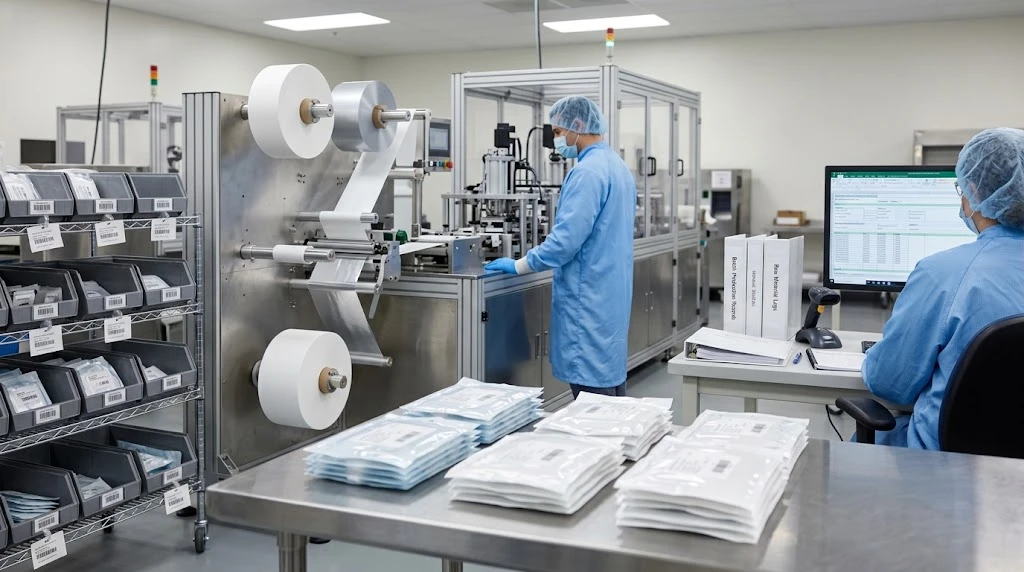
6. Connecting Traceability to Production Equipment
Manufacturing equipment can also be part of the traceability system.
For example, production records may identify the equipment or production line associated with a particular batch.
This can become useful when investigating a process event.
Suppose an unusual trend is identified in a particular production period.
The manufacturing team may need to understand:
- Which line produced the batch?
- Which equipment was being used?
- Was maintenance performed?
- Was tooling changed?
- Were there relevant setup activities?
Connecting production records with equipment information can help narrow the investigation.
This is especially useful in manufacturing environments where multiple production lines are used for similar products.
7. Tooling Can Be Part of the Traceability Chain
Tooling may also be relevant when a product requires dedicated or product-specific production tools.
For example, a custom electrode pad shape may use a particular die or fixture.
If tooling identification is recorded as part of the manufacturing history, the production team can later connect the finished batch with the tool used during manufacturing.
The traceability chain may therefore look like:
Product → Batch → Production Line → Tooling → Process Records
This does not mean that tooling information must always be recorded at the same level for every product.
Rather, the traceability system should reflect what is relevant to the manufacturing process.
8. Inspection Records Complete Another Part of the Picture
Traceability becomes more useful when production records can be connected to inspection results.
For example, a batch record may reference relevant in-process or final inspection information.
This can help answer questions such as:
- What was inspected?
- When was it inspected?
- Which batch was involved?
- What was the result?
- Was the batch released according to the applicable procedure?
This distinction is important:
Traceability tells you which records are associated with a product.
It does not automatically mean that the product passed every requirement.
Inspection and release procedures still determine whether the product meets the applicable requirements.

9. Traceability Helps During Manufacturing Investigations
One of the most practical benefits of traceability is investigation.
Suppose a manufacturing team receives information about an unexpected product characteristic.
The first question is often:
Which products or batches could be affected?
Without organized traceability, the investigation may require searching through large amounts of production information.
With a structured traceability system, the team can begin with an identifier and work backward through relevant records.
For example:
Finished Product
↓
Batch Number
↓
Production Date
↓
Material Lots
↓
Equipment / Tooling
↓
Inspection Records
This does not automatically identify the cause of a problem.
But it can provide a structured starting point for investigation.
10. Traceability and Nonconformance Investigation
When a manufacturing nonconformance is identified, traceability can help define its scope.
For example, the investigation may ask whether the issue is associated with:
- One production batch
- Multiple batches
- A specific material lot
- A particular production period
- A specific machine
- A tooling configuration
- A process event
The answer should come from documented evidence rather than assumptions.
This is where a well-organized traceability system becomes particularly valuable.
It helps manufacturing teams move from:
"Something appears to be wrong."
to:
"Here is the defined production history that needs to be investigated."
11. Traceability Is Not the Same as Serialization
These two concepts are sometimes confused.
Serialization generally assigns a unique identifier to an individual product or unit.
Batch or lot traceability may instead associate multiple products with a common production batch.
A manufacturer may use:
- Lot identification
- Batch identification
- Serial numbers
- Production order numbers
- Material lot numbers
- Other internal identifiers
The appropriate approach depends on the product and manufacturing system.
Not every medical electrode pad needs individual serialization.
What matters is that the identification method provides the level of traceability required by the product and applicable quality system.
12. Digital Traceability Can Reduce Manual Searching
Modern manufacturing environments increasingly use digital records to connect production information.
Instead of relying entirely on paper documents, information may be recorded and retrieved through manufacturing or quality-management systems.
Depending on the system, digital traceability can connect:
Material → Production → Inspection → Release
in a structured database.
This can make information retrieval faster and reduce the risk associated with manually searching through disconnected records.
However, digitalization itself does not guarantee good traceability.
The underlying identification logic, data accuracy, procedures, and record controls remain important.
13. Good Traceability Depends on Good Identification
A traceability system is only as useful as its identifiers.
If batch numbers are inconsistent, labels are unclear, or records are not correctly associated, the system can become difficult to use.
A practical identification system should therefore consider:
- Consistent naming
- Unique identifiers where required
- Clear labeling
- Controlled records
- Accurate data entry
- Appropriate access controls
- Record retention
- Defined responsibilities
The objective is straightforward:
A person should be able to start with an appropriate identifier and locate the relevant manufacturing information without unnecessary ambiguity.
14. Traceability Supports Continuous Improvement
Traceability is not only useful when something goes wrong.
Historical manufacturing records can also provide valuable information for improvement.
Over time, manufacturers may be able to identify relationships between:
- Material lots
- Production conditions
- Equipment
- Tooling
- Inspection results
- Process changes
- Manufacturing outcomes
This historical information can help teams understand recurring patterns and investigate opportunities for improvement.
In this sense, traceability creates a kind of manufacturing memory.
The production team does not have to rely entirely on individual experience.
The organization can retain structured information about what happened during previous production.
15. What a Complete Traceability Chain Looks Like
For a medical electrode pad manufacturer, a simplified traceability model could look like this:
1. Incoming Materials
Material identification and relevant lot information are recorded.
↓
2. Production
Materials are assigned to a defined production batch.
↓
3. Manufacturing Process
Relevant production information is documented.
↓
4. Equipment and Tooling
Where appropriate, equipment and tooling information is connected to the production record.
↓
5. Inspection
Relevant in-process and final inspection records are associated with the batch.
↓
6. Finished Product
Finished products receive appropriate identification.
↓
7. Release
The applicable release process determines whether the batch can proceed.
This creates a connected manufacturing history.
Frequently Asked Questions
1. What is traceability in medical electrode pad manufacturing?
2. Can electrode pads be traced back to their raw materials?
3. What information is typically included in a traceability record?
4. Is traceability the same as serialization?