

OEM Multifunction Defibrillator Pads | AED & Manual Pacing Electrodes | TOP-RANK
B2B contract manufacturing of multifunction defibrillation electrodes compatible with ZOLL, Philips, and Physio-Control platforms. Fully compliant with ANSI/AAMI DF80 and IEC 60601-2-4, engineered for 360J biphasic energy withstand, sub-4-second ECG baseline recovery, and 60-minute continuous transcutaneous pacing endurance.
Product Overview
Multifunction defibrillator pads operate as disposable, high-energy transcutaneous interfaces for automated external defibrillators (AEDs), manual monitor/defibrillators, and hospital crash-cart consoles. In acute resuscitation protocols, a single electrode pair must fulfill four distinct clinical functions: delivering high-voltage defibrillation shocks (up to 360 Joules biphasic truncated exponential), executing R-wave synchronized cardioversion for ventricular tachycardia and atrial fibrillation, conducting prolonged non-invasive transcutaneous pacing (NTP) for symptomatic bradycardia, and maintaining biopotential ECG rhythm monitoring.
Generic or poorly engineered defibrillation pads suffer high failure rates during active resuscitation:
- Perimeter Current Crowding & Dermal Flash Arcing: Delivering a 360J shock produces peak currents of 30A to 60A at voltages exceeding 1,800V over 5 to 15 milliseconds. High-frequency electrical charge concentrates along the outer perimeter of the conductive layer (the leading-edge effect). If the conductive substrate lacks perimeter impedance attenuation or exhibits micro-gaps from chest hair and uneven application, this current concentration causes dielectric breakdown of the air gap, triggering open electric arcing that vaporizes the metal substrate and burns the patient's skin down through the dermis.
- Post-Shock Half-Cell Polarization Lockout: A 360J electrical discharge polarizes the metal-electrolyte boundary, creating a massive direct-current (DC) galvanic offset voltage. If the chemical composition of the electrode cannot neutralize this polarization within seconds, the monitor's input amplifier saturates. The defibrillator screen shows a wandering or saturated baseline, blinding the physician or AED rhythm analysis algorithm to post-shock ventricular fibrillation, pulseless electrical activity, or return of spontaneous circulation (ROSC).
- Thermal Desiccation & Runaway During Pacing: Non-invasive transcutaneous pacing requires continuous pulse trains (40 to 140 mA at 20 to 40 ms pulse duration, 60 to 120 pulses per minute) running for up to 60 continuous minutes. Standard hydrogels break down under this prolonged unidirectional current flux: internal water boils off via Joule heating, the gel dries, interface impedance surges, and current crowds into remaining wet areas, inducing full-thickness skin burns.
This multifunction defibrillator pad platform utilizes a 45 um thick, high-purity rolled tin (Sn) foil substrate lined with a screen-printed semi-resistive carbon gradient border. The skin interface uses an isotonic, high-chloride cross-linked aqueous hydrogel (caliper 0.85 mm to 1.10 mm) that maintains an AC impedance below 2.0 Ohm at 30 kHz. Following a 360J biphasic shock, the electrode half-cell discharges polarization to restore baseline offset voltage below 100 mV in under 4 seconds, satisfying ANSI/AAMI DF80:2003/(R)2018 requirements. We contract-manufacture pre-connected and packaged defibrillator pads for emergency medical equipment brands, hospital consumable distributors, and AED manufacturers globally.
Technical & Engineering Description
Continuous manufacturing of multifunction defibrillator pads operates inside ISO 13485-certified Class 8 cleanrooms. The physical cross-section integrates five mechanical and functional layers: an impermeable outer carrier, a medical-grade acrylic adhesive perimeter, an engineered metal conductor, a low-impedance high-chloride hydrogel reservoir, and a fluorosilicone-coated polyester release film.
The conductive layer uses high-purity (99.9%) rolled tin (Sn) foil slit to 45 um thickness. Rolled tin provides superior thermal mass compared to evaporated aluminum or micro-thin Ag/AgCl films, preventing melting or structural perforation when conducting 60A peak currents during 360J discharges. The outer boundary of the tin foil is pattern-printed with a semi-resistive carbon-polymer ink matrix. This carbon strip acts as a series distributed resistor, stepping down the voltage gradient along the foil perimeter to mitigate the edge effect and prevent electric arcing.
For pre-connected pad configurations, multi-strand, high-flexibility tinned copper wire harnesses (1.2 to 2.0 meters long) are mechanically joined to the tin foil. High-tonnage multi-point pneumatic staking presses flare copper strands directly into the tin foil without solder flux, eliminating high-resistance intermetallic layers. The junction is encapsulated in a low-pressure injection molded elastomer boot that withstands >35N axial pull force without terminal delamination. The cable terminates in dedicated molded connectors matching brand pinouts (such as ZOLL multi-pin rectangular sockets, Philips HeartStart barrel connectors, or Physio-Control/Stryker Quik-Combo red plugs).
The patient-contact face is coated with an isotonic, cross-linked aqueous polyacrylate hydrogel with a high sodium chloride electrolyte concentration (2.0% to 3.5% by weight) extruded at a thickness of 0.85 mm to 1.10 mm. This ionic reservoir provides volume resistivity below 15 Ohm-cm, ensuring unhindered charge transfer while absorbing moisture to prevent dry-out during active pacing. The hydrogel is framed by a 1.0 mm cross-linked closed-cell polyethylene (PE) foam backing coated with a high-tack acrylic adhesive that resists sweat and fluids during active CPR chest compressions.
Finished pads are mounted on split-release fluorosilicone PET liners and sealed inside airtight multi-layer PET/AL/PE barrier pouches. The pouch features a molded elastomeric feedthrough gasket that lets the cable exit the sealed bag while keeping the moisture vapor transmission rate (MVTR) near zero, preserving hydrogel hydration over a 36-month shelf life. The standard OEM contract manufacturing minimum order is 50,000 pairs.
Key Features
-
Heavy-Gauge Rolled Tin (Sn) Substrate with Peripheral Carbon Gradient (Eliminating 360J Dermal Arcing & Foil Pitting)
Delivering a 360-Joule biphasic shock generates intense localized Joule heating (Q = ∫ I² R dt) across the electrode-skin interface. In low-cost pads utilizing thin evaporated aluminum films (<10 um) or screen-printed silver inks, high current densities concentrate along the perimeter nearest the sternum-to-apex vector. This concentration causes the metal layer to vaporize instantly, generating localized pinholes (foil pitting) and blowing pinhole air gaps through the hydrogel. Current jumps across these gaps as electrical flashover arcs, burning the patient's epidermal layer. We engineer the conductive plate with a 45 um thick rolled pure tin foil. Tin provides a high volumetric heat capacity and high melting point, maintaining continuous physical integrity under repeated 360J discharges. Furthermore, the foil edge is coated with a screen-printed semi-resistive carbon-polymer gradient that introduces a controlled impedance step from 0.05 Ohm up to 450 Ohm across a 5.0 mm perimeter band. This gradient forces current vectors to distribute uniformly across the full active surface (Adult >= 85 cm2), holding peak temperature rise below 4.0C and preventing electrical flashover burns.
-
Low-Polarization Stoichiometric Gel Chemistry (Sub-4-Second Post-Shock ECG Restoration for Instant VF/VT Discrimination)
Immediately following a high-voltage defibrillation shock, the metal plate and conductive hydrogel form a massive capacitive double-layer polarization potential. In unbuffered hydrogels, this post-shock DC offset exceeds 500 mV and decays slowly over 15 to 30 seconds. When this offset enters the ECG amplifier circuit of an AED or manual monitor, it drives the differential preamplifier into rail-to-rail saturation. The machine flatlines or displays wandering baseline artifacts, delaying the automated shock algorithm or the physician from assessing whether the shock successfully converted the patient to sinus rhythm or if CPR must resume immediately. Our hydrogel is compounded with a stoichiometric chloride-salt reserve paired with organic charge-transfer complexing agents. The formulation facilitates rapid reversible charge exchange across the tin-gel interface. Following a 360J discharge, the half-cell double-layer discharges in milliseconds, dropping the residual offset voltage below 100 mV within 4.0 seconds (and settling below 40 mV within 6.0 seconds). The monitor displays a stable, centered diagnostic ECG waveform immediately after shock delivery, eliminating diagnostic blind spots during cardiopulmonary resuscitation.
-
Thermal-Stabilized Viscoelastic Hydrogel (60-Minute Non-Invasive Pacing Without Moisture Exhaustion or Edge Lift)
Transcutaneous cardiac pacing presents a sustained thermal and mechanical challenge fundamentally distinct from instantaneous defibrillation: applying a continuous train of 140 mA pulses at a rate of 100 pulses per minute forces steady electrical current across the skin for an hour or more. Conventional hydrogels break down through electrical syneresis and heat-driven evaporation: water boils off at the micro-contact points, driving volume resistivity from 15 Ohm-cm to over 120 Ohm-cm within 20 minutes, causing intense cutaneous pain and burning. We address pacing endurance by formulating a dense, cross-linked hydrophilic polymer matrix holding over 40% bound pharmaceutical-grade polyols. The polyol network depresses internal water activity (Aw < 0.60), retarding thermal evaporation under electrical current flow. Concurrently, the 1.0 mm closed-cell PE foam backing, coated with a high-tack acrylic adhesive (peel adhesion 5.5N to 7.2N / 25 mm), resists lateral shear during ongoing manual CPR chest compressions. The pad maintains a stable AC impedance under 2.0 Ohm throughout 60 minutes of uninterrupted pacing, protecting dermal integrity without edge lift or impedance spikes.
Applications
Pre-Hospital Emergency Medical Services (EMS) & Field Resuscitation
Primary disposable resuscitation pads stocked in ambulance fleets, fire department rapid-response vehicles, and municipal public-access AED cabinets. The pre-connected cable-out design allows instant deployment without opening packaging or untangling leadwires during out-of-hospital cardiac arrest (OHCA).
Hospital Emergency Departments & Intensive Care Units (ICU/CCU)
Multi-modal bedside pads deployed on hospital crash carts for manual defibrillation, R-wave synchronized cardioversion for unstable supraventricular tachycardia (SVT), and bridge-to-transvenous cardiac pacing during acute heart block episodes.
Cardiac Catheterization Laboratories & Electrophysiology (EP) Suites
Pre-applied anterior-posterior (A-P) configured radiolucent and low-profile pads placed on patients prior to percutaneous coronary intervention (PCI), transcatheter aortic valve replacement (TAVR), or catheter ablation, standing ready for instantaneous defibrillation should catheter manipulation trigger ventricular arrhythmias.
OEM & Private Label
-
Cable-Out Barrier Pouching & Custom Connector Tooling : Defibrillator pads are available in adult and pediatric geometries mounted on split-release fluorosilicone liners. The packaging features a multi-layer PET/AL/PE foil pouch with an elastomeric hermetic pass-through seal that lets leadwires exit the top weld without breaking moisture barriers. We injection-mold high-precision terminal connectors fully cross-compatible with OEM systems:
• ZOLL Medical (multi-pin rectangular auto-identifying connector)
• Philips Healthcare (HeartStart barrel plug and hands-free multi-pin connector)
• Physio-Control / Stryker (Medtronic Quik-Combo red plug with latch lock)
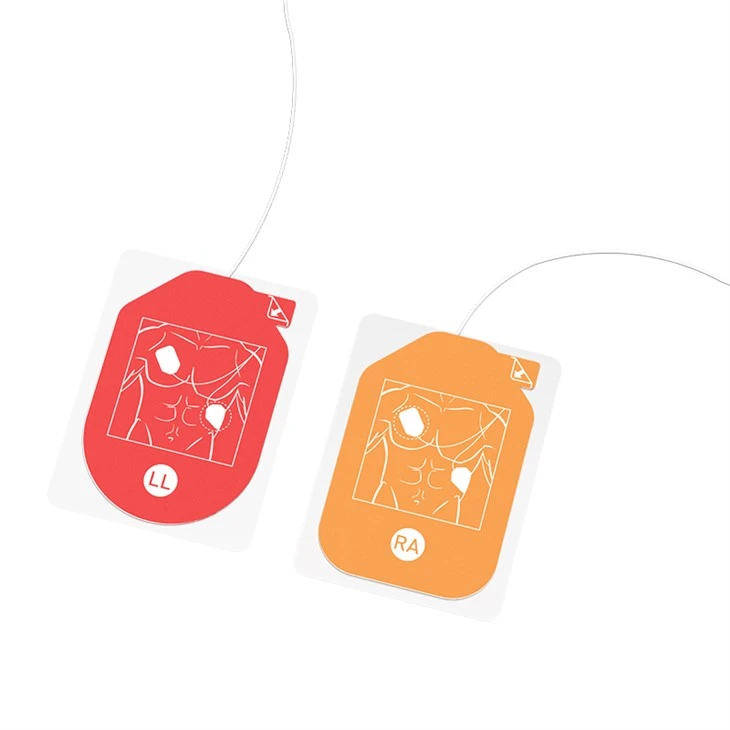
• Mindray, Nihon Kohden, and Schiller custom pinouts. Pouch exteriors are custom-printed with step-by-step visual placement schematics (Anterior-Lateral for AED protocols; Anterior-Posterior for pacing and cardioversion).
-
Two-Center Supply Chain Mechanics : High-purity tin foil precision calendering, carbon gradient gravure printing, high-chloride hydrogel continuous UV-assisted slot-die extrusion, and primary roll converting execute natively inside our primary China facility. Wire harness automated multi-point crimping, connector low-pressure insert molding, cleanroom pouch seal validation, 100% small-signal AC impedance testing, and palletized container loading route through our Vietnam hub, shielding international B2B buyers from regional medical device tariffs and Section 301 duties.
Certifications
-
ANSI/AAMI DF80 & IEC 60601-2-4 Stringent Verification : Master production lots undergo testing in accredited independent testing laboratories confirming strict compliance with ANSI/AAMI DF80:2003/(R)2018 (Medical electrical equipment - Particular requirements for the safety of disposable defibrillation electrodes) and IEC 60601-2-4. Verification testing includes delivering 50 consecutive 360J shocks into non-inductive 50 Ohm test fixtures, confirming that AC impedance remains below 3.0 Ohm, post-shock baseline recovery voltage drops below 100 mV within 4 seconds, and the dielectric insulation withstands 3,000V DC without breakdown or arcing.
-
ISO 10993 Comprehensive Dermal Biocompatibility : Direct skin-contact hydrogels and perimeter foam adhesives undergo continuous batch evaluation against ISO 10993-5 (In Vitro Cytotoxicity Grade 0), ISO 10993-10 (Skin Sensitization: 0% allergic response), and ISO 10993-23 (Primary Dermal Irritation Index = 0.0). The complete pad assembly is 100% natural rubber latex-free, phthalate-free, and contains zero toxic heavy metal plasticizers.
-
MDSAP & ISO 13485 Manufacturing System Controls : Cable assembly stations, cleanroom converting decks, and sealing lines operate strictly under certified ISO 13485:2016 and MDSAP regulatory frameworks (covering US FDA, Health Canada, TGA Australia). Unbroken electronic Device History Records (DHR) log all critical manufacturing parameters, including foil lot conductivity, hydrogel moisture percentage, terminal tensile pull values, and final pouch seal vacuum retention.
Technical FAQ
Q: Why is rolled pure tin (Sn) foil preferred over silver/silver-chloride (Ag/AgCl) for 360J high-energy defibrillation, and how is the resulting half-cell polarization managed?
A: While silver/silver-chloride (Ag/AgCl) is standard for micro-volt diagnostic ECG electrodes due to its reversible non-polarizing characteristics, it fails under high-energy defibrillation. The deposited AgCl layer on typical commercial sensors is only 1.0 to 3.0 microns thick. When subjected to a 360-Joule discharge delivering peak currents of 30A to 60A, this microscopic chloride layer undergoes instantaneous electrochemical depletion and thermal vaporization within milliseconds. The metal layer breaks down into high-resistance pits (pitting corrosion), disrupting the conductive plane and triggering electrical arcing. We resolve this by using a 45 um thick, mechanically rolled pure tin (Sn) foil. Pure tin provides high thermal conductivity and volumetric heat capacity, withstanding repeated 60A surges across 50 consecutive discharges without physical perforation or localized resistance spikes. However, tin behaves as a polarizable electrode, creating a higher initial galvanic half-cell offset potential following high-current discharge. We counteract this intrinsic polarization by loading the hydrogel matrix with a high-concentration stoichiometric sodium chloride electrolyte reserve combined with organic complexing buffer salts. When the 360J pulse ends, the chemical potential gradient at the tin-hydrogel boundary accelerates rapid ion recombination, collapsing the charge accumulation across the Helmholtz double layer. The residual offset voltage drops below 100 mV in under 4.0 seconds, allowing the monitor to immediately resume artifact-free ECG rhythm tracking without causing amplifier saturation.
Q: How do CPR chest compressions induce perimeter edge-lift arcing, and how does the 1.0 mm closed-cell PE foam backing prevent electrical flashover?
A: During manual cardiopulmonary resuscitation, emergency responders deliver 100 to 120 chest compressions per minute at a depth of 5 to 6 cm. This mechanical cycling continuously deforms the thoracic cage, causing cyclical lateral shear forces across the skin where the defibrillator pads are seated. Concurrently, patients in cardiac arrest often present with diaphoretic (sweaty) skin. If an electrode uses a thin film, an open-cell foam, or a low-tack adhesive, the combination of cyclical shear stress and fluid wicking causes the pad borders to peel away from the skin. When the operator delivers a shock across an edge-lifted pad, the distance between the metal foil and the skin forms an air gap. Air has a dielectric breakdown strength of approximately 3 kV/mm. The 1,500V to 2,000V defibrillation pulse ionizes the air within this micro-gap, striking a high-temperature plasma arc across the opening that produces severe third-degree flash burns and destroys the electrode. We prevent perimeter delamination by using a 1.0 mm thick cross-linked closed-cell polyethylene (PE) foam substrate (density 65 kg/m3). The closed-cell structure provides three-dimensional mechanical dampening, absorbing shear deformation from chest compressions without transferring peeling torque to the adhesive boundary. The skin-contact face is pattern-coated with a cross-linked medical pure acrylic adhesive delivering an initial peel strength of 5.5N to 7.2N / 25 mm that resists sweat and fluids. The pad margin remains flush against the thoracic wall throughout aggressive CPR cycles, eliminating air gaps and preventing electrical flashover burns during shock delivery.
Emergency medical equipment manufacturers, EMS procurement directors, and hospital biomedical engineering leads can request accredited ANSI/AAMI DF80 50-shock test validation dossiers, 60-minute transcutaneous pacing thermal logs, and unbranded evaluation sample pairs fitted with ZOLL, Philips, or Physio-Control Quik-Combo compatible connectors.
👉 [Request Multifunction Defibrillator Pad Evaluation Samples]
Hot Tags: aed & manual defibrillator, China aed & manual defibrillator manufacturers, suppliers, factory, Adhesive Defibrillator Pads, defib electrodes, Defibrillator Electrode Pads, defibrillator electrodes, Defibrillator Pads, Electrodes for Defibrillation
Specifications
| Analytical Parameter | Engineering Baseline | Testing Standard |
| Operational Mandate | ANSI/AAMI DF80:2003/(R)2018 & IEC 60601-2-4 | Disposable defibrillation electrodes |
| Energy Withstand | Up to 360 Joules Biphasic (50 Consecutive Discharges) | 50 consecutive 360J shocks into 50 Ohm |
| Active Conductive Area |
Adult: >= 85 cm2 per pad (Pair >= 170 cm2)
Pediatric: >= 35 cm2 per pad (Pair >= 70 cm2) |
Compliant with DF80 surface limits |
| Post-Shock Recovery | Residual Offset Voltage < 100 mV at 4.0 Seconds | Post-360J discharge (typical < 40 mV) |
| AC Small-Signal Impedance | < 2.0 Ohms at 30 kHz (DF80 limit: < 3.0 Ohms) | Four-wire test setup |
| DC Offset Voltage | < 50 mV (Pre-defibrillation state) | Baseline half-cell stability |
| Transcutaneous Pacing | 60 Minutes Continuous at 140 bpm / 140 mA / 40 ms | In-vitro load testing |
| Conductive Substrate | 45 um High-Purity Rolled Pure Tin (Sn) Foil | High thermal mass |
| Carrier Backing | 1.0 mm Cross-Linked Closed-Cell PE Foam (65 kg/m3) | Impermeable to fluid & blood |
| Dermal Dynamic Peel | 5.5N to 7.2N / 25 mm on Stainless Steel Coupon | ASTM D3330 |
| Cable & Lead Terminals | 1.2 m to 2.0 m Low-Noise Shielded Cable | Molded plugs: ZOLL, Philips, Quik-Combo, Mindray |
| Packaging & Pre-Connect | Pre-Connected Cable-Out Multi-Layer Barrier Foil Pouch | 36-Month shelf life |


