OEM Adult Foam Snap ECG Pads | 72-Hour Monitoring Electrodes | TOP-RANK
B2B contract manufacturing of disposable adult foam snap ECG pads for ICU, CCU, and telemetry monitoring. Fully compliant with ANSI/AAMI EC12, featuring <150 Ohm AC impedance at 10 Hz, <0.8 mV DC offset, 72-hour fluid-impermeable closed-cell PE foam, and high-retention brass snap studs.
Product Overview
Adult foam snap ECG pads function as the standard disposable biopotential interface across hospital monitoring networks, capturing microvolt-level cardiac depolarization signals (0.5 mV to 2.0 mV) over extended inpatient stays. Applied to designated precordial and limb landmarks, these electrodes connect via standard 4.0 mm leadwire grabbers or snap connectors to telemetry transmitters, bedside multi-parameter monitors, and Holter recorders. Clinical dwell times run continuously from 24 to 72 hours within Intensive Care Units (ICU), Coronary Care Units (CCU), Post-Anesthesia Care Units (PACU), and general telemetry step-down wards.
Standard high-volume adult foam electrodes break down across three hardware mechanisms during multi-day inpatient deployment:
- Snap-to-Eyelet Galvanic Corrosion and Contact Jitter: The electrode stud is mechanically crimped onto a plastic eyelet coated with silver/silver-chloride (Ag/AgCl). If the plating on the brass snap lacks passivated barriers or if crimping tolerances allow mechanical play, micro-movement from heavy lead cables creates physical shifting between the snap and eyelet. This dynamic contact resistance generates 50/60 Hz baseline jitter and motion noise. Furthermore, moisture penetration into this interface creates a secondary galvanic couple that shifts baseline DC offset voltages unpredictably.
- Adhesive Plasticization and Hydrogel Edge-Lift Over 72 Hours: Extended monitoring exposes the electrode to insensible perspiration and skin oils. Open-cell foam carriers or poorly crosslinked acrylic adhesives absorb moisture, undergoing polymer plasticization and losing shear resistance. The outer perimeter peels away from the stratum corneum, shrinking the active contact area, driving up interface impedance, and triggering false lead-off alarms on central telemetry stations.
- AgCl Depletion and Amplifier Saturation Post-Defibrillation: Telemetry patients experiencing sudden cardiac arrest require immediate transthoracic defibrillation (200J to 360J biphasic). The resulting high-energy electrical surge dumps high current through adjacent monitoring pads. If the Ag/AgCl sensor layer lacks sufficient chloridation thickness (under 2.0 um), the electrical transient depletes the chloride salt reserve, polarizes the electrode half-cell, and leaves a high DC residual offset voltage (>100 mV). This saturates the monitor preamplifier, blinding the display to post-shock ventricular rhythms for 10 to 30 seconds.
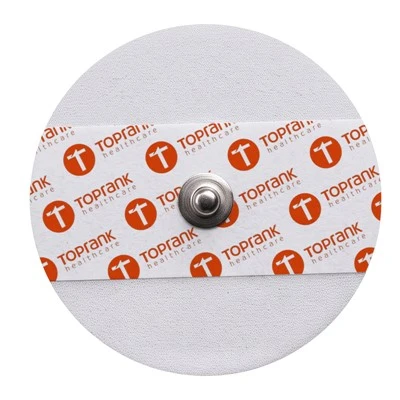
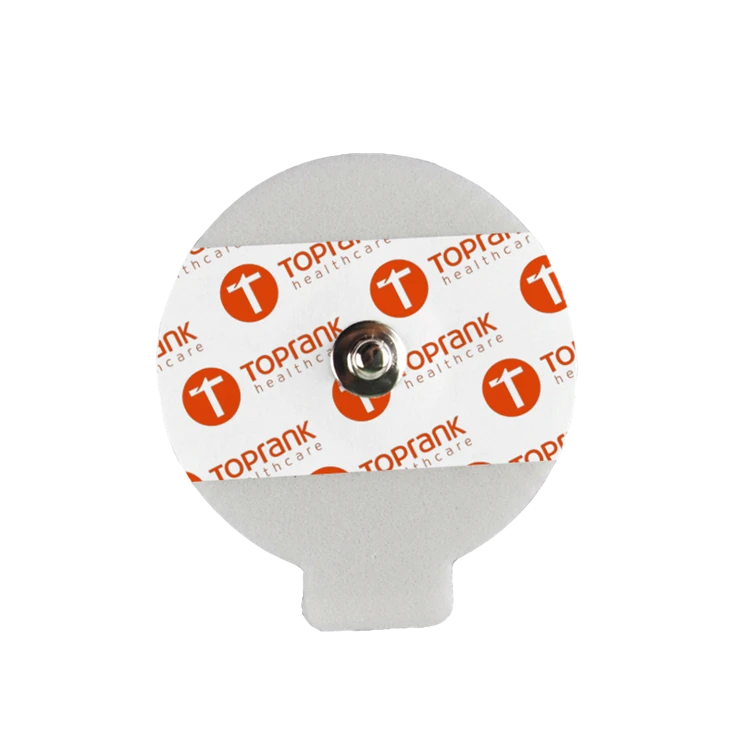
This adult foam snap ECG pad platform utilizes an automated eyelet-staking assembly that crimps a nickel-plated brass snap directly into an ABS sensor eyelet coated with a stoichiometric Ag/AgCl layer (thickness 4.0 um to 6.0 um). The patient interface incorporates an isotonic, high-chloride crosslinked polyacrylate solid hydrogel (thickness 0.85 mm to 1.00 mm) engineered for 72-hour moisture retention without edge weep. The carrier consists of a 1.0 mm closed-cell polyethylene (PE) foam backing coated with a hydrophobic medical-grade pure acrylic adhesive, maintaining a peel adhesion above 5.0N / 25mm. We contract-manufacture round (50 mm, 55 mm) and teardrop (43 x 45 mm, 50 x 55 mm) geometries for medical monitoring device brands, hospital consumable distributors, and international GPO networks.
Technical & Engineering Description
The mass manufacturing of adult foam snap ECG pads operates inside ISO 13485-certified Class 8 cleanrooms utilizing continuous multi-station rotary die-cutting, automated eyelet staking, and precise gel laminating decks. The physical assembly comprises six functional layers:
- Snap Stud: Precision-stamped solid brass stud with a 4.0 mm nominal engagement head, electroplated with a passivated nickel layer to prevent oxidation and copper ion leaching.
- Conductive Eyelet Base: Injection-molded ABS eyelet coated with an electrochemically deposited Ag/AgCl layer. The chemical ratio of metallic silver to silver chloride is held at 80:20, with coating thickness controlled between 4.0 um and 6.0 um.
- Barrier Foam Backing: A 1.0 mm thick crosslinked closed-cell polyethylene (PE) foam (bulk density 65 kg/m3). The fully closed matrix exhibits water absorption below 0.01 g/cm3, preventing fluids, blood, and sweat from wicking through to the skin.
- Perimeter Adhesive Matrix: A hypoallergenic, crosslinked medical-grade pure acrylic pressure-sensitive adhesive (dry coat weight 45 to 55 g/m2). The formulation contains zero rosin esters or hydrophilic tackifiers, resisting moisture plasticization.
- Conductive Solid Hydrogel: A high-cohesion, crosslinked polyacrylate aqueous hydrogel slab (thickness 0.85 mm to 1.00 mm, volume resistivity below 25 Ohm-cm). The formulation blends pharmaceutical-grade sodium chloride (2.0% to 2.8% by weight), vegetable glycerol, and purified water within a dense covalent polymer network, balancing moisture retention against dermal wet-out.
- Protective Release Carrier: A 75 um siliconized polyester (PET) or polyethylene-coated kraft release liner with kiss-cut geometries allowing rapid single-handed peeling by clinical staff.
The mechanical connection between the snap stud and the Ag/AgCl eyelet is executed via a multi-tonnage pneumatic rotary staking press. The rivet shank of the stud expands symmetrically within the recess of the eyelet, establishing an interference fit with an axial retention force exceeding 60N. This tight mechanical bond prevents micro-rotational slipping under cable drag, holding snap-to-eyelet contact resistance below 0.02 Ohm.
Finished pads pass through 100% inline automated optical inspection (AOI) verifying snap crimp concentricity, hydrogel presence, and adhesive perimeter integrity. Electrodes are collated onto release strips in arrays of 3, 5, 10, or kiss-cut rolls, and sealed into airtight multi-layer PET/AL/PE barrier pouches with heat-sealed tear notches. The standard minimum OEM contract production run is 500,000 units.
Key Features
-
Zero-Tolerance Interference Staking Assembly (Eliminating Mechanical Micro-Slip and 50/60 Hz Contact Chatter Under Leadwire Drag)
In continuous telemetry monitoring, patient ambulation and bed-turning subject the lead cable to constant mechanical tension. In low-cost electrodes where the metallic stud is joined using loose stamping tolerances, axial pull forces create microscopic relative displacement between the brass stud and the plastic eyelet. This mechanical shifting disrupts electrical contact between the nickel-plated metal and the underlying Ag/AgCl layer, causing contact resistance to spike dynamically between 0.05 Ohm and several hundred Ohms. The monitor's differential preamplifier interprets these resistance fluctuations as high-amplitude 50/60 Hz line-frequency noise and baseline wander. We eliminate mechanical displacement by utilizing an automated hydraulic-pneumatic staking station that drives an expanded radial interference crimp. The brass shank expands outward against the internal wall of the ABS eyelet with a clamping force exceeding 60N, locking the metallic face flush against the conductive silver matrix. Contact resistance remains stable under dynamic 45-degree angled cable drag, delivering flat, artifact-free baseline recordings without motion-induced waveform spikes.
-
Hydrophobic Closed-Cell PE Foam Shell with Crosslinked Acrylic Border (72-Hour Continuous Dwell Without Sweat Delamination)
In intensive care units, standard clinical protocols demand up to 72 hours of continuous electrode wear without replacement to prevent skin irritation from frequent adhesive changes. However, sensible and insensible perspiration releases moisture that attacks conventional electrode adhesives. Open-cell foam carriers wick this sweat along the foam structure, softening the pressure-sensitive adhesive through hydro-plasticization until the margins peel away. Our design utilizes a 1.0 mm thick crosslinked closed-cell polyethylene (PE) foam backing with a bulk density of 65 kg/m3. The closed-cell structure has zero open pores, preventing water and perspiration from penetrating the carrier. The skin-contact face is pattern-coated with a synthetic crosslinked pure acrylic adhesive devoid of hydrophilic tackifying resins. The adhesive maintains dynamic peel strength above 5.0N / 25mm across 72 hours of continuous contact on adult thoracic skin. The adhesive perimeter seals around the central conductive hydrogel, preventing perspiration from seeping inward to dilute the gel while stopping internal gel moisture from weeping outward.
-
Controlled Stoichiometric Ag/AgCl Deposition (Sub-5-Second Baseline Restoration Post-360J Emergency Defibrillation Overload)
When a bed-bound telemetry patient collapses into ventricular fibrillation, clinical responders discharge a 200J to 360J biphasic shock directly across the thorax. This delivers peak currents of tens of amperes through the torso, with a portion shunting directly into monitoring ECG electrodes. Standard thin-film electrodes utilize thin silver ink layers with flash-chloridated coatings (under 1.0 um AgCl thickness). The electrical shock rapidly depletes this microscopic chloride reserve, polarizing the half-cell interface and driving the DC offset voltage above 150 mV. The bedside monitor's differential amplifier locks into full rail saturation, displaying a flatline or wild oscillation for up to 30 seconds after the shock. We manufacture our sensor eyelets by electrochemically growing a dense, stoichiometric Ag/AgCl matrix (thickness 4.0 um to 6.0 um, Ag:AgCl ratio maintained at 80:20). The high chemical reserve provides reversible redox pathways that neutralize high-voltage polarization charges. Following a full 360J defibrillation overload discharge, the residual offset voltage recovers below 25 mV within 5.0 seconds (decay rate under 1.0 mV/s), allowing clinicians to verify the return of sinus rhythm or identify persistent ventricular fibrillation without signal blindness.
Applications
Intensive Care & Coronary Care Units (ICU / CCU 72-Hour Bedside Telemetry)
Continuous multi-lead hemodynamic surveillance for critically ill, post-infarction, and post-cardiac surgery patients; the solid hydrogel resists moisture dry-out under air-conditioned hospital air handling systems across uninterrupted 72-hour clinical dwell times.
Emergency Department Triage & Resuscitation Bays
Initial diagnostic monitoring for patients arriving with suspected acute coronary syndromes (ACS), syncope, or severe trauma; the aggressive acrylic adhesive establishes fast grip on cold or diaphoretic skin without requiring lengthy skin prep.
Ambulatory Telemetry Step-Down Units & Inpatient Ward Transport
Wireless telemetry pouch monitoring for mobile, recovering inpatients during physical rehabilitation, ward ambulation, and radiology transfers; the zero-play staked snap stud prevents cable motion noise during walking and movement.
OEM & Private Label
-
Geometries, Custom Liner Kiss-Cuts & Barrier Packaging : We supply standard adult configurations formatted for automated packaging lines:
· Geometries: Circular (50 mm and 55 mm diameter) for standard telemetry; Teardrop (43 x 45 mm and 50 x 55 mm) with integrated pull tabs for fast removal.
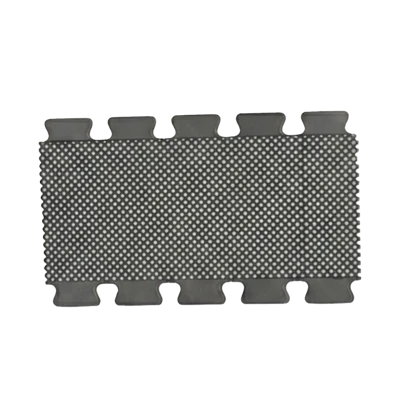
· Liner Formats: Individual kiss-cut strips, perforated cards holding 3, 5, or 10 electrodes per strip, or bulk continuous rolls for automated lead-placement kits.
· Secondary Packaging: Sealed in multi-layer PET/AL/PE barrier foil pouches with tear notches and zip-lock reclosable tops (packed 30, 50, or 100 pcs per pouch). Pouches can be custom-printed with private-label brand graphics, regulatory UDI barcodes, and multi-language instructions.
-
Two-Center Supply Chain Mechanics : High-speed continuous PE foam coating, medical acrylic adhesive compounding, solid polyacrylate hydrogel extrusion, and Ag/AgCl eyelet automated deposition execute natively inside our primary China facility. High-speed multi-station rotary die-cutting, automated snap staking, optical AOI inspection, foil pouch heat sealing, 100% batch impedance testing, and palletized ocean container export route through our Vietnam hub, shielding international B2B buyers from regional medical consumable tariffs and Section 301 duties.
Certifications
-
ANSI/AAMI EC12:2000/(R)2020 Type Verification : Master production lots undergo testing in accredited independent testing laboratories confirming strict compliance with ANSI/AAMI EC12 (Disposable ECG electrodes) and IEC 60601-2-27. Test dossiers confirm: AC small-signal impedance remains below 150 Ohm at 10 Hz (standard limit: < 3,000 Ohm); initial DC offset voltage remains below 2.0 mV (typical < 0.8 mV); post-defibrillation recovery settles below 25 mV at 5.0 seconds; and drift rate remains below 1.0 mV/s.
-
ISO 10993 Comprehensive Dermal Biocompatibility : Skin-contact solid hydrogels and perimeter adhesives undergo batch validation in accredited testing laboratories confirming compliance with ISO 10993-5 (In Vitro Cytotoxicity Grade 0), ISO 10993-10 (Skin Sensitization: 0% allergic response), and ISO 10993-23 (Primary Dermal Irritation Index = 0.0). The complete assembly is 100% natural rubber latex-free, phthalate-free, and solvent-free.
-
MDSAP & ISO 13485 Manufacturing System Controls : Multi-station converting decks, automated staking units, and packaging barrier suites operate strictly within facilities certified to ISO 13485:2016 and MDSAP regulatory frameworks (covering US FDA 21 CFR 820, Health Canada, TGA Australia). Unbroken electronic Device History Records (DHR) capture raw foam density, hydrogel salt concentrations, eyelet staking pull forces, and hermetic pouch seal vacuum retention.
Technical FAQ
Q: Why does the mechanical crimping clearance between the metallic snap stud and the ABS eyelet dictate ECG baseline stability, and how does improper staking induce false artifactual arrhythmias?
A: In an ECG monitoring loop, current flow is on the order of microamperes (I < 10μA). At these low signal amplitudes, any dynamic fluctuation in interface resistance (Rcontact) acts as a source of electrical noise:Δ V = Ibias · Δ Rcontact where Ibias is the monitor's input amplifier bias current. When the brass snap stud is loosely staked into the Ag/AgCl ABS eyelet, an air gap or loose mechanical boundary exists between the metal flange and the conductive eyelet coating. During clinical monitoring, patient respiration, postural shifts, or the weight of unsupported lead cables apply cyclical mechanical moments to the snap stud. This movement causes the metal flange to rock within its seat, shifting microscopic contact asperities. The contact resistance swings erratically between 0.02 Ohm and several hundred Ohms. This mechanical shifting generates step-function voltage transients (Δ V) ranging from 0.1 mV to 1.5 mV. In the monitor's signal processing chain, these step changes fall directly into the frequency band of physiological biopotentials (0.05 Hz to 40 Hz). The monitor's arrhythmia detection algorithms misinterpret these sudden baseline spikes as ventricular premature complexes (VPCs), paroxysmal ventricular tachycardia, or asystolic dropouts. We resolve this by using automated hydraulic-pneumatic staking dies that expand the brass rivet shank radially inside the eyelet cavity. The radial expansion generates a continuous mechanical clamping force exceeding 60N, seating the nickel-plated flange directly against the Ag/AgCl face with an interference fit. Contact resistance remains flat (R < 0.02Ω) under dynamic multi-axis cable loads, eliminating contact-jitter artifacts and preventing false arrhythmia alarms.
Q: How does a crosslinked solid hydrogel maintain electrical conductivity across 72 hours of open air-conditioned ICU exposure without experiencing the moisture desiccation typical of liquid wet gels?
A: Conventional liquid wet gels consist of an aqueous electrolyte solution held inside an open-cell sponge reservoir. Because water molecules in liquid gels are unconstrained by a polymer backbone, their thermodynamic chemical potential (μw) is high, matching free water. When deployed in hospital intensive care units operating continuous HVAC laminar airflow (ambient relative humidity typically controlled between 40% and 50%), this high chemical potential drives evaporation. Over 24 to 36 hours, water evaporates out of the open sponge pores, causing volume shrinkage. Unbound electrolyte salts precipitate into micro-crystals, collapsing electrical conductivity and driving AC impedance from 100 Ohm to over 5,000 Ohm, which causes signal dropout. Our solid hydrogel formulation resolves this through a covalently crosslinked polyacrylate polymer network combined with a ternary humectant system. The matrix incorporates pharmaceutical-grade vegetable glycerol (30% to 38% by weight) crosslinked with acrylic acid monomers via narrow-band UV photopolymerization. The hydroxyl groups (-OH) on the polyol chains form dense hydrogen-bonding networks with the water molecules, lowering the saturation vapor pressure and trapping water within the polymer meshes (Aw < 0.70). During 72 hours of exposure to dry air conditioning, evaporation is held below 15% of initial mass. The gel retains its flexible viscoelastic state without phase separation or salt crystallization, maintaining volumetric resistivity below 25 Ohm-cm. In parallel, the closed-cell PE foam backing functions as a lateral barrier, preventing ambient air from circulating across the hydrogel perimeter and maintaining a stable skin-electrode interface throughout multi-day monitoring.
Hospital clinical procurement directors, biomedical engineering department heads, and patient monitoring OEM brands can request complete ANSI/AAMI EC12 electrical compliance dossiers, 72-hour telemetry baseline stability test logs, and unbranded evaluation sample pouches (50 mm round or teardrop, 30 or 50 pcs/pack).
👉 [Request Adult Foam Snap ECG Pad Evaluation Samples]
Hot Tags: adult foam snap ecg pads, China adult foam snap ecg pads manufacturers, suppliers, factory, Ecg Electrode, Ecg Electrode Stickers, electrode stickers
Specifications
| Analytical Parameter | Engineering Baseline | Testing Standard |
| Operational Standard | ANSI/AAMI EC12:2000/(R)2020 & IEC 60601-2-27 | Disposable ECG electrodes |
| Electrode Geometries |
Round: 50 mm / 55 mm dia.
Teardrop: 43 mm x 45 mm / 50 mm x 55 mm |
Standard anatomical profiles |
| Terminal Snap Stud | 4.0 mm Universal Male Stud, Nickel-Plated Solid Brass | Tensile pull > 60N |
| Sensor Substrate | Injection-Molded ABS Eyelet with Ag/AgCl Coating | 4.0 to 6.0 um AgCl thickness |
| Conductive Interface | Isotonic Crosslinked Acrylic Solid Hydrogel (0.85 mm) | High-chloride solid matrix |
| AC Small-Signal Impedance | < 150 Ohm at 10 Hz (AAMI EC12 limit: < 3,000 Ohm) | Four-wire test fixture |
| DC Offset Voltage | < 2.0 mV (Typical < 0.8 mV, EC12 limit: < 100 mV) | Unpaired electrode pair |
| Combined Noise & Drift | Peak-to-Peak Noise < 150 uV over 5 Minutes | EC12 baseline stability |
| Defibrillation Recovery | Residual Offset < 25 mV at 5.0 Seconds (Slope < 1 mV/s) | Post-200J/360J discharge |
| Bias Current Tolerance | DC Offset shift < 10 mV under 200 nA continuous bias | 8-Hour testing |
| Carrier Backing | 1.0 mm Closed-Cell Crosslinked PE Foam (65 kg/m3) | Fluid-impermeable |
| Dynamic Peel Adhesion | > 5.0N / 25 mm on Polished Stainless Steel | ASTM D3330 |
| Dwell Time Endurance | 72 Hours Continuous Monitoring on Intact Skin | In-vivo telemetry logging |
| Packaging Configurations | 30, 50, or 100 pcs per Sealed Moisture-Barrier Pouch | Multi-layer PET/AL/PE |