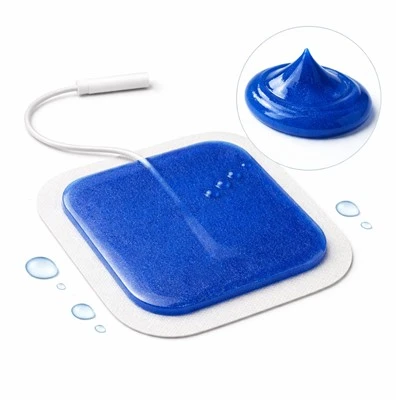

OEM Tan Tricot TENS Electrodes | Flesh-Tone Knit Electrotherapy Pads | TOP-RANK
B2B contract manufacturing of Tan Tricot TENS Electrodes for physical therapy and DME supply. Engineered with 28-gauge lockstitch warp-knit backing, C6 fluorocarbon soil-release finish, polyurethane strike-through barrier, and 35+ reuse polyacrylate hydrogel.
Product Overview
Tan Tricot TENS Electrodes function as reusable cutaneous biopotential delivery consumables built on a flesh-tone warp-knit textile carrier for transcutaneous electrical nerve stimulation (TENS), neuromuscular electrical stimulation (EMS), and interferential therapy (IFT) consoles. Standardized across 50x50 mm square, 50x90 mm rectangular, and 40x60 mm oval footprints, these electrodes conduct charge-balanced biphasic pulse trains (1 Hz to 150 Hz, pulse widths 50 to 400 microseconds, amplitudes up to 80 mA) across cervical, lumbar, and extremity musculature. Unlike disposable paper or open-fiber spunlace cloth pads, the warp-knit tricot backing withstands repeated application, water-drop maintenance, and multi-week ambulatory wear without edge fraying or textile staining.
Deploying low-grade knitted or non-woven fabric electrodes across 30-to-45-cycle rehabilitation regimens exposes three distinct textile, coating, and dyeing failures:
- Sebum Wicking, Lotion Saturation, and Garment Dye Crocking: Unfinished textile backings act as capillary wicks that absorb skin sebum, topical analgesic creams, and perspiration. Over two weeks of reuse, the fabric turns dark grey, harbors bacterial odor, and absorbs indigo or black dye crocked from dark jeans and athletic apparel.
- Die-Cut Edge Fraying and Loose Yarn Contamination of Hydrogel Margins: Conventional open-knit fabrics lack loop-locking stitch geometry. When rotary dies cut through the textile, severed warp and weft threads unravel along the perimeter. Loose synthetic filaments curl inward onto the adhesive hydrogel border during pouch extraction or cold-water rinsing, forming insulating barriers that lift the pad edge off the skin.
- Hydrogel Strike-Through and Piece-Dyed Color Bleeding Under Acidic Sweat: Open-loop tricot fabrics contain microscopic interstitial gaps between knit wales. During slot-die coating, liquid hydrogel precursors penetrate through the knit loops, curing into stiff, glossy plastic spots on the exterior face. Simultaneously, surface piece-dyed beige fabrics leach unfixed disperse dyes when saturated with acidic sweat (pH 4.5 to 5.5), staining patient skin and undergarments.
The Tan Tricot TENS Electrode platform resolves these textile degradation modes through controlled knit and finishing specifications: a 28-gauge two-bar lockstitch warp-knit carrier spun from solution-dyed (dope-dyed) flesh-tone polyester-nylon filaments (ISO 105-E04 perspiration colorfastness Grade 4.5–5) that eliminates dye bleed and edge fraying; a C6 fluorocarbon oleophobic and hydrophobic soil-release finish (AATCC 118 Oil Repellency Grade 5) that repels lotions, sweat, and garment dye transfer; and a 14 g/m2 elastomeric polyurethane tie-coat that blocks hydrogel strike-through while preserving multiaxial knit elongation. We contract-manufacture private-label tan tricot electrodes with 2.0 mm pin sockets or 3.5 mm snap studs for DME replenishment suppliers, physical therapy distributors, and OTC retail brands globally.
Technical & Engineering Description
The industrial manufacture of Tan Tricot TENS Electrodes executes inside ISO 13485-certified Class 8 cleanrooms across continuous web-converting lines integrating low-tension warp-knit unwinding, C6 fluorocarbon soil-release finishing, elastomeric polyurethane tie-coating, ultrasonic terminal staking, and rotary tungsten-carbide die-cutting. The manufacturing sequence proceeds through five coordinated engineering stages:
- Stage 1: Solution-Dyed Tricot Unwinding & C6 Fluorocarbon Soil-Release Treatment: Master rolls of 28-gauge two-bar lockstitch warp-knit tricot (125 g/m2, spun from solution-dyed flesh-tone 85% polyester / 15% elastane filaments) unwind under closed-loop servo dancer tension control below 10 N to prevent static knit distortion. The exterior textile face passes through a kiss-roll finishing station applying a medical-grade C6 fluorocarbon soil-release emulsion, cured at 140C in a tenter frame to orient perfluoroalkyl side chains outward-establishing AATCC 118 Grade 5 oil repellency without blocking moisture vapor transpiration.
- Stage 2: Micro-Gravure Polyurethane Tie-Coat & Carbon-Polyolefin Lamination: The interior face of the tricot web traverses an atmospheric corona discharge unit (elevating surface energy past 52 dynes/cm) followed by a micro-gravure coater applying an aqueous elastomeric polyurethane tie-coat at 14 g/m2 dry weight. Cured in an 85C infrared tunnel, this continuous elastic membrane bridges the open knit wales to halt hydrogel strike-through while retaining 40% multiaxial fabric stretch. The primed tricot laminates onto a 45 um conductive carbon-loaded polyolefin film (isotropic sheet resistance 28 to 40 Ohm/sq).
- Stage 3: Ultrasonic Leadwire Busbar Staking & Polyester Anchor Reinforcement: Multi-strand tinned copper leadwire assemblies terminated in injection-molded 2.0 mm female phosphor-bronze sockets (or 3.5 mm surgical stainless steel snap studs) feed into automated wire-splaying fixtures. Stripped copper filaments spread into a 12x16 mm conductive fan welded onto the carbon-polyolefin collector via a 20 kHz ultrasonic horn, capped with a 125 um polyester dielectric reinforcement patch that holds axial pull forces above 40.0 N.
- Stage 4: 0.90 mm Polyacrylate Hydrogel Slot-Die Extrusion & UV Curing: An aqueous monomer formulation compounding acrylic acid, pharmaceutical vegetable glycerol, propylene glycol, purified water, 1.5% sodium chloride electrolyte, and bi-functional covalent crosslinkers is metered through a precision slot-die head directly onto the conductive carbon web at a calibrated caliper of 0.90 mm (+/- 0.02 mm). The coated web immediately traverses an enclosed nitrogen-blanketed ultraviolet (UV) curing tunnel, achieving >99.6% double-bond conversion within 45 seconds to form a high-cohesion solid polyacrylate gel slab (G' > 4,000 Pa), then consolidates against a 75 um fluorosilicone PET release liner.
- Stage 5: Lockstitch-Aligned Rotary Kiss-Cutting & Nitrogen Foil Pouching: The laminated web feeds into a rotary converting station equipped with hardened tungsten-carbide cutting dies featuring 3.5 mm corner radii. The rotary blades kiss-cut through the lockstitch tricot, carbon film, and hydrogel down to the PET liner without pulling loose yarn ends, extracting the skeletal waste matrix via continuous vacuum manifolds. Line-scan vision cameras inspect perimeter cut smoothness, corner radii, and lead alignment at 100% web speed. Finished sets of four electrodes mount onto dual-sided release cards, enter multi-layer PET/AL/PE zip-closure barrier pouches under dry nitrogen purge, and undergo hermetic heat-sealing. The baseline contract manufacturing MOQ is 5,000 packs.
Key Features
-
C6 Fluorocarbon Soil-Release Exterior & Solution-Dyed Pigmentation (Resisting Lotion Saturation, Garment Dye Crocking, and Sweat Dye Bleed Across 40+ Cycles)
Reusable electrodes worn over multiple weeks fail cosmetically and hygienically when porous textile backings absorb topical lipids and external garment dyes:
1. Capillary Soil Absorption and Piece-Dye Bleed in Standard Cloth Pads: Unfinished white non-woven and standard piece-dyed beige fabrics wick skin sebum, topical analgesic creams, and perspiration through surface micro-capillaries. Within 10 to 15 uses, the pad turns grey, retains body odor, and absorbs indigo or black dyes crocked from dark denim and athletic leggings. Furthermore, piece-dyed beige textiles rely on surface-adsorbed disperse dyes that leach onto skin and light undergarments when exposed to acidic human perspiration (pH 4.5 to 5.5).
2. Dope-Dyed Filaments & C6 Fluorocarbon Barrier Finishing: Our tan tricot carrier eliminates staining and dye migration through fiber-level chemistry:
• Solution-Dyed (Dope-Dyed) Flesh-Tone Yarns: Mineral-oxide flesh-tone pigments are compounded directly into the molten polyester-nylon polymer prior to spinneret extrusion, locking pigment inside the filament core and achieving ISO 105-E04 perspiration colorfastness Grade 4.5–5 with zero dye leaching.
• C6 Fluorocarbon Soil-Release Treatment: Thermal curing orients perfluoroalkyl side chains across the outer knit surface, delivering AATCC 118 Oil Repellency Grade 5 and AATCC 22 Spray Rating 90-repelling skin lotions, sweat oils, and dark textile dye crocking across 40+ reuse cycles without impairing breathability.
-
28-Gauge Two-Bar Lockstitch Warp-Knit Geometry (Preventing Die-Cut Perimeter Fraying and Loose Thread Contamination During Water-Drop Rehydration)
Knitted electrode backings must maintain clean, fray-free borders through high-speed rotary die-cutting and repeated consumer handling:
1. Edge Unraveling and Yarn Wicking in Open-Knit Fabrics: Conventional circular-knit or loose weft-knit fabrics rely on continuous horizontal yarn loops that unravel immediately once cut by rotary dies. As patients peel pads off PET release cards or rinse the hydrogel face with tap water to restore tack, severed yarn ends pull loose along the perimeter and curl onto the sticky hydrogel border-creating non-conductive fiber bridges that lift the adhesive edge off the skin.
2. 28-Gauge Lockstitch Warp-Knit Stability & 3.5 mm Corner Radii: Our tricot substrate eliminates perimeter fraying through stitch-level mechanical locking:
• Two-Bar Lockstitch Interlocking Loops: Knitted on 28-gauge warp-knitting machinery using a closed pillar-and-inlay lockstitch pattern, every filament loop is mechanically knotted at its intersection so severed edge threads cannot run or unravel.
• 3.5 mm Continuous Corner Radii: Hardened tungsten-carbide rotary dies stamp 3.5 mm radius curves around all four corners, eliminating sharp fabric tips that catch on fingernails during liner removal or water-drop cleaning.
-
14 g/m2 Elastomeric Polyurethane Tie-Coat (Blocking Hydrogel Strike-Through While Preserving 40% Multiaxial Knit Stretch)
Coating aqueous polyacrylate hydrogel precursors onto porous knitted textiles presents an acute liquid-penetration challenge:
1. Liquid Monomer Bleed-Through in Open-Loop Knits: Warp-knit tricot fabrics feature open diamond-shaped spaces between knit wales and courses. When liquid hydrogel monomer is slot-die extruded directly onto an unprimed or lightly coated knit backing, capillary pressure drives the aqueous liquid through the textile pores. Under UV curing, the penetrated monomer polymerizes into hard, glossy plastic spots on the exterior tan face-ruining aesthetic uniformity and creating rigid local stiffeners that irritate skin under tight clothing.
2. Micro-Gravure Elastomeric Polyurethane Tie-Coat: Our inline priming stage seals the textile underside without compromising fabric stretch:
14 g/m2 Continuous Elastomeric Membrane: Applied via micro-gravure cylinder and cured at 85C, the aqueous polyurethane tie-coat forms an unbroken, pinhole-free elastic film across the underside of the knit loops, completely blocking monomer strike-through.
3. Synchronized 40% Multiaxial Elongation: Because the cured polyurethane membrane possesses >300% ultimate elongation and <0.15 MPa tensile modulus, it stretches and recovers in lockstep with the 28-gauge tricot knit (35% to 45% elongation at 10 N load, >94% recovery) without delaminating from the conductive carbon-polyolefin collector.
Applications
Durable Medical Equipment (DME) & Medicare Chronic Pain Replenishment Programs
Sourced in high container volumes by DME replenishment suppliers, workers' compensation medical networks, and pain management distributors fulfilling recurring monthly supply orders for chronic lumbar, cervical, and neuropathic pain patients; the C6 fluorocarbon soil-release finish and 28-gauge lockstitch tricot withstand 35 to 45 daily applications and cold-water rehydration cycles without edge fraying, lotion staining, or garment dye transfer.
Outpatient Physical Therapy Clinics & Active Kinesiology Rehabilitation
Deployed across outpatient orthopedic rehabilitation clinics and sports physiotherapy practices treating shoulder impingement, patellofemoral pain, and elbow epicondylitis; 40x60 mm oval and 50x90 mm rectangular tan tricot pads stretch 35% to 45% under low tensile loads (<10 N) during active range-of-motion exercises, maintaining continuous <26 Ohm interfacial contact without edge-lift.
OTC Pharmacy Retail & Discrete Daytime Electrotherapy Brands
Sourced by private-label consumer healthcare brands and retail pharmacy chains catering to office workers, retail staff, and active adults wearing portable TENS units beneath light-colored business attire or athletic wear; the solution-dyed flesh-tone exterior blends across diverse skin tones with zero dye bleeding under acidic sweat, while the 14 g/m2 polyurethane tie-coat prevents glossy gel bleed-through.
OEM & Private Label
-
Dimensional Matrix, Connector Terminations & Private Brand Packaging : We provide contract manufacturing and custom converting configurations for DME suppliers, physical therapy distributors, and OTC retail brands:
• Standard Footprint Matrix: Universal Square 50x50 mm (2"x2", 24.8 cm2 active area); Elongated Rectangular 50x90 mm / 50x100 mm (2"x4", 43.5–48.5 cm2 active area); Contoured Oval 40x60 mm (cervical and limb placements); and Round Dia 50 mm (shoulder and trigger-point placements).
• Flesh-Tone Shade & Print Customization: Standard Neutral Tan (Pantone 4685C equivalent), Warm Medium Beige, and Deep Tan; supports single-color or multi-color rotary silk-screen brand logo and placement icon printing directly onto the C6-treated tricot exterior.
• Connector Terminations: Injection-molded 2.0 mm female phosphor-bronze sockets (retention force calibrated to 15N–25N, standard 100 mm or 150 mm lead length); 3.5 mm and 4.0 mm surgical stainless steel snap studs (single central snap or dual-snap pitch); and custom color-coded lead jackets.
• Turnkey Packaging Solutions: 4 pads (2 pairs) mounted per double-sided differential PET release card inside resealable multi-layer PET/AL/PE barrier foil pouches; custom full-color retail pouches and folding cartons with euro-hang slots (8-pack, 16-pack, 24-pack, or 40-pack assortments); Amazon FNSKU barcoding; and serialized GS1/UDI medical traceability coding.
-
Two-Center Supply Chain Mechanics : Solution-dyed 28-gauge tricot C6 fluorocarbon soil-release finishing, micro-gravure elastomeric polyurethane tie-coating, conductive carbon-polyolefin lamination, ultrasonic terminal staking, and 0.90 mm polyacrylate hydrogel UV polymerization execute natively inside our primary China facility (ISO 13485:2016 and FDA registered under 21 CFR 820). High-speed rotary tungsten-carbide die-cutting, differential release card mounting, nitrogen-flushed foil pouching, retail cartoning, and palletized ocean container export route through our Vietnam industrial hub, shielding international B2B buyers from Section 301 tariffs and regional medical consumable import barriers.
Certifications
-
ISO 10993 Comprehensive Dermal Biocompatibility : Master production lots undergo testing in accredited independent GLP testing laboratories confirming strict compliance with ISO 10993-5 (In Vitro Cytotoxicity: Grade 0, non-cytotoxic to L929 fibroblasts), ISO 10993-10 (Skin Sensitization: 0% allergic response in guinea pig maximization assays), and ISO 10993-23 (Primary Dermal Irritation Index = 0.0, non-irritating). Certified 100% free of natural rubber latex, PFOA/PFOS long-chain fluorochemicals, colophony rosin tackifiers, and phthalate plasticizers.
-
ANSI/AAMI EC12 & IEC 60601-2-10 Specialized Electrical Standards : Formulated and converted to satisfy international electrotherapy criteria:
AC Small-Signal Interfacial Impedance across human limb and cervical skin holds strictly below 26.0 Ohms at 1 kHz.
Direct-Current (DC) Offset Voltage across resting electrode pairs remains below 10.0 mV.
Delivers uniform electrical current density below 2.0 mA RMS/cm2 across the entire active footprint under 80 mA stimulator output.
-
Textile Colorfastness, Soil Repellency & Mechanical Verification : Tested in accordance with ISO 105-E04 (Perspiration Colorfastness: Grade 4.5–5), AATCC 118 (Oil Repellency: Grade 5), AATCC 22 (Water Spray Rating: 90), ASTM D4964 (Elastic Fabric Tensile Properties: 35%–45% elongation at 10 N, >94% recovery), and ASTM D3330 (Peel Adhesion: 4.0–5.2 N/25mm). Terminal leadwire assemblies withstand axial pull forces exceeding 40.0 N without mechanical fracture or electrical disconnection.
-
MDSAP & ISO 13485 Manufacturing System Controls : Continuous textile finishing bays, micro-gravure tie-coating lines, ultrasonic staking workcells, rotary die-cutting suites, and cleanroom pouching lines operate strictly under certified ISO 13485:2016 and MDSAP regulatory frameworks (covering US FDA 21 CFR 820, Health Canada, TGA Australia). Unbroken electronic Device History Records (DHR) capture C6 finish add-on weights, polyurethane tie-coat thicknesses, carbon sheet resistance values, peel tack logs, lead pull strengths (>40 N), and packaging seal burst pressures across every manufactured production lot.
Technical FAQ
Q: Why do standard cloth or beige TENS pads turn grey, absorb body lotions, or bleed dye onto light clothing during multi-week reuse, and how does this tan tricot prevent it?
A: Textile discoloration, lipid fouling, and dye transfer stem from unsealed capillary yarn pores and surface-adsorbed piece-dyeing processes: Capillary Soil Wicking & Piece-Dye Bleed: Unfinished spunlace non-woven and conventional knitted fabrics act as open capillary networks that absorb skin sebum, topical analgesic creams, and perspiration-turning grey within 10 uses and picking up indigo or black dye crocked from dark denim. Furthermore, piece-dyed beige fabrics use surface-bound disperse dyes that leach out when exposed to acidic human sweat (pH 4.5 to 5.5), staining skin and light garments. Our Solution-Dyed Filaments & C6 Fluorocarbon Finish: 1.Solution-Dyed (Dope-Dyed) Yarns: Mineral-oxide flesh-tone pigments are compounded directly into the molten polyester-nylon polymer before extrusion, locking pigment inside the fiber core and passing ISO 105-E04 perspiration colorfastness at Grade 4.5–5 with zero dye bleed. 2. C6 Fluorocarbon Soil-Release Treatment: Thermal curing at 140C orients perfluoroalkyl side chains across the outer knit face, establishing AATCC 118 Oil Repellency Grade 5 and AATCC 22 Spray Rating 90-repelling skin lotions, sweat oils, and dark garment dye transfer across 40+ reuse cycles.
Q: How do you prevent aqueous hydrogel from bleeding through open knit loops during coating, and what stops the die-cut knit edges from fraying during water-drop cleaning?
A: Preventing hydrogel strike-through and edge fraying on knitted backings requires pairing a sub-surface elastomeric barrier with a lockstitch warp-knit structure: 14 g/m2 Elastomeric Polyurethane Tie-Coat (Anti-Strike-Through): Open-loop tricot fabrics contain diamond-shaped interstitial gaps between knit wales. Without a barrier film, liquid hydrogel precursors wick through the knit loops during slot-die extrusion and cure into hard, glossy plastic spots on the exterior tan face. Applying a 14 g/m2 aqueous elastomeric polyurethane tie-coat via micro-gravure roller and curing at 85C seals the underside of the knit loops with a pinhole-free elastic film, completely stopping strike-through while preserving 35% to 45% multiaxial stretch. 28-Gauge Two-Bar Lockstitch Warp-Knit & 3.5 mm Corner Radii (Anti-Fraying): Unlike circular-knit fabrics that unravel when cut, our 28-gauge tricot is knitted using a closed pillar-and-inlay lockstitch pattern that mechanically knots every filament intersection. Combined with 3.5 mm radius rotary die-cut corners, severed edge threads remain locked in place during liner removal and cold-water rehydration across 35 to 45 cycles.
DME replenishment suppliers, physical therapy distributors, and private-label electrotherapy brand managers can request official Certificates of Analysis (COA), AATCC 118 oil repellency and ISO 105-E04 perspiration colorfastness test reports, ASTM D4964 tricot stretch-recovery curves, ISO 10993 dermal biocompatibility dossiers, and unbranded tan tricot evaluation sample packs (available in 50x50 mm square, 50x90 mm rectangular, and 40x60 mm oval footprints with 2.0 mm socket or 3.5 mm snap terminations).
👉 [Request Tan Tricot TENS Electrode Evaluation Packs]
Hot Tags: tan tricot tens electrodes, China tan tricot tens electrodes manufacturers, suppliers, factory, Electro Pads for TENS Unit, Large TENS Unit Pads, TENS electrodes, TENS Replacement Pads, TENS unit gel pads, TENS Unit Patches
Specifications
| Analytical Parameter | Engineering Baseline | Testing Standard |
| Knit Backing Architecture | 28-Gauge Two-Bar Lockstitch Warp-Knit Tricot (125 g/m2) | ASTM D3776 |
| Filament Composition | 85% Solution-Dyed Polyester / 15% Spandex Elastane | ISO 105-E04 |
| Soil & Oil Repellency | C6 Fluorocarbon Finish (Oil Repellency Grade 5, Spray 90) | AATCC 118 & AATCC 22 |
| Strike-Through Barrier | 14 g/m2 Elastomeric Aqueous Polyurethane Tie-Coat | Visual & microscopic inspection |
| Multiaxial Knit Elongation | 35% to 45% Elongation at 10 N Load; >94% Elastic Recovery | ASTM D4964 |
| Conductive Collector | Isotropic Carbon-Loaded Polyolefin Film (28 to 40 Ohm/sq) | Four-point probe (ASTM D257) |
| AC Interfacial Impedance | < 26.0 Ohms at 1 kHz across Human Limb/Cervical Skin | Precision LCR Meter |
| Hydrogel System & Caliper | Extruded Solid Polyacrylate Hydrogel (Caliper: 0.90 mm) | Precision thickness gauge |
| Skin Adhesion Peel Tack | 4.0 N to 5.2 N / 25 mm on Stainless Steel Coupon | ASTM D3330 (180° Peel) |
| Dynamic Shear Modulus | Shear Storage Modulus G' > 4,000 Pa at 1 Hz | Rheometer frequency sweep |
| Corner Radius Profile | 3.5 mm Continuous Corner Radius across Perimeter | Rotary die-cut tooling |
| Connector Interface | Molded 2.0 mm Female Socket (Phosphor Bronze) or 3.5 mm Snap | ANSI/AAMI EC53 |
| Leadwire Pull Strength | Wire-to-Pad Tensile Pull-Out Strength > 40.0 N Axial Force | Tensile pull bench |
| Application Lifespan | 35 to 45 Application Cycles with Water-Drop Maintenance | Clinical cycle trial |
| Primary Packaging & MOQ | 4 Pads (2 Pairs) per Hermetic Ziploc Foil Pouch; MOQ: 5,000 Packs | 36-Month shelf life |