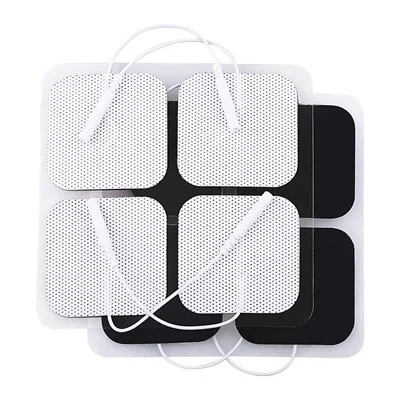


OEM Gel Pads For TENS | Conductive Hydrogel Matrices | TOP-RANK
B2B TENS unit gel pads. Formulated with high-storage modulus (G') polyacrylamide matrices for uniform charge dispersion and long-term shelf stability in OTC hardware kits.
Product Overview
These gel pads are standardized ionically conductive substrates engineered to facilitate current transfer between TENS/EMS pulse generators and the human epidermis. In this electro-mechanical architecture, the hydrogel functions as a viscous, fluid-phase conductor. It serves to bridge the microscopic dielectric air gaps between the rough surface of the skin and the planar carbon-ink electrode. We manufacture these matrices using a precision slot-die coating process, resulting in a consistent Z-axis electrical path that maintains signal integrity across diverse pulse-width profiles. These consumables are supplied in bulk to medical device OEMs and consumer health brands.
Technical/Engineering Description
The manufacturing of high-performance TENS gel pads requires a strictly controlled polymer cross-linking process. The substrate utilizes a polyacrylamide lattice, titrated with specific chloride salts to ensure high ionic mobility. During the coating stage, the gel is deposited onto a release-coated PET liner. Thermal and UV-curing profiles are meticulously tuned to establish a G' (Storage Modulus) value high enough to resist permanent deformation when applied to moving joints, yet low enough to flow into the epidermis's micro-topography. This rheological balance is the primary determinant of effective current dispersion and long-term signal stability.
Key Features
-
Rheological Shear-Thinning (Flow-on-Demand)
Under static storage, the gel pad behaves as a soft solid paste. However, when subjected to the mechanical pressure of manual application (shear stress), the polyacrylamide chains align, temporarily reducing the gel's viscosity. This "shear-thinning" effect allows the pad to instantly conform to the irregularities of the skin surface. Once application pressure ceases, the internal lattice structure recovers, ensuring the pad remains firmly in place despite body heat or subtle skin movement.
-
Electrochemical Polarization Prevention
Standard TENS units output asymmetric biphasic waveforms. Cheap hydrogels often contain corrosive salts that react with the carbon ink layer, leading to electrical polarization-where the pad stops passing current effectively after only a few uses. Our formulation utilizes a stabilized, non-corrosive chloride ion carrier. This prevents the electrochemical "poisoning" of the carbon-film interface, ensuring the pad's impedance profile remains flat from the first use through the final therapeutic cycle.
-
Vapor-Pressure Equilibrium
Water-based hydrogels are susceptible to atmospheric evaporation. A pad with insufficient moisture content rapidly loses conductivity and adhesion, causing painful "stinging" sensations for the user. We calibrate the gel's internal osmotic pressure using hygroscopic glycols. This creates a moisture-locking equilibrium, where the gel retains its baseline hydration levels even in low-humidity clinical or household environments, extending the pad's active functional life to 24+ months when sealed.
Applications
OTC Home Pain Management
Standardized, high-cohesion consumables for retail stimulator kits targeting sciatica, lumbar strain, and joint pain.
Physical Therapy Clinics
Reliable, batch-traceable interfaces for multi-patient utilization in outpatient rehabilitation centers.
EMS Muscle Toning
Specialized high-current capable gel matrices that manage the elevated milliampere (mA) load required for muscular tetany.
OEM & Private Label
-
Rotary Die-Cut Precision : We utilize custom steel-rule rotary anvils to manufacture complex, multi-geometry pads (e.g., butterfly, oblong, or custom shapes) with an edge-ooze tolerance < 0.5mm.
-
Logistics Routing : Bulk chemical compounding and high-speed gel casting operate in our China facilities. Final unit cutting, secondary retail-ready pouching, and global palletization route via our Vietnam facility, mitigating Section 301 and medical-consumable trade tariffs for North American distributors.
Certifications
-
Biocompatibility : Hydrogel matrices are strictly tested against ISO 10993-5 (Cytotoxicity) and ISO 10993-10 (Sensitization) endpoints to ensure absolute dermal safety.
-
Systems : Compounding and high-speed converting lines operate within audited ISO 13485:2016 and MDSAP regulatory frameworks.
FAQ
Q: Do these gel pads contain natural rubber latex?
A: No. We utilize synthetic polyacrylamide and polyurethane substrates. There are zero natural rubber latex derivatives in our manufacturing facility, eliminating the risk of Type I hypersensitivity in sensitive patients.
Q: Why does the impedance increase after the pads are washed?
A: Washing removes the surface-level ionic conductors (salts) trapped in the hydrogel, and excessive water can lead to over-swelling of the polyacrylamide lattice. This structural change inhibits ion transport. For best results, use only a drop of water to remove surface debris; avoid soaking the pad.
B2B clinical hardware OEMs and private-label brands can request rheological data logs and lot-traceable hydrogel samples.
👉 [Request Gel Pad Prototypes]
Hot Tags: gel pads for tens machine, China gel pads for tens machine manufacturers, suppliers, factory, TENS sticky pads, Neck Relax Electrode Pads, TENS Unit Electrodes, TENS unit replacement pads, TENS Machine Sticky Pads, TENS Pads
Specifications
| Parameter | Metric Configuration | Engineering Detail |
| Storage Modulus (G') | 15,000 - 25,000 Pa | Maintains shape under mechanical shear |
| Volume Resistivity | < 100 Ohm-cm | Optimized for low-frequency TENS |
| Cohesive Tack | 3.5N - 5.0N / 25mm | Prevents peeling during muscle contraction |
| Moisture Content | 45% - 55% | Thermodynamic equilibrium |
| Compatibility | Pin/Snap interfaces | Universal hardware mating |