OEM Snap-Type TENS Electrode Pads | Button Snap Electrodes | TOP-RANK
B2B contract manufacturing of snap-type TENS/EMS electrode pads for wireless stimulation pods and snap-lead clinical devices. Features 3.5 mm/4.0 mm nickel-plated brass snap studs, radial silver-carbon dispersion eliminating center hotspots, >50N stud pull-out retention, and 30 to 50 reuse cycles.
Product Overview
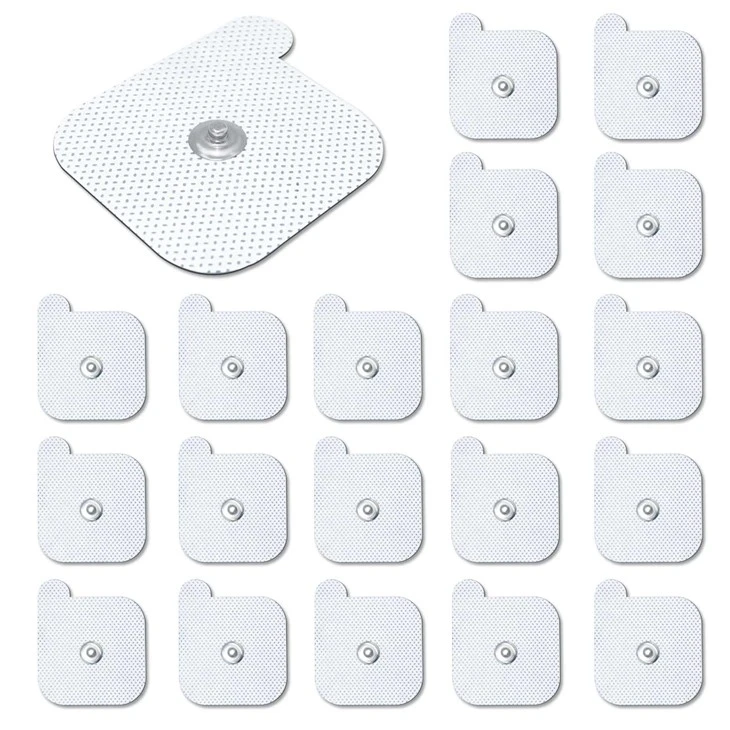
Snap-type TENS electrode pads serve as the standardized electromechanical interface for button-coupling transcutaneous electrical nerve stimulation (TENS) and electrical muscle stimulation (EMS). Instead of flexible pigtail wires, these pads utilize an upright metallic male stud (nominally 3.5 mm or 4.0 mm diameter) staked directly through the electrode substrate. This design enables direct snap-on mounting of battery-powered wireless stimulation pods, wearable sports recovery hubs, and clinical snap-terminated lead cables across pain management and athletic muscle conditioning protocols.
Conventional snap electrodes display three critical failure modes under clinical and consumer use:
- Focal Sub-Stud Current Bottlenecks (Center Stinging): In standard snap assemblies, the metallic brass or stainless-steel stud makes direct electrical contact with a uniform-resistivity carbon film. Electrical current takes the shortest, least-resistive vertical path directly down through the metal rivet base into the hydrogel. Current dumps straight through the center zone rather than spreading outward, spiking localized current density past 3.0 mA/cm2 directly beneath the button. Patients experience sharp stinging sensations before output reaches therapeutic levels.
- Cantilever Torque Tearing from Wireless Pods: Unlike lightweight cables that flex freely, direct-mount wireless EMS pods (weighing 25 to 60 grams) project outward from the electrode face. Body movement applies continuous cantilever bending moments to the upright stud. In low-cost pads where the stud is clinched through thin backing fabric without mechanical load spreading, dynamic torque shears the fabric around the rivet perimeter, ripping the stud out of the pad or fracturing the conductive trace.
- Stud Plating Micro-Flaking and Connection Chatter: Low-grade studs manufactured from brass with thin decorative flash-nickel plating experience mechanical wear during repeated pod attachment and detachment cycles (requiring 8N to 15N snap force). Surface plating micro-cracks and flakes off, exposing the underlying reactive brass to ambient air and conductive hydrogel salts. The exposed copper oxidizes into high-resistance verdigris, creating intermittent electrical contact, baseline waveform distortion, and sudden power dropouts.
This snap-type electrode platform resolves these failure modes through an engineered radial silver-carbon gradient printed beneath the stud, stepping down interface potential before current enters the hydrogel plane. The upright stud incorporates a 3.5 mm or 4.0 mm nickel-plated solid brass post cold-staked against an internal rigid polyolefin reinforcement washer that distributes cantilever loads across a 16 mm diameter anchor zone, withstanding axial pull forces beyond 50N. We contract-manufacture single-snap and dual-snap pads (with calibrated 40 mm or 50 mm center-to-center pitch) across square, oval, butterfly, and lumbar shapes for electrotherapy brands, wireless device OEMs, and medical supply networks globally.
Technical & Engineering Description
The industrial manufacture of snap-type TENS electrode pads is conducted inside ISO 13485-certified Class 8 cleanrooms utilizing multi-station rotary die-cutting systems integrated with automated pneumatic indexing snap-staking stations. The cross-section comprises six functional layers:
- Outer Carrier Backing: A 65 g/m2 multi-directional spunlace non-woven fabric, tan warp-knitted tricot, or 1.0 mm closed-cell polyethylene (PE) foam. The carrier is precision die-punched with center pilot alignment holes to receive the snap shank.
- Anti-Torque Reinforcement Washer: A 16 mm diameter, 250 um thick rigid polyolefin or polyethylene terephthalate (PET) structural washer positioned directly beneath the fabric backing. This washer acts as a mechanical load-spreader, increasing the effective contact footprint of the rivet flange to distribute bending stresses caused by attached devices.
- Snap Stud Component: A precision cold-headed male stud formed from H62 solid brass, barrel-plated with a 3.0 um passivated bright nickel coating. Dimensions are held to tight tolerances: stud head diameter 3.50 (+/- 0.03) mm or 4.00 (+/- 0.03) mm, and undercut groove depth calibrated to match the internal snap springs of standard female connectors.
- Radial Silver-Carbon Transition Conductor: A 45 um conductive polyethylene substrate screen-printed with a specialized radial electrode pattern. A high-conductivity silver-polymer ring (sheet resistance < 0.5 Ohm/sq) is printed directly beneath the metallic eyelet foot, which interfaces with an expanding starburst pattern of blended carbon ink. This geometry creates a progressive impedance step-down profile from the rivet center to the perimeter of the pad.
- Conductive Solid Hydrogel Slab: An ultraviolet-polymerized crosslinked polyacrylate aqueous hydrogel extruded at a caliper of 0.85 mm to 1.00 mm. Formulated with 2.5% pharmaceutical sodium chloride and 40% vegetable glycerol, the hydrogel yields an isotropic bulk volume resistivity below 20 Ohm-cm while maintaining mechanical cohesion during shear stresses.
- Protective Carrier Liner: A 75 um optical-grade siliconized polyester (PET) or polypropylene release sheet, featuring printed dual-snap pitch alignment grids for dual-stud configurations.
The mechanical joining of the snap stud through the reinforcement washer, backing fabric, and conductive film is executed on a multi-tonnage pneumatic orbital cold-staking press. The hollow shank of the male stud undergoes radial outward deformation inside the internal cavity of a conductive carbon-doped lower eyelet foot. The cold-staking cycle creates an interference fit under a clamping force exceeding 800N, compressing the fabric and washer into a rigid, gap-free sandwich. Contact electrical resistance between the brass stud and the silver ring is locked below 0.03 Ohm.
For dual-snap wearable pads, twin staking heads operate on a shared CNC tooling base that locks the center-to-center pitch at 40.0 mm (+/- 0.25 mm) or 50.0 mm (+/- 0.25 mm) to ensure compatibility with rigid dual-receptacle wireless stimulation pods. Finished pads pass through automated optical inspection (AOI) stations verifying stud head circularity, plating integrity, and hydrogel placement, before being sealed in nitrogen-purged multi-layer PET/AL/PE barrier pouches. The minimum OEM contract production run is 10,000 pouches (40,000 individual electrode pads).
Key Features
-
Multi-Tier Radial Silver-Carbon Dispersion (Suppressing Center Current Funneling and Sub-Snap Dermal Stinging)
In conventional snap electrodes, current injected through the metallic stud discharges directly beneath the rivet. Because the metal rivet exhibits near-zero resistance compared to the surrounding carbon layer, current follows the path of least resistance: it dumps straight down into the hydrogel directly beneath the button. This creates a vertical current bottleneck where local current density climbs past 3.0 mA/cm2 across a small circular area of skin. Patients experience sharp, painful stinging under the button before the rest of the pad delivers adequate therapeutic stimulation. We resolve this by printing a multi-tier radial silver-carbon transition pattern directly beneath the metallic eyelet foot. A high-conductivity silver-polymer circle (sheet resistance under 0.5 Ohm/sq) captures incoming current from the rivet and spreads it horizontally outward into radial conductive carbon ink spokes (graded sheet resistance 15 to 35 Ohm/sq) before the charge enters the hydrogel plane. Current density across the sub-snap zone remains below 1.5 mA/cm2 at full therapeutic output, eliminating center stinging and allowing patients to increase stimulation amplitude comfortably.
-
Integrated Flange Washer with Cold-Formed Rivet Staking (>50N Cantilever Pull-Out Retention Under Wireless Battery Pod Loads)
Wearable wireless TENS/EMS pods feature onboard lithium batteries and pulse generators, weighing up to 60 grams. When mounted directly to the stud, these pods create a mechanical cantilever arm: as the patient walks, bends, or contracts muscle groups, the heavy pod applies continuous rotational torque and lateral shear to the upright pin. In cheap electrodes, the stud rivet head pulls straight through the flexible non-woven backing under forces as low as 18N. We eliminate this structural failure mode by inserting an internal 16 mm diameter polyolefin reinforcement washer directly beneath the fabric carrier prior to orbital cold-staking. The staking die expands the brass shank with high radial force, clamping the fabric, washer, and conductive film between wide-diameter flanges. When dynamic cantilever torque is applied by an attached wireless pod, the bending stress transfers through the rigid washer and distributes across a broad 200 mm2 surface area rather than focusing on the rivet edge. Mechanical tensile testing verifies this joint withstands axial pull forces exceeding 50N and angled cantilever loads over 35N without stud loosening, fabric tearing, or trace fracture.
-
Calibrated 3.5 mm / 4.0 mm Stud Tooling with Passivated Nickel Plating (Consistent 8N to 14N Engagement Over 100+ Pod Cycles)
The mechanical interface between the male stud and the female snap receptacle on a wireless pod relies on spring-wire retention. If the male stud head diameter or undercut neck profile varies by even 0.05 mm, the connection fails: undersized studs cause the heavy pod to wobble and disconnect during movement, while oversized studs demand excessive force that crushes the electrode into the patient's skin during attachment. Furthermore, friction from repeated snap cycles scrapes away thin plating, exposing reactive copper to air and gel salts. Our studs are cold-headed on precision multi-station forming machinery, holding head diameters strictly within 3.50 (+/- 0.03) mm or 4.00 (+/- 0.03) mm, with an engineered undercut radius that provides smooth, positive engagement. The brass substrate is electroplated with a dense 3.0 um passivated bright nickel coating. Mechanical endurance testing confirms the stud retains smooth engagement force (8.0N to 14.0N) and disengagement force (7.0N to 12.0N) across more than 100 mating cycles without plating micro-cracking, contact chatter, or corrosive copper-ion leaching.
Applications
Wireless Wearable EMS & Athletic Recovery Pods (Direct Snap-Mount Hardware)
Formulated for direct-mount wireless electrotherapy pods (such as dual-stud sport muscle stimulators, knee therapy units, and abdominal toning modules); the rigid reinforcement washer absorbs the mechanical weight and cantilever movements of the wireless hub without pad delamination during active athletic conditioning.
Clinical Multi-Lead Electrotherapy Consoles (Snap-Terminated Lead Cables)
Used alongside clinical electrotherapy units where leadwires utilize 3.5 mm or 4.0 mm pinch grabbers or snap connectors instead of pin sockets; the radial silver-carbon pattern provides uniform current distribution across large muscle groups during TENS, EMS, and interferential therapy sessions.
Consumer OTC Wearable Pain Relief Brand Bundling (Dual-Stud Fixed-Pitch Pads)
Pre-calibrated dual-snap butterfly and rectangular pads manufactured with fixed center-to-center distances (40 mm or 50 mm), packed as branded replacement supplies for wireless menstrual relief devices, lumbar support belts, and cervical pain management wearables sold through retail pharmacies and e-commerce platforms.
OEM & Private Label
-
Stud Calibers, Dual-Snap Pitch Tooling & Packaging Customization : We offer comprehensive contract manufacturing options for single-snap and multi-snap wearable formats:
· Snap Configurations: Single-stud formats for traditional snap-cable leads; dual-stud formats with CNC-locked center-to-center pitch of 40.0 mm (+/- 0.25 mm) or 50.0 mm (+/- 0.25 mm) for wireless pods; custom stud spacings available on demand.
· Stud Calibers: Standard 3.5 mm male stud (widely adopted by consumer sports and wearable wellness brands) or 4.0 mm male stud (the standard for clinical medical consoles and hospital snap leads).
· Pad Geometries & Backings: 50x50 mm square, 50x100 mm rectangle, 75 mm round, ergonomic dual-wing butterfly, and wide lumbar pads; backing materials include white spunlace non-woven cloth, tan elastic tricot, or 1.0 mm closed-cell white PE foam.
· Packaging Configurations: Packed 2, 4, or 10 pads per resealable PET/AL/PE barrier foil pouch with zip-lock closures; pouches support full-color gravure printing, client logo branding, and compliant machine-readable UDI barcodes.
-
Two-Center Supply Chain Mechanics : High-volume conductive hydrogel chemical synthesis, conductive carbon film continuous extrusion, precision screen-printing of radial silver-carbon gradient traces, and brass stud stamping execute natively inside our primary China facility. Automated rotary die-cutting, pneumatic index snap staking, AOI machine vision inspection, multi-layer barrier foil heat sealing, and palletized ocean container export route through our Vietnam hub, shielding international B2B buyers from regional medical consumable tariffs and Section 301 duties.
Certifications
-
Electrical Safety & Mechanical Joint Verification : Product lines satisfy FDA 21 CFR 882.1320 requirements for cutaneous electrotherapy electrodes and IEC 60601-1 Type BF electrical safety standards. Lot release testing confirms stud retention force remains within 8N to 14N across 100 connection cycles, and axial stud pull-out resistance consistently exceeds 50N without component separation.
-
ISO 10993 Dermal Biocompatibility Testing : Skin-contacting solid hydrogels and perimeter adhesives undergo batch validation in accredited independent testing laboratories confirming compliance with ISO 10993-5 (In Vitro Cytotoxicity Grade 0/1), ISO 10993-10 (Skin Sensitization: 0% allergic response), and ISO 10993-23 (Primary Dermal Irritation Index = 0.0). The complete assembly is certified 100% natural rubber latex-free, DEHP-free, and phthalate-free.
-
MDSAP & ISO 13485 Manufacturing System Controls : Continuous coating decks, automated staking stations, and cleanroom packaging suites operate strictly within facilities certified to ISO 13485:2016 and MDSAP regulatory frameworks (covering US FDA 21 CFR 820, Health Canada, TGA Australia). Unbroken electronic Device History Records (DHR) capture stud dimensional tolerances, plating thickness reports, hydrogel salt content, and snap pull-force test logs across every manufactured production lot.
Technical FAQ
Q: Why do conventional snap electrodes cause focal burning or sharp stinging directly under the metallic stud, and how does a printed radial impedance gradient eliminate this center hotspot?
A: In standard snap electrodes, current injected from the lead connector passes into a metallic stud that has an electrical resistance below 0.01 Ohm. The stud is riveted directly against a uniform-resistance carbon film (typically 40 Ohm/sq). Because electrical current follows the path of least resistance, charge takes the shortest vertical path through the base of the metal rivet into the underlying hydrogel. Almost no current spreads laterally into the distant corners of the pad. The electrical energy dumps straight down through a circular skin area measuring less than 10 mm in diameter. Local current density spikes above 3.0 mA/cm2 in this small zone, exceeding the firing threshold of epidermal pain fibers and causing painful stinging or burns directly beneath the button.We eliminate this failure mode by printing a radial impedance transition pattern directly between the metal stud foot and the carbon carrier:1.Low-Resistance Silver Collector: An inner ring of high-conductivity silver ink (sheet resistance under 0.5 Ohm/sq) sits directly beneath the rivet foot. This metal-matching layer captures incoming charge and spreads it horizontally outward away from the center axis. 2.Radial Resistive Spokes: Branching outward from the silver ring is a starburst pattern of blended carbon-silver ink. The sheet resistance of these spokes is engineered to step up gradually from 5 Ohm/sq near the center to 35 Ohm/sq at the outer margins.This radial gradient creates a controlled planar resistance that forces current to spread outward across the entire surface of the electrode before it passes down into the hydrogel layer. Current density beneath the button drops from over 3.0 mA/cm2 down to a balanced 1.2 to 1.5 mA/cm2, matching the rest of the pad. Patients receive smooth, uniform current across the entire contact area without painful center hotspots.
Q: How does direct-mounting a battery-powered wireless EMS pod apply cantilever torque to the snap stud, and what structural design prevents rivet detachment from the backing during removal?
A: Unlike flexible wire connections that transmit only pure axial tensile forces, direct-mount wireless EMS pods house rechargeable lithium batteries, circuit boards, and wireless antennas inside rigid plastic enclosures. These devices weigh between 25 and 60 grams and extend 40 to 80 mm outward from the connection point. When a patient ambulates, exercises, or adjusts posture, the mass of the pod acts as a lever arm. The device applies dynamic cantilever torque to the upright snap stud: Torque = Mass × Acceleration × Lever Length. This bending moment concentrates destructive shear stresses along the narrow outer edge of the metallic rivet flange. In cheap electrodes where the rivet is crimped through flexible non-woven cloth alone, this continuous mechanical rocking cuts through the fabric fibers. When the user pulls the rigid pod off the pad (requiring up to 14N of perpendicular disengagement force), the rivet tears completely out of the backing, destroying the electrode.
Wearable electrotherapy device manufacturers, wireless EMS brand operators, and clinical consumable procurement leads can request official Certificates of Analysis (COA), 100-cycle snap mechanical retention logs, ISO 10993 dermal biocompatibility dossiers, and unbranded evaluation sample packs (3.5 mm or 4.0 mm single/dual-snap configurations).
👉 [Request Snap-Type TENS Electrode Evaluation Packs]
Hot Tags: snap-type tens electrode pads, China snap-type tens electrode pads manufacturers, suppliers, factory, Electronic Pulse Massager Pads, extra large TENS pads, Rehabilicare TENS Unit Pads, self adhesive electrode, Self Adhesive Electrodes for TENS Unit, TENS Therapy Replacement Pads
Specifications
| Analytical Parameter | Engineering Baseline | Testing Standard |
| Snap Stud Caliber | Universal 3.5 mm or 4.0 mm Male Stud (+/- 0.03 mm) | Standard snap gauge |
| Stud Metallurgy | Solid H62 Brass with 3.0 um Passivated Bright Nickel Plating | Salt spray 48h |
| Snap Retention Force | 8.0N to 14.0N engagement; 7.0N to 12.0N disengagement | Calibrated load cell |
| Rivet Pull-Out Strength | Axial Pull > 50N; 90-Degree Cantilever Shear > 35N | Tensile tester |
| Center-to-Center Pitch | 40.0 mm or 50.0 mm (+/- 0.25 mm fixed pitch) | Dual-snap formats |
| Current Dispersion | Radial Screen-Printed Silver-Carbon Gradient Trace | Gradient conductivity |
| Active Substrate | Sheet resistance: 30 to 45 Ohm/sq (outer active zone) | Four-point probe |
| Conductive Hydrogel | Crosslinked Polyacrylate Solid Hydrogel (0.85 to 1.00 mm) | High-chloride system |
| 90-Degree Peel Tack | 3.8N to 5.2N / 25 mm on Polished Stainless Steel | ASTM D3330 |
| Backing Carriers | 65 g/m2 Spunlace Cloth; Tan Tricot; 1.0 mm White PE Foam | Biocompatible |
| Reapplication Endurance | 30 to 50 Cycles on clean, degreased skin | Clinical protocol |
| Storage & Packaging | 2, 4, or 10 pcs per Sealed PET/AL/PE Zip-Lock Pouch | 36-Month shelf life |