OEM Square 50x50 mm TENS Electrodes | 2x2 Inch Pads | TOP-RANK
B2B contract manufacturing of square 50x50 mm (2x2 inch) TENS/EMS electrode pads. Features 3.5 mm radius anti-curl corners, multi-strand fan-crimped 2.0 mm pigtail leads with >40N pull retention, <20 Ohm-cm conductive hydrogel, and high-speed rotary die multi-cavity converting.
Product Overview
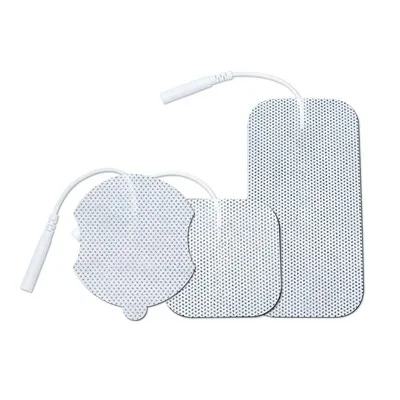
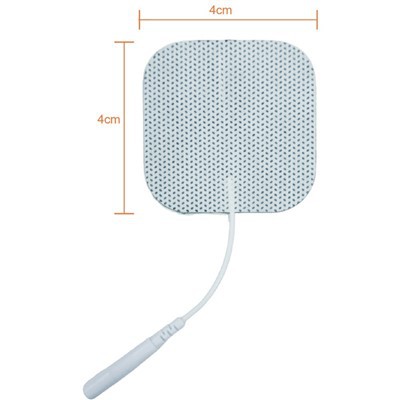
Square 50x50 mm (nominal 2x2 inch) TENS electrodes serve as the dimensional baseline across clinical electrotherapy and OTC neuromuscular stimulation. Providing an active footprint of approximately 25 cm2, this specific square layout is engineered for symmetrical placement across bilateral muscle groups, paraspinal tracks, and medium-sized limb musculature. The pad functions under biphasic pulsed stimulation to activate cutaneous afferents without spilling charge outside targeted anatomical boundaries.
High-throughput clinical turnover and mass distribution reveal three specific mechanical and electrical failure modes inherent to square-format electrodes:
- Apex Stress Concentration at 90-Degree Corners: Conventional converting lines frequently use sharp square dies to simplify scrap stripping. When placed on flexing anatomical planes under tight clothing, mechanical shear stress concentrates at the pointed 90-degree tips. Friction from moving fabric snags these corners, peeling the backing away and collapsing the active contact area from 25 cm2 down to under 12 cm2, causing severe edge lifting.
- Hydrogel Cold-Flow Ooze During Multi-Lane Rotary Converting: Mass manufacturing of 50x50 mm pads utilizes 6- to 8-cavity rotary tooling operating at line speeds above 30 meters per minute. Compressive shear forces during blade strikes squeeze soft hydrogels laterally. Uncontrolled cold flow forces viscous gel into the die perimeter, contaminating the release liner borders, causing pads to stick to pouch interiors, and creating gummy edges upon opening.
- Peripheral Field Fringing and Edge Stinging Across Quadrant Borders: In square geometry, electric field lines naturally crowd along the straight peripheral boundaries and right-angle edges. If the conductive carbon layer lacks uniform bulk volume resistivity, charge dumps preferentially along the outer perimeter rather than spreading across the central 25 cm2 plane. Local current density along the edges climbs past 2.0 mA/cm2, causing stinging sensations before the central target muscle receives adequate stimulation.
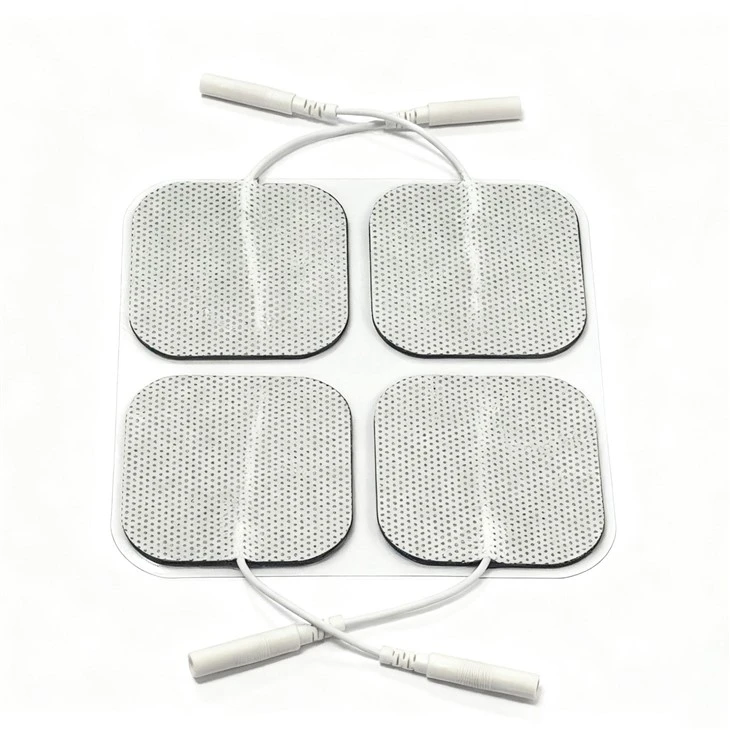
This square 50x50 mm platform incorporates CNC-machined rotary tooling that imparts a continuous 3.5 mm radius arc to all four corners, eliminating sharp tips to stop friction snagging. The conductive substrate uses a high-dispersion carbon polyethylene film held to an isotropic surface resistivity of 30 to 45 Ohm/sq, distributing current uniformly across the entire 24.8 cm2 contact area. The contact hydrogel utilizes an elevated crosslink density formulated to halt lateral cold flow during 30 m/min converting strikes while maintaining 3.8N to 5.2N/25mm peel tack. We manufacture this standard 2x2 inch footprint in spunlace cloth, tan tricot, and foam carriers for medical device OEMs, clinical distributors, and healthcare brands.
Technical & Engineering Description
The industrial manufacturing of square 50x50 mm TENS electrodes operates in ISO 13485-certified Class 8 cleanrooms utilizing multi-cavity rotary die-cutting machinery. The cross-section comprises five functional layers:
- Outer Flexible Carrier: A 60 to 65 g/m2 spunlace non-woven fabric manufactured from a 70:30 polyester and viscose blend (or a 1.0 mm closed-cell polyethylene foam for waterproof applications). The hydro-entangled fiber structure yields balanced tensile elongation (25% in the machine direction, 45% in the cross direction), flexing naturally over joint curves without transmitting peeling stress to the adhesive layer.
- Medical Bonding Adhesive: A crosslinked medical-grade pure acrylic pressure-sensitive adhesive applied at a coat weight of 35 to 45 g/m2, joining the spunlace cloth to the conductive film without bleeding through fabric pores.
- Isotropic Conductive Carbon Conductor: A 45 um low-density polyethylene carrier loaded with conductive furnace carbon black. The film delivers surface sheet resistance between 30 and 45 Ohm/sq across the entire 50x50 mm area, dispersing incoming current from the center out to the margins.
- Leadwire Anchor Assembly: Flexible 26 AWG multi-strand copper wire encased in flame-retardant PVC insulation. The stripped copper core is splayed into a fan pattern and anchored to the conductive carbon film via conductive pressure-sensitive adhesive transfer tape. A reinforced polyester patch is laminated directly over the copper junction, clamping the wire termination against axial shear loads. The distal end terminates in an injection-molded 2.0 mm female safety socket compatible with standard stimulator pin leads.
- Conductive Solid Hydrogel: A slot-die coated, ultraviolet-polymerized crosslinked polyacrylate solid hydrogel (thickness 0.85 mm to 1.00 mm). Compounded with pharmaceutical-grade glycerol, purified water, and sodium chloride electrolyte salts, the hydrogel maintains an equilibrium water activity that suppresses evaporation during ambient storage while delivering volume resistivity below 20 Ohm-cm.
Converting operates on an 8-lane rotary die press equipped with vacuum waste matrix stripping. Tooling clearances between the anvil roller and the tungsten-carbide cutting edge are held within 2.0 um to shear the elastic hydrogel cleanly without edge fraying. Finished electrodes are collated in sets of four onto siliconized release liners, sealed into nitrogen-flushed multi-layer PET/AL/PE barrier pouches with reclosable zip-lock tops, and inspected via inline optical cameras. The minimum contract manufacturing order is 10,000 pouches (40,000 individual electrode pads).
Key Features
-
Continuous 3.5 mm Radius Die-Cut Geometry (Eliminating Acute Apex Stress Concentrations and Garment-Induced Rolling)
Standard 50x50 mm square electrodes die-cut with sharp 90-degree corners experience premature detachment when worn under daily clothing. The sharp apex acts as a geometric focal point: lateral drag from fabric moving across the skin applies a concentrated peeling moment to a contact zone measuring less than 1 square millimeter. Once the corner lifts, the loose fabric tab catches further movement, rapidly peeling the backing away from the skin. We eliminate this mechanical weak point by stamping our 50x50 mm pads with continuous 3.5 mm radius rounded corners using hardened tungsten-carbide rotary dies. The smooth curvature distributes external frictional forces tangentially along the perimeter rather than focusing stress onto a point. In standardized rubbing tests, this rounded perimeter profile withstands more than 200 cycles of dynamic fabric friction without corner lifting, preserving the full 24.8 cm2 active footprint throughout patient ambulation.
-
Shear-Resistant Hydrogel Network for Multi-Cavity Tooling (Halting Perimeter Cold Flow and Pouch Blocking at 30 m/min Speeds)
In high-volume automated converting, 50x50 mm electrodes are processed on 6- or 8-cavity rotary lines running at web speeds above 30 meters per minute. Standard soft hydrogels exhibit viscoelastic cold flow under rapid die strikes: as the blade penetrates the multi-layer web, mechanical compression displaces the uncrosslinked fluid phase laterally into the cut channels. This displaced hydrogel oozes past the carrier border, pooling on the release liner and sticking to the inside of the foil pouch during storage. We prevent cold flow by modifying the UV photopolymerization process, raising the multi-functional PEGDA crosslinker ratio to lift the gel's resting elastic shear modulus. The crosslinked network withstands the millisecond impact of the die blade without lateral displacement. Cutting margins remain dry, crisp, and dimensionally stable, eliminating edge ooze, preventing packaging adhesion, and ensuring clean, tack-free handling upon opening.
-
25 cm2 Planar Boundary Impedance Management (Even Charge Dispersion Across Paraspinal Muscle Placement Sites)
When 50x50 mm electrodes are deployed symmetrically along the bilateral erector spinae or upper trapezius, the flat square edges run parallel to longitudinal muscle fibers. If the underlying carbon film has irregular surface resistance, pulse current concentrates along the straight boundary facing the opposing electrode, creating an edge-fringing effect. This peripheral current bottleneck spikes local current density above 2.0 mA/cm2, causing cutaneous stinging before the target muscle contracture threshold is reached. Our platform resolves this by using an extruded carbon-loaded polyethylene layer held to a tightly controlled surface sheet resistance of 30 to 45 Ohm/sq across the entire 25 cm2 face. The film provides controlled lateral planar impedance that balances current flow between the center and the margins. Charge enters the hydrogel as a uniform planar sheet, suppressing peripheral fringing and allowing clinical users to increase stimulation amplitude without border burning sensations.
Applications
DME / HME Medicare Part B Prescription Resupply (HCPCS E0720 / E0730)
The standard 50x50 mm square format qualifying under Medicare Part B billing codes for two-lead (E0720) and four-lead (E0730) electrotherapy devices; supplied in monthly 4-pad sealed foil packs to chronic pain patients managing lower back pain, cervical spondylosis, and osteoarthritis.
Hospital Outpatient Rehabilitation & Physical Therapy Suites
Standard consumable deployed across clinical electrotherapy workstations during TENS, EMS, and interferential treatments for joint mobilization, soft tissue pain modulation, and muscle re-education.
Consumer OTC Handheld TENS/EMS Device Bundling
Packaged as standard in-box starter sets and retail replenishment packs for portable digital stimulators sold through pharmacy retail networks and cross-border e-commerce channels.
OEM & Private Label
-
Backing Options, Packaging Formats & Turnkey Branding : We supply standard 50x50 mm configurations tailored to client specifications:
· Backing Materials: Standard white spunlace non-woven cloth (breathable, flexible); tan tricot cloth (wear-resistant, skin-toned for discreet wear); or 1.0 mm closed-cell white PE foam (fluid-impermeable for hydrotherapy environments).
· Leadwire Customization: Standard 10 cm to 15 cm pigtail wires with molded 2.0 mm female safety sockets (white, black, or translucent PVC/TPE); custom wire lengths available; optional 3.5 mm or 4.0 mm snap stud terminals.
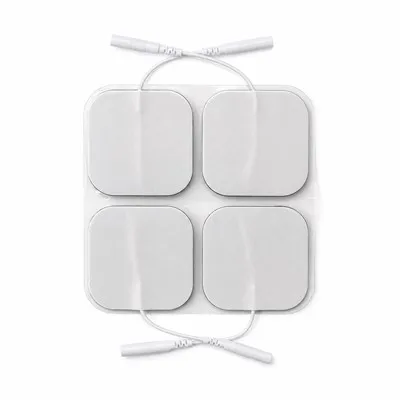
· Packaging Formats: Packed 4 pads per multi-layer PET/AL/PE barrier foil pouch with zip-lock resealable tops; 40-pad clinic bulk bags; pouches support full-color gravure printing, client logos, and serialized UDI barcodes.
-
Two-Center Supply Chain Mechanics : High-volume raw hydrogel chemical synthesis, conductive carbon PE film continuous extrusion, spunlace fabric adhesive coating, and primary automated leadwire staking execute natively inside our primary China facility. High-speed multi-station rotary die-cutting, optical camera inspection, foil pouch hermetic sealing, final cleanroom cartoning, and container palletization route through our Vietnam hub, shielding international B2B buyers from regional medical consumable tariffs and Section 301 duties.
Certifications
-
Electrical Safety & ANSI/AAMI Verification : Product lines satisfy FDA 21 CFR 882.1320 requirements for cutaneous electrodes and IEC 60601-1 Type BF electrical safety standards. Routine lot sampling confirms 2.0 mm socket insertion/retention force remains between 5N and 15N after 50 connection cycles, and leadwire pull resistance consistently exceeds 40N.
-
ISO 10993 Dermal Biocompatibility Rigor : Master production lots undergo testing in accredited independent testing laboratories confirming strict compliance with ISO 10993-5 (In Vitro Cytotoxicity Grade 0/1), ISO 10993-10 (Skin Sensitization: 0% allergic response), and ISO 10993-23 (Primary Dermal Irritation Index = 0.0). The pads are certified 100% natural rubber latex-free, non-cytotoxic, and non-irritating over multi-day repeated application protocols.
-
MDSAP & ISO 13485 Manufacturing System Controls : Continuous coating lines, rotary die-cutting bays, and pouch packaging operations run strictly under certified ISO 13485:2016 and MDSAP regulatory frameworks (covering US FDA 21 CFR 820, Health Canada, TGA Australia). Unbroken electronic Device History Records (DHR) capture raw non-woven tensile values, carbon film surface resistivity, hydrogel coat weights, and leadwire tensile pull-force data for full lot traceability.
Technical FAQ
Q: Why does changing from a 90-degree right angle to a 3.5 mm radius corner reduce friction-induced peeling on moving anatomical surfaces?
A: When an electrode is adhered to skin beneath clothing, the sliding contact of fabric across the backing generates mechanical shear friction. In a pad with 90-degree right-angle corners, the sharp point acts as a mechanical stress concentrator: the contact area of the corner tip is microscopic, meaning even minor lateral drag from clothing generates a high peeling moment per unit area. Once the apex of the corner lifts, the lifted fabric flap catches additional friction, propagating delamination inward along the perimeter.Stamping the pad with a 3.5 mm radius curve eliminates the pointed stress concentration point. When clothing drags across the pad, the friction force encounters a tangential arc rather than a sharp corner. The shear load distributes smoothly along the perimeter curve rather than focusing on a single point. Mechanical peel testing demonstrates that rounding the corners increases the threshold force required to initiate edge lifting by over 60% compared to sharp-cornered square pads, keeping the perimeter flush against skin during daily patient movement.
Q: How does multi-cavity high-speed rotary die slitting control hydrogel edge ooze during 30 m/min continuous web converting?
- A: In high-speed manufacturing of 50x50 mm pads across 8-lane webs running at 30 m/min, rotary die blades must shear through multi-layer laminates comprising fibrous spunlace cloth, dense carbon PE film, and soft elastomeric hydrogel. Solid hydrogels exhibit viscoelastic flow under mechanical compression: when a dull die blade or excessive cutting pressure pinches the material against the anvil roll, the compressive stress forces the gel to flow laterally away from the cutting line. This squeezed hydrogel oozes out along the perimeter cuts, contaminating the release liner and causing packaged pads to stick inside foil pouches. We control edge ooze through three tooling and process parameters:1.Tooling Geometry and Clearance: The rotary die cylinders are machined from solid tungsten carbide with razor-honed cutting angles (typically 42 degrees). Blade-to-anvil clearances are held within 2.0 um, ensuring a sharp, clean shear cut through the hydrogel without compressive crushing. 2.Web Tension Stabilization: Continuous web tension across the 8-lane converting line is maintained by servo-driven dancer rollers within a tight tension window, keeping web elongation below 1.0%. This prevents tensile stretching of the hydrogel prior to die engagement, which would otherwise cause elastic springback and edge bead formation after cutting. 3.Crosslink Density Calibration: The UV-cured hydrogel is formulated with a higher ratio of multi-functional covalent crosslinkers, lifting its resting elastic shear modulus. The firmer gel matrix resists lateral cold flow during the millisecond shear duration of the rotary die strike, producing clean, dry edges that do not bleed or stick during downstream pouch packaging.
Electrotherapy device manufacturers, DME consumable distributors, and private-label retail brands can request official Certificates of Analysis (COA), tensile pull-test logs, ISO 10993 biocompatibility testing dossiers, and unbranded 4-pad evaluation foil pouches (50x50 mm square).
👉 [Request Square 50x50 mm TENS Electrode Evaluation Packs]
Hot Tags: square 50x50 mm tens electrodes, China square 50x50 mm tens electrodes manufacturers, suppliers, factory
Specifications
| Analytical Parameter | Engineering Baseline | Testing Standard |
| Nominal Dimensions | 50 mm x 50 mm (+/- 0.5 mm) | Standard 2x2 in |
| Corner Geometry | Continuous 3.5 mm Radius Die-Cut Corners | Eliminates 90-deg angles |
| Active Contact Area | Approx. 24.8 cm2 (Accounting for radius corners) | Full-face conduction |
| Backing Substrate | 60 to 65 g/m2 Spunlace Non-Woven Cloth (White/Tan) | Breathable matrix |
| Leadwire Terminal | 2.0 mm Female Recessed Socket (Molded PVC/TPE) | IEC 60601-1 |
| Wire Pull-Out Force | Axial Pull Force > 40N (Typical: 45N to 60N) | Tensile test fixture |
| Conductive Substrate | Carbon-Loaded Polyethylene Film (Thickness: 45 um) | Isotropic |
| Surface Sheet Resistance | 30 to 45 Ohm/sq across entire 25 cm2 area | Four-point probe |
| Conductive Hydrogel | Crosslinked Polyacrylate Solid Hydrogel (0.85 mm) | UV-polymerized |
| Volume Resistivity | < 20.0 Ohm-cm at 1 kHz (Typical: 10 to 14 Ohm-cm) | Four-electrode cell |
| 90-Degree Peel Adhesion | 3.8N to 5.2N / 25 mm on Polished Stainless Steel | ASTM D3330 |
| Reapplication Cycles | 30 to 50 Applications on clean, dry skin | Clinical protocol |
| Release Liner | 75 um Transparent PET with 10x10 mm Alignment Grid | Easy-peel silicone |
| Packaging Configurations | 4 pcs per Zip-Lock PET/AL/PE Foil Bag; 36-Month Shelf Life | Multi-layer barrier |