

OEM Snap-On TENS Electrodes | 3.5mm Wire Interface | TOP-RANK
B2B snap-on electrodes for wired TENS/EMS pulse generators. Engineered with 3.5mm brass rivets, Tyvek strain relief, and dielectric masking to prevent wire tear-out and focal current leakage.
Product Overview
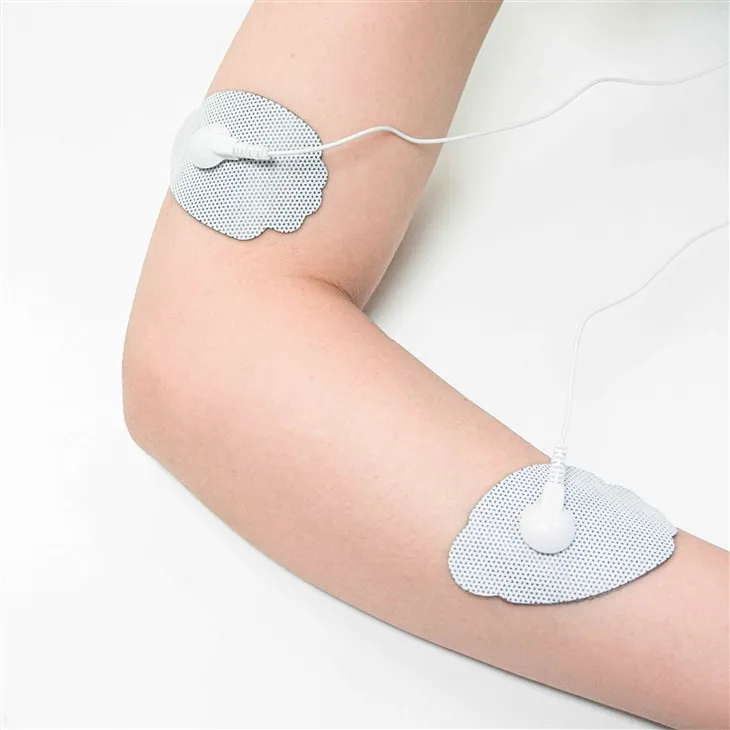
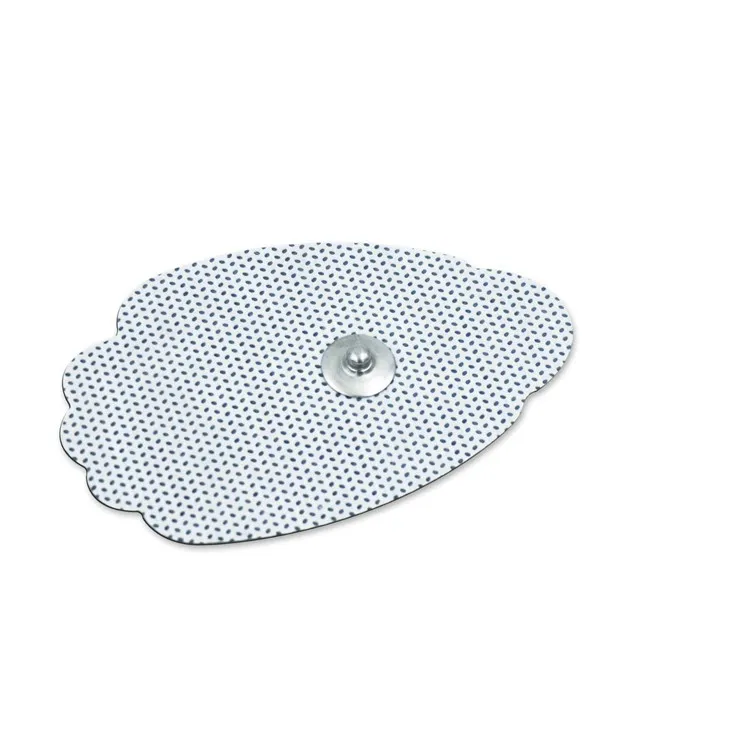
These snap-on electrodes function as the mechanical and electrical interface between the human epidermis and lead wires equipped with female snap receptacles. Featuring a stamped metal rivet (typically 3.5mm or 3.9mm), this substrate allows clinicians and patients to quickly connect and disconnect cables without disturbing the hydrogel adhesion on the skin. The structural performance of this consumable relies on balancing the extraction force of the metal snap against the cohesive strength of the underlying hydrogel matrix. We supply these standardized interfaces to clinical distributors and rehabilitation hardware OEMs.
Key Features
-
Dielectric Rivet Masking
Metal possesses near-zero electrical resistance compared to the surrounding printed carbon film. If the base of the metal rivet remains directly exposed to the hydrogel layer, the electrical current from the lead wire spikes vertically down the metal shaft, bypassing the carbon dispersion layer. This physical short-circuit produces a severe point-burn on the patient's skin. The lamination line applies an aggressive non-conductive masking patch directly over the inner rivet head. This forces the electrons to travel laterally across the carbon trace before penetrating the hydrogel, maintaining a uniform current density across the entire geometric footprint.
-
Extraction Strain Distribution
Patients and clinicians frequently detach the lead wire by pulling the cord directly, rather than prying the snap base. This concentrated pulling force exerts extreme vertical shear on the substrate. Without reinforcement, the metal rivet tears straight through the soft spunlace backing, destroying the electrode. The insertion of a localized Tyvek reinforcement layer during lamination distributes this kinetic extraction energy outward across the backing, preventing the hardware from rupturing the polymer and non-woven fibers.
-
Hydrogel Cohesion vs. Snap Tolerance
The mechanical fit between the pad's male rivet and the lead wire's female receptacle is a strict tolerance variable. If the snap engagement is too tight, unplugging the wire requires a force that exceeds the adhesion of the gel. This causes the entire pad to peel off the patient's skin during disconnection. The stamping dies calibrate the rivet's outer diameter to maintain a detachment force that is marginally lower than the 3.0N physical grip of the hydrogel layer.
Applications
Clinical Physiotherapy
Rapid connection and disconnection of lead wires across multiple patients without replacing the pad mid-session.
Dynamic EMS Training
Maintains circuit integrity while heavy lead wires shift and swing during active physical movement.
Diagnostic Monitoring
Hardware compatible with standard snap-style ECG and Holter monitor pinch clips.
OEM & Private Label
-
Rivet Specification : We provide both 3.5mm standard and 3.9mm/4.0mm specific rivet profiles to match the exact engagement tolerances of proprietary OEM lead wires.
-
Logistics Routing : Base conductive lamination and rivet stamping run on our China lines. Final dimensional cutting, QA sorting, and moisture-barrier pouch sealing operate through our Vietnam hub to manage supply chain resilience and optimize global freight variables.
Certifications
-
Systems : Metal stamping and continuous lamination lines operate strictly within audited ISO 13485:2016 frameworks.
-
Biocompatibility : Polymeric hydrogel matrices are documented against ISO 10993-5 (Cytotoxicity) limits.
FAQ
Q: Why do patients sometimes feel a sharp biting sting exactly under the metal snap?
A: This indicates a critical failure in the dielectric masking phase. If the non-conductive insulation patch shifts during high-speed lamination or is omitted, the electrical pulse bypasses the carbon resistance layer and strikes the epidermis directly through the metal rivet, causing a localized point-burn.
Q: Can we make the metal snap significantly tighter so the lead wire never falls off during running?
A: Modifying the tooling to increase the engagement friction is possible, but it disrupts the detachment hierarchy. If the wire extraction force exceeds the peel strength of the hydrogel, pulling the wire will rip the pad entirely off the patient's skin rather than safely disconnecting the circuit.
CTA
B2B procurement teams can request rivet tolerance specifications and Tyvek tear-resistance samples.
👉 [Request Snap-On Pad Prototypes]
Hot Tags: snap-on tens electrodes, China snap-on tens electrodes manufacturers, suppliers, factory, Neck Relax Electrode Pads, Electrotherapy Replacement Pads, Electrical Stimulation Pads, electronic pulse pads, Replacement Gel Pads for TENS Machine, adhesive electrode pads
Specifications
| Parameter | Metric Configuration | Engineering Detail |
| Connector | 3.5mm / 3.9mm Brass Snap | Tolerates repeated wire extraction |
| Pull Force | > 30N | Tyvek layer reinforced |
| Impedance | < 50 Ohms | Lateral current dispersion |
| Hydrogel | High-Cohesion Matrix | Resists detachment during un-snapping |
| Backing | Spunlace Non-Woven | Multi-directional anatomical contouring |


