


When discussing electrode pad performance, conductivity is often mentioned as a single specification.
But an electrode pad is not simply a piece of conductive material.
It is a multi-layer system in which different components perform different functions.
One of the most important internal components is the conductive layer.
The conductive layer forms part of the electrical pathway between the device connector and the conductive hydrogel. Its design can influence how electrical energy is transferred across the electrode surface.
Understanding this layer is particularly important for OEM and ODM buyers developing TENS, EMS, NMES, FES, and other electrical stimulation products.
Quick Answer
The conductive layer is the part of an electrode pad that helps carry electrical energy from the connector across the electrode structure toward the conductive hydrogel.
Its role is to provide an appropriate electrical pathway while working together with:
Connector → Conductive Layer → Hydrogel → Skin
The conductive layer may be designed using different materials and manufacturing methods depending on the electrode pad's application, size, shape, electrical requirements, and production process.
For OEM buyers, the conductive layer should therefore be evaluated as part of the complete electrode construction, rather than as an isolated conductivity specification.
1. What Is a Release Liner?
A typical electrode pad may contain several functional layers.
The exact construction varies by product, but a simplified structure can look like:
Backing Material
↓
Conductive Layer
↓
Conductive Hydrogel
↓
Skin
The connector provides the electrical interface with the stimulation device.
The conductive layer then distributes electrical energy across the electrode structure before it reaches the hydrogel and skin.
The release liner, discussed in our previous article, protects the hydrogel surface before use.
This means each layer has a different role.
2. The Conductive Layer Creates an Electrical Pathway
The most fundamental function of the conductive layer is to provide a pathway for electrical current.
The basic system can be understood as:
Stimulation Device → Connector → Conductive Layer → Hydrogel → Skin
The conductive layer needs to work together with the other components rather than being evaluated independently.
For example, a highly conductive material does not automatically guarantee excellent electrode performance if the connection between layers is inconsistent or the hydrogel interface is poorly designed.
This is why electrode engineering is a system-level problem.

3. Conductive Layer vs Conductive Hydrogel
These two components are sometimes confused because both participate in electrical conduction.
However, they serve different functions.
Conductive layer
Primarily provides an electrical pathway within the electrode structure.
Conductive hydrogel
Provides the interface between the electrode and the user's skin while also supporting electrical transmission.
In simplified terms:
Conductive layer = internal electrical pathway
Conductive hydrogel = skin-facing electrical interface
They need to work together.
A change to one component may therefore require evaluation of the complete electrode system.
4. What Materials Can Be Used?
Different electrode pad designs can use different conductive materials and construction methods.
Depending on the product architecture, conductive layers may involve:
- Printed conductive materials
- Conductive coatings
- Metal-based conductive structures
- Conductive films
- Other engineered conductive materials
The appropriate option depends on factors such as:
- Electrode size
- Required electrical performance
- Flexibility
- Manufacturing method
- Intended application
- Cost requirements
- Product design
There is therefore no single conductive layer material that is ideal for every electrode pad.
5. Printed Conductive Layers
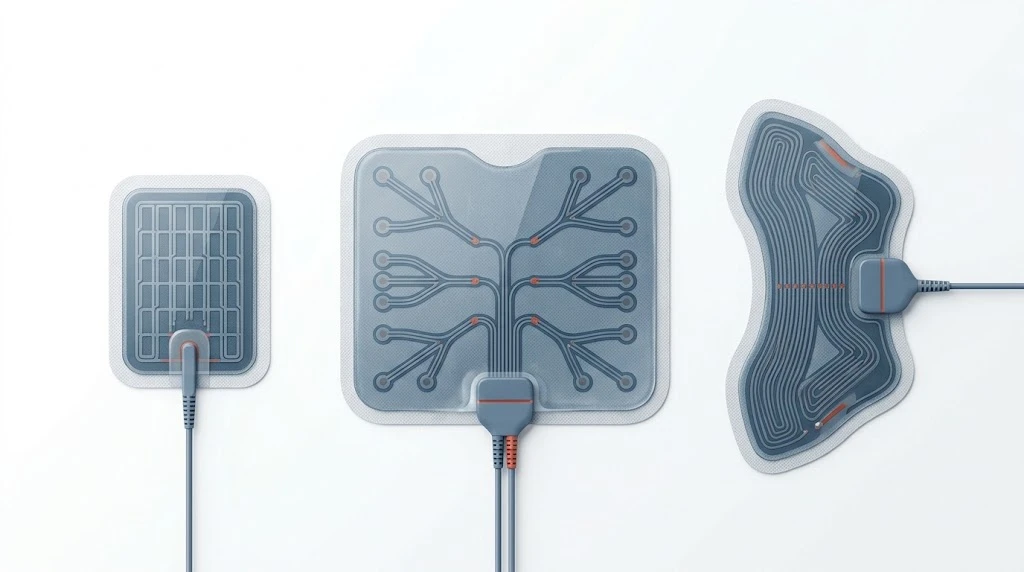
For flexible electrode pads, conductive printing can be used to create the electrical layer on a flexible substrate.
This approach can provide design flexibility because the conductive pattern can be engineered according to the electrode geometry.
Depending on the manufacturing process, the conductive pattern may be designed to:
- Cover a defined area
- Connect to a specific connector location
- Accommodate different electrode shapes
- Support flexible product construction
For OEM projects, this can be useful when the electrode requires a customized geometry rather than a simple standard configuration.

6. Conductive Pattern Design Can Matter
The conductive layer does not always need to be a completely uniform sheet.
Its pattern and geometry can be engineered according to the product design.
Factors may include:
- Electrode dimensions
- Connector position
- Active area
- Flexible areas
- Material thickness
- Manufacturing tolerances
The goal is to create a suitable electrical pathway while maintaining the mechanical characteristics required by the electrode.
This is especially relevant for customized OEM electrode pads.
7. The Connector-to-Conductive-Layer Connection Is Critical
The conductive layer cannot perform its function if the electrical connection between the connector and the conductive structure is unreliable.
This interface needs to maintain appropriate contact during:
- Manufacturing
- Storage
- Handling
- Application
- Normal product use
The connector itself may be perfectly designed, but the complete electrical pathway still depends on how the connector is integrated with the conductive layer.
This is why connector design and conductive-layer design should be evaluated together during product development.
8. Conductive Layer Uniformity Matters
A conductive layer should provide a consistent electrical pathway across the intended electrode area.
Manufacturing variation can potentially result from:
- Material variation
- Printing thickness
- Pattern accuracy
- Surface defects
- Process variation
- Registration errors
For high-volume OEM manufacturing, process control is therefore important.
The objective is not simply to make one electrode that works.
It is to make large numbers of electrodes that behave consistently within the defined product requirements.

9. Flexibility Is Also Important
An electrode pad needs to conform to the body during use.
That means the conductive structure may need to accommodate bending and movement without compromising the overall electrode construction.
The conductive layer therefore needs to be considered alongside:
- Backing material
- Hydrogel
- Connector
- Electrode geometry
A conductive structure that performs well electrically but does not suit the mechanical design may not be appropriate for the final product.
For flexible medical electrodes, electrical and mechanical design cannot always be separated.
10. Conductive Layer Design Depends on the Application
Different electrical stimulation applications may have different electrode requirements.
Examples include:
TENS
Often designed for transcutaneous nerve stimulation applications.
EMS / NMES
May require electrode configurations appropriate for muscle stimulation.
FES
May involve specific electrode geometries and placement requirements depending on the application.
Other electrical stimulation systems
May have their own electrical and mechanical interface requirements.
The conductive layer should therefore be developed according to the complete application rather than selected as a generic component.
11. How Is the Conductive Layer Evaluated?
The conductive layer can be evaluated as part of the overall electrode construction.
Depending on the product requirements, evaluation may include:
- Electrical continuity
- Resistance or impedance-related measurements
- Pattern accuracy
- Dimensional inspection
- Visual inspection
- Connection integrity
- Mechanical integrity
The specific test methods and acceptance criteria should be established according to the product design and applicable requirements.
Importantly, testing the conductive layer alone does not replace evaluation of the complete electrode pad.
The final product needs to perform as an integrated system.
12. What Should OEM Buyers Ask About the Conductive Layer?
When developing a customized electrode pad, OEM buyers can ask manufacturers about:
Material
What conductive material or construction is used?
Construction
How is the conductive layer integrated into the electrode?
Pattern
Is the conductive pattern customized for the electrode geometry?
Connection
How is the conductive layer connected to the connector?
Flexibility
How does the conductive structure perform when the electrode bends?
Quality control
How is conductive-layer consistency controlled during mass production?
Customization
Can the conductive structure be modified for a specific device or application?
These questions can help buyers understand what is actually inside the electrode pad rather than evaluating the product only from its external appearance.
Common Mistakes
Looking only at the conductivity number
A single conductivity-related specification does not describe the entire electrode construction.
Assuming the hydrogel is the only conductive component
The conductive layer and hydrogel perform different functions within the electrical pathway.
Ignoring the connector interface
The electrical pathway depends on reliable integration between the connector and conductive structure.
Treating electrical and mechanical design separately
Flexible electrodes need a conductive structure that works with the overall mechanical construction.
Evaluating only the prototype
The conductive layer also needs to remain consistent throughout mass production.
Frequently Asked Questions
What does the conductive layer do in an electrode pad?
Is the conductive layer the same as the hydrogel?
What materials are used for conductive layers?
Does the conductive layer affect current distribution?