OEM Neonatal Pre-Wired Electrodes | Pre-Attached Leadwire Pads | TOP-RANK
Wholesale neonatal pre-wired ECG electrodes for NICU incubators. Engineered with ultra-flexible stranded leadwires, sub-1.5N peel hydrogels, and zero-profile molded junctions to eliminate pressure necrosis.
Clinical & Physical Profile
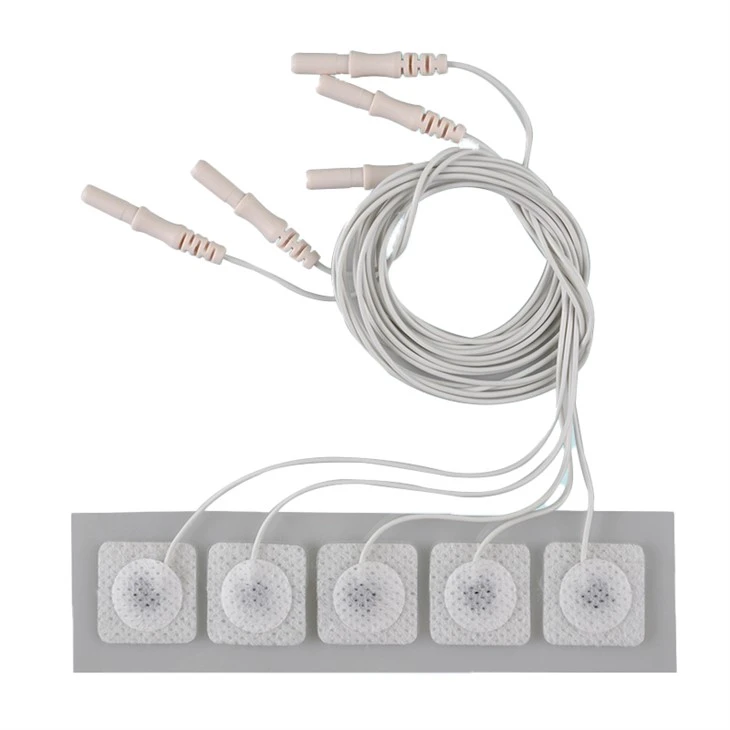
These neonatal pre-wired electrodes operate as specialized, single-use bio-potential sensor interfaces engineered explicitly for neonatal intensive care units (NICU), special care baby units (SCBU), and infant transport incubators. Monitoring vital cardiac and respiratory signals (0.5mV to 3mV) in very low birth weight (VLBW) and extremely low birth weight (ELBW) premature infants presents critical safety hurdles: rigid metal snap studs create severe localized point-pressure when an infant lies supine or prone, causing ischemic tissue breakdown and skin pressure necrosis within hours. Furthermore, cable weight and repetitive snap-coupling transmit mechanical shear directly to immature epidermal layers (<10μm stratum corneum). This pre-wired electrode eliminates the metal snap stud entirely, integrating factory-attached, multi-strand flexible leadwires terminating in safety DIN 42802 touchproof sockets. The zero-profile sensor core is embedded in an ultra-low peel hydrogel or hydrocolloid matrix (<1.5N/25mm) that preserves skin integrity under high-humidity incubator conditions (>80% RH). We manufacture these sterile-ready pre-wired sets for neonatal monitoring hardware OEMs, NICU packagers, and pediatric medical supply chains globally.
Manufacturing Kinetics & Leadwire Overmolding
The industrial fabrication of neonatal pre-wired electrodes combines continuous precision web printing, ultra-flexible multi-strand wire stripping, micro-resistance resistance/soldering welding, and low-pressure encapsulation molding inside cleanroom environments. High-flexibility 28-30 AWG silver-plated multi-strand copper or carbon-filament wires are stripped with laser precision. The wire leads are welded directly onto a micro-sputtered Ag/AgCl sensing pad on an optical-grade polyester substrate. The junction is overmolded with a flexible medical TPU strain-relief boot with a profile height under 1.8mm, eliminating sharp edges and rigid pressure points. A hypoallergenic, high-water-content polyacrylamide hydrogel or hydrocolloid matrix is slot-die extruded over the sensing zone. High-speed rotary die-cutters punch out teardrop (22mm × 22mm) or circular footprints. Color-coded 1.5mm DIN touchproof sockets (AAMI/IEC color sequences) are molded onto the terminal wire ends. Completed 3-lead or 4-lead electrode sets are card-mounted and hermetically sealed into zero-MVTR foil pouches inside ISO Class 7 cleanrooms, enforcing an MOQ threshold of 300,000 sets.
Core Engineering Assets
-
Zero-Snap Planar Encapsulation (Elimination of Infant Pressure Necrosis)
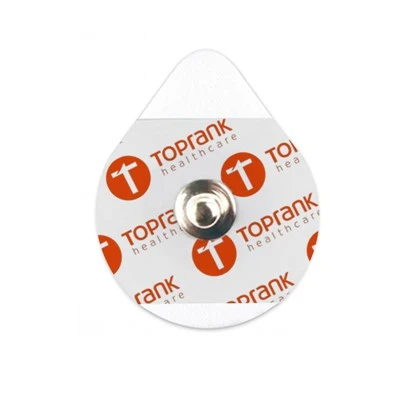
Standard adult and pediatric electrodes utilize a raised metallic snap stud (4 - 6mm vertical height). When a low-birth-weight infant lies on an electrode stud inside an incubator, the baby's body weight creates high focal pressure (>60mmHg), exceeding capillary perfusion pressure and triggering local tissue ischemia, skin blanching, and necrotic ulceration. Our pre-wired design replaces the metal stud with a flat, planar welded joint encapsulated in a soft, low-modulus elastomeric boot with a total profile under 1.8mm. The smooth, flush transition dissipates external mechanical loads across the entire pad area, eliminating focal pressure points and allowing safe supine and prone infant positioning.
-
Ultra-Flexible Stranded Micro-Leadwires (Strain Decoupling & Motion Artifact Defense)
Connecting standard heavy leadwires to neonatal sensors introduces high mechanical tension: stiff cables pull at the electrodes when infants kick or undergo incubator adjustments, pulling sensors off the skin and generating violent baseline voltage spikes. We integrate lightweight, 28-30 AWG stranded leadwires sheathed in a supple medical-grade TPU jacket. The micro-wire exhibits near-zero bending resistance, flexing effortlessly with infant limb movements. The integrated molded joint acts as a mechanical strain-relief, absorbing axial and torsional cable tugs without transmitting peeling shear to the hydrogel-epidermal boundary.
-
High-Humidity Incubator Gel Matrix (Anti-Liquefaction & Gentle 1.0N Dermal Release)
Premature infants in modern incubators require high ambient humidity (70% to 90% RH) to prevent trans-epidermal water loss. Standard hydrogels absorb ambient water vapor, becoming over-hydrated, losing their cohesive network, and liquefying into a sticky residue. Our neonatal hydrogel/hydrocolloid matrix incorporates a covalently balanced polymer lattice formulated with high moisture equilibrium. It maintains structural cohesion (G' > 18,000Pa) across 120 hours of continuous exposure at 37℃ and 85% RH, anchoring without edge lifting yet peeling away with an ultra-gentle force (1.0N–1.5N/25mm) to prevent epidermal stripping.
Clinical & NICU Deployments
NICU & SCBU Continuous Vital Sign Telemetry
Pre-wired 3-lead and 4-lead sets deployed by neonatal nurses for continuous ECG, heart rate, and impedance respiration monitoring in incubator-bound premature infants.
Infant Transport & Emergency Resuscitation
Rapid-application, pre-connected electrode sets utilized in air and ground neonatal transport incubators for immediate diagnostic ECG acquisition without hunting for snap leadwires.
Pediatric Patient Monitor OEM Accessory Kits
Pre-packaged, sterile 3-piece electrode arrays branded for patient monitor manufacturers supplying neonatal accessory bundles with diagnostic hardware.
Precision Packaging & Global Supply Routing
-
Zero-MVTR Barrier Pouching with Leadwire Management : Neonatal pre-wired sets require strict moisture control and anti-tangling containment. Electrodes and their 45cm/60cm leadwires are neatly carded on recyclable PET carriers and heat-sealed into heavy multi-layer AL/PE foil pouches with 8mm hermetic thermal seals, driving Moisture Vapor Transmission Rates (MVTR) near zero to guarantee a 24-month warehouse shelf life.
-
Transnational Logistics Resilience : Ag/AgCl sensor sputtering, hydrogel compounding, and continuous web lamination execute natively inside our primary China facility. Precision micro-welding, junction overmolding, 1.5mm DIN socket assembly, and automated sterile packaging route through our Vietnam hub, protecting global B2B procurement networks from regional medical device trade tariffs.
Regulatory & Quality Safeguards
-
ANSI/AAMI EC12 & ISO 10993 Dermal Safety Clearance : Pre-wired electrode lots undergo continuous batch testing against ANSI/AAMI EC12 electrical performance requirements, as well as ISO 10993-5 (Cytotoxicity Grade 0), ISO 10993-10 (Sensitization), and ISO 10993-23 (Primary Dermal Irritation Index =0.0) boundaries, confirming zero skin allergy, cytotoxicity, or chemical irritation on fragile premature infant epidermis.
-
MDSAP Certified Cleanroom Manufacturing : Micro-welding, overmolding, gel dispensing, and pouching lines operate strictly under ISO 13485:2016 and MDSAP regulatory frameworks, delivering unbroken lot-serialization from raw copper wire to outbound shipping pallets.
Technical FAQ
Q: Why are pre-wired leadwire electrodes mandated in modern NICU protocols over traditional snap-stud electrodes?
A: Traditional snap electrodes feature a raised metal stud (4 - 6mm height). When a low-birth-weight infant lies on the stud, localized focal pressure (>60mmHg) cuts off capillary microcirculation, causing skin pressure necrosis. Furthermore, pushing snap leads onto the stud exerts downward mechanical trauma directly onto fragile infant ribs. Pre-wired electrodes eliminate the metal stud entirely, utilizing a flush, planar molded joint (<1.8mm) that distributes pressure evenly without skin injury.
Q: How does the hydrogel formulation prevent lifting or dissolving inside high-humidity (>80% RH) infant incubators?
A: Standard hydrogels continuously absorb atmospheric moisture, swelling and dissolving into a runny fluid that slides off the patient. Our neonatal matrix utilizes an osmotic equilibrium polymer network with a tight cross-linking density. The gel resists swelling, maintaining structural integrity (G' > 18,000 Pa) and a stable 1.0N–1.5\N/25mm peel adhesion throughout 120 hours of continuous exposure to 37℃ and 85% RH incubator environments.
Neonatal care procurement networks, NICU nurse managers, and patient monitoring OEMs can request ANSI/AAMI EC12 electrical test reports, high-humidity incubator stability logs, and unbranded evaluation sample sets for clinical trial validation.
👉 [Request Neonatal Pre-Wired Electrode Samples]
Hot Tags: neonatal pre-wired electrodes, China neonatal pre-wired electrodes manufacturers, suppliers, factory, Ecg Electrode, Ecg Electrode Stickers, electrode stickers
Technical Specifications
| Analytical Parameter | Target Baseline | Testing Standard |
| Industry Standard | ANSI/AAMI EC12 & IEC 60601-2-27 | Full compliance with neonatal ECG standards |
| Junction Profile Height | < 1.8 mm Total Thickness | Zero-pressure planar profile |
| Peel Adhesion Force | 1.0N - 1.5N / 25mm | MARSI-prevention ultra-low avulsion |
| Leadwire Specifications | 45cm / 60cm Multi-Strand Copper/TPU | Ultra-lightweight, high flex-fatigue life |
| Connector Socket | 1.5mm Safety DIN 42802 Socket | Touchproof color-coded molded terminal |
| Incubator Stability | 120 Hours at 37℃ & 85% RH | Zero gel liquefaction or edge lifting |
| DC Offset Voltage | < 5 mV | Micro-sputtered pure Ag/AgCl sensor |