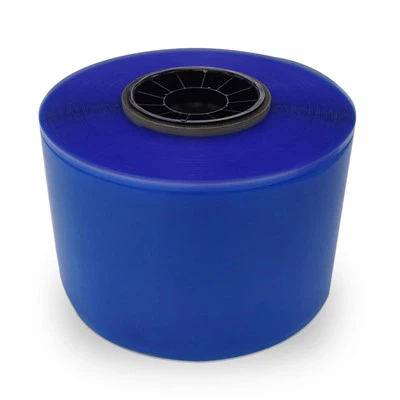

Conductive Hydrogel Master Rolls | TENS/EMS Substrate | TOP-RANK
Bulk conductive hydrogel rolls for medical device converters. Calibrated for high-speed die-cutting with < 0.5mm edge ooze. ISO 13485 compliant.
Product Overview
Hydrogel master rolls are semi-finished raw materials supplied to B2B medical converters. The substrate consists of a continuous web of ionically conductive polymer matrix coated onto a release liner. Converters utilize these rolls in high-speed rotary or flatbed die-cutting processes to manufacture finished TENS, EMS, and diagnostic electrode pads.
Key Features
-
Anti-Oozing Rheology for Rotary Die-Cutting
Low-cohesion gels transfer residue onto cutting blades, requiring frequent machine halts for cleaning. The master roll formulation increases internal cohesive strength relative to surface tack. During vertical blade impact, the gel shears cleanly without polymer stringing, maintaining an edge glue overflow tolerance of < 0.5mm at processing speeds of 30 meters per minute.
-
Web-Width Coating Tolerance Control
Inconsistent gel thickness causes variable impedance across different batches of finished electrodes. We utilize automated slot-die coating heads with closed-loop laser thickness monitors. This maintains a cross-web thickness deviation of less than +/- 0.05mm across a 450mm width, stabilizing the electrical resistance of the final die-cut units.
-
Calibrated Release Liner Tension
If the release force of the PET liner is mismatched with the gel's tack, the web will stretch or delaminate during automated feeding. We specify a double-sided silicone treatment on the 75-micron PET liner. This targets a constant unwind tension, preventing web-breaks and registration errors in multi-layer lamination machines.
Applications
TENS/EMS Consumables
Base substrate for stamping carbon-film or silver-grid stimulator pads.
ECG/EKG Diagnostics
Low-impedance variants integrated into snap-based cardiovascular sensors.
Cosmetic Microcurrent
Substrate for die-cutting facial lifting pads compatible with 1MHz RF outputs.
OEM & Private Label
-
Core Formatting: Supplied on standard 3-inch or 6-inch cardboard/plastic cores to match converter unwinding shafts.
-
Packaging Barrier: Rolls are vacuum-sealed inside thick AL/PE foil bags with desiccant limiters to arrest moisture exchange during ocean freight.
-
Origin Routing : Bulk polymerization occurs in China; bonded warehousing available via our Vietnam hub for material call-offs.
Certifications
Raw Material Compliance: Meets REACH, RoHS, and FDA biocompatibility mandates for intact skin contact.
Facility Audits: ISO 13485:2016 and MDSAP certified.
Lot Traceability: Batch reports log specific gravity, pH, viscosity prior to coating, and final peel force.
FAQ
Q: Why does the hydrogel leave adhesive residue on the rotary die anvil?
A: This indicates a cohesive failure where the internal polymer bonds are weaker than the adhesion to the tooling. It is caused by an under-cured matrix. Our thermal-UV dual curing profile polymerizes the gel past the cohesive failure threshold, forcing a clean release from metal surfaces.
Q: What is the maximum allowable web tension before the gel deforms?
A: The structural integrity relies on the 75-micron PET liner, not the gel. The liner sustains up to 25 N/cm of web tension without elongation, preventing the gel from thinning out in the machine direction (MD) during lamination.
CTA
B2B converters and die-cutting facilities can request master roll samples and lot-specific COA data.
👉 [Request Hydrogel Roll Samples ]
Hot Tags: conductive hydrogel master rolls, China conductive hydrogel master rolls manufacturers, suppliers, factory, Hydrogel, Medical Hydrogel
Specifications
|
MODELS |
SPECIFICATIONS | IMPEDANCE | APPLICATION |
|
MH051 |
T: 0.85±0.1mm, W:230±1mm, L:100m/Roll |
<130Ω |
Stimulating Hydrogel |
|
MH051+/C |
T: 0.85±0.1mm, W:230±1mm, L:100m/Roll |
<130Ω | Stimulating Hydrogel |
|
MH051/CM |
T: 0.85±0.1mm, W:230±1mm, L:100m/Roll |
<130Ω | Stimulating Hydrogel |
|
MH052 |
T: 0.85±0.1mm, W:230±1mm, L:100m/Roll |
<130Ω | Cooling Hydrogel |
|
MH053 |
T: 0.85±0.1mm, W:230±1mm, L:100m/Roll |
<130Ω | Heating Hydrogel |
|
MH055 |
T: 0.85±0.1mm, W:230±1mm, L:100m/Roll |
<130Ω |
Stimulating Hydrogel corrosion-resistant hydrogel |
|
MH056 |
T: 0.85±0.1mm, W:230±1mm, L:100m/Roll |
<130Ω |
Stimulating Hydrogel |
|
MH011 |
T: 0.65±0.1mm, W:180±1mm, L:100m/Roll |
<50Ω High-frequency impedance |
Grounding Hydrogel |
|
MH031 |
T: 0.85±0.1mm, W:230±1mm, L:100m/Roll |
<130Ω |
ECG/EKG electrode |