

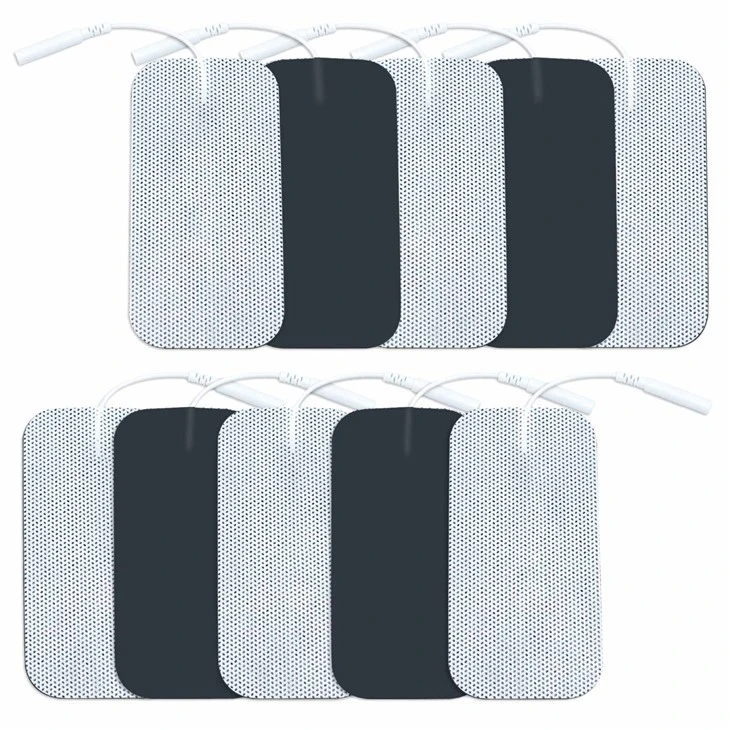
OEM Rectangular TENS Pads | 2x4 Electrodes | TOP-RANK
B2B rectangular TENS electrodes (50x100mm). Engineered with long-axis carbon compensation to prevent current attenuation and focal hotspots during paraspinal and large muscle recruitment.
Product Overview
Rectangular TENS pads, specifically the industry-standard 2x4 inch (50x100mm) format, serve as the primary elongated transdermal interface for clinical electrotherapy. Designed to cover extended muscle bellies like the erector spinae or quadriceps, these pads present unique physical challenges regarding longitudinal current attenuation. We manufacture these specific rectangular substrates in high volumes for B2B physical therapy distributors and orthopedic hardware OEMs, providing a reliable baseline for therapies requiring directional current vectoring.
Technical/Engineering Description
The lamination architecture incorporates a flexible spunlace non-woven or PU backing, a conductive carbon film, and a highly cross-linked polyacrylamide hydrogel. In a 50x100mm geometry, if the wire terminal is placed at one end or in the exact center, electrical resistance naturally increases as the current travels toward the distal edges. To counter this, the carbon ink extrusion is calibrated with a specific resistance gradient along the long axis. The die-cutting process utilizes precision steel-rule rotary anvils to separate the rectangular blanks, maintaining an edge glue overflow tolerance strictly below 0.5mm. Standard bulk B2B operations require an MOQ of 20,000 packs.
Key Features
-
Long-Axis Carbon Compensation
In an elongated electrode, current naturally concentrates around the lead wire insertion point, leaving the distal ends under-stimulated. This longitudinal attenuation causes severe focal burns near the terminal at high mA outputs. Our carbon coating process utilizes a gradient compensation technique. By manipulating the sheet resistance along the 100mm axis, the electrical vector is forced to spread evenly across the entire rectangular surface, ensuring the furthest hydrogel edge delivers the exact same milliampere load as the center.
-
Longitudinal Muscle Belly Alignment
Unlike square pads which offer an isotropic current spread, rectangular pads dictate a directional current flow. When applied parallel to muscle fibers-such as along the sciatic nerve pathway or the rectus femoris-the 100mm length physically aligns the electrical field with the physiological motor units. This specific geometry maximizes the number of depolarized nerve fibers within a single channel output, optimizing motor recruitment efficiency for athletic EMS protocols.
-
Kinetic Strain Dissipation
A 100mm pad applied to the lower back or thigh is subjected to severe mechanical elongation during patient movement. A rigid substrate will buckle, causing the short edges to lift and break the electrical circuit. We integrate a multi-directional stretch spunlace backing with the viscoelastic hydrogel. This combination absorbs the kinetic shear force along the long axis, maintaining complete epidermal contact during dynamic joint flexion without substrate delamination.
Applications
Paraspinal Pain Gating
Parallel placement along the lumbar spine for targeted sciatic nerve root stimulation without crossing the unyielding vertebrae.
Quadriceps/Hamstring Recruitment
Elongated coverage for intense EMS motor unit activation during post-operative joint rehab or athletic conditioning.
Carpal/Cubital Tunnel Protocols
Longitudinal wrapping along the forearm flexors and extensors for deep tissue neuromodulation.
OEM & Private Label
-
Multi-Cavity Zero-Gap Nesting : Rectangular formats are highly optimized for web processing yield. We utilize zero-gap nesting on our rotary dies to minimize hydrogel matrix waste. This drastically reduces the per-unit cost for million-unit wholesale B2B orders compared to complex butterfly or oval geometries.
-
Logistics Routing : Base web lamination and high-speed carbon printing execute in China. Final dimensional die-cutting, terminal integration, and heavy-gauge AL/PE barrier pouching route through our Vietnam hub to optimize supply chain resilience and absorb global medical consumable tariffs.
Certifications
-
Biocompatibility Endpoints : Skin-contact matrix layers are continuously audited against ISO 10993-5 (Cytotoxicity) and ISO 10993-10 (Sensitization) limits.
-
Quality Systems : High-speed lamination and cleanroom packaging operate firmly under audited ISO 13485:2016 and MDSAP regulatory frameworks.
FAQ
Q: Can the lead wire terminal be placed at the very edge of the 100mm pad instead of the center?
A: Yes, offset terminal placement is common for rectangular pads to manage wire routing. However, extreme offset placement requires even stricter carbon compensation (a thicker conductive trace at the distal end) to prevent the electrical current from decaying before it reaches the opposite side of the 100mm pad.
Q: Will the long 100mm edges roll up under patient clothing?
A: Not if the correct backing is selected. While standard thick PET backings will curl and catch on denim, our low-profile PU film and multi-directional stretch spunlace options conform seamlessly to the skin's curvature. This negates the mechanical leverage caused by clothing friction.
B2B physical therapy distributors and hardware OEMs can request rectangular die-cut prototypes and long-axis impedance mapping reports.
👉 [Request 2x4 Pad Prototypes]
Hot Tags: rectangular tens pads, China rectangular tens pads manufacturers, suppliers, factory, Back Massager Electrodes, Back Stimulation Pads, large TENS pads, Replacement Gel Pads for TENS Machine, stimulation pads, TENS machine pads
Specifications
| Parameter | Metric Configuration | Engineering Detail |
| Dimensions | 50x100mm, 50x90mm | Elongated anatomical coverage |
| Impedance | < 50 Ohms (at distal edge) | Measured at furthest point from terminal |
| Peel Force | 3.0N - 4.5N | Resists longitudinal shear |
| Edge Profile | Micro-Radius (R5 - R8) | Prevents mechanical snagging |
| Interface | 2.0mm Pin / 3.5mm Snap | Centered or offset tooling |


