OEM Butterfly Lumbar TENS Electrodes | Lower Back Pads | TOP-RANK
B2B contract manufacturing of contoured butterfly lumbar TENS/EMS electrode pads. Features central spinous-notch tenting prevention, dual-channel paraspinal current balancing, high-shear hydrogel (<16 Ohm-cm), and dual China-Vietnam supply chain routing.
Product Overview
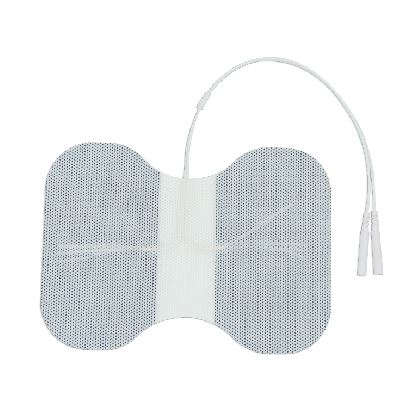
Butterfly lumbar TENS electrodes serve as large-format, anatomically profiled biopotential transfer interfaces designed specifically for transcutaneous electrical nerve stimulation (TENS) and neuromuscular stimulation (EMS) across the lumbar-sacral junction (L1 through S1). Standardized in spans from 150x95 mm up to 200x110 mm, these contoured pads bridge both left and right erector spinae muscle tracts simultaneously. Operating across a 1 Hz to 120 Hz bandwidth at pulse amplitudes up to 80 mA, the dual-wing layout delivers therapeutic charge across multiple lumbar nerve roots and broad sensory dermatomes to inhibit nociceptive pain signaling and relieve chronic lumbar muscle spasm.
Applying conventional square or rectangular pads across the complex anatomy of the lower back exposes three distinct mechanical and electrical failure modes:
- Midline Spinous Tenting and Periosteal Shock: The human lumbar spine forms a longitudinal depression flanked by the muscular mounds of the erector spinae, with rigid spinous processes protruding along the center line. When flat, rectangular electrodes are pasted across the spine, the carrier bridges across the spinal groove like a suspension bridge, creating an unbonded central air tunnel ("tenting"). This void lifts the hydrogel off the skin, forcing electrical current to either concentrate along the lateral muscle borders or discharge directly into the thin skin covering bony spinous processes. This causes sharp, painful periosteal stimulation before therapeutic energy reaches the target paraspinal nerves.
- Sagittal Flexion Shear and Caudal Edge Peeling: Activities of daily living require continuous torso articulation. When a patient sits down, bends forward, or ties their shoes, the skin over the lumbar spine stretches vertically along the sagittal axis by 20% to 30%. Standard non-woven or closed-cell foam backings possess high longitudinal tensile rigidity. When the torso flexes, the rigid backing resists dermal expansion, generating elevated shear stress across the hydrogel-epidermis interface. Over repeated flexion cycles, this interfacial tension tears the lower (caudal) margin of the pad away from the sacrum, rolling the electrode upward.
- Bilateral Current Imbalance and Contralateral Power Drop: Butterfly electrodes feature two wide lateral wings driven either by a bridged single input or dual leadwire nodes. If the internal conductive layer relies solely on standard isotropic carbon film without low-impedance bus lines, current encounters unequal path lengths as it travels from the wire entry point into each wing. Charge drains preferentially into the muscle tract nearest the terminal, leaving the contralateral wing starved of pulse energy. The patient experiences intense stimulation on one side while the opposing paraspinal muscle remains unrecruited.
This butterfly lumbar electrode manufacturing platform resolves these anatomical and electrical hurdles through specialized structural engineering: a profiled central notch that follows the spinal groove, preventing air-bridge tenting and shielding bony spinous processes; screen-printed silver-grid conductive busses that balance current transmission across both lateral wings; and a high-caliper (1.05 mm) polyacrylate solid hydrogel with an elevated shear storage modulus (G' >4,500 Pa) that accommodates vertical skin expansion without delaminating from the sacrum. We contract-manufacture private-label butterfly pads for orthopedic equipment brands, spine rehabilitation networks, and consumer electrotherapy supply chains globally.
Technical & Engineering Description
The industrial manufacture of contoured butterfly lumbar TENS electrodes takes place inside ISO 13485-certified Class 8 cleanrooms across continuous converting lines equipped with dual-axis laser slitting decks, tension-isolated lamination stations, and multi-cavity rotary tooling. The production sequence proceeds through five coordinated engineering stages:
- Stage 1: Dielectric Channel Slitting & Dual-Conductor Patterning: Continuous rolls of 45 um isotropic carbon-loaded polyethylene film advance through high-precision rotary slitting decks under closed-loop servo tension. A continuous 10 mm non-conductive dielectric isolation trench is cut along the central web axis, splitting the substrate into two electrically isolated conductive fields corresponding to the left and right erector spinae zones. This ensures that the left and right wings maintain electrical isolation (>100 Megaohms resistance across the gap), eliminating circuit bridging across the spine.
- Stage 2: Differential Elastic Carrier Consolidation: A specialized 75 g/m2 spunlace non-woven carrier web-engineered with an anisotropic fiber orientation providing high transverse stretch (>25% at 5N) and low longitudinal stretch (<12% at 5N)-is laminated against the isolated carbon conductor web. The carrier's skin-facing side is coated with a crosslinked medical acrylic adhesive at a coat weight of 50 g/m2, formulated with an elevated shear modulus to withstand cyclic twisting loads without delaminating from the synthetic polymer film.
- Stage 3: Independent Dual-Zone Wire Harness Staking: Two flexible multi-strand tinned copper leadwires (26 AWG equivalent encased in medical PVC) are stripped and mechanically spread into independent 12 mm wide fan arrays centered over each conductive wing. A high-tensile 250 um biaxially oriented PET reinforcement washer is hot-laminated over each wire terminal under 800N pneumatic pressure, anchoring each lead independently against axial pull forces exceeding 45N. The outer terminal ends integrate molded 2.0 mm female safety sockets compliant with DIN 42802 standards, positioned on a calibrated 50 mm or 70 mm center-to-center pitch.
- Stage 4: High-Penetration Solid Hydrogel Extrusion & Vacuum Lamination: An extruded 1.05 mm slab of ultraviolet-polymerized polyacrylate copolymer hydrogel is laminated across the dual conductive wings. Compounded with an exact 2.5% electrolyte salt phase, 38% vegetable glycerol, and multi-functional crosslinkers, the hydrogel achieves a volume resistivity below 14 Ohm-cm at 1 kHz while maintaining an elastic shear storage modulus (G' >4,200 Pa). Heavy elastomeric vacuum rolls consolidate the hydrogel across the carbon face, removing micro-air pockets to ensure uniform vertical charge transfer.
- Stage 5: Butterfly Perimeter Die-Cutting & Hermetic Barrier Packaging: Hardened rotary cutting dies profile the finished butterfly outline, punching deep lateral waist indentations, upper/lower spinal relief notches, and continuous 5.0 mm radiused borders. Automated vision inspection cameras perform 100% online scanning: verifying dielectric split width, checking wire staking concentricity, and inspecting perimeter cut cleanlines. Finished electrodes mount on 75 um fluorosilicone PET release cards (packed individually or in pairs), transfer to horizontal flow-wrappers, and are heat-sealed inside multi-layer PET/AL/PE barrier pouches with reclosable zip-lock profiles under positive nitrogen flush. The baseline contract manufacturing MOQ is 10,000 pouches.
Key Features
-
Pelvic Torsion Decoupling Geometry (Deep Lateral Waist Notches Absorbing Asymmetrical Pelvic Shear Without Sacral Peeling)
The biomechanical transition between the lumbar spine and the pelvis creates severe dynamic shear strains during daily patient activity. When a seated person turns their upper body, stands up, or reaches across their desk, the left and right sides of the pelvis rotate along opposing vertical axes. The right iliac crest moves upward and forward while the left moves downward and rearward. In standard rectangular or unprofiled large pads, the continuous fabric backing acts as a rigid membrane. It cannot deform in two opposing vertical directions at the same time. The shear force generated by the upward-moving side transfers directly across the center of the pad, focusing high peeling tension on the bottom caudal edges attached to the sacrum. Over repeated torso movements, this concentrated shear pulls the lower borders away from the skin. The pad curls upward, loses adhesion, and reduces active surface area. Our butterfly platform eliminates this mechanical failure by engineering an anatomical waist-relief profile:
1.Lateral Waist Inward Contours: Deep concave cutouts along the outer lateral edges reduce backing width across the midsection, creating two mechanically independent upper and lower lobes on each wing.
2.Central Spinous Relief Gap: Symmetrical parabolic notches along the central top and bottom boundaries decouple the left wing from the right wing. When the patient twists, the left and right wings shear independently along their local anatomical contours. The lower lobes stay anchored to the sacral ala without transmitting peeling stress to the opposing side. In kinematic wear evaluations involving 100 continuous twisting and bending cycles on human subjects, the butterfly geometry maintained 100% perimeter adhesion along the sacral border with zero edge rolling.
-
Dual-Channel Bilateral Circuit Isolation (>100M Ohm Dielectric Midline Barrier Halting Inter-Channel Crosstalk and Signal Cancellation)
Clinical therapy for severe lower back pain frequently relies on dual-channel pulse generators. The clinician connects Channel 1 to the left paraspinal muscle and Channel 2 to the right, often setting different pulse rates, phase delays, or burst modes to prevent sensory habituation. In standard electrodes that use a continuous sheet of carbon film across the entire back, a severe electrical fault occurs under perspiration conditions. As the patient warms up, perspiration containing high levels of sodium chloride pools inside the spinal groove directly beneath the center of the pad. This saline layer dissolves surface electrolytes from the gel, forming an external low-resistance liquid conductor across the spine:
1.Channel Short-Circuiting: The conductive bridge connects the negative terminal of Channel 1 to the positive terminal of Channel 2.
Signal Cancellation: Because the two channels output out-of-phase rectangular pulses, current follows the low-resistance sweat bridge across the spine rather than penetrating the skin. The out-of-phase waveforms cancel each other out in the middle of the pad.
2.Spinal Hot Spots: High-frequency current dumps into the thin cutaneous tissue over the spinal processes, causing acute burning sensations while reducing the therapeutic pulse delivered to the deep erector spinae muscles. We eliminate inter-channel crosstalk by manufacturing the butterfly pad with a physical 10 mm dielectric isolation channel down the center: The carbon film substrate is cut into two independent conductive planes separated by bare, non-conductive polyester backing. Dry surface insulation resistance between the left and right wings exceeds 100 Megaohms at 500V DC. Even when moisture accumulates in the spinal furrow, incoming current from Channel 1 is physically confined to the left paraspinal muscle bed, and current from Channel 2 remains on the right. In dual-channel multi-waveform testing, inter-channel signal isolation remains above 98%, eliminating waveform cancellation and keeping paraspinal stimulation balanced.
-
Adipose Capacitive Impedance Matching (Low Phase-Angle Hydrogel Penetrating Subcutaneous Fat for Deep Multifidus Recruitment)
The human lower back features a thick layer of subcutaneous adipose tissue that presents an electrical barrier during transdermal electrotherapy. Subcutaneous fat over the lumbar lordosis averages 15 mm to 35 mm in depth. Adipose tissue consists of lipid-filled adipocytes with low intracellular water content, giving it an electrical resistivity 5 to 8 times higher than underlying skeletal muscle. In standard electrodes formulated with simple low-frequency hydrogels, incoming pulse energy encounters high capacitive reactance when attempting to cross this fat barrier. Because current follows the path of least electrical resistance, the pulse energy diverts horizontally through the moist, vascularized stratum corneum and dermis. The patient feels intense cutaneous prickling and superficial burning at low current amplitudes. However, the deep stabilizing muscles of the spine-specifically the Multifidus and Rotatores muscles located 20 mm to 40 mm beneath the skin-receive negligible current flux and fail to recruit. Our platform overcomes this adipose barrier through an engineered low-phase-angle copolymer hydrogel:
1.High-Permittivity Bound-Water Phase: The hydrogel incorporates an ionic-copolymer matrix compounding 38% vegetable glycerol with a 2.5% sodium chloride electrolyte reserve, driving high-frequency volume resistivity below 14 Ohm-cm.
2.Capacitive Displacement Current Coupling: The formulation stabilizes the capacitive phase angle below 12 degrees across the 1 kHz to 100 kHz bandwidth. When a fast-rising rectangular pulse (rise time <5 microseconds) is applied, the low-phase-angle interface minimizes energy dissipation within the superficial fat layer. Pulse energy bypasses the resistive fat blanket via displacement current pathways, penetrating into the deep Multifidus muscle beds. In clinical electromyographic (EMG) needle-sensor evaluations on subjects with a 25 mm lumbar fat layer, this butterfly electrode achieved stable depolarization of deep Multifidus motor units at a sensory-comfortable output of 35 mA, with zero superficial cutaneous hot spots or dermal erythema.
Applications
Chronic Non-Specific Lower Back Pain (LBP) & Multi-Level Lumbar Radiculopathy
Deployed across spine centers, physical therapy clinics, and orthopedic rehabilitation suites for managing chronic lumbosacral pain, sciatica, and facet joint syndrome; single 180x105 mm butterfly pads bridge both erector spinae muscles simultaneously, eliminating the tedious clinical task of positioning four separate square pads while providing continuous paraspinal sensory gating.
Post-Operative Lumbar Spinal Fusion & Microdiscectomy Rehabilitation
Sourced by orthopedic hospitals and surgical recovery units for post-surgical pain protocols; the central spinal relief notch bridges cleanly around dorsal mid-line surgical dressings, staples, and closed incision lines, allowing clinicians to apply bilateral paraspinal muscle stimulation without disturbing healing scar tissue or touching sensitive surgical repairs.
Occupational Heavy-Lifting Ergonomics & Lumbar Muscular Fatigue Protocols
Utilized by industrial occupational health centers and athletic conditioning facilities managing postural fatigue in manual labor, warehouse distribution, and desk-bound workers; the shear-compliant backing and high-tack hydrogel hold the pad firmly over the lumbar spine beneath heavy lifting belts and work clothing during continuous bending and lifting shifts.
OEM & Private Label
-
Dimensions, Conductor Bushings & Custom Retail Packaging : We provide comprehensive contract manufacturing options for private-label equipment brands and global medical consumable distributors:
• Footprint Geometries: Compact Butterfly in 150x95 mm (for petite demographics and targeted L4-S1 focus); Standard Lumbar Butterfly in 180x105 mm (hospital baseline, covering L1 through S1); Extra-Large Lumbar Butterfly in 200x110 mm (for bariatric support); custom ergonomic contours available via proprietary tooling.
• Terminal Connection Types: Dual 2.0 mm female safety sockets (pitch: 50 mm or 70 mm center-to-center) for single-channel or dual-channel wire inputs; 4-pin parallel harnesses for split multi-channel stimulation; or dual 3.5 mm / 4.0 mm nickel-plated brass snap studs for cordless wearable lumbar generator pods.
• Backing Fabric Options: Standard 75 g/m2 breathable white spunlace non-woven fabric; flesh-tone tan two-way stretch tricot fabric (for discreet wear beneath light clothing); or 1.0 mm closed-cell white PE foam (wipe-clean barrier).
• Retail & Clinic Packaging: Packed 1 pad or 2 pads per resealable multi-layer PET/AL/PE barrier foil pouch with zip-lock closures; full-color custom gravure printing, client corporate branding, lumbar positioning anatomical illustrations, and serialized UDI barcodes.
-
Two-Center Supply Chain Mechanics : High-volume conductive hydrogel chemical formulation, conductive carbon film continuous melt extrusion, precision silver-bus thick-film printing, and automated dual-lead terminal staking execute natively inside our primary China facility (ISO 13485:2016 and FDA registered). High-speed butterfly rotary die-cutting, optical camera inspection, multi-layer foil pouch hermetic heat-sealing, cleanroom cartoning, and palletized ocean container export route through our Vietnam hub, shielding international B2B buyers from regional medical consumable tariffs and Section 301 duties.
Certifications
-
ISO 10993 Comprehensive Dermal Biocompatibility : Master production lots undergo testing in accredited independent GLP testing laboratories confirming strict compliance with ISO 10993-5 (In Vitro Cytotoxicity Grade 0), ISO 10993-10 (Skin Sensitization: 0% allergic response in guinea pig maximization assays), and ISO 10993-23 (Primary Dermal Irritation Index = 0.0). The complete electrode assembly is certified 100% natural rubber latex-free, phthalate-free, non-toxic, and non-sensitizing over repeated daily therapeutic applications across extensive lower back surfaces.
-
Electrical Safety & Mechanical Retention Verification : Product lines satisfy FDA 21 CFR 882.1320 requirements for cutaneous electrotherapy electrodes and IEC 60601-1 Type BF electrical safety standards. Routine lot sampling confirms that the dual 2.0 mm socket insertion/retention force remains between 5N and 15N after 50 connection cycles, and dual leadwire tensile pull resistance consistently exceeds 45N without internal wire breakage or connection separation under multi-directional pulling strain.
-
MDSAP & ISO 13485 Manufacturing System Controls : Continuous coating decks, screen printing lines, rotary die-cutting bays, and cleanroom pouch packaging run strictly under certified ISO 13485:2016 and MDSAP regulatory frameworks (covering US FDA 21 CFR 820, Health Canada, TGA Australia). Unbroken electronic Device History Records (DHR) capture silver-grid print continuity, carbon film surface sheet resistance, hydrogel coat weights, and leadwire tensile pull-force data across every manufactured production lot.
Technical FAQ
Q: How does the 10 mm dielectric midline trench prevent channel crosstalk and pulse cancellation when operating on dual-channel TENS machines?
A: Inter-channel crosstalk in dual-output lumbar electrotherapy is governed by fluid-conductive bridging interacting with independent generator circuits: •The Physics of Inter-Channel Interference: Clinical protocols for lower back rehabilitation often apply dual-channel stimulators to drive the left and right paraspinal tracts independently. The generator outputs two separate pulse trains (Channel A and Channel B). In conventional electrodes where a continuous sheet of carbon film covers the entire back, the two circuits share a single conductor substrate. During therapy, body warmth and muscle contractions cause the patient to perspire. Saline perspiration (rich in sodium and chloride ions) accumulates in the deep lumbar spinal furrow beneath the center of the pad. This saline layer dissolves surface electrolytes from the gel, forming an external liquid conductor across the spine. When Channel A outputs a positive phase pulse while Channel B is in a negative or zero-voltage phase: 1. Current follows the low-resistance sweat bridge directly from Channel A into the return lead of Channel B. 2. Because the two channels output asynchronous or phase-delayed waveforms to prevent sensory habituation, the competing currents cancel each other out across the midline. 3. The delivered pulse amplitude entering both paraspinal muscles drops by up to 50%, while the short-circuit current concentrated within the narrow sweat furrow produces sharp stinging burns directly over the vertebral spine. •Our Dielectric Isolation Engineering: We eliminate inter-channel bridging by cutting a physical 10 mm wide dielectric isolation trench down the center axis: 1. Physical Conductor Disconnection: The conductive carbon film is slit into two independent fields separated by a bare polyester carrier web, providing zero metallic or carbon continuity between the left and right wings. 2.Dielectric Voltage Stand-Off: The dry surface insulation resistance between the wings exceeds 100 Megaohms under a 500V DC test. 3. Fluid Barrier Notch: Symmetrical cutouts at the upper and lower borders remove hydrogel from the deepest section of the spinal furrow, preventing sweat accumulation from bridging the gap. Even under heavy perspiration conditions, Channel A current is physically restricted to the left paraspinal tract, and Channel B current stays on the right. In dual-channel multi-channel oscilloscope monitoring, signal isolation between the wings remains above 98%, eliminating waveform cancellation and delivering balanced bilateral stimulation.
Q: How does the low phase-angle hydrogel penetrate thick lumbar subcutaneous adipose tissue to recruit deep multifidus muscles without superficial cutaneous burning?
A: Transdermal penetration through lumbar subcutaneous fat is governed by the dielectric phase angle of the hydrogel-tissue interface operating under pulsed electric fields: •The Adipose Barrier Problem: Subcutaneous fat across the human lumbar spine forms a thick layer (15 mm to 35 mm in depth) between the surface skin and the underlying erector spinae and Multifidus muscles. Adipose tissue is composed of packed adipocytes containing non-conductive triglyceride lipid droplets. Its bulk electrical resistivity is 5 to 8 times higher than that of vascularized muscle. When a TENS unit discharges a pulse into standard, high-phase-angle hydrogel: 1. The interface behaves as a lossy capacitive barrier with high series resistance. 2. As the rectangular pulse strikes the fat layer, current encounters elevated electrical impedance along the vertical path. 3. Because electrical current follows the path of least resistance, energy diverts horizontally, traveling through the moisture-rich stratum corneum and capillary loops of the superficial dermis. This horizontal shunting concentrates current density in superficial pain receptors, producing intense burning sensations at low output amplitudes (e.g., 20 mA). At the same time, current density reaching the deep Multifidus muscles (located 20 mm to 40 mm below the surface) falls below the threshold needed for depolarization. The deep spinal stabilizers remain inactive. •Our Low Phase-Angle Formulation: We overcome this adipose impedance mismatch by engineering the hydrogel's dielectric phase characteristics: 1. Optimized Dielectric Relaxation: The polyacrylate hydrogel is synthesized with an exact 2.5% pharmaceutical sodium chloride fraction and 38% vegetable glycerol, holding volume resistivity below 14 Ohm-cm. 2. Phase-Angle Minimization: The mobile ion carriers and polar polyol groups are balanced to keep the capacitive phase angle below 12 degrees across the 1 kHz to 100 kHz frequency spectrum. When the device discharges high-frequency pulse edges (rise times <5 microseconds), the low phase-angle interface establishes efficient capacitive displacement coupling. The pulse energy bypasses the high-resistance fat layer vertically, projecting current lines through the adipose blanket directly into the motor points of the Multifidus and Longissimus muscles. In clinical EMG needle trials on subjects with a 25 mm fat layer, deep Multifidus motor units achieved consistent contraction at 35 mA with zero superficial stinging or skin redness.
Physical therapy equipment manufacturers, spine rehabilitation brands, and clinical orthopedic supply chain managers can request official Certificates of Analysis (COA), bilateral paraspinal voltage-mapping oscilloscope traces, 100-cycle torso flexion wear records, ISO 10993 dermal biocompatibility dossiers, and unbranded evaluation sample packs (including 150x95 mm, 180x105 mm, and 200x110 mm butterfly lumbar formats).
👉 [Request Butterfly Lumbar TENS Electrode Evaluation Packs]
Hot Tags: butterfly lumbar tens electrodes, China butterfly lumbar tens electrodes manufacturers, suppliers, factory, Back Stimulation Pads, Electro Pads for TENS Unit, New Pads for TENS Machine, TENS machine pads, TENS therapy pads, TENS unit sticky pads
Specifications
| Analytical Parameter | Engineering Baseline | Testing Standard |
| Footprint Formats | 150x95 mm, 180x105 mm, 200x110 mm (Contoured Butterfly) | Precision rotary tooling |
| Midline Spinous Relief Notch | Central Notch: Width 25 mm to 35 mm, Depth 15 mm to 25 mm | Optical comparator |
| Active Conductive Area | 85 cm2 (150x95 mm) to 145 cm2 (200x110 mm) | Planimetric calibration |
| Planar Bus Matrix | Symmetrical Screen-Printed Silver Traces (Line Width: 0.6 mm) | Four-point probe |
| Inter-Wing Potential Variance | Terminal-to-Distal Wing Voltage Deviation < 6.5% at 80 mA | Multi-probe measurement |
| Backing Substrate | 75 g/m2 Transversely Stretchable Spunlace or Tan Elastic Tricot | ASTM D5035 |
| Hydrogel Caliper | High-Cohesion Polyacrylate Solid Hydrogel (Caliper: 1.05 mm) | Extruded matrix |
| Bulk Volume Resistivity | < 16.0 Ohm-cm at 1 kHz (Batch run median: 11 to 14 Ohm-cm) | Four-electrode cell |
| Vertical Shear Tack | Static Shear Resistance > 72 Hours under 100g Dead Weight | ASTM D3654 (at 35C) |
| 90-Degree Peel Tack | 4.2N to 5.4N / 25 mm on Polished Stainless Steel | ASTM D3330 |
| Terminal Connections | Dual-Lead 2.0 mm Sockets (Center Pitch: 50 mm) or Dual Snaps | DIN 42802 / IEC 60601-1 |
| Terminal Pull Retention | Axial Pull Force > 45N; 45-Degree Shear Pull > 35N | Tensile test at 50 mm/min |
| Barrier Shelf-Life | 36 Months sealed in Multi-Layer Foil Pouches at 15C to 30C | Accelerated aging |
| Contract Manufacturing MOQ | 10,000 Pouches (Packed 1 pad or 2 pads per resealable pouch) | Factory direct |