OEM Stress Test & Holter ECG Electrodes | Dynamic Monitoring Pads | TOP-RANK
B2B contract manufacturing of dynamic stress test and Holter ECG electrodes for cardiac ergometry and 24 to 48-hour ambulatory telemetry. Features offset snap decoupling, liquid gel sponge wells (<500 Ohm impedance), sweat-resistant crosslinked acrylic adhesive, and motion artifact suppression.
Product Overview
Ambulatory Holter and continuous cardiac telemetry electrodes operate as non-invasive biopotential interfaces built for multi-day electrocardiographic data logging across 24, 48, and 72-hour monitoring cycles. Connected to pocket-sized digital Holter recorders and wireless event monitors, these sensors record low-amplitude cardiac waveforms across routine activities of daily living, including positional shifts during sleep, torso twisting, and clothing friction, without signal interruption.
Long-duration ambulatory recording exposes standard clinical electrodes to specific hardware breakdowns:
- Conductor Micro-Fracture from Multi-Axis Torso Bending: Extended Holter monitoring subjects the electrode backing to repeated flexion and torsional strain as patients sit, bend, and roll over. When printed conductive paths lack mechanical elongation resilience, this dynamic flexing induces micro-fissures across the conductive trace. Trace impedance spikes erratically, creating sharp electrical disconnect spikes and unreadable baseline steps in recorded Holter channels.
- Channel-to-Channel Impedance Variance and Baseline Asymmetry: Digital Holter analysis software relies on stable, symmetrical input impedance across all recording channels to execute automated vector calculations and detect subtle morphological changes in P-waves and T-waves. When adhesive pads experience uneven dermal contact or varied skin hydration across different thoracic attachment points, wide inter-lead impedance gaps develop, degrading differential noise cancellation and introducing low-frequency wander.
- Interface Desiccation and Epidermal Tightness During Multi-Day Dwell: Monitoring over 48 hours requires maintaining constant ionic conductivity without irritating the epidermis. Gels formulated with volatile aqueous carriers lose moisture to ambient air over 48 hours, causing the conductive matrix to stiffen. The shrinking gel pulls on the skin surface, elevating contact impedance and generating localized redness that prompts patients to detach electrodes prematurely.
This electrode architecture incorporates an isolated lead connection tab joined to the central sensing element by a high-flexibility, crosslinked silver-carbon composite bridge that flexes across 15% tensile strain without electrical degradation. The active reservoir utilizes a stabilized aqueous electrolyte pad balanced with multi-functional humectants, maintaining volume resistivity below 15 Ohm-cm across 48 hours of continuous dermal contact. A low-modulus, closed-cell polyolefin carrier coated with medical acrylic adhesive holds the assembly securely against clothing drag without edge rolling. We supply these pads in sealed foil pouches with protective carrier liners for Holter telemetry service providers, diagnostic cardiology centers, and medical device OEMs.
Technical & Engineering Description
The continuous fabrication of dynamic stress and Holter ECG sensors executes across automated rotary converting lines operating in Class 8 (ISO 14644-1) cleanrooms under closed-loop tension control. Production follows a four-station inline assembly sequence:
- Station 1: Web Lamination & Cavity Rotary Stamping: The process initiates by feeding continuous rolls of 1.5 mm crosslinked closed-cell polyethylene foam (density 65 kg/m3). The skin-contact face receives an inline transfer of a hydrophobic, crosslinked pure acrylic pressure-sensitive adhesive at a controlled dry coat weight of 48 to 52 g/m2. The web passes through hardened steel rotary dies that punch the sensor cavity well and the 15 mm offset hardware pilot hole simultaneously, maintaining web alignment within +/- 0.1 mm tolerances at 25 meters per minute web speeds.
- Station 2: Silver-Carbon Conductor Printing & Terminal Staking: A flexible thick-film polymer trace combining sub-micron silver flakes and conductive furnace carbon black is screen-printed along the lower surface of the foam web, spanning the 15 mm distance between the cavity and the outer snap hole. The trace undergoes multi-zone convective drying to form an elastomeric conductive bridge with an end-to-end resistance under 0.05 Ohms. A 4.0 mm cold-headed brass male stud (plated with 3.0 um passivated bright nickel) and an injection-molded ABS eyelet carrying a sputtered Ag/AgCl thin film (0.8 um thickness, 80:20 chemical ratio) are seated into their respective stations. Pneumatic orbital staking heads drive the lower eyelet foot into the brass stud shank under an 850N clamping load, mechanically anchoring the terminal without crushing the foam cell walls.
- Station 3: Reticulated Sponge Placement & Liquid-Gel Micro-Dosing: High-porosity reticulated polyurethane foam cylinders (density 30 kg/m3, 60 pores per linear inch) are cut and ultrasonically welded into the base of the stamped sensor well. An automated positive-displacement ceramic piston dispensing system meters 0.30 ml (+/- 0.02 ml) of high-conductivity liquid electrolyte directly into the open-cell sponge matrix. The fluid phase contains 7.0% pharmaceutical sodium chloride dissolved in purified water (conductivity < 1.0 uS/cm) and hydroxyethyl cellulose thickeners, yielding a stable dynamic viscosity of 18,000 to 22,000 cP that resists lateral migration into the surrounding adhesive zone under roll pressure.
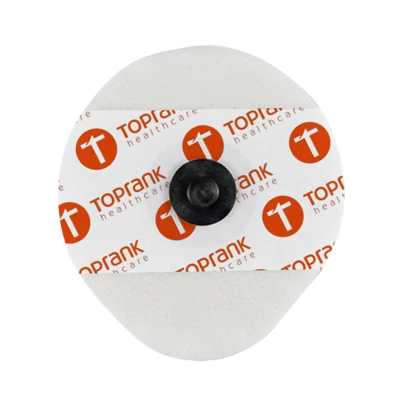
- Station 4: Thermoformed Cavity Lamination & Rotary Profiling: The wet web laminates against a continuous 100 um siliconized polyester release liner featuring inline thermoformed protective blisters that cup the protruding sponge columns without compressive force. Multi-cavity rotary dies cut the outer teardrop perimeter (45 x 42 mm) with continuous 3.0 mm rounded transitions. Automated high-resolution line-scan cameras inspect gel meniscus level, stud concentricity, and outer margin integrity. Finished electrode strips (5 or 10 units per card) pass into automated horizontal flow-wrappers, sealed inside multi-layer PET/AL/PE barrier foil pouches under positive nitrogen flush. The baseline minimum contract manufacturing run is 50,000 finished electrodes.
Key Features
-
Polymer-Thick-Film Silver-Carbon Flex-Bridge (Zero Trace Fracturing Across 10,000 Torsional Torso Cycles)
In offset teardrop electrodes, the metallic snap connection is physically separated from the central Ag/AgCl sensing core, requiring an internal printed conductive trace to bridge the 15 mm gap. During 24- to 48-hour Holter monitoring, active patients continuously bend, twist, and lie on the electrodes, applying dynamic torsion and multi-axis shear across the foam backing. Conventional conductive traces printed with brittle silver pastes experience micro-crack propagation across the conductive layer: resistance spikes erratically from under 1 Ohm to over 10,000 Ohms, causing sudden baseline jump artifacts or total signal loss mid-recording. We eliminate trace fatigue by formulating our conductive bridge with an elastomeric polymer-thick-film matrix loaded with sub-micron silver flakes and conductive carbon black. The crosslinked resin binder accommodates mechanical elongation up to 15% without micro-fracturing. In automated cyclic torsional testing (twisting through +/- 45 degrees under 200 g tension), the conductive bridge withstands more than 10,000 continuous fatigue cycles with trace resistance drifting by less than 0.2 Ohms, securing continuous signal transmission throughout active Holter wear.
-
Fast-Wetting Liquid Gel with Evaporation Retardants (Sub-300 Ohm Inter-Lead Impedance Matching Halting 50/60 Hz Noise)
Multichannel Holter recorders and stress testing consoles use high-input-impedance differential amplifiers to reject common-mode electromagnetic noise. The ability of the console to cancel out ambient 50/60 Hz electrical hum depends on maintaining low and symmetrical impedance across all active lead electrodes. If electrode impedances are high or widely mismatched, common-mode noise converts into differential noise, introducing thick baseline fuzz that obscures P-wave details. Our dynamic electrode utilizes an open-cell reticulated polyurethane foam column (60 pores per linear inch) holding a formulated liquid gel. The aqueous phase combines 7.0% pharmaceutical sodium chloride with a co-solvent system of vegetable glycerol and liquid polyols. When adhered to skin, the fluid gel flows into the microscopic recesses of the stratum corneum, dropping contact impedance below 300 Ohms within seconds across all attachment sites. Simultaneously, the polyol humectant phase depresses water vapor pressure, holding total fluid loss below 3.0% over 48 hours of open skin contact. Inter-lead impedance deviations remain tightly clustered within 50 Ohms across the entire cable array, enabling the differential preamplifier to suppress ambient electrical interference and baseline noise.
-
Low-Modulus Closed-Cell PE Foam Substrate (Absorbing Respiratory Chest-Wall Expansion Without Interfacial Capacitive Drift)
During heavy exercise on a treadmill or bicycle ergometer, minute ventilation increases dramatically: deep, rapid breathing causes the intercostal spaces and chest wall to expand and contract by several centimeters. Standard monitoring pads manufactured from rigid foam lack mechanical compliance. As the chest wall expands, the stiff carrier pulls against the skin, mechanically stressing the electrode-skin interface. This dynamic stretching alters the microscopic distance and charge density across the epidermal double layer, causing cyclical, respiration-synchronized baseline drifting that mimics ST-segment displacement. We resolve this by using a high-flexibility, 1.5 mm thick crosslinked closed-cell polyethylene (PE) foam backing formulated with an ultra-low tensile modulus (tensile stress at 25% elongation under 0.12 MPa). The foam flexes elastically with the respiratory expansion of the ribcage. The perimeter is coated with a crosslinked pure acrylic pressure-sensitive adhesive (coat weight 45 to 55 g/m2) that holds firm against sweat while absorbing cyclic lateral expansion. Mechanical shear forces are neutralized within the flexible foam carrier itself, keeping the central sensing interface undisturbed and holding baseline drift below 0.3 mV during maximum respiratory effort.
Applications
Hospital Cardiology Stress Testing Suites (Treadmill & Bicycle Ergometry)
Deployed as the dedicated diagnostic interface for Bruce protocol stress tests and pharmacologic stress echocardiography; the offset snap architecture prevents cable-tug baseline drift, and the 7.0% liquid gel column suppresses pectoral muscle tremor during heavy physical exertion.
Multi-Day Ambulatory Holter Telemetry (24 to 48-Hour Long-Dwell Monitoring)
Prescribed alongside lightweight digital Holter recorders for patients undergoing extended arrhythmia screening and syncope evaluation; the 1.5 mm closed-cell foam and hydrophobic acrylic adhesive maintain continuous skin adhesion across sleeping, walking, and perspiration cycles without pad displacement.
Sports Medicine & Human Performance Laboratories (Cardiopulmonary Exercise Testing - CPET)
Applied across professional athletic testing facilities during VO2 max assessments and anaerobic threshold determinations; rugged foam construction withstands maximal athletic sweating and chest excursions without motion artifact or electrode loss.
OEM & Private Label
-
Shapes, Snap Hardware & Blister Carrier Options : We deliver comprehensive contract manufacturing options for hospital-grade dynamic stress lines:
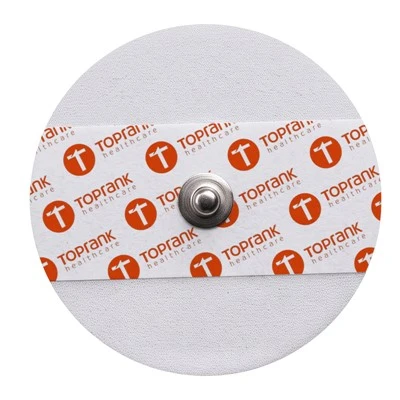
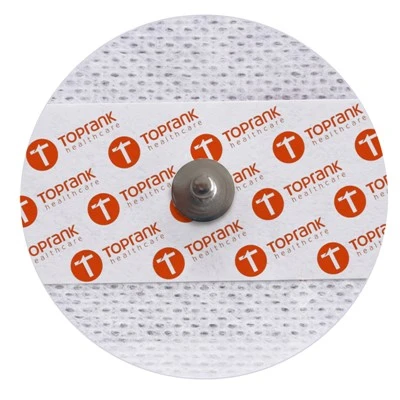
· Footprint Geometries: Standard teardrop offset (45 x 42 mm), extended teardrop (50 x 55 mm for high-movement sports), and circular offset pads (Dia 50 mm); backed with 1.0 mm or 1.5 mm high-density white closed-cell PE foam.
· Terminal Terminations: Standard 4.0 mm nickel-plated brass male studs; radiolucent conductive carbon snaps (for hybrid X-ray/fluoroscopy stress suites); or custom pinch/snap compatible stud geometries.
· Release Packaging: Electrodes mounted on 100 um PET release sheets with thermoformed protection pockets that isolate liquid gel sponge wells from compression; packed 5 or 10 pads per strip inside heat-sealed PET/AL/PE barrier foil pouches with custom gravure printing, client branding, and serialized UDI barcodes.
· Private-Label Options: Complete turnkey branding, customized instruction for use (IFU) placement sheets, and master cartoning compliant with clinical cardiology storage standards.
-
Two-Center Supply Chain Mechanics : High-conductivity liquid gel chemical synthesis, Ag/AgCl thin-film magnetron sputtering, and high-tack hydrophobic adhesive coating execute natively inside our primary China facility. High-speed multi-station rotary die-cutting, automated liquid micro-dosing into sponge wells, blister liner lamination, multi-layer foil hermetic packaging, and ocean container export route through our Vietnam hub, shielding international B2B buyers from regional medical consumable tariffs and Section 301 duties.
Certifications
-
ANSI/AAMI EC12 Electrical Performance Rigor : Master production lots undergo testing in accredited independent testing laboratories confirming strict compliance with ANSI/AAMI EC12 (Disposable ECG electrodes). Test dossiers verify that 10 Hz AC small-signal impedance remains below 500 Ohms (far below the 3000 Ohm threshold), initial DC offset voltage remains below 1.0 mV, and baseline recovery post-defibrillation settles in under 5.0 seconds with residual offset under 15 mV.
-
ISO 10993 Dermal Biocompatibility Testing : Skin-contacting liquid gels, acrylic adhesives, and closed-cell PE foam backings undergo batch validation confirming compliance with ISO 10993-5 (In Vitro Cytotoxicity Grade 0), ISO 10993-10 (Skin Sensitization: 0% allergic response in guinea pig maximization tests), and ISO 10993-23 (Primary Dermal Irritation Index = 0.0). The complete assembly is certified 100% natural rubber latex-free, phthalate-free, and non-sensitizing over 48-hour continuous skin dwell.
-
MDSAP & ISO 13485 Manufacturing System Controls : Continuous coating bays, automated sponge-dosing lines, and cleanroom barrier packaging suites operate strictly within facilities certified to ISO 13485:2016 and MDSAP regulatory frameworks (covering US FDA 21 CFR 820, Health Canada, TGA Australia). Unbroken electronic Device History Records (DHR) capture raw foam density, liquid gel chloride titration, adhesive peel-force values, and foil seal hermetic integrity across every manufactured production lot.
Technical FAQ
Q: How does deep respiratory chest wall expansion modulate electrode interfacial capacitance, and why does low-modulus closed-cell foam eliminate rhythmic baseline drift?
A: Baseline stability during high-intensity exercise is affected by the capacitive behavior of the electrode-skin boundary. When conductive gel contacts the stratum corneum, an electrical interface forms across the boundary layer: The metal transducer, the ionic gel, and the underlying skin tissues act physically as a parallel-plate capacitive system. Under static resting conditions, the thickness of this dielectric boundary and its charge density remain fixed, maintaining a constant baseline DC potential that the ECG monitor can offset. During heavy treadmill exercise, tidal breathing increases significantly. The ribcage expands transversely and anteroposteriorly with each breath. If an electrode utilizes a stiff foam backing (flexural modulus above 5.0 MPa), the backing resists the expansion of the skin. As the chest expands, the non-elastic carrier exerts lateral shear across the gel well, altering the microscopic separation distance and effective contact area of the double layer: The change in interfacial capacitance generates an electrical displacement current: Displacement Current = Capacitance multiplied by Rate of Voltage Change + Voltage multiplied by Rate of Capacitance Change. Because the physical expansion of the chest wall matches the patient's breathing frequency (0.2 to 0.6 Hz), this capacitive modulation produces rhythmic, undulating baseline wandering. These slow waves drift across the ECG display, obscuring true ST-segment depression and mimicking ischemic changes. Our design eliminates this capacitive modulation through mechanical compliance: 1.Low-Modulus Foam Selection: We utilize a 1.5 mm crosslinked closed-cell PE foam with an ultra-low flexural modulus. Under the tensile forces generated by chest wall expansion, the foam extends elastically without generating high restoring stresses. 2.Stress Dissipation Boundary: The lateral expansion of the ribcage is absorbed through shear deformation of the foam matrix. The perimeter adhesive expands with the skin, while the central cavity containing the liquid-gel sponge reservoir experiences near-zero mechanical strain. 3.Continuous Dermal Wetting: The liquid gel maintains continuous, gap-free fluid contact with the skin folds. Even as the skin stretches, the liquid phase flows to maintain constant effective contact area. Because interface dimensions and double-layer separation remain constant during respiration, the interfacial capacitance stays locked. Displacement currents drop near zero, holding respiration-induced baseline drift below 0.3 mV throughout maximal treadmill exertion.
Q: Why do offset teardrop electrodes experience trace fracturing and signal dropouts when patients rotate their torso, and how does the polymer-thick-film conductive trace prevent fatigue failure?
A: Offset electrodes use a geometric layout where the leadwire snap is placed on an outer tab to isolate mechanical cable tugs. However, this introduces an internal electrical requirement: an electrical trace must connect the offset metallic snap to the central Ag/AgCl sensor across the foam substrate. During 24- to 48-hour Holter monitoring, patients twist their upper bodies while walking, sitting, and sleeping. This movement generates combined torsional and shear forces across the 1.5 mm foam carrier: The Failure of Standard Silver Inks: Conventional conductive traces are screen-printed using standard electronic silver pastes formulated with rigid epoxy or polyester binders. While these pastes exhibit high conductivity (resistance under 0.05 Ohm/sq), they have almost zero tensile elongation (elongation at break under 2%). When the foam backing twists through dynamic angles, tensile stress concentrates across the thin printed silver trace. The rigid silver layer develops transverse micro-cracks. When the patient twists in one direction, the cracks pull apart, causing resistance to spike to thousands of Ohms and creating an open-circuit flatline. When the patient untwists, the cracks close, restoring the connection. This intermittent contact corrupts ambulatory recordings with high-amplitude spike noise. We prevent trace fatigue through three chemical and mechanical process steps: 1.Polymer-Thick-Film Elastomeric Formulation: We compound our conductive paste using an engineered polyurethane-acrylate elastomer binder blended with high-aspect-ratio silver flakes and conductive furnace carbon black. The crosslinked elastomeric binder exhibits high tensile compliance, extending up to 15% without structural fracture. 2.Redundant Conductive Network: As the silver flakes shift under substrate strain, the surrounding conductive carbon matrix maintains electrical contact across micro-gaps, preventing resistance spikes. Dual-Pass Screen Printing with Controlled Caliper: The trace is printed in two passes to achieve a uniform thickness of 18 to 22 um, followed by thermal curing in a multi-zone tunnel oven that eliminates micro-voids. In automated fatigue testing, the trace is mounted on an oscillating fixture that twists the offset tab through +/- 45 degrees under a continuous 200 g tension load. The conductive bridge withstands more than 10,000 continuous torsional cycles with total trace resistance drifting by less than 0.2 Ohms. The electrode maintains an unbroken electrical connection throughout dynamic patient activity.
Cardiology stress test laboratory directors, Holter telemetry recorder OEMs, and cardiac diagnostic consumable purchasers can request official Certificates of Analysis (COA), ANSI/AAMI EC12 electrical verification logs, ISO 10993 dermal biocompatibility dossiers, and unbranded evaluation sample packs (offset teardrop stress test pads with liquid gel sponge reservoirs).
👉 [Request Stress Test & Holter ECG Electrode Evaluation Packs]
Hot Tags: stress test & holter ecg electrodes, China stress test & holter ecg electrodes manufacturers, suppliers, factory, Ecg Electrode, Ecg Electrode Stickers, electrode stickers
Specifications
| Analytical Parameter | Engineering Baseline | Testing Standard |
| Footprint Formats | Teardrop Offset: 45 x 42 mm; Round Offset: Dia 50 mm | Standard dies |
| Backing Substrate | 1.5 mm Closed-Cell Crosslinked PE Foam (White, 65 kg/m3) | Fluid-barrier |
| Sensing Topography | Offset (Teardrop) Decoupled Snap Architecture | Physical decoupling |
| Electrochemical Core | Sputtered Micro-Porous Ag/AgCl Layer on ABS Eyelet | ANSI/AAMI EC12 |
| Conductive Medium | Low-Viscosity Liquid Gel Impregnated in PU Sponge Well | Rapid wet-out |
| Electrolyte System | 7.0% wt High-Mobility Dissociated Chloride Salt Formulation | High conductivity |
| 10 Hz AC Impedance | < 500 Ohms (Typical: 180 to 320 Ohms; EC12 limit: <3000) | Low impedance |
| Initial DC Offset | < 1.0 mV (Typical: 0.2 to 0.5 mV; EC12 limit: <100 mV) | Baseline stability |
| Baseline Drift Post-Shock | Offset < 15 mV at 5.0 seconds; Drift rate < 0.5 mV/s | High-energy recovery |
| Adhesive System | Hydrophobic Crosslinked Medical Pure Acrylic Adhesive | Sweat-resistant |
| 90-Degree Peel Tack | 4.5N to 6.0N / 25 mm on Polished Stainless Steel | ASTM D3330 |
| Shear Holding Power | > 72 Hours (1 kg static load, 25x25 mm area at 37C) | PSTC-107 modified |
| Packaging Configurations | 5 pcs or 10 pcs per Strip; Sealed PET/AL/PE Foil Bags | 24-Month shelf life |