OEM Disposable ECG Snap Electrodes | Bulk Monitoring Pads | TOP-RANK
B2B contract manufacturing of Disposable ECG Snap Electrodes in 30-pack and 50-pack ward pouches. Engineered for 30-day open-pouch impedance stability (<650 Ohms), 3.95 mm universal snap fit, and ANSI/AAMI EC12 compliance.
Product Overview
Disposable ECG Snap Electrodes are single-patient, pre-gelled biopotential sensors built for routine cardiac rhythm surveillance across general medical-surgical wards, emergency triage bays, outpatient telemetry units, and pre-operative holding areas. Equipped with a universal 3.95 mm male stainless-steel snap stud mounted over an Ag/AgCl sensing eyelet, each electrode acquires 0.5 mV to 2.5 mV cardiac signals across a 0.05 Hz to 150 Hz bandwidth while connecting directly to snap-socket and pinch-grabber ECG cables from Philips, GE, Mindray, Dräger, and Nihon Kohden consoles.
Hospital purchasing teams standardizing bulk 30-pack and 50-pack disposable snap electrodes across multi-department wards face three recurring operational breakdowns:
- Open-Pouch Gel Desiccation Inside Bulk 50-Piece Ward Packs: Clinical nursing carts stock 50-count bulk pouches that get opened and re-folded 15 to 20 times over three to four weeks. Conventional solid-gel snap pads lose moisture rapidly once the foil seal breaks; within 10 days, remaining pads dry out and AC impedance climbs past 2,500 Ohms, introducing 50/60 Hz mains hum and forcing staff to discard half-full pouches.
- Snap-Stud Sizing Drift Triggering "Alarm Fatigue" and Leadwire Clip Wear: General wards run mixed fleets of reusable ECG trunk cables. Stamped brass studs with loose dimensional spread (>4.04 mm) permanently pry open expensive OEM leadwire pinch clips, while undersized studs (<3.88 mm) pop loose when patients turn in bed-flooding central nursing stations with false "Lead-Off" alerts.
- Skin Maceration and Adhesive Stripping During 24–48 Hour Ward Rotations: Hospital infection-control policies mandate swapping disposable ECG pads every 24 to 48 hours. Non-breathable backings trap perspiration on febrile ward patients, macerating skin beneath the border, while aggressive rubber-resin adhesives tear fragile geriatric epidermis upon routine removal (Medical Adhesive-Related Skin Injury, MARSI).
Our Disposable ECG Snap Electrodes standardize ward performance through three manufacturing controls: a low-vapor-pressure solid polyacrylate hydrogel (Water Activity Aw = 0.68) packaged in zip-closure aluminum barrier pouches that holds 10 Hz AC impedance under 650 Ohms across 30 full days of open-pouch ward use; precision-formed 304/316L stainless-steel studs calibrated to 3.95 mm (+/- 0.03 mm) with chamfered crowns delivering 12–18 N clip retention without over-spreading OEM grabbers; and a three-carrier platform (70 g/m2 breathable spunlace cloth with MVTR > 2,400 g/m2/24h, 1.0 mm waterproof PE foam, or clear perforated PE tape for skin inspection) fitted with dry lift tabs and 3.8–4.8 N/25mm low-trauma acrylic adhesive. We contract-manufacture bulk 30-pack, 50-pack, and 3/5-pack telemetry strips for hospital GPOs, medical distributors, and patient-monitor OEMs globally.
Technical & Engineering Description
High-volume manufacturing of Disposable ECG Snap Electrodes runs inside ISO 13485-certified Class 8 cleanrooms across continuous rotary web-converting lines integrating precision stud staking, solid hydrogel die-transfer, and automated multi-count pouching. Producing millions of consistent single-patient sensors per month relies on four synchronized stages:
- Precision Cold-Headed Stainless Stud & Ag/AgCl Eyelet Mating: Snap studs are cold-headed from austenitic 304 or 316L stainless steel wire to a 3.95 mm (+/- 0.03 mm) barrel diameter with a radiused entry crown and burr-free undercut groove, eliminating the plating flakes and nickel leaching common in cheap nickel-flashed brass studs. Injection-molded ABS sensor eyelets receive an inline thick-film stoichiometric Ag/AgCl coating (3.5 to 5.0 um dry thickness) thermally cured at 90C to withstand both 200 nA DC bias currents and 4-pulse EC12 defibrillation overloads.
- Carrier Web Conditioning & Dry Lift-Tab Masking: Master rolls of 70 g/m2 microporous spunlace non-woven (MVTR > 2,400 g/m2/24h), 1.0 mm closed-cell PE foam, or clear perforated PE tape are coated with 42 g/m2 medical-grade pure acrylic pressure-sensitive adhesive calibrated to 3.8–4.8 N/25mm. Inline edge-masking applies a 7.0 mm non-adhesive paper or polyester lift strip along one margin so nurses wearing nitrile gloves can peel the pad off skin without scraping the adhesive border.
- Low-Vapor-Pressure Solid Hydrogel Casting & Die-Transfer: The electrolyte hydrogel combines polyacrylate-AMPS copolymer, 2.5% pharmaceutical potassium-sodium chloride, and a binary glycerol-sorbitol humectant system locked to a water activity of Aw = 0.68. Cured under nitrogen UV tunnels at 0.85 mm caliper (<2 ppm residual monomer), the hydrogel web is rotary-punched into 16 mm or 18 mm sensing discs and transferred directly over the Ag/AgCl eyelet face-keeping the gel isolated from the outer acrylic border adhesive so border tack does not soften during 36-month storage.
- High-Speed Orbital Staking, Vision Gating & Zip-Pouch Packaging: Automated vibrating-bowl feeders index stainless studs and Ag/AgCl eyelets into rotary staking heads that clinch the two parts through the punched carrier web at controlled torque (<0.02 Ohm internal stud-to-eyelet resistance). Line-scan cameras verify gel disc centering, stud concentricity, and zero missing eyelets at 100% web speed before die-cut strips of 3, 5, or 10 electrodes collate into reclosable zip-lock PET/AL/PE foil barrier pouches (30 or 50 electrodes per pouch; baseline MOQ: 50,000 electrodes).
Key Features
-
30-Day Open-Pouch Impedance Retention (Aw = 0.68 Humectant-Locked Solid Gel Holding <650 Ohms After Pouch Opening)
Hospital triage stations and telemetry carts rarely consume an entire 50-count ECG pouch in a single shift. Once the top heat-seal is torn open, repeated air exchange over 2 to 4 weeks strips free water from ordinary hydrogel pads, driving 10 Hz contact impedance above the 2,000 Ohm ANSI/AAMI EC12 ceiling and forcing staff to throw away dried pads.
Balancing glycerol and D-sorbitol within our polyacrylate-AMPS gel lowers equilibrium water activity to Aw = 0.68-reducing evaporative driving force at 25C / 40% RH ambient ward humidity. Paired with a press-to-close zipper inside the PET/AL/PE foil pouch, electrodes retain >88% hydration and stay below 650 Ohms AC impedance at Day 30 post-opening.
-
3.95 mm (+/- 0.03 mm) Chamfered Stainless Studs (Preventing Leadwire Clip Spring Fatigue and False "Lead-Off" Alarms)
Reusable hospital ECG leadwire sets cost $120 to $250 per set and mate with thousands of disposable snap pads over their service life. Stamped brass studs whose head diameters fluctuate past 4.04 mm permanently deform the internal spring blades inside Philips, GE, or Mindray pinch grabbers; conversely, studs below 3.88 mm wobble and disconnect when patients roll onto their side, driving nursing alarm fatigue.
Cold-heading solid 304/316L stainless steel studs to 3.95 mm (+/- 0.03 mm) with a smooth chamfered crown keeps snap-on/snap-off retention strictly between 12 and 18 N across major OEM leadwire styles while eliminating plating flake wear inside reusable female clips.
-
Three-Carrier Ward Platform with 7.0 mm Dry Lift Tabs (Matching Breathability, Waterproofing, or Visual Skin Inspection Without MARSI)
No single backing material fits every hospital unit: high-perspiration telemetry wards need rapid moisture vapor transmission to stop skin maceration, wet operating rooms require fluid-proof foam barriers, and fragile geriatric or pediatric wards need transparent tape to inspect skin redness beneath the adhesive without peeling the pad off.
Our rotary lines run all three standardized carriers-70 g/m2 microporous spunlace (MVTR > 2,400 g/m2/24h), 1.0 mm closed-cell PE foam, and clear perforated PE tape-using identical 3.8–4.8 N/25mm low-trauma acrylic adhesive and a 7.0 mm dry non-adhesive lift tab for clean, single-motion removal by gloved clinicians.
Applications
General Medical-Surgical Wards & Step-Down Telemetry Units (50-Pack Breathable Spunlace)
Sourced in container volumes by hospital GPOs and regional medical distributors for 24-to-48-hour continuous bedside monitoring; 70 g/m2 spunlace backing (MVTR > 2,400 g/m2/24h) prevents skin maceration on febrile patients, while the 30-day open-pouch gel eliminates waste on ward nursing carts.
Emergency Triage, EMS Ambulances & Pre-Op Holding Bays (3/5-Pack Waterproof PE Foam Strips)
Deployed inside ambulance cardiac monitor kits and emergency crash carts where single-patient 3-lead or 5-lead strip cards prevent cross-patient pouch handling; 1.0 mm closed-cell PE foam blocks blood, sweat, and antiseptic prep fluids while meeting ANSI/AAMI EC12 defibrillation recovery limits (<18 mV at 5 s).
Outpatient Cardiology, Geriatric Care & Diaphoretic Skin Monitoring (Clear Perforated PE Tape)
Utilized in geriatric wards, home telemetry programs, and dermatologically sensitive outpatient clinics; clear perforated PE tape allows nurses to visually inspect skin erythema beneath the border without lifting the electrode, and the 3.8–4.8 N/25mm acrylic adhesive with 7.0 mm dry tab minimizes MARSI skin stripping.
OEM & Private Label
-
Multi-Carrier SKU Matrix, Strip Cards & Hospital Packaging :
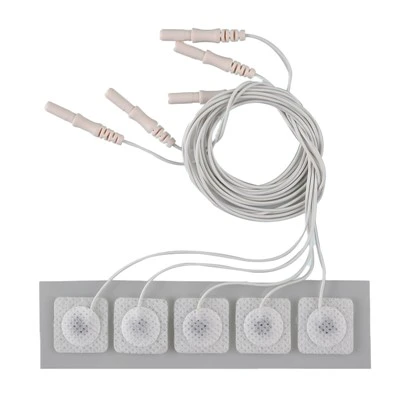
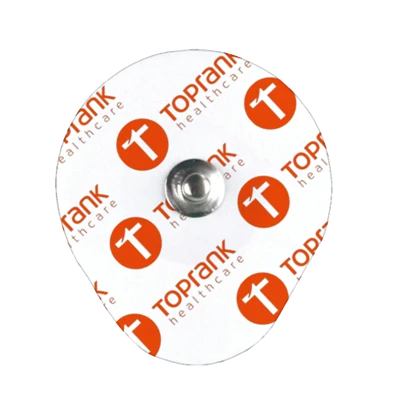
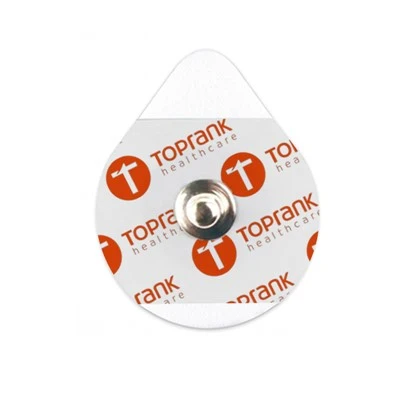
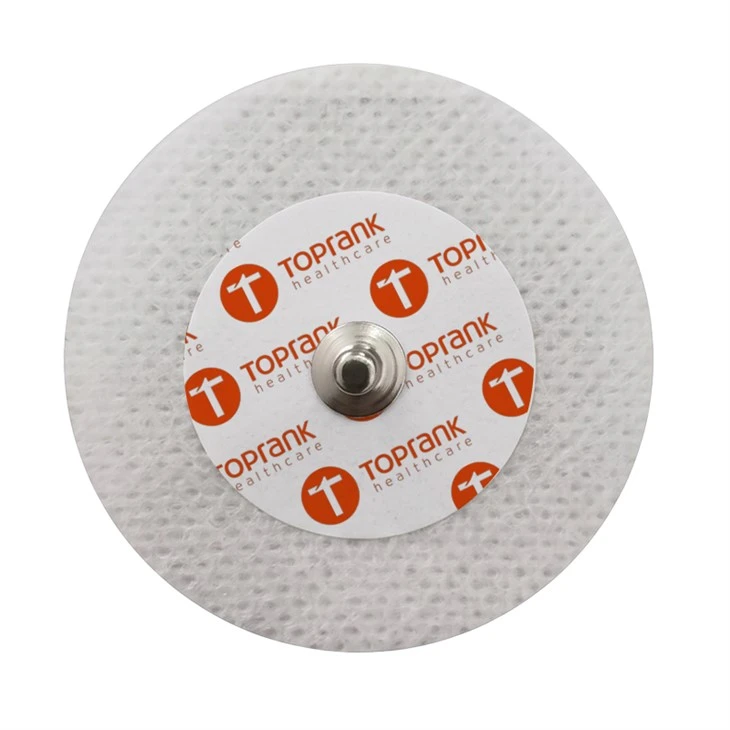
• Dimensional & Shape Options: Round Dia 42 mm (compact/pediatric), Dia 50 mm and Dia 55 mm (adult standard); Teardrop 43x45 mm and 50x55 mm (with built-in pull-tab nose); Square/Rectangular 38x45 mm.
• Backing & Gel Combinations: 70 g/m2 white microporous spunlace cloth, 1.0 mm white closed-cell PE foam, or transparent perforated PE tape; standard 30-day open-pouch solid hydrogel (Aw = 0.68) or optional rapid-wetting conductive wet-gel sponge for stress/ER kits.
• Pouching & Traceability: 30 pcs or 50 pcs per reclosable zip-lock PET/AL/PE foil pouch (600–1,000 pcs per dispenser box); 3 pcs or 5 pcs single-patient telemetry strip cards in sealed mini-pouches; custom 4-color private-label foil printing, multi-language IFUs, and GS1/UDI 2D barcoding (MOQ: 50,000 electrodes).
-
China-Vietnam Dual-Center Supply Chain Allocation : Precision stainless-steel stud cold-heading, stoichiometric Ag/AgCl eyelet coating, medical acrylic adhesive web coating, and nitrogen-cured UV hydrogel casting execute inside our ISO 13485:2016 and FDA 21 CFR 820 registered China plant. High-speed rotary orbital staking, die-cutting, inline vision verification, 30/50-pack zip foil pouching, and palletized ocean container export route through our Vietnam manufacturing hub to shield North American and European GPO distributors from Section 301 tariffs.
Certifications
-
ANSI/AAMI EC12:2000/(R)2020 Full Electrical Qualification : Every lot family is type-tested and release-verified against ANSI/AAMI EC12 mandatory criteria: 10 Hz AC impedance <280 Ohms fresh (<650 Ohms after 30-day open-pouch aging, vs. 2,000 Ohm limit), DC offset <1.5 mV (vs. 100 mV limit), post-defibrillation recovery <18 mV at 5 s with <0.35 mV/s slope (vs. 100 mV / 1.0 mV/s limit), 8-hour 200 nA bias drift <12 mV (vs. 100 mV limit), and internal noise <18 uV p-p (vs. 150 uV limit).
-
ISO 10993 Dermal Biocompatibility Screening : Production lots pass independent GLP laboratory assays confirming ISO 10993-5 (In Vitro Cytotoxicity: Grade 0), ISO 10993-10 (Skin Sensitization: 0% allergic response), and ISO 10993-23 (Primary Dermal Irritation Index = 0.0). Certified 100% free of natural rubber latex, rosin tackifiers, and DEHP/phthalates, with residual acrylic monomers <2 ppm via GC-MS.
-
ISO 13485:2016, FDA 510(k) / CE MDR & MDSAP Traceability : Eyelet coating lines, UV hydrogel bays, rotary staking presses, and Class 8 cleanroom packaging lines operate under ISO 13485:2016 and MDSAP audits. Electronic Device History Records (DHR) archive XRF Ag/AgCl thickness logs, optical stud gauges (3.95 +/- 0.03 mm), EC12 electrical release tests, ASTM D3330 peel curves, and zip-pouch seal burst checks per lot.
Technical FAQ
Q: How long can a 50-piece foil pouch of Disposable ECG Snap Electrodes remain open on a hospital ward cart without the remaining pads drying out?
Standard solid-gel ECG pads stored in folded-over non-zip pouches typically dry past the 2,000 Ohm ANSI/AAMI EC12 impedance limit within 7 to 10 days after opening. Our Disposable ECG Snap Electrodes use a humectant-locked polyacrylate-AMPS hydrogel calibrated to Aw = 0.68 water activity inside a press-to-close zipper PET/AL/PE barrier pouch. In controlled open-pouch cycling at 25C and 40% RH (opened twice daily and resealed), remaining pads retain >88% baseline moisture and hold 10 Hz AC impedance below 650 Ohms through Day 30.
Q: Will the 3.95 mm stainless-steel snap studs fit both snap-socket and pinch-grabber ECG cables from Philips, GE, and Mindray without loosening clip tension?
Yes. ANSI/AAMI EC53 snap-socket and pinch-grabber ECG leadwires are engineered around a nominal 3.95 mm stud interface. Stamped brass studs with loose tolerances (>4.04 mm) permanently bend open spring clips inside reusable cables, whereas studs below 3.88 mm cause intermittent dropouts. Our cold-headed 304/316L stainless studs hold 3.95 mm (+/- 0.03 mm) diameter with a smooth chamfered entry crown, delivering 12 to 18 N retention across major OEM cable brands without metal flaking or spring fatigue.
Hospital GPO procurement managers, medical consumable distributors, and patient-monitoring OEMs can request batch Certificates of Analysis (COA), full ANSI/AAMI EC12 electrical qualification reports, 30-day open-pouch impedance stability curves (<650 Ohms), ISO 10993 biocompatibility dossiers, and unbranded evaluation pouches (30-pack or 50-pack in breathable spunlace, waterproof PE foam, or clear perforated PE tape).
👉 [Request 50-Pack Disposable ECG Snap Electrode Evaluation Pouches]
Hot Tags: disposable ecg snap electrodes, China disposable ecg snap electrodes manufacturers, suppliers, factory, Ecg Electrode, Ecg Electrode Stickers, electrode stickers
Specifications
| Engineering Domain | Target Specification | Verification Protocol |
| Compliance Benchmark | Exceeds All Clauses of ANSI/AAMI EC12:2000/(R)2020 | Full pair-to-pair electrical qualification |
| 10 Hz AC Impedance | Fresh: < 280 Ohms; 30-Day Open-Pouch: < 650 Ohms (EC12 Limit: 2,000) | LCR bridge at 10 Hz |
| DC Offset Voltage | < 1.5 mV Typical (EC12 Limit: 100 mV) | Pair-to-pair differential voltmeter |
| Defib Overload Recovery | Residual < 18 mV at 5.0 s; Slope < 0.35 mV/s after 4x 200V/10 uF Pulses | ANSI/AAMI EC12 4-pulse sequence |
| Internal Noise Floor | < 18 uV peak-to-peak across 0.15 Hz to 100 Hz | High-gain instrumentation amp |
| Bias Current Tolerance | < 12 mV Voltage Drift over 8 Hours under 200 nA DC Bias | ANSI/AAMI EC12 clause 4.2.2.5 |
| Snap Stud Geometry | 3.95 mm (+/- 0.03 mm) 304/316L Stainless Steel with Chamfered Crown | Optical ring gauge |
| Ag/AgCl Sensing Core | Injection-Molded ABS Eyelet Coated with 3.5–5.0 um Ag/AgCl | XRF thickness gauge |
| 30-Day Open-Pouch Gel | 0.85 mm Polyacrylate-Polyol Solid Hydrogel (Water Activity Aw = 0.68) | Chilled-mirror dew point |
| Carrier Backing Matrix | 70 g/m2 Breathable Spunlace (MVTR > 2,400), 1.0 mm PE Foam, Clear PE Tape | ASTM E96 & ASTM D3330 |
| Border Peel Adhesion | 3.8 N to 4.8 N / 25 mm on Steel; Integrated 7.0 mm Dry Lift Tab | ASTM D3330 (180° Peel) |
| Pad Formats & Sizes | Round Dia 42/50/55 mm; Teardrop 43x45 / 50x55 mm; Square 38x45 mm | Rotary die-cut (+/- 0.15 mm) |
| Packaging & Order MOQ | 30 or 50 pcs/Zip Foil Pouch; 3 or 5 pcs/Strip Card; MOQ: 50,000 pcs | 36-Month sealed shelf life |